
Ethereum’s Shanghai/Capella network upgrade is slated for Feb. 28

  • Ethereum plans to deploy the Shanghai/Capella upgrade on Sepolia testnet
  • The update is scheduled to test staked ETH withdrawals.
  • The Shanghai-Capella was earlier tested on the Zhejiang testnet but developers discovered minor bugs.

Ethereum developers have announced that they have scheduled a test run of the Shanghai/Capella (Shapella) upgrade for February 28. The test run is planned to go live on Sepolia testnet to test staked ETH withdrawals on Ethereum’s proof-of-stake blockchain.

The test on Sepolia will bring the Ethereum chain closer to the ability to withdraw the staked ETH tokens from the Beacon Chain. According to the communication from Ethereum, “The Shapella upgrade combines changes to the execution layer (Shanghai), consensus layer (Capella) and the Engine API.”

Shanghai upgrade

The upgrades on Shanghai will introduce Warm COINBASE, PUSH0 instruction, Limit and meter initcode, Beacon chain push withdrawals as operations, and Deprecate SELFDESTRUCT.

The changes can be viewed in the new Python reference implementation for the execution layer, Ethereum Execution Layer Specification (EELS).

Capella upgrade

The Capella upgrades will introduce full and partial withdrawals for validators, BLSToExecutionChange messages, which allow validators using a BLS_WITHDRAWAL_PREFIX to update it to an ETH1_ADDRESS_WITHDRAWAL_PREFIX, a prerequisite for withdrawals, and independent state and block historical accumulators to replace the original singular historical roots.

Unlocking the over 16 million staked ETH

Ethereum validators are eagerly waiting for the unlocking of the more than 16 million ETH tokens that are currently staked on the Beacon Chain smart contract which opened in 2020.

While the validators await their assets to be unlocked, the majority of the other crypto investors are waiting to see how the Ethereum price will respond to the whole process. A wider majority believe that the staked ETH withdrawals may attract more institutional interest and also trigger an ETH price surge.

The post Ethereum’s Shanghai/Capella network upgrade is slated for Feb. 28 appeared first on CoinJournal.
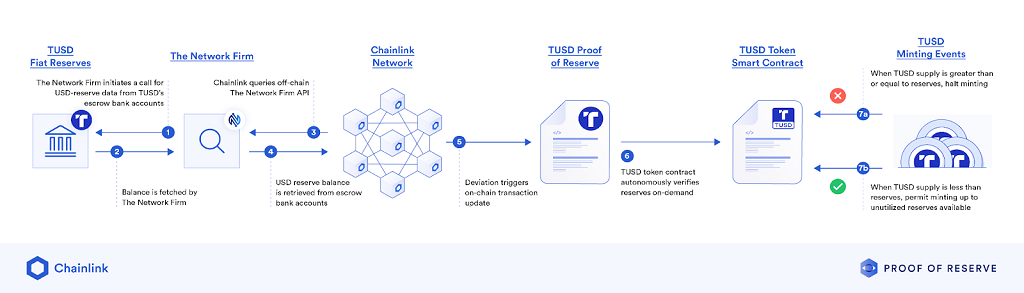
TrueUSD the first USD-backed stablecoin to use Chainlink ‘Proof of Reserve’ to mint

  • TrueUSD will use Chainlink Proof of Reserve (PoR) in minting the TUSD stablecoin.
  • It is the first stablecoin to use Chainlink PoR in controlling the minting process.
  • The PoR will check the balance between the total supply of TUSD and US dollars held in reserve.

TrueUSD has today announced that it will be using Chainlink (LINK) Proof of Reserve (PoR) to secure the minting of its fully collateralized USD-backed stablecoin TUSD. The news comes after TrueUSD launched TCNH, a TRON-Based stablecoin pegged to offshore Chinese Yuan in December 2022.

This makes TrueUSD the first stablecoin to programmatically control minting using real-time on-chain verification of off-chain reserves. This is a paradigm shift in decentralization, transparency, and independent verification.

How the programmed minting process will work

The TUSD reserve data is aggregated by The Network Firm LLP (TNF), which is an independent industry-specialized accounting firm in the US. TNF will aggregate all reserve data of US dollars held at financial institutions in real-time and serve that information on-chain through Chainlink’s oracle network. This is what is referred to as proof of reserve.

TUSD smart contract will then use this Proof of Reserve data feed to automatically check whether the total supply of TUSD would exceed the total amount of US dollars held in reserve before a new stablecoin is minted.

The automatic workflow is transparent in the smart contract code and supported by open independent data feeds thus affirming TUSD’s commitment to ensuring the stability of the ecosystem and the redeemability of the underlying dollars for clients.

TUSD users can feel confident that they have an accurate and transparent source of information about the reserves backing the TUSD stablecoin.

Commenting on the development, the co-founder of Chainlink Sergey Nazarov said:

“We are proud to support TUSD in its efforts to bring new layers of transparency, risk management, and security to its stablecoin minting process. With Chainlink Proof of Reserve, TUSD is able to provide greater levels of assurance and confidence to its users, and help bring greater stability to stablecoins and the broader crypto industry.”

The post TrueUSD the first USD-backed stablecoin to use Chainlink ‘Proof of Reserve’ to mint appeared first on CoinJournal.

Tezos price surges as Google Cloud becomes a Tezos validator

  • Tezos blockchain has partnered with Google to drive Web3 innovation.
  • In the partnership, Tezos will onboard Google Cloud as a validator.
  • Google also partners with Ethereum, Flow, and Solana blockchains.

The price of Tezos (XTZ) is rising following a partnership between Tezos blockchain and search engine behemoth Google. At press time, the TXZ token was trading at $1.32 after surging by 6.32% in the past 24 hours.

The partnership between the search engine behemoth and the proof-of-stake blockchain will drive Web3 innovation on the Tezos blockchain. Tezos Foundation will onboard Google Cloud as a validator.

What it means for Google Cloud users

Following the agreement, Google Cloud users can build Web3 applications and deploy decentralized applications on the Tezos blockchain. They will be able to tap Tezos nodes to develop blockchain applications.

Tezos nodes, just like any other blockchain nodes, function as communication points that allow corporate users to confirm transactions, track the network’s history, as well as run the software needed for Web3 apps among other tasks.

Select startups incubated by Tezos will also have access to Google Cloud mentorship and credits.

The engineering director of Web3 at Google Cloud, James Tromans, commented on the partnership saying:

“At Google Cloud, we’re providing secure and reliable infrastructure for Web3 founders and developers to innovate and scale their applications. We look forward to bringing the dependability and scalability of Google Cloud to power Web3 applications on Tezos.”

Google recently integrated crypto payments on its Cloud services in a partnership with crypto exchange Coinbase. In the partnership, Coinbase is to allow Google Cloud users to settle their payments using digital currencies like Ether (ETH), Bitcoin (BTC), and other eight cryptocurrencies.

The post Tezos price surges as Google Cloud becomes a Tezos validator appeared first on CoinJournal.

Should you buy Coinbase stock after Q4 results?

  • Coinbase reports market-beating results for its fiscal Q4.
  • Mizuho’s Dan Dolev shares his outlook on Coinbase Global.
  • Coinbase stock is currently up about 90% for the year.

Coinbase Global Inc (NASDAQ: COIN) is trading slightly up in extended hours after reporting market-beating results for its fourth financial quarter.

How is its current quarter going so far?

Also a positive was its update on the current quarter.

Year-to-date, Coinbase said the crypto market cap is up 40% and transaction revenue was $120 million last month. Nonetheless, the crypto company is not very bullish on the rest of the year, as per its letter to the shareholders.

Given the unpredictability of crypto markets, we have limited certainty around the rest of the year.

Coinbase stock is currently up about 90% for the year.

Is Coinbase stock a ‘buy’ now?

Coinbase ended the quarter with 8.3 million monthly transacting users – slightly ahead of 8.2 million that Street had anticipated. Still, Mizuho’s Dan Dolev said on CNBC’s “Closing Bell: Overtime”:

The take rate continues to come down. Interest income is non-core to this business. Retail investors are uninvolved. So, I don’t think it’s much to ride on about.

Dolev currently has an “underperform” rating on Coinbase stock. His $30 price target suggests an alarming 50% downside from here.

Notable figures in Coinbase Q4 report

  • Lost $557 million that translates to $2.46 a share
  • That compares to $840 million of profit last year
  • Revenue tanked about 75% YoY to $629 million
  • Consensus was $2.52 loss on $588 million revenue
  • Trading volume in its Q4 tanked to $145 million

Dolev is bearish on the category

According to Coinbase, its subscription and services revenue climbed 34% in the recent quarter, as per its earnings press release. Still, Mizuho’s Dolev said:

I’m extremely bearish on the overall category. As money becomes tighter and people realise they might be laid off, I don’t think they’ll play crypto. So, I don’t see great things in 2023 for them.

Transaction revenue was down 12% year-on-year in the fourth quarter. Coinbase now has $5.50 billion worth of total dollar resources.

The post Should you buy Coinbase stock after Q4 results? appeared first on CoinJournal.

Bitcoin “shrimp” addresses surge to all-time high above 43 million

  • Bitcoin “shrimp” wallets, which hold 1 bitcoin recently surged to 43.2 million.
  • Bitcoin addresses with 0.01 BTC or less have also hit an all-time high of 32.6 billion.
  • Data also shows bitcoin wallets in profit have reached 70% after recent price gains.

Bitcoin price recently reached an eight month high when it rallied to highs above $25,000 last week.

Despite this, the latest market data from asset manager CoinShares shows Bitcoin investment products saw outflows of $25 million, about 78% of the $32 million that exited amid negative sentiment. But a new report shared by crypto exchange Bitfinex indicates that Bitcoin still saw massive growth in terms of the address count with one BTC or lower.

Bitcoin “shrimp” addresses hit 43.2 million

According to data shared in the Bitfinex Alpha report published Monday, 20 February 2023, Bitcoin addresses with less than one bitcoin, or “shrimps”, recently jumped to 43.2 million – the highest the count has hit in the flagship cryptocurrency’s history.

No doubt this has been greatly helped by the massive growth in addresses with 0.01 BTC or less. Per the Bitfinex report, and from on-chain data by analytics platform Glassnode, the number of wallets with balances of 0.01 BTC or under recently hit 32.6 million.

Overall, wallet addresses with non-zero balances are at an all-time high, which Bitfinex researchers say is indicative of “an influx of new investors.” 

As CoinJournal recently covered, shrimps actually increased their buying even as prices fell after the FTX collapse. And it is this increase in the number of non-zero wallets that could have fueled Bitcoin’s recent upside momentum, the Bitfinex team noted in their report.

Is it the start of a new Bitcoin bull market?

Bitcoin has been largely upwards in January and February, with nearly 50% in overall gains year-to-date as of 21 February. In fact, as Glassnode data shows, the number of Bitcoin wallets in profit (7-day moving average) has also just hit a 10-month high.

While analysts warn of a potential pullback amid profit booking across crypto, the sentiment is still mostly bullish for BTC in the short term. And the recent growth in shrimp wallet addresses aligns with historical market trends in a bear market.

In this case, bull markets have traditionally been highlighted by wealth distribution, with the entry of new short term holders a metric that helps signal the shift in market direction.

However, as Bitfinex analysts noted in their report, the latest data is only a “snapshot of the current situation.” In short, it is hard to predict where the market goes next at any one given time.

The post Bitcoin “shrimp” addresses surge to all-time high above 43 million appeared first on CoinJournal.