
Bitget debuts in lending with the launch of ‘Crypto Loans’

  • Bitget launched its native “Crypto Loans” product on Tuesday.
  • Digital lending is expected to advance at a CAGR of 20.5%.
  • Singapore and Thailand have recently banned crypto lending.

Bitget – a Seychelles-based digital assets trading platform launched “Crypto Loans” to debut in the lending space on Tuesday.

Here’s what we know so far

Its new product will cater particularly to users that are not fully satisfied with the traditional credit institutions. According to Gracy Chen – the Managing Director of Bitget:

Users now have the opportunity to stake less-demanded coins, enabling them to obtain loans in more liquid assets for investment purposes.

Each loan, as per the press release, will be coupled with a specific interest rate. Bitget did not, however, reveal the cryptocurrencies that’ll be eligible for Crypto Loans.

The news arrives only days after Bitget formally entered Turkey with a new website as part of its commitment to expand globally (find out more).

Digital lending is seeing strong demand

Digital lending is expected to grow at a compound annual rate of 20.5% between 2023 and 2032 after hitting the $8.5 billion mark last year which suggests strong demand. Chen also said today in the press release:

Bitget’s new product highlights flexibility of collateralized currency usage, enhancing capital utilization. Our flexible borrowing and repayment mechanism caters to needs of all users.

The top crypto derivatives platform is entering the crypto lending sector at a time when multiple countries, including Singapore and Thailand, have banned crypto companies from issuing loans.

Bitget did not state in its press release whether the new service will be available in the United States.

The post Bitget debuts in lending with the launch of ‘Crypto Loans’ appeared first on CoinJournal.
Voyager Digital creditors’ lawyers to pocket $16.48M after the recent invoice

  • In the third and final bill lawyers representing Voyager Digital creditors have billed $5.1 million.
  • When all the invoices are fully paid, Voyager Digital creditors will have paid a total of $16.48 million to the lawyers.
  • The legal charges will top the firm’s bankruptcy budget by $5.28 million from the initial $11.2 million.

In the recent court filing, the creditors of bankrupt cryptocurrency brokerage company Voyager Digital have been billed $5.1 million by New York-based law firm McDermott Will & Emery. The firm is billing for services offered between March 1 and May 13, 2023.

The law firm submitted a court filing on July 3 billing the legal costs to the “Official Committee of Unsecured Creditors.” According to the filing, the law firm billed for its services at an hourly rate of $1,026.76.

In total, the law firm is charging for 5,332.6 hours of professional, semi-professional, and non-professional services, including advising the unsecured Voyager creditors committee. It also wants to be reimbursed $151,221 for its expenses.

How much have Voyager Digital creditors paid so far?         

McDermott Will & Emery law firm submitted its third and final bill, bringing its total compensation between July 5, 2022, and May 19, 2023, to $16.48 million, of which $8.97 million has already been paid by the creditors.

McDermott Will & Emery isn’t the only law firm that is willing to help Voyager, though. Legal counsel Kirkland & Ellis also sent Voyager a bill for $1.1 million in legal costs for the month of April on June 28.

Voyager Digital woes

Voyager Digital filed for Chapter 11 bankruptcy in July 2022, after the massive crypto meltdown that resulted from the collapse of Terra Luna. At the time, Voyager owed $620 million to the currently bankrupt crypto hedge fund Three Arrows Capital.

The bankruptcy court has since ordered Voyager to pay interim reimbursement to the professionals including its lawyers.

Voyager had agreed to FTX’s bid for its assets just before FTX went down and also filed for bankruptcy meaning the deal did not go through.

Voyager then agreed to sell its assets to Binance.US but Binance.US pulled out of the deal triggering the liquidation of Voyager. Binance.US has also been locked in a legal battle with the US Securities and Exchanges Commission (SEC) which recently sued it for violating the country’s securities laws.

The post Voyager Digital creditors’ lawyers to pocket $16.48M after the recent invoice appeared first on CoinJournal.

Justin Bieber’s $1.3M NFT investment depreciates by more than 95%

  • Justin Bieber invested about $1.3 million into the Bored Ape Yacht Club (BAYC) NFT.
  • There are speculations that Justin Bieber was gifted the NFT by MoonPay as a promotional tactic.
  • The investment has however depreciated to $59,000.

Dexerto revealed in a tweet that global pop superstar Justin Bieber’s $1.3 million investment in BAYC NFT had depreciated to $59,000; meaning he has lost about $1.2 million.

Celebrity endorsements and investments have risen sharply since the introduction of non-fungible tokens (NFTs). These blockchain-based, one-of-a-kind digital assets have given celebrities new ways to interact with their fan bases, monetize their brands, and explore the fascinating world of cryptocurrencies.

However, the NFT market is infamously unpredictable and volatile, leading to frequent sharp fluctuations in price. Unfortunately for Bieber, this instability led to the loss of his Bored Ape Yacht Club (BAYC) NFT investment. Although a sharp decline in value is unquestionably a serious financial blow, it is crucial to take the bigger picture into account.

Justin Bieber’s forays into NFTs

The $1.2 million loss from his NFT investment, while significant, is probably manageable for Justin Bieber, whose estimated net worth was $285 million as of September 2021. The “Peaches” artist has diversified his sources of income, reducing the impact of the NFT’s decline through music, merchandising, and endorsements.

There are also speculations that the BAYC NFT was a reward from MoonPay as a promotional tactic.

Many famous people have adopted the NFT culture, however, not everyone has been successful. Some people have made these investments as part of a bigger marketing strategy rather than to earn rewards. Celebrities get exposure and audience interaction by affiliating with the forward-thinking digital movement by purchasing NFTs. Some like Snoop Dogg and Wiz Khalifa have gone ahead to launch ApeCoin-themed Music NFTs.

However, not all NFT endeavours are unsuccessful. Some celebrities have gotten rich by selling NFTs for astronomical prices. It’s a game with a high chance of a high payoff.

The post Justin Bieber’s $1.3M NFT investment depreciates by more than 95% appeared first on CoinJournal.

Why is the Verge (XVG) price soaring? It’s up 295%

  • At press time, the price of XVG token had soared 295% over the past seven days.
  • The token was trading at $0.006906.
  • The Verge’s market cap has also gone up by almost 400% over the past three weeks.

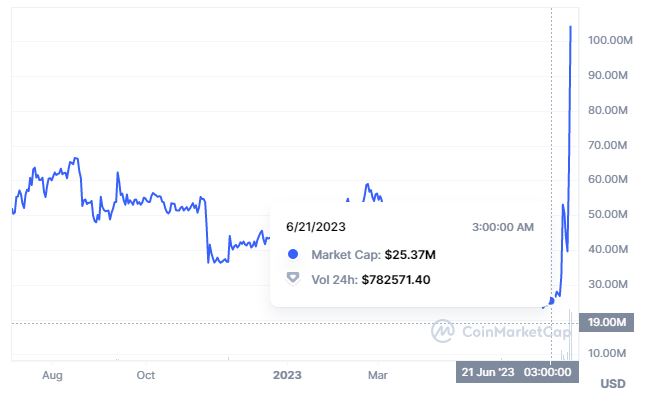
What started as a slow steady bull case for the Verge (XVG) token has turned into a monster Bull Run after the token price went up by about 300% on June 3. And although the price has slightly pulled back from the June 3 high, it is still 295% high compared to where it was seven days ago.

Verge was long considered dead after it drastically dipped at the beginning of 2023 at a time when most of the cryptocurrencies showed some signs of recovery from the 2022 bear market. However, all that started to change in mid-June when the current bull trend started.

Verge (XVG) price chart. Source Coinmarketcap


While the Verge investors and traders are excited about the current bull case for the token, most crypto investors are still sceptical about the upward movement as questions of why the token is taking a ride ringer. In this article, we shall explain why the Verge (XVG) token price is rising.

Increased Verge (XVG) activity

In addition to the price surging, the Verge has also experienced an increased trading volume, which skyrocketed by a staggering 380% on June 4 to a record $507 million. And although the trading volume had dropped to $480 million at press time, the figure still shows there is still a high trading activity.

In addition to the increased market activity, there are speculations of possible manipulation by seasoned cryptocurrency investors otherwise known as crypto whales who could be angling to dispose of their large XVG holdings at a profit. While this is not confirmed, it is important to be careful when trading cryptocurrencies since they are extremely volatile assets.

The post Why is the Verge (XVG) price soaring? It’s up 295% appeared first on CoinJournal.

Thailand introduces new digital asset service providers’ regulations

  • Thailand’s SEC has introduced new regulations ensuring investor protection from digital asset service providers.
  • Digital asset providers will also not be able to provide digital assets deposited by users for loans or investments.
  • The new regulations require providers to clearly disclose the risks that may arise from trading cryptocurrencies.

In order to prioritize investor protection, Thailand’s Securities and Exchange Commission (SEC) introduced new rules for companies that provide services for digital assets.

The rules now require crystal-clear risk warnings for cryptocurrency trading. A clear warning about the possible risks associated with trading digital assets must also be provided by providers of digital assets in accordance with the new regulations.

The Thai SEC stated that the warning message, along with the disclosure of the outcomes of the investment suitability assessment and appropriate asset allocation, must be displayed prominently. According to the rules, service providers must make sure customers consent and understand the risks before using their services.

Restrictions on lending and deposit services

The new guidelines place restrictions on the deposit and lending services provided by digital asset businesses in addition to risk disclosure. With the exception of certain pre-approved promotional activities, these rules forbid the provision or support of such services beginning on August 30.

According to the Thai SEC’s guidelines, it is strictly forbidden for any entities other than businesses dealing in digital assets to promote or otherwise influence deposit-taking and lending services.

On September 1, 2022, the Thai SEC approved the requirement that cryptocurrency business operators disclose security warnings about the risks of trading cryptocurrencies, starting a dialogue on investor protection regulations.

The post Thailand introduces new digital asset service providers’ regulations appeared first on CoinJournal.