
Ripple CEO slams SEC for weaponizing XRP reports in lawsuit

  • Ripple CEO Brad Garlinghouse says the SEC took Ripple’s transparency reports and used them against the company.
  • The SEC sued Ripple over its XRP sales in December 2020, alleging the sales amounted to securities contracts.
  • A court decision recently declared XRP not a security.

In Ripple news today, CEO Brad Garlinghouse has slammed the US Securities and Exchange Commission (SEC) over its apparent weaponization of what’s been “good-faith” transparency reports on XRP.

Acccoridng to him, the SEC took the regular reports and used their details in its lawsuit against the company and its top executives. Garlinghouse, who was also sued by the SEC in December 2020, however, reiterated Ripple’s commitment to transparency.

“We began these reports to voluntarily provide updates given our XRP holdings. Sadly, they were used against us in the SEC lawsuit – however, we remain steadfast in our commitment to transparency but I suspect they’re going to look a bit different moving forward,” he said.

Ripple’s XRP markets reports

Garlinghouse’s remarks followed Ripple’s release of its Q2, 2023 XRP Markets Report, with the company noting the different approach taken. With previous editions, Ripple has focused on multiple XRP ecosystem developments, including market insights and quarterly sales.

“While published in a good faith effort at transparency, these quarterly reports have been weaponized against the Company by the SEC. Ironic for an agency that touts transparency and disclosure. Accordingly, Ripple is re-evaluating the role and contents of this report going forward and will have updates on that front in Q3 2023,” Team Ripple wrote in its report published July 31.

The change in approach already saw the Q2 report focus on the July 13, 2023 court ruling on XRP, including details “debunking misconceptions” about the ruling being a split decision and that the court deemed some sales of XRP as securities and others not.

The post Ripple CEO slams SEC for weaponizing XRP reports in lawsuit appeared first on CoinJournal.
Worldcoin to allow governments and businesses to use its ID-verifying technology

  • Worldcoin launched its native token WLD on its mainnet on July 24, 2023.
  • The crypto project has faced serious criticism from several quarters for fears of data privacy.
  • The latest development is the Worldcoin suspension in Kenya because of what the government says are security concerns.

According to a Reuters report, Worldcoin intends to broaden its operations so that businesses and governments can make use of its iris-scanning and identity-verification technology to attract more users.

In the report, Ricardo Macieira, the general manager for Europe at Tools For Humanity, which is the company that created Worldcoin, said that the company is on a mission of “building the biggest financial and identity community” possible.

Macieira said, “The idea is that as we build this infrastructure and that we allow other third parties to use the technology.” He went ahead to add “The idea is that anyone can in the future build their own orb and use it to benefit the community that it’s aiming for.”

Plans to open-source the Orbs technology

To enable broader use of Worldcoin’s products, Macieria added that the company intends to open source the technology that powers the iris-scanning orbs. This will be a huge step towards countering difficulties in attracting users.

However, although reports about Worldcoin’s difficulties attracting users after its launch have recently gone around, Sam Altman, a co-founder of the project, has refuted those allegations in posts on X that include videos of people waiting in line for iris scans.

In the report, Macieira has also gone ahead to explain Worldcoin intends for companies and governments to pay to use its digital identity system. This will allow the institutions to implement some sort of localized system without having to gather personal data.

However, it is not clear how Worldcoin intends to circumvent the regulatory framework around the world, especially seeing that its data collection methods have already come under scrutiny from regulators around the world.

France’s privacy watchdog said that it finds the project “questionable,” while German regulators launched investigations into Worldcoin’s operations back in 2022. Regulators in the UK are also considering opening an inquiry into Worldcoin. And in Kenya where the project had received such a huge reception, the government has slumped the door citing security concerns.

The post Worldcoin to allow governments and businesses to use its ID-verifying technology appeared first on CoinJournal.

Kenya suspends Worldcoin activities after nearly half a million sign-ups

  • The registration exercise for Worldcoin in Kenya took place at the Kenyatta International Convention Centre.
  • Registered users are entitled to 25 free Worldcoin tokens worth about $2 amounting to about Sh7000.
  • The Worldcoin activities in the countries have been suspended by the Ministry of Interior for security concerns.

The activities of Worldcoin, which launched on July 24, have been halted in Kenya after a thrilling uptake by the population. The Ministry of Interior has suspended the activities including registration citing security concerns.

On August 2, Kenya’s minister of internal security announced on Facebook that the country had suspended Worldcoin operations until relevant government agencies had verified that there were no risks to Kenyans. The statement from the cabinet secretary Ministry of Interior, Kithure Kindiki read:

“Relevant security, financial services, and data protection agencies have started inquiries and investigations to establish the authenticity and legality of the aforesaid activities… Appropriate action will be taken on any natural or juristic person who furthers, aids, abets or otherwise engages in or is connected with the activities afore described.”

The Capital Markets Authority (CMA) in Nairobi had also warned against the ongoing registration stating that Worldcoin and its products were not regulated under the Capital Markets Act.

Kenya is not the first country to question the safety of data collected by Worldcoin. France’s privacy watchdog has also questioned Worldcoin’s data collection and is currently investigating the crypto project.

Why are Kenyans so excited about Worldcoin?

Despite the privacy concerns, Kenyans have been trooping in thousands to the Kenyatta International Conference Center (KICC) in Nairobi and lining up for hours to have their eyeballs scanned for the 25 free Worldcoin (WLD) tokens which when exchanged translate to about Ksh7000.

Days after the new cryptocurrency project started registration in the country, media outlets were reporting that more than 350,000 individuals had registered.

The suspension news is a big setback for Worldcoin, which in an investor presentation had previously highlighted it had seen significant demand in Nairobi as a city. The presentation which was prepared in In December 2022, Worldcoin boasted of more than a quarter of a million sign-ups in Nairobi where it has 45 of its retina-scanning orbs positioned.

The post Kenya suspends Worldcoin activities after nearly half a million sign-ups appeared first on CoinJournal.

FTX claimants to hold equity securities and tokens in the rebooted exchange

  • The new FTX CEO is working tirelessly to have the FTX crypto exchange launched.
  • FTT token holders will not receive any distributions from the rebranded FTX exchange.
  • FTX claimants will, however, own interests in the newly established offshore FTX Company.

The newly appointed CEO of FTX Trading Ltd., John J. Ray III, has unveiled a new draft strategy to “reboot” the defunct FTX cryptocurrency exchange.

In the proposal, which was unveiled on Monday, FTX.com claimants are allowed to own equity securities, tokens, or other types of interests in the newly established offshore company.

What will happen to FTT holders?

The new plan describes the debtors’ approach to grouping claimants into different categories. Users of the offshore FTX.com exchange will be referred to as “Dotcom customers,” while those using the FTX US will be called “U.S. customers.”

The Dotcom Customer Pool, the U.S. Customer Pool, and General Pool are the three main recovery pools that are suggested to be created on the new exchange. All fiat, digital, and other specified assets connected to FTX.com and FTX US will be included in these pools.

The newly created company, which was established in collaboration with outside investors, will run a “rebooted” offshore platform that won’t be available to American investors.

Each Dotcom customer will receive a pro-rata share of the proceeds from a pool of assets tied to the FTX.com exchange. However, the new plan indicates that claims from FTT holders, the collapsed exchange’s native token, “will be cancelled and extinguished as of the Effective Date and holders will not receive any distribution.”

Furthermore, claims from non-customers, like the regulatory penalties and taxes claims, will be subordinated.

The development comes a few days after FTX and Genesis agreed to an in-principle settlement to resolve claims by the two companies in the bankruptcy proceedings.

FTX 2.0 impending launch

The idea of restarting the collapsed FTX exchange was first suggested by the new FTX boss in January. The new management had targeted to relaunch in Q2, 2023.

According to a court document filed in May, Ray has been actively investigating the steps needed to restart the business and reviewing and completing the “FTX 2.0” materials to be distributed to investors.

Following the recent development and the anticipation of the FTX reboot, the FTT token has been climbing. At press time the FTT token price was trading at $1.41 up 5% in the last 24 hours.

The post FTX claimants to hold equity securities and tokens in the rebooted exchange appeared first on CoinJournal.

Chainlink price prediction: Here’s what top analyst says about LINK

  • Chainlink (LINK) traded to highs of $8.44 before retreating amid broader market uncertainty.
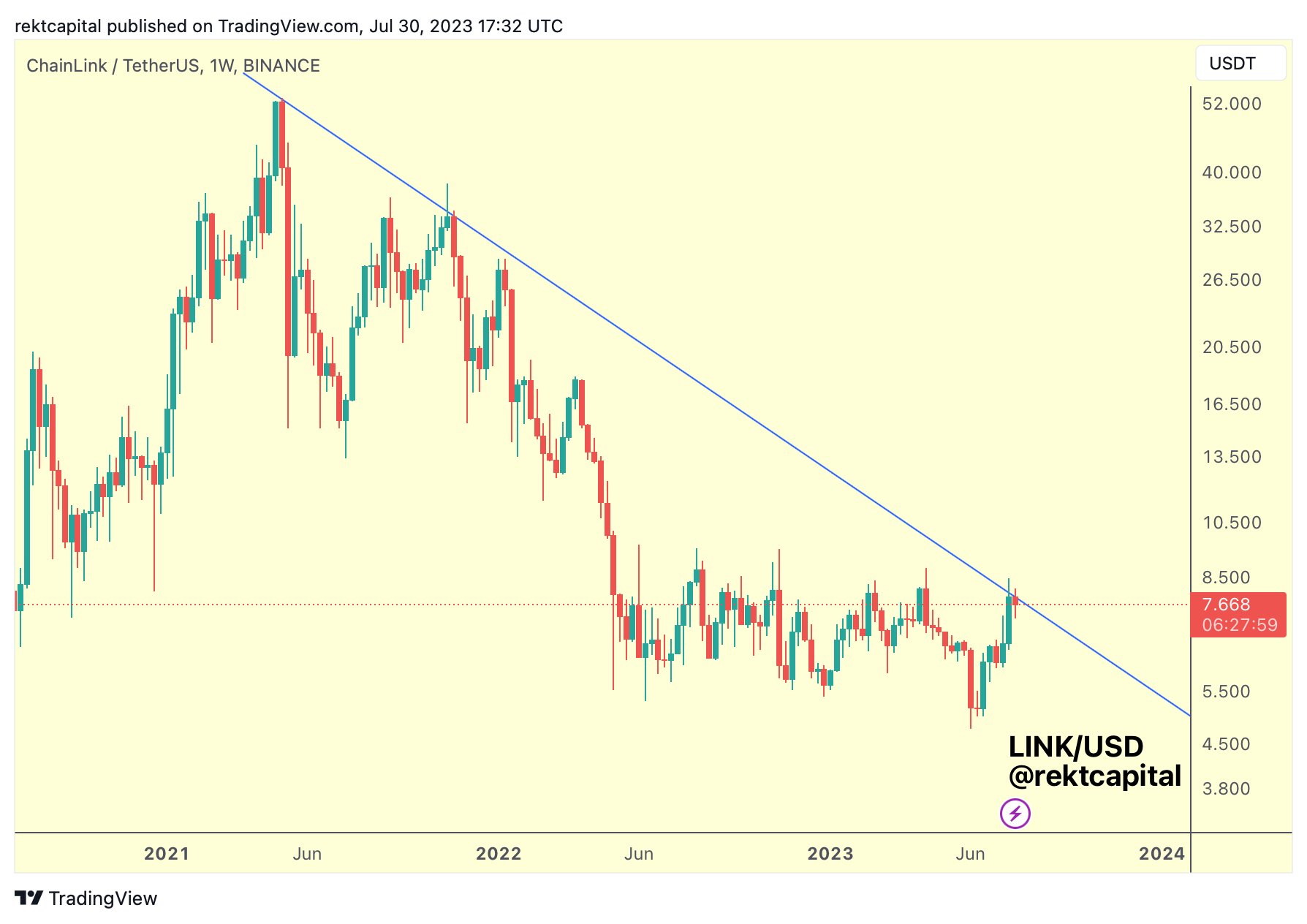
  • A top crypto analyst says LINK seeing a weekly close below the macro downtrend line portends fresh losses. 
  • The “Macro Breakout is postponed” the analyst noted on Monday. 

Chainlink posted an impressive run in the week of July 13-21, notching a +20% gain in a single day on July 20 as it hit a three-month high of $8.44. On-chain volume spiked to over $347 million as traders poured into the altcoin amid positive network developments.

Chainlink price analysis

LINK bulls appeared to be on the way to retesting a key technical level just under $10, with price poised to break a multi-year macro downtrend. 

Crypto analyst Rekt Capital highlighted this on Friday, identifying a potential weekly close above the macro downtrend line as a likely indicator of bullish strength.

As can be seen in the chart below, Chainlink price has recoiled from the crucial hurdle with a weekly close below. According to the analyst, the scenario where the would-be macro breakout has fizzled out (at the moment.)

“$LINK has ultimately performed its new Weekly Close below the Macro Downtrend. As a result, the Macro Breakout is postponed. Unless #LINK is able to reclaim this Macro Downtrend as support, price is positioning itself up for a rejection from here,” Rekt Capital shared on X (fka Twitter).

Chainlink weekly price chart showing LINK new weekly close. Source: Rekt Capital.

LINK currently trades near $7.60, largely flat in the past 24 hours. Investors have seen gains recorded over the past week cut to just 1%. LINK/USD is up 20% in the past 30 days.

If prices fall below $7.00, the next major support zone could be around $5.00. On the upside, $8.50 and $10 are key supply zones. 

Here’s something else the analyst points out about Chainlink price performance.

The post Chainlink price prediction: Here’s what top analyst says about LINK appeared first on CoinJournal.