
Arbitrum price surging as Arbitrum DAO approves staking proposal

  • ARB price is surging after Arbitrum DAO greenlights token staking proposal.
  • ARB holders can stake tokens, funded by the treasury, with an annual yield of 7.84%-78.43%.
  • The staking proposal creates varied staking tiers, promoting community engagement.

The price of Arbitrum (ARB) has seen a notable surge after the Arbitrum decentralized autonomous organization (DAO) approved a token staking proposal.

Arbitrum’s move has brought about significant excitement in the cryptocurrency community, as it introduces a new way for ARB token holders to potentially earn rewards.

Arbitrum price movement

Arbitrum, a blockchain platform that aims to enhance the scalability and efficiency of decentralized applications, has witnessed a surge in its price following the DAO’s decision.

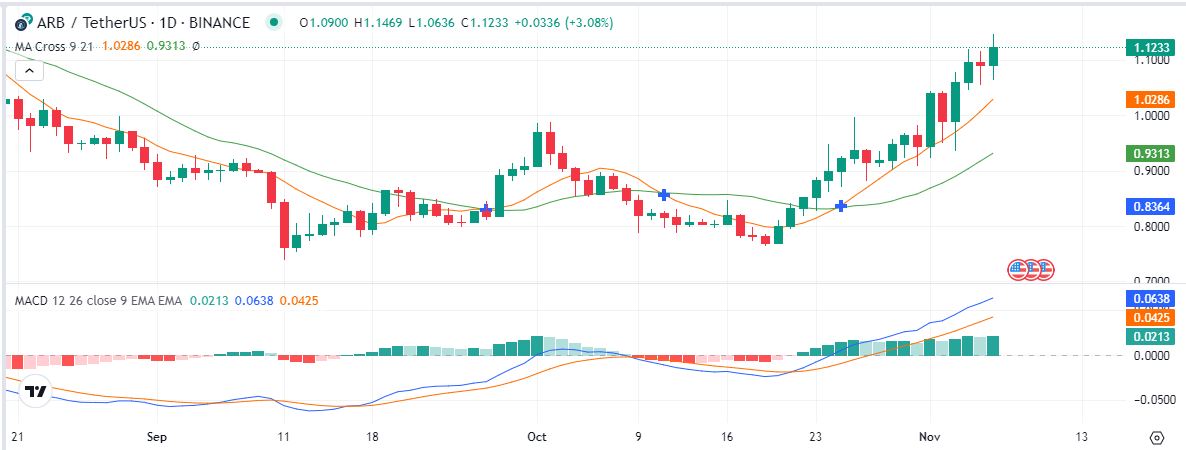
The price of ARB currently stands at $1.13, representing a 3.14% increase over the last 24 hours. This bullish momentum is likely linked to the positive news of the staking proposal’s approval.
Arbitrum price chart


The price of Solana has been on a very strong bullish trend since mid-October and the bullish trend is projected to continue as indicated by the MA crossover and the MACD as seen in the above chart.

The cryptocurrency’s market capitalization is now valued at $1,439,342,086, ranking it 39th in terms of market cap. Additionally, the 24-hour trading volume of ARB has reached $358,674,886, indicating a surge in trading activity.

The Arbitrum token staking proposal

The Arbitrum DAO’s approval of the staking proposal opens up a new opportunity for ARB token holders. Stakers will have the option to lock up their holdings in exchange for a yield, which will be distributed over a 12-month period through a smart contract.

The proposal initially presented different tiers for token allocation, offering stakers the choice to receive 1%, 1.5%, or 1.75% of the total 10 billion ARB supply as staking rewards. A majority of over 66% of DAO members voted in favour of the lowest tier, allocating 1% (100 million tokens) towards staking, while 33% voted against the proposal, revealing a community disagreement regarding the use of treasury funds for staking incentives.

With an estimated annualized yield ranging from 7.84% to 78.43%, this staking mechanism is expected to be an attractive option for ARB token holders to earn additional tokens. Unlike other staking mechanisms, where tokens are typically used for network security or revenue distribution, this arrangement allows stakers to earn tokens directly from the treasury.

The DAO is now poised to consider a subsequent proposal that will focus on the specifics of the staking implementation, including the selection of technology service providers, associated contracts, and the appointment of an auditor to ensure the process’s integrity. A two-week review period will follow, during which the community can assess the implementation details before they are put into practice.

The post Arbitrum price surging as Arbitrum DAO approves staking proposal appeared first on CoinJournal.
FTX seeking approval to sell funds from Grayscale and Bitwise

  • FTX seeks to sell $744 million in Grayscale and Bitwise assets amid its bankruptcy proceedings.
  • The asset sale aims to prepare for creditor payouts and minimize price volatility risks.
  • FTX founder Sam Bankman-Fried was recently found guilty of all the charges that had been levelled against him.

In a move to address its financial obligations and recover from bankruptcy, the troubled crypto exchange FTX, along with its debtors, has submitted a proposal to the US bankruptcy court in Delaware seeking to sell trust assets.

The proposal outlines the sale of trust assets, consisting of funds from Grayscale and Bitwise, with a combined estimated value of $744 million.

Upcoming creditor payouts

FTX, once a major player in the crypto exchange industry, filed for bankruptcy in November the previous year after reports revealed the misappropriation of customer funds. The proposed sale of “trust assets” is aimed at preparing the estates for forthcoming distributions to creditors and streamlining the sale of these assets at the most opportune time.

The assets earmarked for sale include approximately $691 million held in five Grayscale Trusts and an additional $53 million managed by Bitwise. These valuations are based on market values as of October 25, 2023. These trusts offer investors a means to gain exposure to digital assets without direct ownership.

The rationale behind this proposed sale is to proactively manage the risk associated with price volatility, thereby safeguarding the value of the trust assets. This approach is designed to maximize returns for creditors and facilitate a fair distribution of funds within the debtor’s plan of reorganization.

The proposal not only involves the use of an investment adviser but also the establishment of a pricing committee where all stakeholders will be represented. The investment adviser will be mandated to obtain a minimum of two bids from different counterparties before the sale of assets, ensuring transparency and fair market value determination.

Sam Bankman-Fried’s conviction

The founder of FTX, Sam Bankman-Fried, was recently found guilty of all the charges that had been levelled against him related to the collapse of the FTX crypto exchange.

A tentative sentencing date has been set for March 28, 2024, with potential implications of a significant prison term, though estimates vary between 15-20 years according to experts.

This development bears significance not only for FTX and its creditors but also for the broader cryptocurrency industry, shedding light on the challenges and risks faced by participants in the ever-evolving digital asset landscape.

The post FTX seeking approval to sell funds from Grayscale and Bitwise appeared first on CoinJournal.

Yuga Labs and Magic Eden announce new Ethereum NFT marketplace to protect creator royalties

  • Yuga Labs and Magic Eden plan to launch the new Magic Eden ETH marketplace before the end of 2023.
  • The startups claim this will be the first major Ethereum marketplace “contractually obligated” to protect creator royalties.
  • Yuga Labs CEO Daniel Alegre says the new ETH marketplace is a win for the web3 ecosystem.

Yuga Labs, the Web3 startup behind the popular Bored Ape Yacht Club (BAYC), Otherside, Meebits and CryptoPunks, is partnering cross-chain NFT platform Magic Eden to launch a new Ethereum marketplace.

According to an announcement posted today on X, Yuga Labs said the collaboration with Magic Eden is for the launch of Magic Eden ETH marketplace, set to become the first Ethereum NFT marketplace to feature a contractual obligation to protect creator royalties.

The blockchain startup expects the marketplace to be live by the end of this year. 

Creators are critical to Web3

Yuga Labs and Magic Eden’s endeavour comes as the NFT space grapples with the issue of creator royalties, particularly as major marketplaces slash fees or scrap them altogether. The two startups are unequivocal about the need to respect creative entrepreneurs, stating in a press release that the issue of “creator royalties is non-negotiable.”

The BAYC creator says it will, going forward, exclusively partner with marketplaces that seek to protect creators.

“We see this partnership with Magic Eden as a win for the whole ecosystem,” Yuga Labs CEO Daniel Alegre noted.

According to him, creators are key to Web3, and without them, the ecosystem won’t thrive.

Magic Eden CEO and co-founder, Jack Lu said:

“Right now, it’s a priority to provide creatives with the support they deserve with creator royalty programs. In collaboration with Yuga Labs, we’re set to develop an Ethereum marketplace that resets the standard for royalty allocation and are hopeful this action will reverberate throughout the ecosystem.”

The post Yuga Labs and Magic Eden announce new Ethereum NFT marketplace to protect creator royalties appeared first on CoinJournal.

Derivatives DEX platform Derivio launches mainnet on zkSync Era

  • Derivio, a Binance Labs incubated decentralised derivatives exchange, announced its mainnet is live on the zkSync Era.
  • zkSync Era is an Ethereum Layer 2 scaling solution.
  • Users have a chance to trade perpetuals and options on more than 20 markets.

Derivio, a decentralised derivatives exchange built on the Ethereum Layer 2 scaling solution zkSync Era, has launched its mainnet, according to an announcement.

The Binance Labs-incubated DEX platform seeks to carve a share of the DeFi market by bringing the benefits of on-chain derivatives trading to users. Its infrastructure leverages zkSync Era features such as fast transactions, low gas fees and account abstraction to allow for greater adoption of derivatives.

“We’re excited to announce that Derivio’s mainnet beta is now live at derivio.xyz! Users can trade perpetuals & options with more than 20 different markets, provide liquidity and earn high organic risk-adjusted DeFi yield on @zksync Era,” the platform posted on X.

In addition to supporting perps and options trading on multiple markets, Derivio offers access to real yield for liquidity providers. 

Institutions and builders can also tap into the key features of decentralisation and modularity for their hybrid order book protocols or derivatives vaults. 

As part of the launch and to incentivise further adoption, Derivio plans to introduce several mainnet events, including trading competitions and retroactive incentives.

The post Derivatives DEX platform Derivio launches mainnet on zkSync Era appeared first on CoinJournal.

Voyager Token (VGX) soars after a 30% token supply burn

  • VGX surges 20% post-30% token burn.
  • 52 million VGX tokens were sent to a burn address.
  • The burn event comes as Voyager manoeuvres its Chapter 11 bankruptcy.

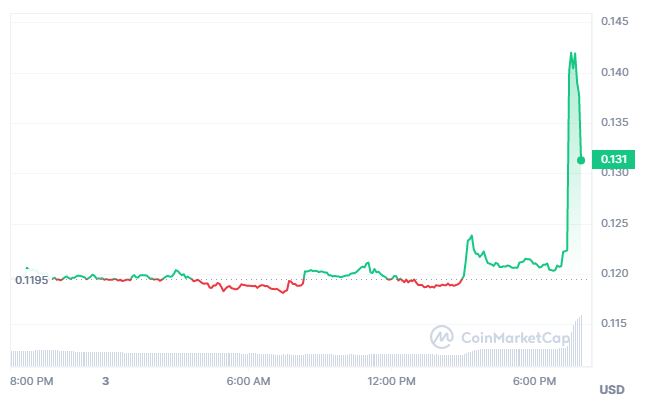
In a surprising turn of events, the native token of Voyager Digital, Voyager Token (VGX), witnessed a remarkable surge in its price, gaining 20% in value, following the transfer of 52 million tokens to a burn address.

The VGX token price had however started going down, at press time as seen in the chart below.

VGX token price chart


30% of VGX token supply bunt

On-chain data from Etherscan shows that the wallet in question is linked to Voyager and was named “Voyager 1.” It had remained dormant for 225 days.

This wallet suddenly came to life, initiating a test transaction of 123.45 tokens before proceeding to transfer a larger batch valued at $7.3 million.

This substantial transfer was directed towards a burn address, a cryptocurrency wallet where tokens are rendered inaccessible, essentially eliminating them from circulation.

Voyager’s troubled past

Voyager Digital’s recent history has been marked by turbulence, with the company filing for bankruptcy following the collapse of FTX, a cryptocurrency exchange that was in discussions to acquire Voyager before its abrupt implosion. The repercussions of FTX’s troubles extended across the cryptocurrency market, leading to a widespread downturn.

It remains unclear why Voyager decided to send such a significant portion of VGX tokens to a burn address. However, this move could have multiple implications in the crypto space.

Token burns are often employed to reduce the total supply of a cryptocurrency, creating a sense of scarcity and, in turn, potentially bolstering the value of the remaining tokens in circulation. The market’s response to this event was notably positive, with VGX witnessing a 20% price increase, reflecting investor optimism regarding the potential value appreciation due to the reduced supply.

Voyager Digital had earlier announced that it intended to liquidate assets in relation to its ongoing financial difficulties and its strategy to manage assets and liabilities within the context of its bankruptcy proceedings.

The post Voyager Token (VGX) soars after a 30% token supply burn appeared first on CoinJournal.