BONK price sees 12% drop as Solana pares gains

  • Bonk (BONK) was trading 12% down as Solana (SOL) moved lower after its recent surge.
  • An analyst says BONK could see a “slow bleed before nuke”, suggesting the downward move could gather pace.

Meme coin Bonk (BONK) is trading about 12% down in the past 24 hours, the dip coming amid increased profit taking deals for Solana (SOL).

According to data from CoinGecko, SOL price was down 2% to around $112 as the recent rally appeared to hit brakes above $123. These are the levels that Solana traded at as it nosedived in April 2022.

As liquidations for the cryptocurrency mounted to over $20 million – more than $12 million in longs – the pullback in SOL reflected in the Solana ecosystem tokens such as Bonk, Orca and Jito.

Bonk swelled more than 10x amid major exchange listings by Binance and Coinbase. The gains also saw a massive demand for Solana Saga phones.

What next for BONK?

While BONK remains the third largest by market cap behind Shiba Inu and Dogecoin with over $958 million, another swing lower could see CorgiAI threaten that status quo. The CORGIAI token currently has a market cap of $769 million, with the meme coin’s price up 80% this past week.

BONK is still more than 59% up in the past two weeks and over 350% in the green over the past month. However, at current prices, the meme coin has lost more than half of its value since hitting the all-time high of $0.00003416 on December 15.

Crypto analyst Nebraskagooner says BONK could see a “slow bleed” before it nukes.

“Doesn’t look done yet. Needs to hold the base of that breakout candle on the left otherwise it would get super ugly,” the analyst noted, sharing the prediction in a post on X (formerly Twitter).

The post BONK price sees 12% drop as Solana pares gains appeared first on CoinJournal.

Polygon, Render Token price prediction as Everlodge reshape real estate with tokenization

  • RNDR climbs steadily gaining 57% in the past month.
  • Polygon (MATIC) surges 21%, signalling a run for new yearly highs.
  • Everlodge reshapes real estate with fractional ownership, NFTs, and a dynamic ELDG token in its presale.

Render Token (RNDR) and Polygon (MATIC) are making waves with significant price movements. While RNDR experiences a surge and hints at potential highs, MATIC sees a seismic shift aiming for new yearly records.

Meanwhile, Everlodge is disrupting the real estate sector with tokenization and a revolutionary presale. Let’s delve into the technicalities of these developments, exploring price movements, predictions, and the innovative approach of Everlodge.

RNDR’s steady ascent

Render Token (RNDR) has been steadily climbing the crypto charts, showcasing resilience amid market volatility. Over the past week, RNDR witnessed a consistent rise, adding over 16% to its portfolio. This trend becomes more significant when looking at the cumulative gain of over 57% in the past month.

RNDR faced a brief consolidation phase, trading between $1.844 and $2.189. Bulls, however, gained power, breaking the price out of this range. Despite a short-lived rally with rejection at $2.542, RNDR has maintained stability, trading between $2.189 as support and $2.542 as resistance for approximately three weeks.

Render Token (RNDR) price prediction

RNDR has traded in a rising channel pattern since mid-September, showcasing a robust bullish sentiment.
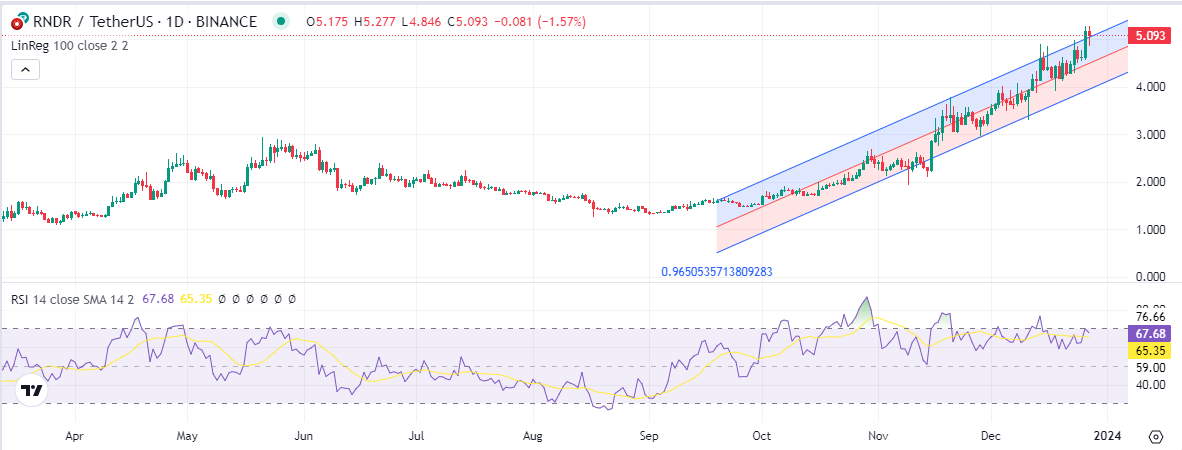
RNDR price chart


Technical indicators, such as the 50-day EMA acting as dynamic support, hint at the potential for massive price action in the near future.

With the Relative Strength Index (RSI) staying above the mid-point and bullish convergence in averages, indications point towards continued value appreciation. If the bulls maintain momentum, RNDR might aim to reclaim its all-time high of $8.76 in the first quarter of 2024, potentially testing $6 by December 31st, 2023.

MATIC price: bulls charge for new highs

Polygon (MATIC) is on the verge of a breakthrough, soaring over 21% in early trading hours. The protocol’s bulls are aggressively pushing for new yearly highs, signalling readiness to surpass the crucial $0.9 price level. The recent surge is supported by a 179% jump in trading volume over the past 24 hours, reaching $2,145,624,558.

Polygon price prediction: analyst insights

Top market analyst Ali Martinez suggests that if MATIC surges above the $0.96 price point, a rally to $1.73 is likely before a breather. The analyst’s charts and projections highlight the potential for significant price movements.

However, the exact timeline for this rally remains uncertain, and investors are advised to stay vigilant.

Everlodge revolutionizing real estate investment

Everlodge is making headlines with its innovative approach to real estate investment. The platform combines fractional vacation home ownership with timeshare and NFT technology, introducing a groundbreaking property marketplace on the blockchain.

Currently in the beta stage of its presale, Everlodge is set to redefine how users co-own and invest in hotels, vacation homes, and luxury villas.

Everlodge Token (ELDG)

The ELDG token is central to Everlodge’s ecosystem, offering holders various benefits. These include discounts on property purchases, utility within the Everlodge platform, and rewards akin to timeshares, such as free nightly stays.

Staking ELDG tokens provide users with a fixed monthly interest, creating avenues for passive income.

Everlodge’s ELDG token operates on the Ethereum chain, with an initial price of $0.01 and a total fixed supply of 800,000,000. Notably, the project implements a dynamic pricing model, expecting a 280% price increase during the presale stage and a 30x rally on the launch day. The team has taken measures such as locking team tokens for 2 years and an 8-year liquidity pool lock to ensure transparency and prevent rug-pulls.

Conclusion

In a crypto landscape marked by innovation and volatility, RNDR and MATIC’s price movements signify potential shifts in the market. Meanwhile, Everlodge’s disruptive model in real estate adds a new dimension to blockchain applications.

As these cryptocurrencies chart their way, the above market predictions and analysis could help crypto investors and enthusiasts alike identify investment opportunities heading into 2024.

The post Polygon, Render Token price prediction as Everlodge reshape real estate with tokenization appeared first on CoinJournal.

Polygon (MATIC) holds above key level as bulls target $1

  • Polygon (MATIC) price is poised above $0.85, a key support level that could see bulls eye $1 in coming weeks.
  • Bullish catlysts for crypto and developments in the Polygon ecosystem could buoy MATIC upside momentum.

Polygon (MATIC) price continues to hold above $0.85, a key level above buyers could target the psychological $1 hurdle. Despite the broader market’s lull amid the thinned trading expected this Christmas holiday week, MATIC could still see a major breakout.

Could it be one of the top altcoins under $1 in the market today? Here’s the price outlook for Polygon.

Polygon an “underdog”?

Polygon has not experienced the kind of price explosion some coins have witnessed in 2023 overall or in recent weeks. But Polygon’s zero-knowledge EVM (zkEVM) technology, Chain Development Kit (CDK) and MATIC to POL migration mark a few of the key developments for the blockchain in the year.

Polygon also recently integrated with Chainlink Data Feeds, a move hailed as a likely “game-changer” for the decentralised finance (DeFi) space.

Despite these Polygon founder Sandeep Nailwal thinks the layer-2 blockchain is an “underdog” in the ecosystem.

MATIC price remains above key level

Polygon (MATIC) has not traded above the $1 mark since May this year. Polygon bulls however did move to within touch of the price level in November and earlier this month. MATIC/USD reached highs of $0.98 on November 14 and $0.94 on December 9.

Although prices dipped to lows of $0.76 on December 19, bulls are looking to hold above $0.85 on December 25.

The bullish sentiment across the market and within the Polygon ecosystem could help keep prices from dipping below $0.80. In this case, it’s likely a retest of recent highs near the critical $1 could be on cards before the year ends.

One of the catalysts for further gains in the year could include the highly anticipated spot Bitcoin ETF. Analysts and market experts say the US Securities and Exchange Commission (SEC) could finally give a nod to spot Bitcoin ETFs by January 10, 2024.

The post Polygon (MATIC) holds above key level as bulls target $1 appeared first on CoinJournal.

Japan removes corporate tax on unrealized crypto profit

  • Japan has scrapped corporate tax on unrealized profits
  • Companies holding unrealized gains on their crypto assets will not pay tax on them as from April 1, 2024.

Japan is reportedly doing away with corporate tax on unrealized profits from cryptocurrency holdings, according to the latest news by local media outlets.

Japan changes corporate tax law on crypto

Per the news updates, companies and institutions holding crypto will not pay tax on their “unrealized gains” from April 2024. 

The cabinet approved the tax changes on December 22, local media outlet Nikkei reported. The new tax regime will take effect on April 1, 2024 – the date that Japan’s fiscal year starts.

This follows the Japanese government’s approval of a revision to the country’s tax law as applies to companies that hold digital assets issued by third parties. Companies are set to only get taxed on realized profits- after they sell.

As it stands and per the law, corporate crypto holders are subject to taxation on the “mark-to-market valuation” of their assets every fiscal year. However, with the revision, companies that hold unrealized cryptocurrency profits will not be subject to this tax.

In June, Japan’s tax agency clarified that crypto issuers were no longer subject to the 35% capital gains tax.

The post Japan removes corporate tax on unrealized crypto profit appeared first on CoinJournal.

BarnBridge DAO agrees to settle $1.7M with the SEC for charges against it

  • BarnBridge DAO, founders to settle SEC charges for $1.7M over unregistered SMART Yield bonds.
  • SEC alleges failure to register crypto asset securities, cites violation of securities laws.
  • Gurbir Grewal emphasizes blockchain compliance, highlighting the universal application of securities laws.

Decentralized finance (DeFi) protocol BarnBridge DAO and its founders, Tyler Ward and Troy Murray, are set to pay over $1.7 million to settle charges brought by the Securities and Exchange Commission (SEC).

The charges against BarnBridge were related to the failure to register the offer and sale of their structured crypto asset securities known as SMART Yield bonds. The SEC alleged that the DAO and its founders marketed these bonds without proper registration, a violation of securities laws.

BarnBridge DAO’s $1.7M settlement

BarnBridge DAO, a player in the evolving DeFi space, has agreed to a settlement exceeding $1.7 million with the SEC. The settlement includes BarnBridge yielding almost $1.5 million in proceeds from SMART Yield bond sales, and individual civil penalties of $125,000 for both Ward and Murray.

The US SEC accused the DAO and its founders, Tyler Ward and Troy Murray, of not registering the “offer and sale of structured crypto asset securities known as SMART Yield bonds.” According to the SEC’s statement, SMART Yield pooled cryptocurrencies from investors to generate returns for paying investors.

The SEC’s investigation revealed that Ward and Murray extensively promoted SMART Yield, likening it to asset-backed securities, through social media and appearances on YouTube channels related to decentralized finance. This approach attracted investments exceeding $509 million from various investors. 

In the wake of this settlement, the SEC reinforces its stance on the necessity for compliance within the blockchain and crypto space. The regulatory environment is evolving, and companies operating in this sector must navigate it with a keen awareness of regulatory obligations.

The post BarnBridge DAO agrees to settle $1.7M with the SEC for charges against it appeared first on CoinJournal.