
Paxos integrates with Arbitrum for institutional on-chain assets adoption

  • Paxos integrates with Arbitrum to expand institutional adoption of on-chain assets.
  • The partnership enhances real-world asset tokenization using Arbitrum’s low-cost network.
  • Paxos focuses on stablecoin growth post-SEC inquiry, driving long-term digital asset use.

Stablecoin issuer Paxos has announced its integration with Arbitrum, Ethereum’s leading Layer 2 scaling solution. The integration marks Paxos’ first foray into a Layer 2 network, signifying a significant step toward facilitating institutional adoption of on-chain assets.

According to a press release issued by Arbitrum and Paxos, the collaboration aims to bring real-world asset tokenization to the Arbitrum ecosystem, leveraging its high-speed, low-cost infrastructure to enhance the utility of digital assets for enterprises.

Paxos tapping into Arbitrum’s DeFi ecosystem

By integrating with Arbitrum, Paxos taps into Ethereum’s deep liquidity, enabling faster transactions and reduced costs, which are crucial for institutions seeking to adopt blockchain technology.

Arbitrum, which launched in 2021, has quickly grown to become one of the most robust ecosystems in decentralized finance (DeFi), boasting over 520,000 active addresses and nearly 700 decentralized applications.

In addition to offering Paxos access to Arbitrum’s ecosystem, this integration will also allow Paxos to expand its reach within the Ethereum ecosystem, enhancing the accessibility of digital assets for both retail and institutional users.

Leveraging the stablecoin growth

Paxos’ entry into Arbitrum comes at a time when stablecoins growth is poised to accelerate, following the conclusion of an SEC investigation into the company’s Binance-branded stablecoin, BUSD.

With the regulatory hurdles behind it, Paxos is now focused on driving the integration of real-world assets onto the blockchain.

Luke Xiao, Fintech Partnership Lead at Arbitrum, highlighted the transformative impact of Paxos’ tokenization platform on the DeFi ecosystem. Walter Hessert, Paxos’ Head of Strategy, echoed these sentiments, stating that the partnership would drive long-term adoption of digital assets.

As Paxos and Arbitrum work together to bring real-world assets on-chain, this collaboration is set to reshape institutional engagement with blockchain technology and fuel the next wave of innovation in digital finance.

The post Paxos integrates with Arbitrum for institutional on-chain assets adoption appeared first on CoinJournal.
FTM, AAVE, TAO see double-digit gains as Bitcoin retests $57k

  • Fantom (FTM), Bittensor (TAO) and Aave (AAVE) are among the biggest gainers in the past 24 hours.
  • The altcoins are seeing the most upside action in the top 100 coins by market cap as of 4pm ET on September 9.
  • Meanwhile, Bitcoin (BTC) has bounced above $57,000 after revisiting sub-$54k over the weekend.

FTM, AAVE and TAO tokens are all up double digits, with Bittensor price up more than 16% to change hands above $286. Meanwhile, Fantom price was trading above $0.46, up nearly 14% at the time of writing, and Aave price hovered near $142 with the DeFi token’s value up more than 13% in the past 24 hours.

Bitcoin price bounces above $57k

Bitcoin’s bounce to above $57,000 follows Monday’s upward action after BTC dropped to below $54k over the weekend. While the flagship cryptocurrency remains in a bearish hold with the Fear & Greed Index in extreme fear, analysts are bullish on long term prospects.

As highlighted earlier, Bernstein analysts see the US election as a key factor in the short term. A win for Donald Trump could mean a price explosion to above $80k.

On the flipside, Kamala Harris winning could catalyse a downward move to lows of $30k.

FTM, TAO and AAVE tokens surge

The Bittensor token soared when Grayscale unveiled the AI tokens fund, allowing for exposure to top artificial intelligence tokens like Render (RNDR), Filecoin (FIL), and Near (NEAR). While the latest surge occurred amid a broader market spike, TAO looks to have hit an upward gear as fresh network developments highlighted TAO staking and delegation.

Meanwhile, FTM is soaring as the community cheers developments around Sonic Labs. The Sonic testnet has achieved key milestones, while Fantom founder Andre Cronje believes the Sonic blockchain network could tap into an $11 trillion market that’s the unsecured lending industry.

On the other hand, AAVE price looked to bounce after a dedicated Ether.fi (ETHFI) market went live on Aave. The deployment allows users to borrow stablecoins, including USDC, PYUSD and FRAX against their liquid staking tokens weETH.

weETH is among the liquid restaking tokens that are enabling DeFi strategies such as leveraged ETH staking. Aave already has a dedicated market like this on the top Ethereum staking platform Lido.

The post FTM, AAVE, TAO see double-digit gains as Bitcoin retests $57k appeared first on CoinJournal.

Coinbase faces legal setback as judge allows shareholder lawsuit to proceed

  • Judge allows parts of Coinbase’s shareholder lawsuit to proceed on negligence claims.
  • Plaintiffs allege Coinbase misled about regulatory risks; some claims dismissed.
  • Coinbase remains confident and committed to defending against the remaining allegations.

In a significant legal development, US District Judge Brian Martinotti has partially a motion filed by Coinbase to dismiss a class action lawsuit filed by shareholders.

The lawsuit, dating back to 2022, accuses Coinbase of misleading investors about the potential risks of regulatory action from the US Securities and Exchange Commission (SEC).

Coinbase accused of providing false and misleading statements

The plaintiffs allege that Coinbase provided materially false and misleading statements about its exposure to regulatory scrutiny.

They claim that the exchange painted an overly optimistic picture regarding the likelihood of SEC enforcement actions by asserting that the digital assets listed on its platform were not classified as securities. This stance, they argue, was contradicted when the SEC subsequently sued Coinbase for alleged violations of federal securities laws in June 2023.

Judge Martinotti’s recent ruling allows parts of the shareholder lawsuit to proceed, specifically those alleging that Coinbase acted negligently in its communications about regulatory risks.

While many of the plaintiffs’ claims were dismissed, the court found that some allegations regarding Coinbase’s portrayal of its regulatory exposure were sufficiently plausible to warrant further examination. The decision highlights ongoing concerns about transparency and the accuracy of risk disclosures in the cryptocurrency sector.

Coinbase’s spokesperson has expressed confidence in the company’s position, noting that the court’s decision is based on the plaintiffs’ allegations rather than established facts. The spokesperson emphasized that the company remains committed to defending itself and proving its case.

This legal battle underscores the critical importance of transparent and accurate communications for companies, particularly in the highly regulated and evolving field of cryptocurrency.

As Coinbase navigates these challenges, the outcome of this lawsuit could have broader implications for the industry’s approach to regulatory compliance and investor relations.

The post Coinbase faces legal setback as judge allows shareholder lawsuit to proceed appeared first on CoinJournal.

Cardano (ADA) on the spot amid mysterious transactions as ecosystem registers growth

  • ADA’s price has rebounded to $0.343 after a low of $0.3054 amid market volatility.
  • Mysterious transactions involving large ADA amounts stir speculation and concern.
  • The Cardano ecosystem grows with increased transactions, wallets, and Plutus scripts.

Cardano (ADA) has been in the spotlight recently, facing a mix of market turbulence and intriguing developments. Notably, mysterious wallet transactions involving millions of ADA have stirred speculation and heightened market interest.

Despite this, the Cardano ecosystem continues to showcase impressive growth, with significant increases in transactions, wallets, and development activities reported in recent updates.

Cardano (ADA) going through a turbulent phase

Cardano’s price has been navigating a turbulent phase, marked by recent volatility. After hitting a low of $0.3054 on September 7, ADA’s price has shown some bullish trends, surpassing $0.34, which hints at potential market recovery.

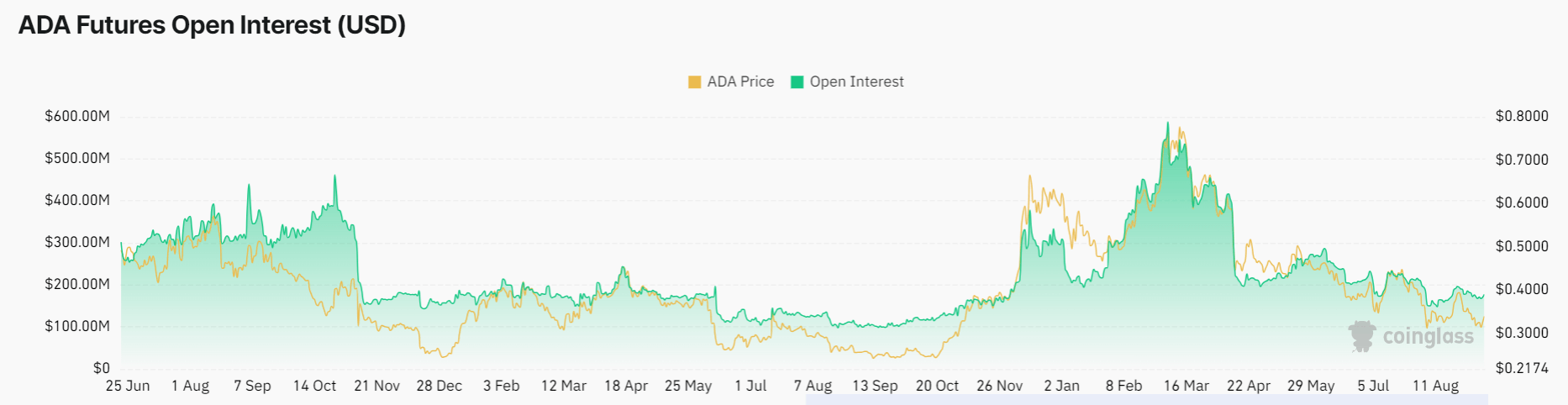
The cryptocurrency’s price surge, currently trading around $0.343, reflects a general resurgence across digital currencies. This positive price movement comes amid rising trading volumes and open interest, suggesting increasing investor confidence.

However, there are concerns about the impact of the recent revelations of mysterious wallet transactions involving a top Cardano wallet that initiated a large-scale transaction that, coincidentally, occurred during significant network congestion linked to a new platform release.

Mysterious ADA transactions

The mysterious transactions involving ADA began with a user converting SOL to ADA using SimpleSwap, with the ADA being directed to a new wallet created through GeroWallet. This wallet then transferred ADA to another new Vespr wallet. The transaction faced delays but was eventually completed.

Subsequently, a large amount of ADA was transferred back to the original wallet and then returned to Solana.

This sequence of transactions was further complicated by the involvement of a wallet flagged as an ‘enterprise address’ on Cexplorer, typically used by exchanges and custodians. This address, known as vx7j28, had been active for 12 days and handled a significant volume of ADA.

Speculation has arisen about whether this wallet’s activity is linked to exchange operations or network anomalies, such as reorgs or stress-induced issues.

The wallet’s behaviour, including receiving a substantial amount of ADA and transferring it back shortly after, suggests either an unusual network edge case or potential deliberate manipulation. This has led to widespread discussions and investigations within the crypto community to understand the full scope and impact of these transactions on the Cardano network.

Key metrics point to Cardano ecosystem growth

Despite the market turbulence and mysterious transactions, the Cardano ecosystem has shown remarkable growth. According to the Cardano Foundation’s August 2024 report, several key metrics highlight this expansion:

  • Transaction Volume: Cardano network transactions grew by 1.51% in August, reaching 95.9 million transactions.
  • Wallets and Delegated Wallets: The number of wallets increased by 0.67% to 4.87 million, with delegated wallets growing by 0.98%.
  • Plutus Scripts: The number of Plutus scripts rose by 0.75% to 6,709.
  • Native Tokens: Native tokens saw a 0.85% increase, totalling 10.3 million, with token policies up by 6.53% to 160,299.

In addition to these metrics, Input Output Global (IOG) reported that as of August 30, 2024, there are 1,373 projects actively building on Cardano. The number of token policies increased by 8,375, and 110,000 new native tokens were minted.

Plutus scripts experienced a significant rise of 5,995, reaching a total of 74,729. Furthermore, the total number of transactions saw an increase of 1.5 million over the month.

This growth underscores the ongoing development and expansion within the Cardano ecosystem, showcasing its resilience and potential despite market challenges.

As Cardano (ADA) navigates a complex landscape of market fluctuations and mysterious transactions, the underlying growth in its ecosystem reflects a positive and robust trajectory.

The post Cardano (ADA) on the spot amid mysterious transactions as ecosystem registers growth appeared first on CoinJournal.

RPL price jumps 30% after Binance announces perpetual contracts

  • Rocket Pool (RPL) price jumped more than 30% to break above $12.50 on Monday.
  • The surge follows an announcement of support for RPL perpetual contracts on Binance Futures.

Rocket Pool (RPL) price rocketed as the crypto market reacted to the latest market news around the decentralised Ethereum (ETH) liquid staking protocol.

The staking feature allows ETH holders to tap into their holdings for a chance to earn yield. The staked Rocket Pool ETH token rETH allows users to stake and earn rewards with as little as 0.1 ETH.

Rocket Pool surges amid Binance listing

RPL rose sharply to highs of $12.58 across major digital asset exchanges after the world’s largest crypto exchange announced the listing of Rocket Pool perpetual futures contracts.

According to Binance, the launch USD-Margined RPL perpetual contract expands the trading options users have. Binance Futures is set to offer RPLUSDT contract starting from 12:30 UTC on September 9, 2024. Traders will have access to up to 75x leverage for the Rocket Pool futures, the exchange noted.

Earlier in the day, RPL price had struggled to below $10, with the last time the cryptocurrency traded above this level being a brief surge to $10.07 on Sept. 6. Gains in the past 24 hours have RPL price retesting a critical downtrend line.

Rocket Pool RPL/USD price on the 4-hour chart. Source: TradingView

As the chart above shows, a descending channel has been in place since the last week of August.

Rocket Pool’s price traded within the range since dropping from near $16 on Aug. 23. This negative outlook followed RPL’s decline from highs of $32 in mid-June.

The post RPL price jumps 30% after Binance announces perpetual contracts appeared first on CoinJournal.