
Is ApeCoin a buy after retesting $4.3 support?

  • ApeCoin finds support at the $4.3 price level.
  • APE is down 83.8% from its all-time high.

  • Trends around Metaverse directly affect the long-term value.

The ApeCoin DAO airdropped millions of APE tokens to NFT owners in March this year during the token’s launch. The airdrop went to BAYC, Mutant Ape Yacht Club, and Bored Ape Kennel Club NFT holders. The token distribution and the speculations around it drove it to as high as $27 in April.

The surge was also attributed to the anticipated NFT sales of the BAYC metaverse game ‘Otherside’. However, at the moment, the enthusiasm seems to have faded away. APE is currently trading at $4.28 after a 5.77% decline in the past day and a 10.39% drop in the past week.

Overall, ApeCoin is down 83.8%, with a market capitalization of $1.29 million and #43 in market ranking. The current circulating supply is 299,531,250 from a hard cap of 1 billion. 

ApeCoin is a governance token that is used as a utility token. The token allows holders to be part of a decentralized ecosystem of a Web3 community. The native APE token started trading on March 17, 2022. The token remains bearish despite attracting notable partnerships from major industry players like Animoca Brands. However, as the Web3 economy evolves into the metaverse, projections point to a comeback in the token.

APE retests $4.3 support

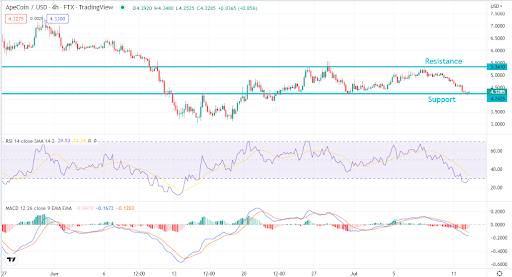
The 4-hour technical chart below shows that APE has retested the $4.3 price support. The MACD line has crossed the signal line from above to below, showing that the momentum is bearish. However, the RSI reading is at the oversold zone and presents a potential trend reversal. If the trend reverses, $5.3 will be the next level to watch. Clearance above the resistance could welcome an uptrend.
Source: TradingView

Summary

While the speculation around NFTs is believed to have been behind the surge in the value of APE, the long-term value seems intact. The technical indicators show mixed signals, with the MACD showing bearish momentum while the RSI seems to have bottomed. For the holders, the trends in the metaverse and NFTs will inform the value of ApeCoin.

The post Is ApeCoin a buy after retesting $4.3 support? appeared first on CoinJournal.
What next as Tezos slips below a short-term trendline?

  • Tezos token XTZ has been bullish this month.

  • The cryptocurrency has breached an ascending trendline and is going lower.

  • XTZ could fall up to $1.3 as weakness develops.

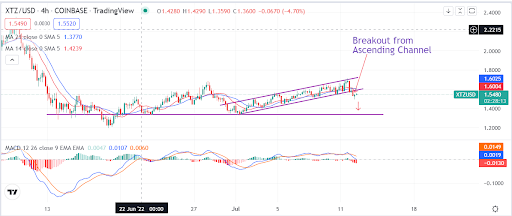
Tezos XTZ/USD has been bullish since the start of July. The cryptocurrency recovered from the $1.3 bottom on July 1, rising to a high of 1.7 on July 11. The crypto weakness has caused a 2% drop in Tezos in the last 24 hours.

Tezos prides itself on being an open-source platform. It seeks to address the barriers that face blockchain adoption for assets and applications. It achieves the goal by ensuring that Web3 is user-governed. Users can directly interface with one another over the network and interact with various applications. Its native token XTZ is used to pay for fees and for staking. It also acts as the basic accounting unit on the blockchain platform.

Whereas the XTZ token surged massively in 2021, it crashed this year. The token currently trades at $1.5, significantly below the high of above $9 in October 2021. Investors could again be looking for an opportunity to snap the token at the bottom. But is Tezos currently a buy?

Tezos bearish breakout is currently underway

Source – TradingView

Technically, the MACD indicator is flashing a bearish market for Tezos. Previously, the cryptocurrency was trading in a system of higher highs and higher lows. Prices always recovered after hitting the 21-day moving average. However, with the recent weakness, Tezos broke below the ascending trendline and channel. It also trades below the 14-day and 21-day moving averages, which affirms the developing bearish move. We recommend a sell of Tezos as the price faces further declines. The cryptocurrency could proceed lower to touch the $1.3 support again.

Summary

Tezos is bearish after breaching an ascending trendline and channel. MACD indicators and moving averages are bearish. The cryptocurrency could fall back to $1.3.

The post What next as Tezos slips below a short-term trendline? appeared first on CoinJournal.

Litecoin price prediction as token trades under $50

  • Litecoin has plummeted over 60% since March

  • The launch of the MWEB privacy upgrade contributed to a bearish sentiment

  • LTC trades lower than $50 psychological support level

Litecoin (LTC/USD) has been trading in lower highs and lower lows since March 2022. The trend has led to a 64% decline from $132. The current trading price is $47, with a daily drop of 4.36%. 

Litecoin is one of the earliest crypto projects that was forked from Bitcoin in 2011. LTC token is a utility crypto powering transactions in the network and acting as a store of value.

Many factors have contributed to the decline in LTC. The launch of Litecoin’s MimbleWimble update received negative sentiment leading to delisting in Binance and multiple Korean exchanges.

Litecoin is also a victim of the overall cryptocurrency bearish sentiment, which has seen most tokens dip. The token was designed to complement bitcoin with a faster block time and larger supply. Due to its similarity with bitcoin, Litecoin is affected by the same sentiment facing BTC. Some of them include the hike of interest rates by the Federal Reserve. The economic intervention with the rising inflation rate has forced investors to less risky assets.

Currently, most cryptos tokens are flashing red lights. Bitcoin has dipped 4.45% in the past day, trading at $19,623. Ethereum is also down 7.88% in the same period at $1,056. BNB, XRP, and Cardano have also plunged 4.3%, 4.88%, and 6%, respectively.

LTC loses $50 Psychological support level

Source: TradingView

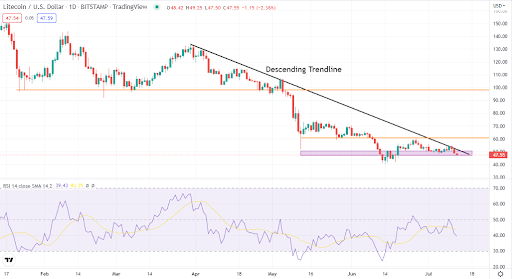
According to Litecoin’s daily chart, LTC has been bouncing off a descending trendline. The token has also lost key support levels at $98 and $60. Furthermore, at the $47 support zone, LTC is looking bearish and can trade lower. The price outlook shows that if the LTC loses the currency support, more positions will be liquidated even as the RSI remains above the Oversold zone.

Closing thoughts

We do not recommend a buy of LTC at the current level as the technical and fundamental analysis points towards a bearish momentum. Investors should remain patient until there is a change of sentiment. The sell-off in LTC is related to both internal factors and the aspects around the macroeconomic level.

The post Litecoin price prediction as token trades under $50 appeared first on CoinJournal.

GMX price has staged a slow recovery. Is it still a good buy?

The GMX price has been in a slow recovery as investors attempt to buy the dip. The token is trading at $21, which is the highest it has been since July 3rd of this year. It has jumped by more than 120% from the lowest level in June this year. GMX has a market cap of over $168 million. 

What is GMX? 

There are primarily two main types of cryptocurrency exchanges: centralized and decentralized platforms. In the past few years, the concept of decentralized exchanges has become so popular that analysts believe that they will soon overtake centralized exchanges like Coinbase and Binance. 

GMX is a relatively small but fast-growing decentralized perpetual exchange that enables people to buy and sell crypto derivatives in just a few steps. Unlike centralized exchanges, you don’t need to register. Instead, all you need is to connect your wallet to its platform and start trading. 

Read our review of the best crypto exchanges.

GMX makes it possible for people to use leverage to maximize their crypto investments. It also has substantially lower fees than other perpetual protocols. In addition to trading, one can easily swap coins in a few steps. 

GMX uses two smart contracts that are all easily available to most users. Its main platform was built on Arbitrum, which is well-known for its low fees and high performance. It is also available on Avalanche. According to its website, GMX has helped to facilitate over $47 billion in trading volume from over 69k users. 

GMX has two tokens: GMX and GLP. GMX, the main coin, is the utility token for the ecosystem. It accrues about 30% of the total fees earned from the ecosystem. Holders earn about 21% on both Arbitrum and Avalanche. On the other hand, GLP is the liquidity provider token for the network. It accrues about 70% of its fees. 

GMX price prediction 

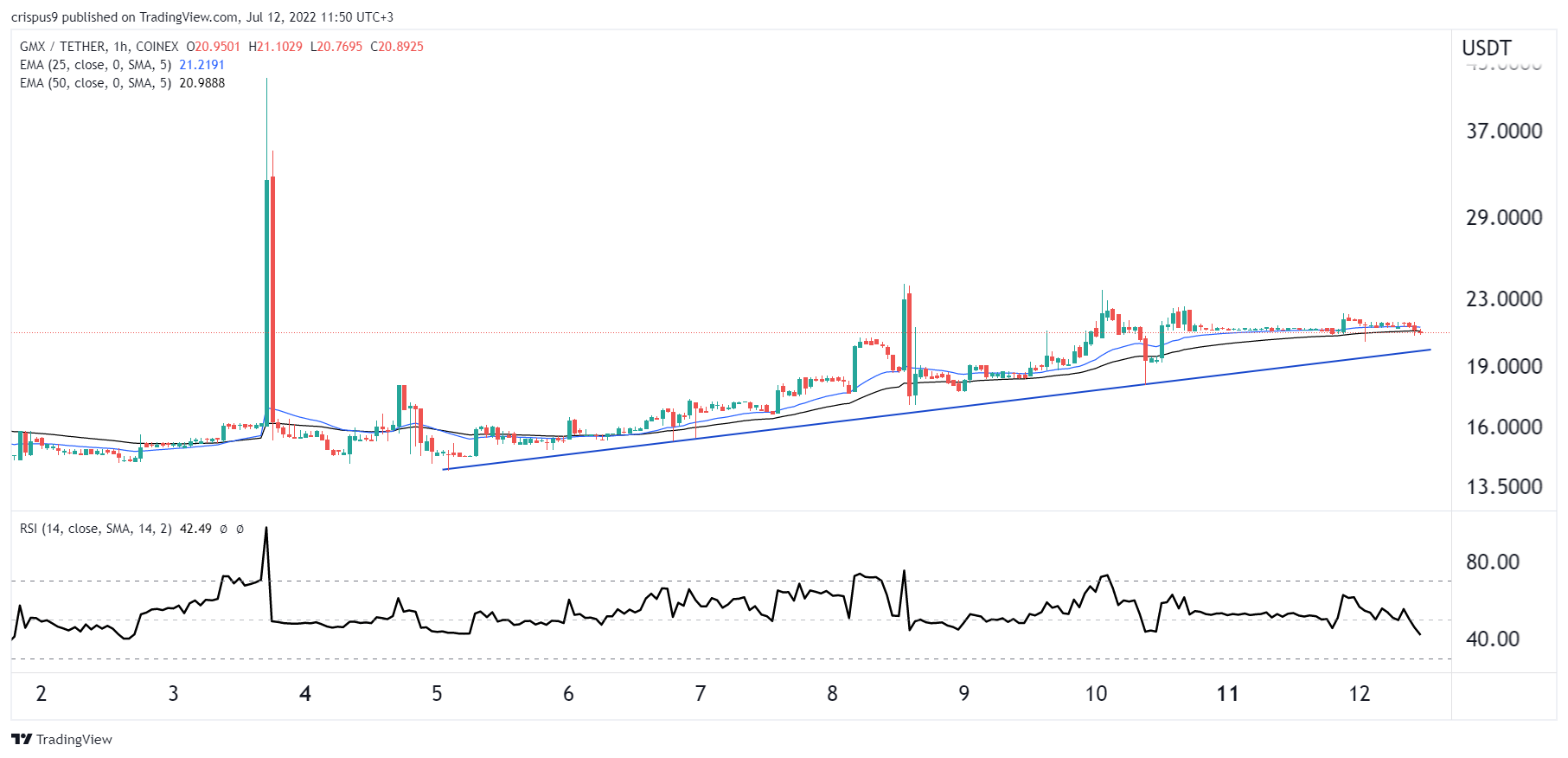
The hourly chart shows that the GMX token price has been in a slow upward trend in the past few days. The coin has managed to move above the ascending trendline that is shown in blue. It is also hovering around the 25-period and 50-period moving averages. 

A closer look shows that it has formed what looks like an ascending head and shoulders pattern. Therefore, we can’t rule out a situation where the GMX price makes a major pullback in the coming days. If this happens, the next key support level to watch will be at $18.

The post GMX price has staged a slow recovery. Is it still a good buy? appeared first on CoinJournal.

Origin Protocol price prediction: Is it safe to buy the OGN dip?

The Origin dollar price joined other cryptocurrencies in a strong sell-off as investors waited for the upcoming American inflation data. OGN, the network’s coin, is trading at $0.2170, which was the lowest level since June 18th. It has crashed by more than 40% from its highest point this month, bringing its total market cap to about $111 million.

What is Origin Protocol and why is it falling?

Origin Protocol is a blockchain project that is at the intersection of three well-known industries in the decentralized industry: DeFi and NFTs. 

DeFi is an industry that is attempting to change how people handle finances. Instead of using centralized companies like banks, DeFi is enabling people to use organizations backed by smart contracts. Anyone can participate in this Decentralized Autonomous Organization (DAO) by buying th OGN token.

Origin Protocol’s DeFi platform is made possible by Origin Dollar (OUSD), which is an algorithmic stablecoin. Unlike popular stablecoins like USDT and USDC, OUSD is not backed by fiat currencies. 

Like Terra UST, OUSD is an algorithmic stablecoin that aims to achieve its peg through arbitrage. According to CoinGecko, Origin Dollar has a total market cap of over $66 million, making it the 319th biggest cryptocurrency in the world.

Like Anchor Protocol, Origin’s DeFi product enables OUSD holders to earn interest by just holding the coin. At the time of writing, the coin has an APY of 12.50%, which is a higher yield than what fiat currencies like the US dollar earns. 

Origin Protocol also owns Origin Story, a platform in the NFT industry. The platform enables people to mint NFTs and sell them in the platform. They can personalize their storefronts and engage their audience easily.

The OGN price has declined recently mostly because people are worried about both the DeFi and NFT ecosystems. There are concerns about the future of the OUSD and the fact that NFT sales are falling.

Origin Protocol price prediction

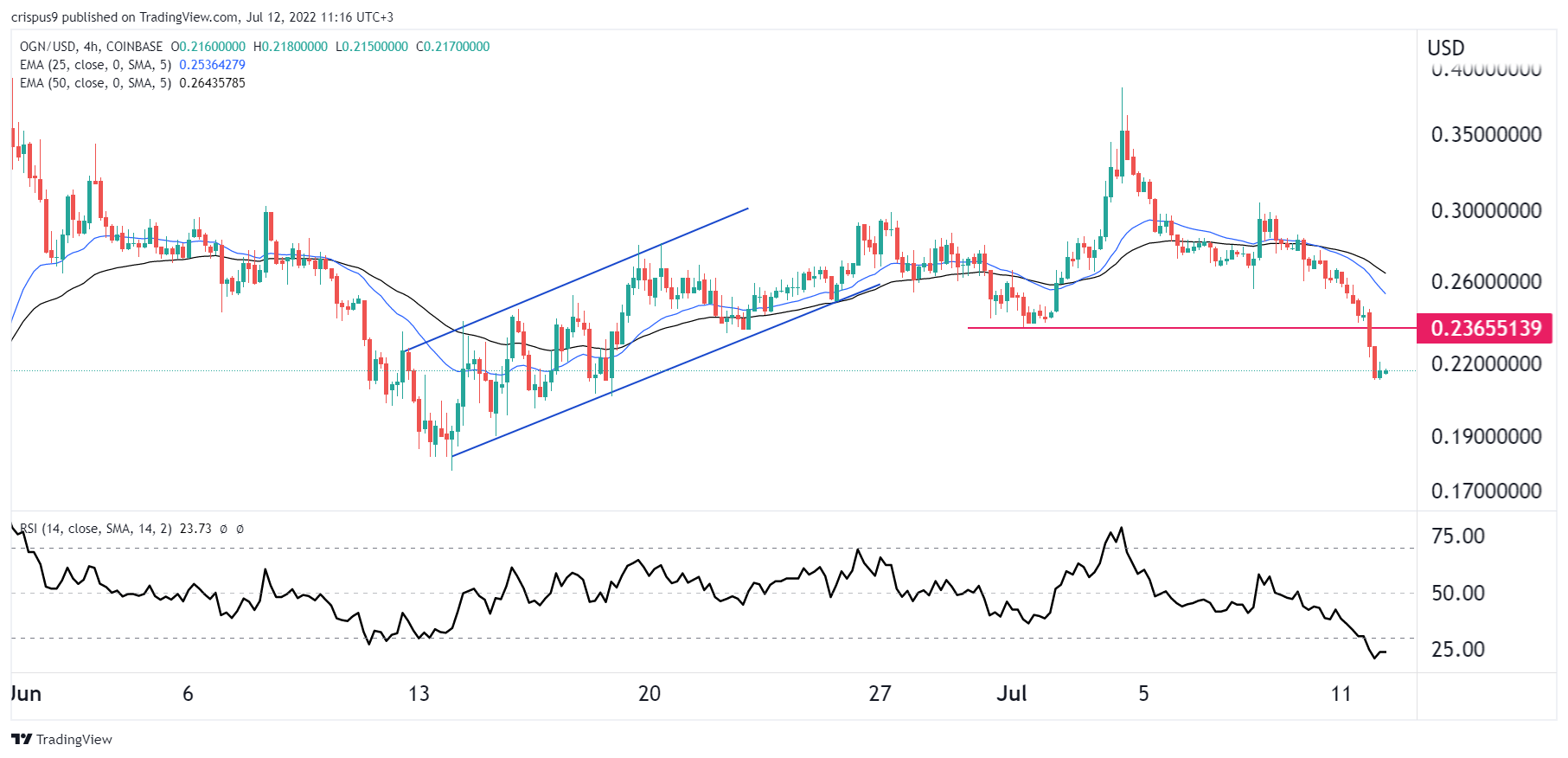
The four-hour chart shows that the OGN price has been in a strong bearish trend in the past few weeks. It has managed to move below the support at $0.2365, which was the lowest level on July 1st. It has also dropped below the 25-day and 50-day moving averages while the Relative Strength Index (RSI) has moved below the oversold level.

Therefore, the Origin Protocol price will likely continue falling as sellers target the key support at $0.1900. 

The post Origin Protocol price prediction: Is it safe to buy the OGN dip? appeared first on CoinJournal.