Avalanche (AAVE) a Polkadot (DOT) Solidify Their Stand Whilst Metacade’s (MCADE) Pre-Sale Attracts Investors’ Interest

A tale of three cryptocurrencies – two established oldies versus a powerful newcomer striving for dominance in the realm of metaverse projects. The Avalanche (AAVE) and Palkadot (DOT) tokens have both seen stability recently, although it’s also the rising stars which can interest us the most. We’ll be taking a careful look at Metacade’s utility token, $MCADE and finding out what’s on offer prior to its upcoming presale.

AAVE – A Blockchain Platform and Token to Rival Ethereum

AAVE is the token belonging to Avalanche a decentralized lending system where users take the roles of borrowers or depositors. It is the AAVE token which facilitates all transactions – acting as the underlying cryptocurrency for the platform. Currently, AAVE has a market cap of $1 billion USD and a circulating supply of 14 billion AAVE.

The AAVE token also serves the function of permitting voting rights on the Avalanche platform. It’s used by the Avalanche community to propose and vote on changes regarding the platform, and any decisions concerning the Avalanche protocol – similar to other metaverse projects. Each AAVE coin carries voting rights equal to one vote in the, and so essentially the more tokens a user holds, the more voting power they have.

Since September, we have seen prices stabilise after a volatile period in July and August. Following initial highs of around $114, prices appear to have settled around $75-76 per token – although as for whether this floor can last remains open to debate. Given current bearish sentiment, it feels somewhat unlikely that prices will rise again to their former highs but time will tell.

DOT – A Useful Linking Protocol and Token

In its simplest form, Polkadot is a protocol that allows unrelated blockchains to connect together in a secure way, allowing transfer between them. In the past, such transfers often required a number of intermediary steps (typically brokers) which increased both processing times and fees. By attempting to centralise the process, Polkadot aims to reduce the overhead of these transfers.

The Polkadot token (DOT) has several utilities, including as a governance tool – so that holders can vote on future developments. It’s also used for staking, as in helping to facilitate verifications on the network. The DOT token also has a specialist function – bonding, which is the process of connecting and disconnecting across their network. Of course, it could be argued it has a utility as an investment opportunity also.

Currently, it has a market cap of over $6 billion USD, and there is a circulating supply of over 1.1 billion DOT. Although prices are nowhere near its all-time market high, they have remained stable since the beginning of 2022. Currently Polkadot has no particular plans for expansion moving forward, relying on the ideas of its community to add to a system which has essentially already completed its roadmap.

MCADE – A Utility Token for the Metacade

Let’s take a look at Metacade and its MCADE token. From what we’ve uncovered, it has great potential to become one of the most exciting metaverse projects we’ve seen so far. A relative newcomer to the scene, Metacade has some novel features which are at first glance interesting but more importantly, offer sustainable expansion into the future.

Dubbed the ultimate Web3 metaverse gaming community – Metacade envisions an arcade-themed space where crypto fanatics, gamers and gentuziaame developers can freely mingle together. The platform is focused on their users exchanging ideas, collaborating on projects and of course, playing games. One particularly unique aspect is the plan to host a number of metaverse games on the platform. 

The chosen currency for Metacade is its MCADE token, which has a number of utility cases across the platform.

There are plans for it to be used in its Play to Earn and Pay to Play arcade suites, entry and rewards for tournaments, community-approved game development funding, and in the future, potential payment for metaverse game-related job opportunities.

Metacade also intends to use its MCADE token for staking – earning income from verifying transactions on its network, as well as to provide voting rights for its community, with plans to transition into a DAO later in development.

What makes MCADE good for the future?

Unlike Polkadot and Avalanche, MCADE is a utility token for which the use cases can be easily extended as Metacade implements features over time. Alongside the unique aspects associated with a virtual arcade, such as multiple titles and integrated game development, MCADE could also potentially be used for other transactions on the platform connected to advertising or even merchandising.

As the crypto sphere continues to push out new protocols and services based on blockchain technology, it is becoming increasingly important to consider the longevity of metaverse projects as they mature. While the tokens available on platforms like Avalanche and Polkadot are transformative, it is still worth considering whether the impact they can make is sustainable, and what affect that can have on them as viable investments. 

Strong sustainability requires deep levels of innovation, which is why projects like Metacade – offering a community-driven platform in a high-growth sector like gaming is so interesting. By closely linking the MCADE token to Metacade’s diverse features, there is a level of inherent support built into its design which is currently unavailable to DOT or AAVE. We highly recommend you take a look at MCADE to discover more about its exceptional potential.

You can participate in the Metacade presale here.

The post Avalanche (AAVE) a Polkadot (DOT) Solidify Their Stand Whilst Metacade’s (MCADE) Pre-Sale Attracts Investors’ Interest appeared first on CoinJournal.
BNB price prediction after the Musk Twitter buyout

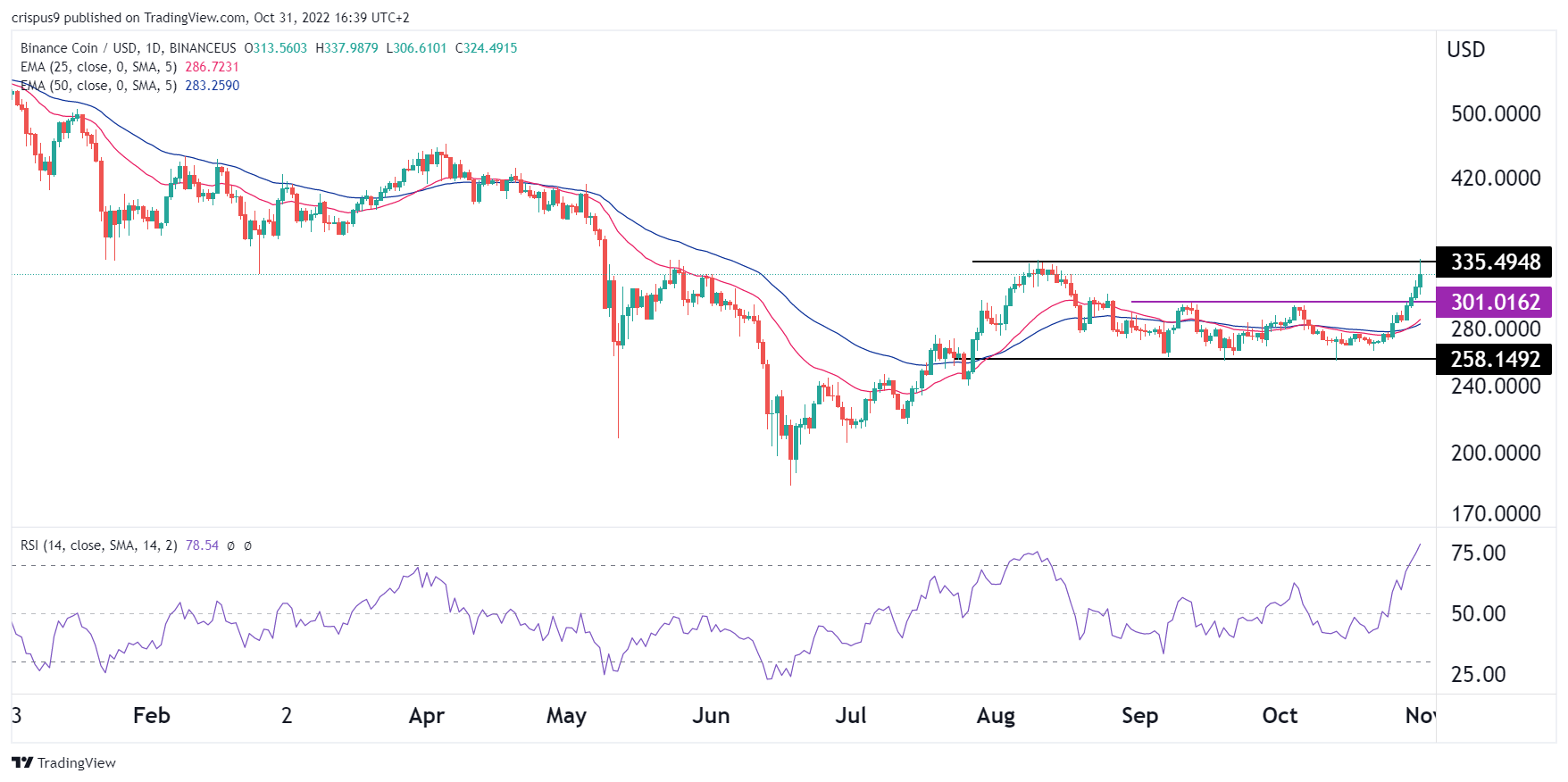
The Binance Coin price has been in a strong bullish trend in the past few days. Binance Coin rose to a high of $337, which was the highest level since May. It has rebounded by more than 80% from its lowest level this year. 

Elon Musk Twitter purchase

BNB and DOGE prices have rallied sharply in the past few days as investors focus on Elon Musk’s purchase of Twitter. Twitter is one of the biggest social media companies in the world with more than 200 million daily users.

Dogecoin price rose because Elon Musk has emerged to become one of its biggest supporters. It is estimated that he owns DOGE worth millions of dollars. 

Meanwhile, BNB price has risen because Binance was one of the companies that contributed in Musk’s Twitter purchase. It is unclear how much money Binance contributed to the acquisition. Excluding banks, Elon Musk’s friends contributed over $7.1 billion in Twitter’s buyout.

Therefore, analysts believe that Binance will play an important role in Twitter going forward. There are several ways that this can happen. First, Twitter and Binance could partner to offer more crypto-related services. Binance is the biggest crypto exchange in the world.

Second, Twitter could select the BNB Smart Chain to become its preferred blockchain provider. There is precedence to this since Instagram has selected Flow to be its NFT infrastructure provider. Further, Twitter could incorporate Binance USD as a payment option in its platform.

Still, all these are hypotheticals and it is unclear how this relationship will evolve in the long term. Historically, too much enthusiasm has led to significant disappointments in the long term. For example, FLOW price has struggled despite partnering with Instagram and Facebook.

BNB price rose as the BNB Smart Chain reclaimed second place in DeFi rankings from Tron. It has a TVL of over $8.3 billion, which is higher than Tron’s $6.1 billion.

BNB price prediction

The daily chart shows that the Binance Coin has been in a strong bullish trend recently. In this period, it has managed to move above the 25-day and 50-day moving averages while the Relative Strength Index (RSI) has moved to the overbought level.

Therefore, the coin will likely pullback in the coming days as enthusiasm about Twitter’s acquisition fades. If this happens, it will likely retest the key support at $280.

The post BNB price prediction after the Musk Twitter buyout appeared first on CoinJournal.

Tether leads as pack chases, but is DAI as dead as Terra? – The stablecoin war, a Deep Dive

Cryptocurrency can be a polarising subject. Some believe it will change the world. They say we will live in a society with Bitcoin as the reserve currency; we will purchase our chai tea lattés in Starbucks with digital tokens, and then we will post them on social media domiciled in Web3, with everything running seamlessly through decentralised pipelines.

Then there are those who say it’s a complete waste of space, a voraciously capitalist money-grab awash with Ponzi schemes and shameless promotions (Kim Kardashian, if you’re reading this, I am looking at you).

But even among those who are sceptical about crypto, the majority appreciate the power of blockchain technology and the impact that it could have on society.

One of the more intriguing elements of blockchain technology is stablecoins. Simply fiat currency domiciled on the blockchain, it allows users to circumvent the volatility of crypto while still utilising the blockchain. This means the downside of a portfolio yo-yo-ing all over the shop is avoided, yet the benefits of blockchain – accessibility, speed, cheap transactions – can be utilised.

And given so much of crypto is funnelled through USD, all the biggest stablecoins are dollar iterations. In a year where the greenback has crushed every major currency, while nations around the world fight against rampant inflation, this gives citizens the opportunity to park their wealth in USD rather than hold their own (often unstable) currency.

So, which stablecoin is the most popular? And how are they growing? I took a dive into what is the most boring crypto in the world – in terms of price volatility – yet for a variety of other reasons, is incredibly exciting.

This is the stablecoin report.

Timeline – growth of stables

I look back now at the start of 2020 as the “new paradigm” of crypto. COVID broke onto the scene in the first quarter, and following a meltdown in March as the world sat down to try and figure out what exactly this coronavirus meant, crypto surged.

It took its place on the centre stage and prices, volume and liquidity rocketed upwards. Then this year, in 2022, we transitioned to a new age of high interest rates, as the money printing bonanza of recent years caught up with us and inflation flexed its muscles.

This sent tokens crashing. Bitcoin fell from $69,000 to below $20,000, and funds flowed out of stablecoins. Some stables have fared better than others, however. Hit “play Timeline” on the below graph to get a picture of the movements over the last two years.

Indeed. A run from $20 billion to $160 billion in two years – that’s an 8X, people.

Of course, there is the elephant in the room when looking at that above graph. And that elephant has a name – Terra.

 Decentralised vs Centralised

Perhaps blinded by the allure of a decentralised stablecoin, many crypto enthusiasts bought into TerraUSD (UST). Working off some seriously broken circular logic, the stablecoin was backed by Luna, which itself was backed by nothing. A fancy way to say it was uncollaterised, and the whole house of cards came tumbling down, dragging a lot of the crypto ecosystem with it.

I was involved in this, too, to be fair. I knew the model was flawed but I thought it would last longer than it did. I have written about my involvement in the circus plenty, with this piece detailing me finally cutting my losses and selling my UST, swallowing a nasty loss and a rather unpleasant blow to my already-bruised ego.

But anyhow. Terra is past tense. The other remaining decentralised stable is DAI, sitting at a market cap of $6 billion. The only issue here is that, to me, DAI is just as broken as Terra. Sure, the implications won’t be as severe and this won’t be an insane death spiral, but if you ask me, DAI has the same probability as Terra of ever becoming a reputable and impactful stablecoin – zero.

That’s because the model makes no economic sense. Overcollateralisation means in order to receive $100 DAI, one must pledge $150 in collateral. That is grossly inefficient and is all you need to know. Then there is also the fact that it’s not even decentralised, with so much exposure to USDC and other centralised assets.

In order to pursue this seductive quality of decentralisation, DAI compromised by sacrificing capital efficiency. In a world of rising interest rates, this will never work. And ya…it’s not even decentralised.

A decentralised stable would be fantastic, but there is no way to make it happen right now. Hopefully one day it could happen, but I’m not smart enough to think of how. As for DAI, I can’t ever see it becoming relevant. It will either die (pun intended, I promise) a slow death, or take some drastic governance action as it flails for relevance (appartently it is considering not being a stablecoin any longer and instead “removing” the peg, whatever that means).

Centralised stables – Circle taking Tether’s throne?

So this takes us to centralised stables. Not as romantic, but at least the things work, right?

Tether (USDT) is the OG and central to everything in the space, and is the single biggest liquidity pair. Yet it continues to face questions regarding its reserves, and in the aftermath of the Terra contagion its peg wavered down to 95 cents.

It should be said that Tether never failed to redeem, and sold out massive chunks of their holdings without a hitch – a larger portion of their reserves than most fractional reserve banks would be able to handle. But still, people holding stables want to be able to buy and sell at that $1 mark – no matter where and when they want to.

Circle (USDC) is thus becoming a bigger competitor, but remains adrift in second place. I modelled up the below chart to show how Tether has been eroded downward, with the rise of alternatives. A lot of this is due to the continued narrative that sufficient reserves are not held.

2022 contagion

The year has been a   rough one for crypto markets, obviously. Stables are a pretty good way to show this, as capital packed its bags and flowed out of the system.

I plotted up how different stables have fared from January until now. It’s a good way to show how Circle has made inroads into Tether’s lead. With Tether shedding $10 billion since the start of the year, Circle has actually increased $2 billion.

Binance USD and FTX?

BinanceUSD (BUSD) is another which has made ground. Up to $22 billion, it is the seventh biggest cryptocurrency and third biggest stablecoin.

It is being pushed hard by Binance, the world’s biggest cryptocurrency exchange. Recently, the exchange delisted USDC and auto-converted all holdings into BUSD, which has helped pump the market cap up a bit.

FTX honcho Sam Bankman-Fried referred to it as the “Second Great Stablecoin War”. FTX itself is even planning to launch a stablecoin of its own.

FTX is the second biggest crypto exchange, and it brings up some interesting questions regarding the benefit of having so many stablecoins in the market. In reality, I am not sure it matters as long as they are all managed responsibly with solid reserves and transparent reporting – something which certain stables are certainly better than others at.

Conclusion and future

To wrap this up, it has been an immense couple of years for crypto and, by extension, stablecoins. The latter helps onboard people into crypto. Jumping on-chain but avoiding volatility, stables have a real use case in an industry where that is not always guaranteed.

I put this together now because the stablecoin market has transformed over the last couple of years, yet it now feels like we are embarking upon a new phase. Binance, FTX and Circle are coming for Tether. Corners insist we need a decentralised stable, but until a plan is drawn up which makes that even theoretically possible, it’s just fantasy talk.

Sure, I’d love a decentralised stable. I’d also love to wake up with the voice of Beyoncé tomorrow morning. Both those things are equally unlikely right now, so for the time being we need to chat centralised stables.

It will be interesting to re-assess these ranks this time next year, when God knows what will have happened in the crypto markets. Until then, Tether rules the roost – but the pack are chasing hard.

The post Tether leads as pack chases, but is DAI as dead as Terra? – The stablecoin war, a Deep Dive appeared first on CoinJournal.

Bitcoin price prediction after Goldman Sach’s warming

Bitcoin price remained in a tight range on Monday even as American stocks pulled back. The BTC coin was trading at $20,700, which was slightly below last week’s high of near 21,090. It has risen by more than 14% from the lowest level in October.

Goldman Sachs warns on rates

Bitcoin and stocks had a strong performance in October. This price action was mostly because of the rising hope that the Federal Reserve will start pivoting away from tightening in the coming months. 

Analysts who believe that the Fed should pivot point to the rising fears of a hard landing in the US. As such, they expect that the bank will pause and assess the implications of its recent hikes.

However, recent data suggest that the bank has more room to hike. Data published in October showed that the headline and core consumer price index (CPI) rose to 8.3% in September. That increase was higher than what most analysts were expecting.

Bitcoin price consolidated after analysts at Goldman Sachs upgraded the outlook of Fed rate hikes. In a report, they said that the bank will hike interest rates to 5%, higher than the previous estimate. 

To achieve that, analysts at the bank said that they expect the bank will hike by 0.75% this week followed by 50 basis points in December. These hikes will be followed by smaller 25 basis point hikes in February and March. 

The analysts cited three reasons for a more hawkish Fed: high inflation, the need to cool the economy, and to avoid easing financial conditions prematurely.

Therefore, if Goldman Sach’s analysts are correct, Bitcoin, cryptocurrencies, and stocks could struggle in the coming months. For example, Ray Dalio recently warned that 4.5% rate hikes would sink stocks by 20%.

Bitcoin price prediction

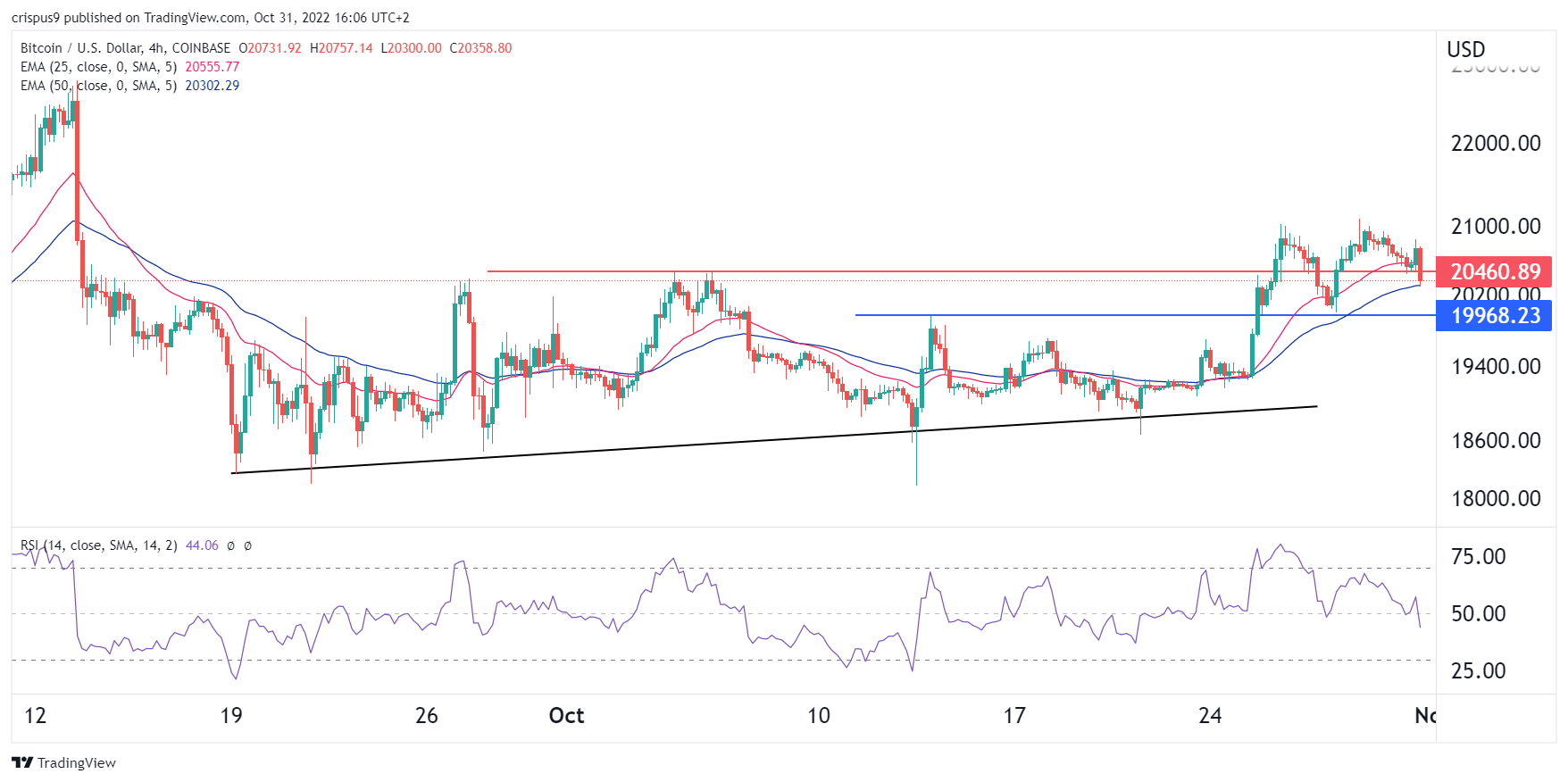
So, is it safe to buy Bitcoin? The daily chart shows that the BTC price has been in a consolidation phase in the past few days after it staged a strong comeback. It remains slightly above the important psychological level of $20,000 and slightly above the 25-day and 50-day moving averages. 

The Relative Strength Index (RSI) has formed a bearish divergence pattern. Therefore, there is a likelihood that the coin will have a bearish breakout as sellers target the key support level at $19,500. A move above the resistance at $21,000 will invalidate the bearish view.

The post Bitcoin price prediction after Goldman Sach’s warming appeared first on CoinJournal.

CHZ rallies by 12% today after ChilizX added Fan Token Logos

CHZ is the best performer amongst the top 100 cryptocurrencies by market cap after adding more than 12% to its value today.

The cryptocurrency market is starting the week in a negative fashion. The total crypto market cap stands at $1 trillion, down by more than 1% in the last 24 hours.

CHZ, the native token of the Chiliz ecosystem, is up by more than 12% in the last 24 hours, making it the best performer amongst the top 100 cryptocurrencies by market cap.

CHZ’s rally comes after ChilizX, the recently revamped Chiliz exchange, announced that it had added Fan Token Logos to the Chiliz𝐗 web. This means that users can now find all available Fan Tokens faster and enjoy the improved user interface.

Bitcoin, the world’s leading cryptocurrency by market cap, continues to trade above $20k per coin despite losing more than 1% of its value today.

Ether has also maintained its price above the $1,500 psychological level and has lost more than 2% of its value in the last 24 hours.

Key levels to watch

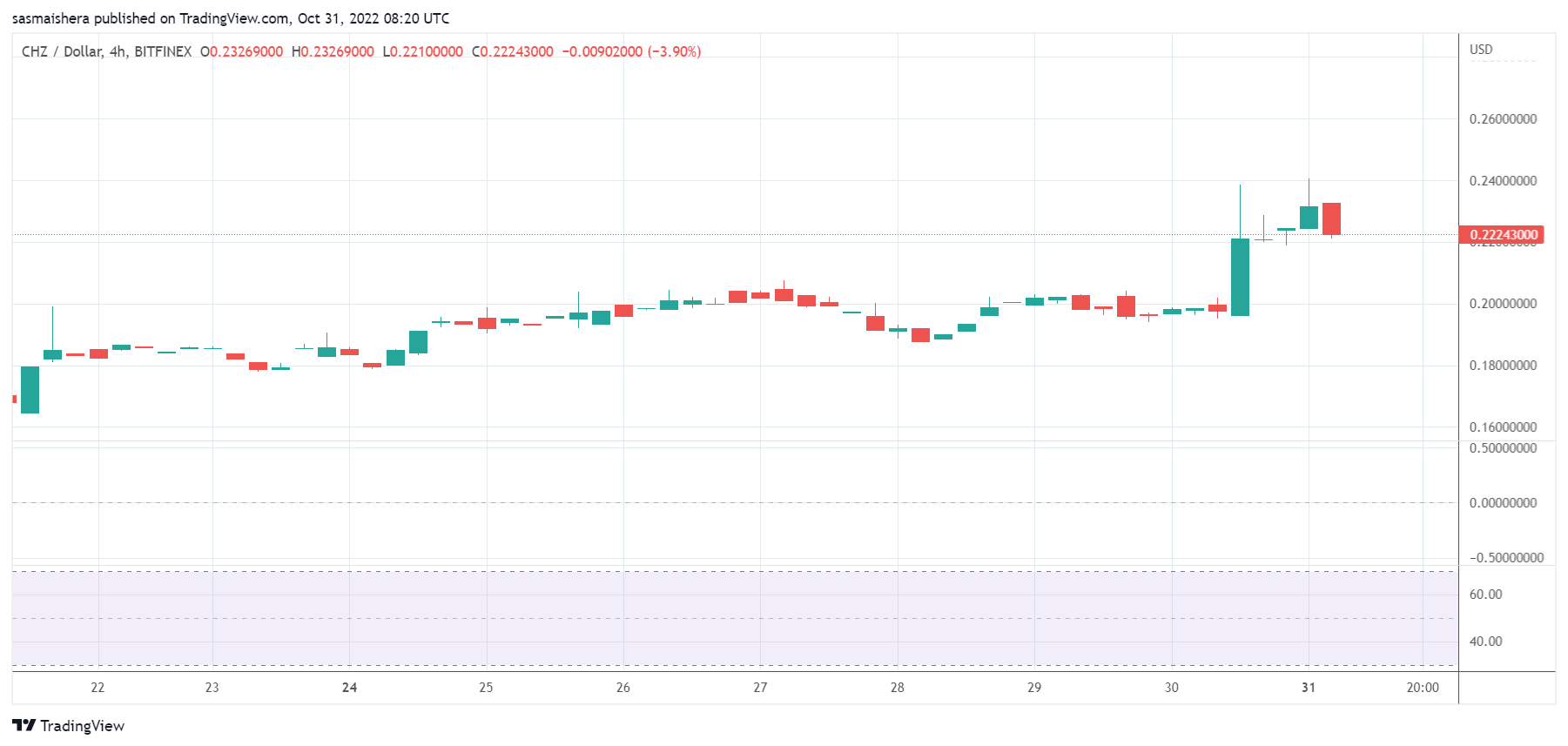
The CHZ/USD 4-hour chart is bullish, as Chiliz has been performing well over the last 24 hours. The technical indicators show that Chiliz is outperforming the broader cryptocurrency market.

CHZ/USD Chart By TradingView

The MACD line is above the neutral zone, indicating that Chiliz is currently in a bullish mode. CHZ has added more than 24% to its value over the last seven days.

The 14-day relative strength index of 68 shows that CHZ could be heading to the overbought region if it can sustain its current momentum. 

At press time, CHZ is trading at $0.22243 per coin. If the bullish trend continues, CHZ could surge past the first major resistance level at $0.2448 before the end of the day.

With the support of the broader cryptocurrency market, CHZ could move past the second major resistance level at $0.2659 for the first time since September. 

Where to buy Chiliz now

eToro

eToro is a global social investment brokerage company which offers over 75 cryptocurrencies to invest in. It offers crypto trading commission-free and users on the platform have the option to manually invest or socially invest. eToro even has a unique CopyTrader system which allows users to automatically copy the trades of popular investors.

Buy CHZ with eToro today

Capital.com

Capital.com is a global broker which offers over 200 cryptocurrencies for its users. It comes with a range of features such as; great security, 24/7 support, demo accounts and a wide variety of assets. On top of that, it also has no inactivity, withdrawal or deposit fees, which makes it stand out from other crypto brands.

Buy CHZ with Capital.com today

The post CHZ rallies by 12% today after ChilizX added Fan Token Logos appeared first on CoinJournal.