Genesis files for bankruptcy, what does it mean for crypto?


Key Takeaways

  • Genesis has over $3 billion in debt and 100,000 creditors
  • Gemini, the exchange founded by the Winklevoss twins, has threatened legal action over an unpaid $900 million loan
  • The SEC has also filed a suit against Genesis for unregistered securities trading
  • Genesis’ parent company is DCG, the same company which runs the Grayscale Bitcoin Trust, the world’s biggest Bitcoin fund
  • Contagion continues to ripple through the industry, with investors hoping that the washout is nearly complete
  • DCG has stakes in over 200 crypto companies, including Circle, Kraken and the media company CoinDesk, which is now seeking a sale


In the move that precisely everybody saw coming, the lending arm of crypto platform Genesis has finally filed for bankruptcy.

It’s another victim on the list for Sam Bankman-Fried, as Genesis becomes the latest firm to succumb to the contagion triggered by the FTX collapse. But crypto investors are now concerned about the subsequent damage that could ripple out from this filing, as Genesis’ parent company is Digital Currency Group (DCG) – the same company which owns the Grayscale Bitcoin Trust, the biggest Bitcoin fund in the world.

Let’s analyse what it all means.

Enormous bankruptcy filing

Looking at bankruptcy documents, Genesis listed over 100,000 creditors. It reportedly has debt greater than $3 billion.

The filing had long been mooted. It suspended withdrawals on November 16th, in the aftermath of the stunning FTX collapse. However, it affirmed that it had “no plans” to file for bankruptcy and would seek to resolve the situation “consensually”.

It then scrambled to raise funds to stave off the inevitable. It reportedly sought investment from Binance, which declined due to a conflict of interests. It also approached several private equity firms but has ultimately filed for Chapter 11 bankruptcy protection.

What happens Gemini?

The filing comes in the same week that the SEC filed a suit against Genesis and its former partner, Gemini, over unregistered dealings with securities.

Gemini is a crypto exchange founded by the Winklevoss twins and offered a similar “Earn” product to a lot of these crypto lenders. The problem was, it was in partnership with Genesis. Under the terms of Earn, customers sent crypto to Gemini in the hopes of earning a yield. Gemini, in order to capture yield to pay to these customers, transferred the deposits to Genesis, who invested those deposits.

The Winklevoss twins say that Gemini owes it $900 million through the Earn product. Withdrawals from the Gemini Earn product are currently suspended.  

Cameron Winklevoss responded to news of the Genesis bankruptcy filing on Twitter, threatening legal action unless “a fair offer to creditors” was made by DCG and CEO Barry Silbert. He has accused Silbert of “fraud” and demanded he step down as CEO.

DCG in the thick of it

For the wider market, it is the involvement of DCG that is the real concern.

The digital assets company has a stake in over 200 crypto companies, including the crypto exchange Kraken and stablecoin issuer Circle. Most high-profile is the fact is the parent of the Grayscale Bitcoin Trust, which is the largest Bitcoin fund in the world. It has come under increasing scrutiny over the safety of its reserves following the FTX collapse and the turmoil facing DCG.

The fund has been trading at a steep discount to its net asset value, with the divergence spiking to 50% post-FTX. I wrote an analysis of the trend two weeks ago after it bounced back, at that point trading at a 37% discount.  The discount is currently 40%.

DCG also own CoinDesk, the crypto news publication. It is currently exploring a potential sale. Ironically, it was the news site that initially published the scoop on FTX, which triggered the hardship for DCG.

“Over the last few months, we have received numerous inbound indications of interest in CoinDesk”, CEO Kevin Worth said this week.

As for Silbert, the embattled CEO wrote on Twitter last week that “it has been challenging to have my integrity and good intentions questioned after spending a decade pouring everything into this company (DCG and the space with an unrelenting focus on doing things the right way”.

DCG responded to the chaos by cutting its dividend, telling shareholders it is focusing on strnegthening its own balance sheet. 

“In response to the current market environment, DCG has been focused on strengthening our balance sheet by reducing operating expenses and preserving liquidity. As such, we have made the decision to suspend DCG’s quarterly dividend distribution until further notice,” DCG announced on Tuesday. 

What does this mean for crypto?

As for the market at large, this is a continuation of the disaster that was the FTX collapse. Contagion was always inevitable, given an $8 billion hole on FTX’s balance sheet. In truth, it is somewhat surprising how well the crypto industry has held up through this.

Bitcoin is up 25% on the year, ETH is up 27%, with both trading at around the same level they were prior to the insolvency. The macro climate is looking a little more optimistic than a couple of months ago, as softer inflation readings have led investors to bet that central banks will pivot off their high interest policy sooner than previously anticipated.

Going back to the thick of the crisis, Bitcoin wobbled but held firm above $15,000.

Perhaps the biggest fallout here is the continued hammering of crypto’s reputation.  The pullback of institutional adoption will likely be severe, the mending process ahead long.

The world economy is teetering on the brink of a recession, as the burden of high interest rates continues to suck liquidity out of markets. In addition to this, inflation remains elevated with a cost-of-living crisis worldwide, despite the picture looking more positive over the last couple of months. Then there is the small matter of a war in Europe.

These are massive challenges for markets and suppressing prices across the board. Uncertainty is as high as it has been since the Great Financial Crash of 2008. And yet, in addition to these huge headwinds, crypto keeps hurting itself, adding to the mess.

Investors will hope that the washout from the scandals of 2022 will throw up no more surprises. With how dire the macro situation is, it doesn’t need any more self-inflicted wounds.

The post Genesis files for bankruptcy, what does it mean for crypto? appeared first on CoinJournal.
Ethereum price retreats as the put/call ratio edges upwards

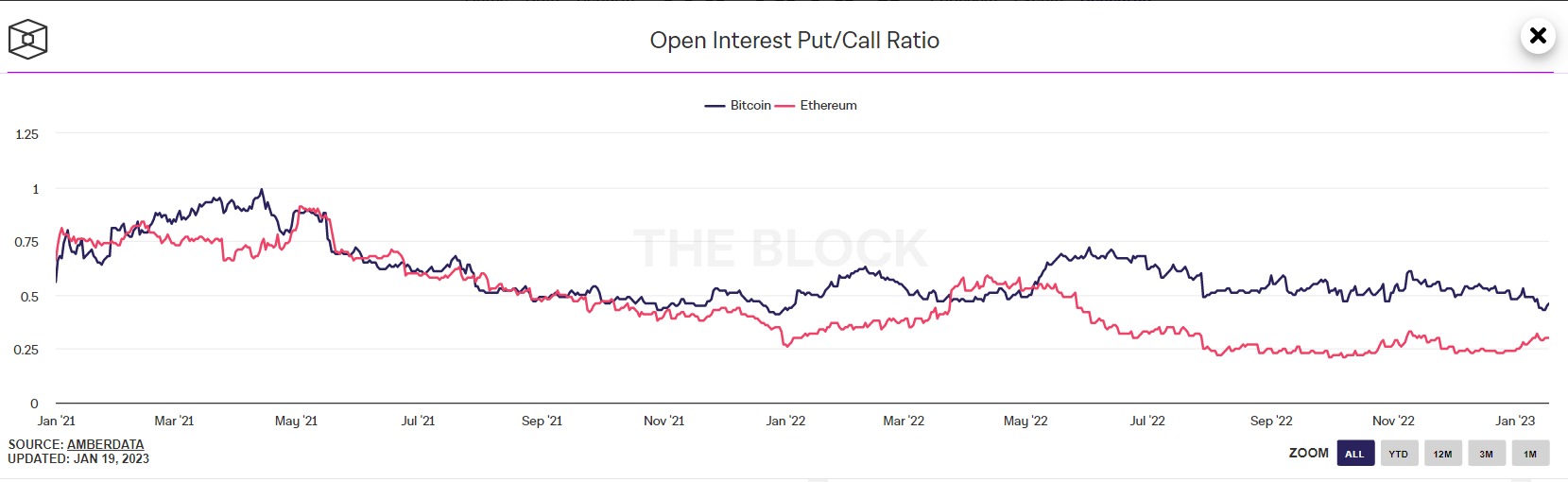
  • Ethereum put and call ratio on Deribit has risen this week.

  • ETH bullish liquidations have also jumped in the past 2 days.

The spectacular crypto comeback has stalled following a series of weak corporate earnings from the United Stats. Ethereum pulled back to $1,500 on Thursday as data showed that the put/call ratio was heading higher. It has fallen by over 5.90% from the highest point this year.

Put and call ratio slips

The options market is an important one across all asset classes, including cryptocurrencies, stocks, and commodities. It involves placing put-and-call trades on an asset. A call gives the trader the right to buy an asset while a put gives them the right to sell.

The put to call ratio is an essential tool that traders and investors use to predict whether an asset will rise or not. That is why it is an important part of the fear and greed index. 

Data compiled by The Block shows that Ethereum’s put/call ratio has edged upward slightly in the past few days. It has risen from 0.24 on January 4 to a high of 0.3. Historically, a lower ratio is usually preferred since it means that there are more buyers in the options market. Still, it should be noted that The Block’s data comes only from Deribit and does not include other exchanges.

Meanwhile, another data by CoinGlass shows that the number of short liquidations in key exchanges rose to the highest point in months on January 15. Liquidations have continued but at a slower pace since then. However, at the same time, long liquidations have been rising. On Wednesday, they rose to the highest level since December 16 of last year.

The main reasons for these liquidations is the weak financial results by companies like Goldman Sachs and JP Morgan. Some of these firms have warned about a recession and announced significant job cuts. Microsoft is laying off over 10,000 people. 

Ethereum price forecast

ETH/USD chart by TradingView

Ethereum has stumbled as put and call ratio and long liquidations rise. This stumbling happened as the coin reached a high of $1,612, the highest point since November. It has moved slightly below the descending trendline shown in purple. 

At the same time, it has struggled moving above the key point at $1,667, the highest point on November 4. Therefore, I still believe that the outlook for Ethereum is still bullish, with the next key point to watch being at $2,000 as I wrote in this article.

How to buy Ethereum

eToro

eToro is a global social investment brokerage company which offers over 75 cryptocurrencies to invest in. It offers crypto trading commission-free and users on the platform have the option to manually invest or socially invest. eToro even has a unique CopyTrader system which allows users to automatically copy the trades of popular investors.

Buy ETH with eToro today

OKX

OKX is a top cryptocurrency exchange which offers over 140 cryptocurrencies to invest in. OKX takes customer security very seriously, they store almost all of their clients‘ funds in cold storage, and the exchange is yet to be hacked. On top of this, the exchange offers very low fees and customers can even use their crypto as collateral for loans on the platform.

Buy ETH with OKX today

The post Ethereum price retreats as the put/call ratio edges upwards appeared first on CoinJournal.

Enjin Coin price pumps as ENJ short liqudations soars

  • Enjin Coin has made a strong comeback in 2023.

  • This rally happened as short liquidations jumped.

  • Metaverse tokens like Decentraland and Sandbox have also surged.

Enjin Coin (ENJ) has been in an unstoppable bull run in 2023. It has jumped in all but two days this year, making it one of the top-performing coins. According to CoinDesk, ENJ was trading at $0.47, which was the highest it has been since November 10 of this year. Here are several reasons why Enjin is soaring.

Short liquidations rise

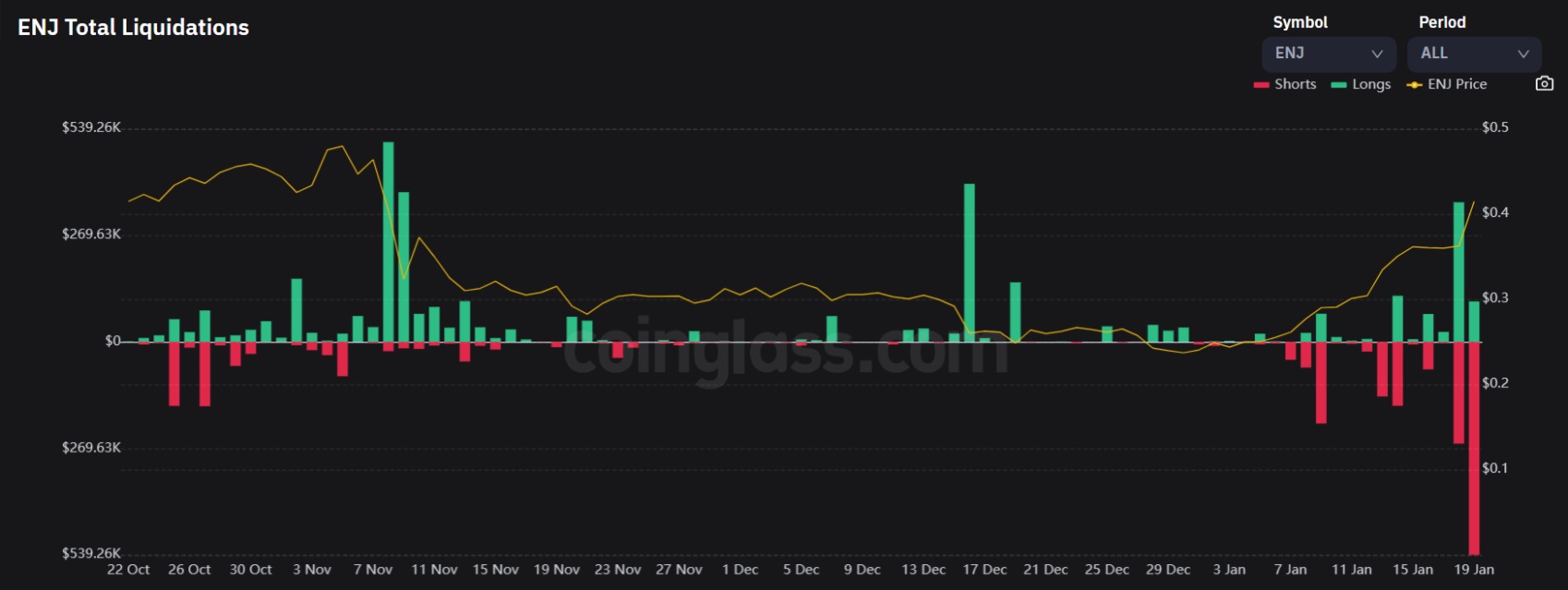
The first main reason why Enjin is soaring is that short liquidations have jumped to the highest level in months. Data provided by CoinGlass shows that over $539k worth of short sales were liquidated on Thursday. This was an increase from the $257k short sales that were liquidated on Wednesday. 

As shown below, these liquidations have been moving in an upward trajectory starting from the first week of the year. This trend is mostly because of the ongoing macro issues as inflation started to drop. Data published in the past two weeks has shown that inflation remains under pressure. On Thursday, numbers revealed that the producer price index (PPI) dropped in December. 

Metaverse tokens soar

The other main reason why Enjin coin price has risen is simply because of the performance of NFT and metaverse tokens. As we wrote here, we have seen most well-known metaverse tokens like Decentraland’s MANA and Sandbox’s SAND rise to their highest levels in months. Historically, cryptocurrencies in similar industries tend to move in sync with each other.

Meanwhile, data compiled by CryptoSlam shows that the volume of NFT sales has started to creep back up in the past few weeks. This is notable since Enjin exists in the NFT industry. Its Efinity product makes it possible for people to mint and sell NFTs using Polkadot’s technology. 

What next for Enjin Coin

ENJ/USD chart by TradingView

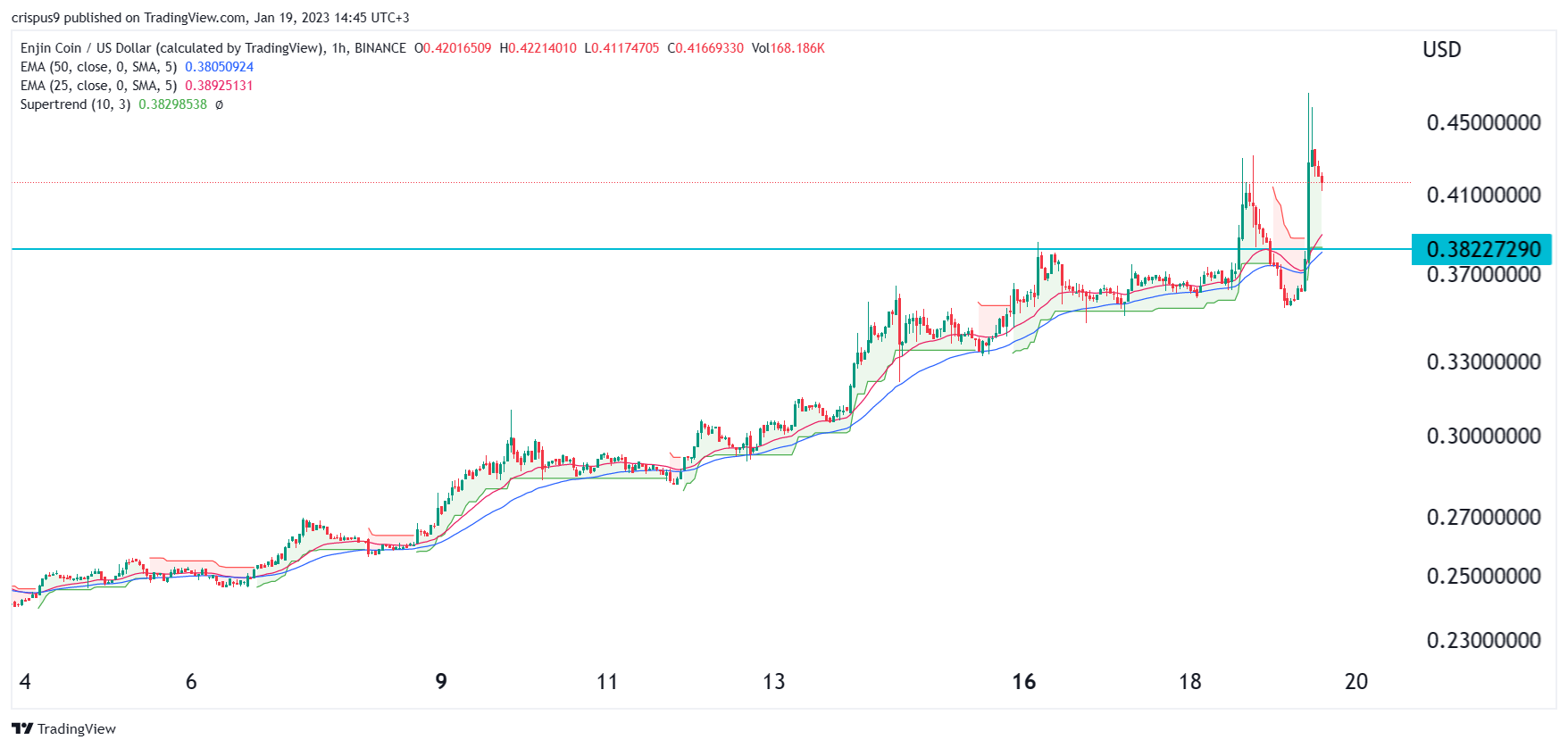
Enjin Coin was one of the worst-performing crypto coins in 2022 as it transitioned into a fallen angel. It finally woke up in 2023, pushing it to the highest point since November. The coin has surged above all key resistance levels and moved above the 25-day moving average. Further, the closely-watched supertrend indicator is still bullish.

However, as shown in the chart above, some longs have started to liquidate their positions as well. This is a sign that the coin could start pulling back in the next few days. If this happens, the next point to focus on will be at $0.3822.

How to buy Enjin Coin

eToro

eToro is a global social investment brokerage company which offers over 75 cryptocurrencies to invest in. It offers crypto trading commission-free and users on the platform have the option to manually invest or socially invest. eToro even has a unique CopyTrader system which allows users to automatically copy the trades of popular investors.

Buy ENJ with eToro today

Bitstamp

Bitstamp is a leading cryptocurrency exchange which offers trading in fiat currencies or popular cryptocurrencies. Bitstamp is a fully regulated company which offers users an intuitive interface, a high degree of security for your digital assets, excellent customer support and multiple withdrawal methods.

Buy ENJ with Bitstamp today

The post Enjin Coin price pumps as ENJ short liqudations soars appeared first on CoinJournal.

Is it safe to buy ENJ coin after gaining 16% today?

Enjin was launched in 2009 in Singapore and quickly became the largest gaming community creation platform. Its popularity led to the birth of ENJ, a cryptocurrency and smart contract meant to create trust and security in the community with minimal transaction fees. 

Enjin lets users create NFTs without coding. Moreover, users can get paid when other users trade digital assets via the Enjin marketplace. 

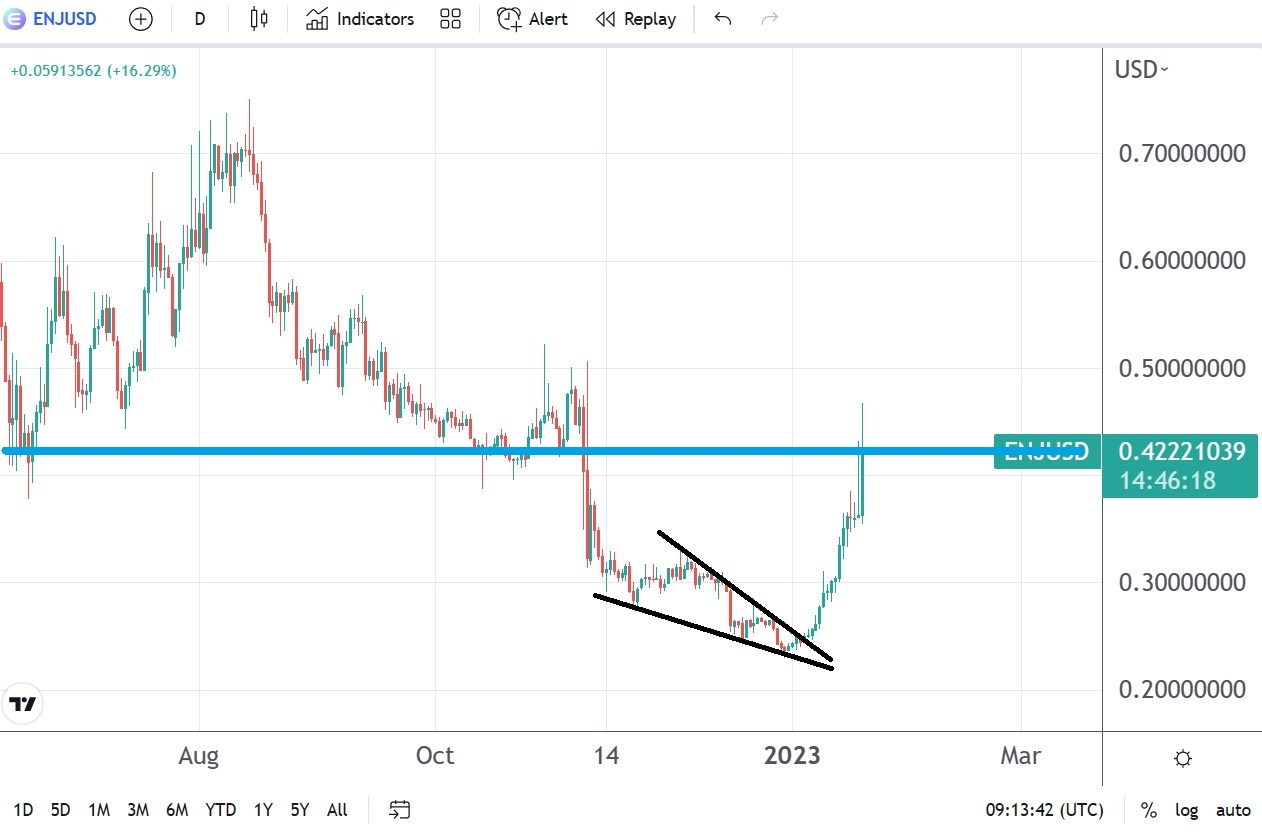
ENJ has a market capitalization of over $450 million and a circulating supply of 1 billion. The start of 2023 saw the ENJ coin gaining close to 100% against the US dollar, with about 16% today only. 

So is it safe to buy ENJ here? 

ENJUSD chart by TradingView

Did the crypto winter end in 2022?

The cryptocurrency market suffered from a string of bad news in 2022. First, it was Bitcoin that led the way lower, as the leading cryptocurrency plunged from over $60k to below $20k. 

Bitcoin lovers have argued for quick cryptocurrency adoption by institutional investors for many years. Finally, the adoption came, but with it, Bitcoin became correlated with the regular markets. 

In other words, Bitcoin was hit hard in 2022 by a strong US dollar. Also, it mainly moved on fundamental news affecting the overall market, such as the US inflation or changes in the Federal Reserve policy. 

As such, speculators in the crypto industry quickly turned their attention to other coins. But Bitcoin’s importance does matter for the overall industry. 

Therefore, when Bitcoin jumped over $21k at the start of 2022, it triggered a similar move on most of the crypto market. 

ENJ is one that followed suit. It gained almost 100% in 2023 after forming a falling wedge pattern at the end of last year. 

So is it fair to assume that the crypto winter of 2022 is over? 

At this point, ENJ tests resistance at an area that provided support in the past. If Bitcoin’s rally is not over, then one should not be surprised to see ENJ pushing above resistance.  

The post Is it safe to buy ENJ coin after gaining 16% today? appeared first on CoinJournal.

Coinbase terminates Japan operations, why is share price still up 50% in two weeks?

Key Takeaways

  • Coinbase is halting all operations in Japan, citing “market conditions”
  • Last week it cut 20% of its workforce, having already cut 18% last June
  • Stock price is up nearly 50% on the year amid crypto rally, but is still 85% off its peak
  • Problems are aplenty at the company, while CEO Armstrong sold 2% of his stake in October


Coinbase has been in a world of pain recently.

Just last week, the exchange announced it was laying off 20% of its workforce, having already cut 18% last June. I wrote a piece analysing what this meant for the company, which was trading at a market cap below $10 billion, 90% down from the price at which it went public in April 2021.

This came after CEO Brian Armstrong unloaded 2% of his stake in the company in October, after which I wrote a deep dive analysing what it all meant for a company that has been viewed as the torch-bearer to carry crypto into mainstream circles once and for all following its high-profile floating on the Nasdaq.

But today, more bad news came. The exchange announced it is halting all operations in Japan, citing “market conditions”.

Coinbase stock price on the up

Despite the onslaught of bad news, Coinbase’s share price has been a big winner in the early weeks of 2023, up 48% in just 18 days.

This comes amid the biggest crypto rally in 9 months, which has seen prices surge across the board. While the bounceback in Coinbase’s share price is great news for investors, it also ironically sums up exactly what the problem is – Coinbase’s correlation to the crypto market.

There are few things more volatile than crypto, so it is not good news to be tied at the hip to its price action. But Coinbase’s performance is dependent on the crypto market because as the price falls, transaction volumes and interest in the industry, and by extension Coinbase, plummets.

During the pandemic, this was a great thing. The money printer was on maximum power, interest rates were low and retail investors were all aboard the FOMO train, armed with a healthy curiosity about crypto and a fat stimulus cheque.

But with the changing macro environment, the crypto industry has freefallen from $3 trillion to $800 billion, before this recent surge popped it back above $1 trillion.

Why are Japanese operations ceasing?

Despite the pleasant pump this past few weeks, zooming out tells you that Coinbase has shed 85% of its value since going public, gone through two rounds of layoffs, seen its CEO sell 2% of his stock in October and now is ceasing operations in Japan.

All Japanese Coinbase customers will have until February 16th to withdraw their holdings from the platform. If they fail to do so, the remaining assets will be converted to Japanese yen. Coinbase had worked hard during the previous crypto winter to expand into the Japanese market, so the abrupt departure is a shame.

But Coinbase is not the only exchange to make this move, with rival Kraken also announcing it was ceasing Japanese operations last month. Also like Coinbase, Kraken had cut a large chunk of its workforce, laying off 30% of employees after the FTX collapse shook the market. The plight of Coinbase’s extreme correlation with the crypto market is once facing exchanges across the industry.

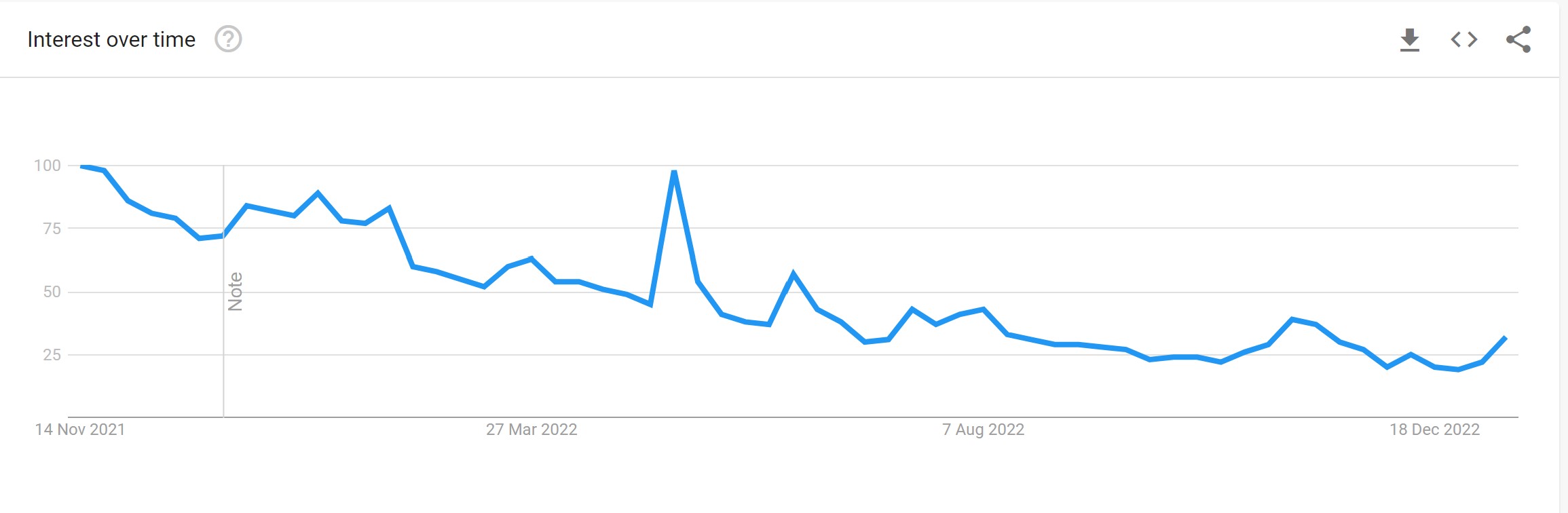
Coinbase Q3 results revealed that transaction volume fell 44% from Q2. The fall in volume and interest ultimately is what has caused the plummeting share price, layoffs, and now ceasing of Japanese operations, with a glance at Google Trends all you need to see the scale of the dropoff in the public’s attention to the exchange.

For $COIN investors, they will hope that the last few weeks of softer macro data and a crypto bounceback are an omen of things to come, otherwise this share price rally will be short-lived.

The post Coinbase terminates Japan operations, why is share price still up 50% in two weeks? appeared first on CoinJournal.