
Bitcoin slides off Fed meeting before bouncing back, but what next?


Key Takeaways

  • Federal Reserve hikes 25 bps, Bitcoin drops over 6%
  • Bounceback in prices follow, however, as market bets on rate cuts down the line
  • Bitcoin originally fell to $26,700 and is now back at $27,700
  • Tight monetary policy appears to be coming to a close, which is exactly what Bitcoin investors want to hear
  • The flipside is that Bitcoin’s reputation may have been tarnished by the chaos in the industry over the last year
  • Whether institutional money and Wall Street capital will trust crypto again remains to be seen

As has been the case over the last year now, Bitcoin continues to oscillate wildly based off interest rate expectations. 

The orange coin took a tumble Wednesday off the back of the latest FOMC meeting, as interest rates were hiked 25 bps despite some analysts calling for a pause following the banking turmoil of recent weeks. 

Why did Bitcoin fall?

Such has been the chaos in the banking markets, markets ahead of the meeting had priced in a genuine chance that rate hikes would be no more. 

Silicon Valley Bank (SVB) triggered the crisis, which last week spread to Europe before the spectacular demise of Credit Suisse, the Swiss institution founded in 1856. 

With deposits fleeing banks and markets reverberating, things were breaking – as they tend to do when rates are hiked hastily. And this past cycle has been the most rapid form of tightening in recent memory. 

Bitcoin fell from $28,500 to $26,700 as the Fed announced a 25 bps hike, a fall of 6.3%. 

However, Bitcoin has since bounced back somewhat, trading at $27,600. This came as the market began digesting the discourse from Fed chair Jerome Powell around the future path of interest rates. 

While the hike did come yesterday, it feels increasingly certain that tight monetary policy is coming to a close. It is worth remembering that before SVB’s demise, this hike was virtually guaranteed to be 50 bps. 

And looking out to rates by the end of July, the market is forecasting cuts rather than hikes. So while the 25 bps hike may have been hawkish, the language afterwards and conclusion coming out of the meeting was very much the opposite. 

Will Bitcoin go up?

The question on everybody’s lips within crypto is then what does this mean for Bitcoin’s price? As always, it’s a difficult question to answer, but the future undoubtedly looks brighter for the coin today than it did a few months ago, that is for certain. 

Not only is further removed from the scandal of FTX and the wave of bankruptcies that followed the sordid collapse of the former tier-1 exchange, but the end appears nigh with regard to the tight monetary policy. 

Bitcoin was launched in 2009 and hence had never experienced anything other than a raging bull market in the wider economy. The S&P 500 increased seven-fold from the nadir of the GFC to its peak – and Bitcoin, alongside tech stocks, rode the wave of low interest rates, warm money printer and an all-around perfect climate. 

As inflation roared last year, however, this flipped entirely. With interest rates hiked aggressively, there was no way for Bitcoin to sustain its previous levels of buoyancy. Down it came, and down it came hard. 

Finally, it appears that the harsh monetary policy which has dragged it through the gutter is nearing an end. And while this doesn’t guarantee anything, it certainly removes the shackles so that there is at least a possibility that it raises. 

Has Bitcoin’s image been tarnished?

The flip side of the argument is that the scale of the damage over the last year has been so substantial that Bitcoin’s long-term trajectory has been dampened, and it won’t be able to get on the same track. 

Crypto winters have come and gone in the past, but this recent one coincided, like we said, with a rout in the wider economy for the first time ever. It also came while Bitcoin was a mainstream financial asset – something which wasn’t true in previous cycles. 

Collapses like FTX, LUNA and Celsius not only pillaged capital out of the space, but embarrassed crypto on the big stage, as unfair as that is to the good players in the industry. Will institutional funds and trad-fi money be happy to trust crypto again?

It’s an interesting debate, and only time will tell. 

The post Bitcoin slides off Fed meeting before bouncing back, but what next? appeared first on CoinJournal.
Bitcoin fails at $29k – will the Fed meeting’s outcome trigger a selloff?

  • The Federal Reserve hiked the funds rate by 25bp
  • Bitcoin moved ahead of the decision and found resistance at $29k
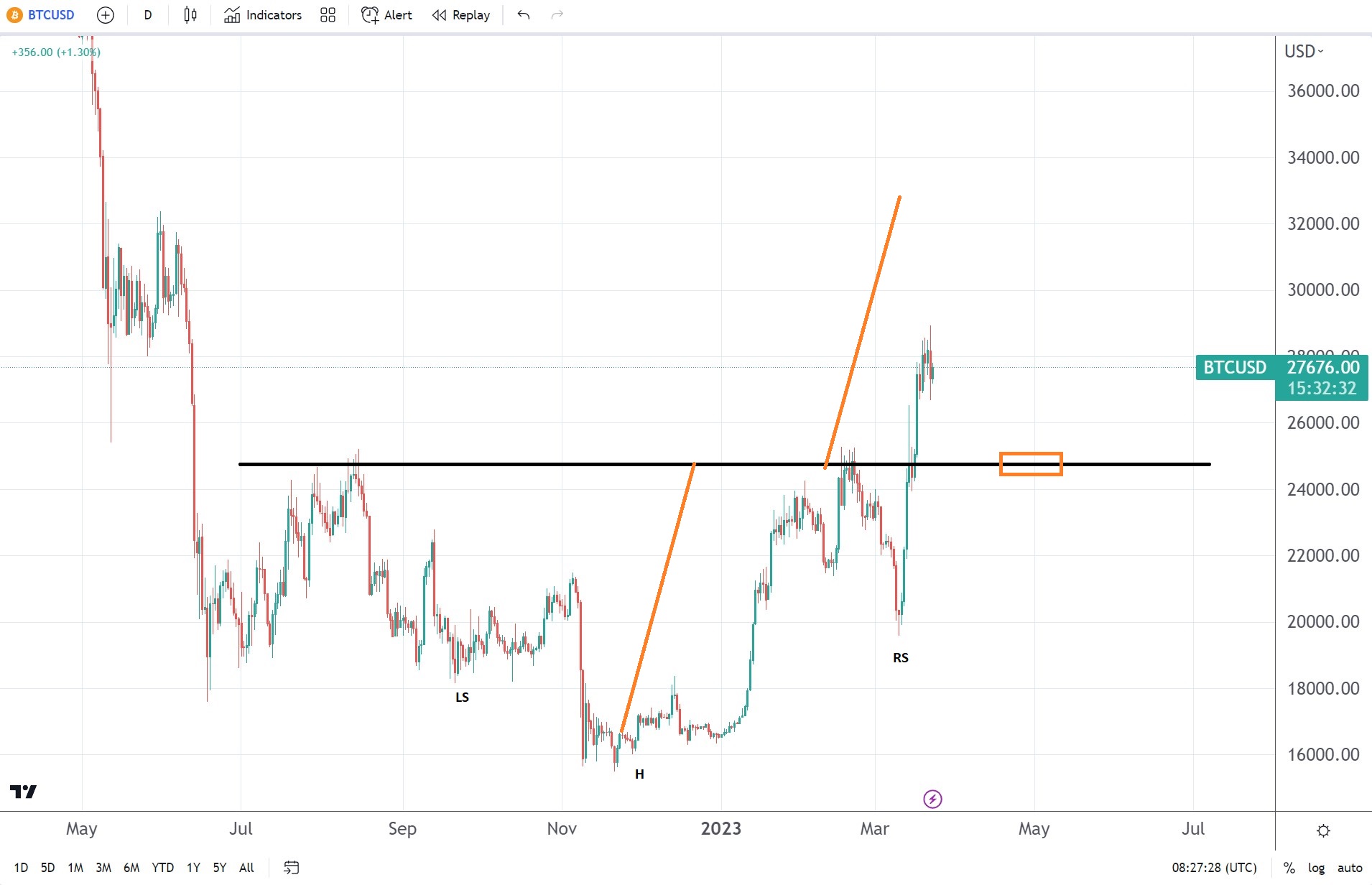
  • An inverse head and shoulders’ neckline might be retested

All eyes were on the Federal Reserve meeting this week. The tensions in the financial market induced by the failure of several banks in the United States triggered uncertainty about what the Fed would do.

Stubbornly high inflation warranted a 50bp rate hike. But the banks are fragile, as seen lately, and such a hike might have done more worse than good.

The Fed opted for a 25bp rate hike, a compromise, and now we stand to see the effects.

Bitcoin rallied before the Fed’s decision. Earlier in March, it found support at $20k and rallied all the way to $29k without the US dollar moving much.

So what is the next possible move for Bitcoin?

Bitcoin chart by TradingView

A pullback to $24k might be on the cards

Technical traders might have spotted an inverse head and shoulders pattern forming in the last six months. The 2023 rally is part of the market’s attempt to reverse and head to the measured move, seen in orange above.

However, the neckline of such a pattern, seen in black above, is usually retested. This is a test of a bull market; if it holds, the price action will likely move toward the measured move.

But will it hold?

Those that bought Bitcoin in March might book half profits and move the stop to break even only to see what happens when and if the market hits the neckline at $24k. Because if the support does not hold, more downside might be in the cards.

The post Bitcoin fails at $29k – will the Fed meeting’s outcome trigger a selloff? appeared first on CoinJournal.

15% of the Ethereum supply is about to be released: Ethereum Shanghai upgrade imminent


Key Takeaways

  • The Ethereum Shanghai upgrade is imminent, meaning stakers will finally be able to unstake their ETH, some of which has been locked up since 2021
  • 17.7 million is ETH is staked, equivalent to 14.8% of the entire supply
  • This is just below the amount of ETH on exchanges, which is 18.3 million ETH, equivalent to 15.2% of the supply
  • Price effects of upgrade are likely already priced in, but this amount of supply being released is nonetheless notable

The Ethereum Shanghai upgrade is slated to occur in mid-April. While not as seismic a shift as the Merge event which took place last September, it is nonetheless an important moment for the world’s second-largest cryptocurrency. 

The most impactful consequence will be around Ethereum stakers. For the first time, those with staked ETH will be allowed to unstake their holdings. 

How much Ethereum is staked?

And that is a lot of ETH. Currently, there is 17.7 million Ether locked up in staking contracts, equivalent to 14.8% of the total supply. 

Once the upgrade goes live, this ETH will finally be eligible to hit the market. That may sound like a scary proposition, but in reality, there have been many liquid staking alternatives available throughout the staking period, which kicked off in late November. 

In such a way, stakers have received back liquid “tokens” which can be traded in place of ETH. These tokens can then be redeemed for actual ETH once the upgrade goes live – which we now know is imminent. 

Nonetheless, there may be some elevated selling pressure in the immediate aftermath of the event. The liquid tokens have traded for (usually small) discounts compared to ETH, while it will also now be more intuitive and simpler for people to sell.

Despite all this, concluding that this will dent ETH’s price would be naive. The market knows this is coming and that same old concept of “priced in” is gain relevant. Remember, many hypothesised that the Merge would drive a massive price increase, but it came and went with only minor volatility. 

If the Shanghai upgrade goes smoothly, it would not be a surprise to see the same happen here. 

Could the Ethereum staking yield be DeFi’s risk-free rate?

One thing I have wondered about is what the yield on staked ETH will look like going forward. 

One theory is that, if Ethereum continues to act as the base layer for decentralised finance, the staking yield could look like some sort of risk-free yield in the space. In such a way, it could be used as a benchmark to value investments in the space, much like the risk-free rate in traditional finance is used. 

Then again, with the way DeFi has gone over the last couple of years, maybe it won’t. The space has seen a flood of capital flee the space as the bear market has ravaged cryptocurrency as a whole. 

Where is the rest of ETH held?

With 15% of the ETH supply locked up in staking contracts, and the number steadily rising from when staking opened up in late 2020, the balance on exchanges has done the opposite. 

There is currently 18.3 million ETH on exchanges, equivalent to 15.2% of the supply, slightly above the 14.8% that is staked. 

The 18.3 million ETH on exchanges represents the lowest figure since June 2018, at the depths of the previous crypto winter. 

The chart shows that the balance has been falling steadily since ETH staking came online. 

Of course, the above charts are in native units. When flipping the denominated unit to the dollar value of ETH instead, you get a much wackier pattern. Nonetheless, the dollar value on exchanges is still above what it was until the first quarter of 2021.

As cryptocurrency markets as a whole rally off the back of renewed hope that the Federal Reserve will pivot off high interest rate policy sooner than previously anticipated, Ethereum has followed, trading at $1,800, its highest price since last September – right when the Merge occurred. 

Macro will continue to drive the price going forward, but the Shanghai upgrade is nonetheless an important moment as Ethereum solidifies its long process of switching from a proof-of-work blockchain to proof-of stake. 

The post 15% of the Ethereum supply is about to be released: Ethereum Shanghai upgrade imminent appeared first on CoinJournal.

Litecoin price prediction: LTC outlook ahead of Fed decision

  • The Federal Open Market Committee will conclude its two-day meeting on Wednesday.

  • This decision will likely have implications for Litecoin and other crypto prices.

  • Economists expect a more balanced Fed as it battles inflation and financial stability.

Litecoin price moved sideways on Wednesday as investors waited for the upcoming interest rate decision by the Federal Reserve. LTC was trading at $80, where it has been in the past few days. Other cryptocurrencies are also wavering, with Bitcoin trading at $28,255 and Ethereum stuck at $1,800. XRP and ADA are two of the best-performing big-cap coins.

Fed decision ahead

The main catalyst for Litecoin price will be the upcoming interest rate decision by the Fed. Economists polled by Reuters expect the Fed will maintain a relatively balanced tone as it combats some of the top challenges in the economy. 

The biggest challenge the Fed is facing is the stability of the financial system following the collapse of several banks, including Credit Suisse and Silicon Valley Bank. And now, several researchers believe that about 190 banks could fail because of their large unrealized losses. 

A lack of confidence in the financial market could lead to chaos as people rush to get their money out. That would put the American economy at risk. 

The other big risk is that America’s inflation seems to be sticky. Data published last week showed that America’s consumer price index (CPI) remained at 6% in February, much higher than the Fed’s target of 2%. As such, the bank will need to show its commitment for fighting inflation in the country. As such, the most balanced way will be for the bank to hike by 25 basis points. In a note, analysts at ING wrote:

“It’s a close call, but we expect a 25bp hike by the Fed today. Ultimately, Powell’s primary goal is to restore investor confidence and a hold might signal a lack of trust in the financial system. The dot plots may also be revised slightly higher, and the dollar could recover a bit.”

A hawkish tone by the Fed could dent the recent rally in cryptocurrencies. Most coins have jumped by double digits in the past few days as investors price in a more dovish tone by the bank. 

Litecoin price prediction 

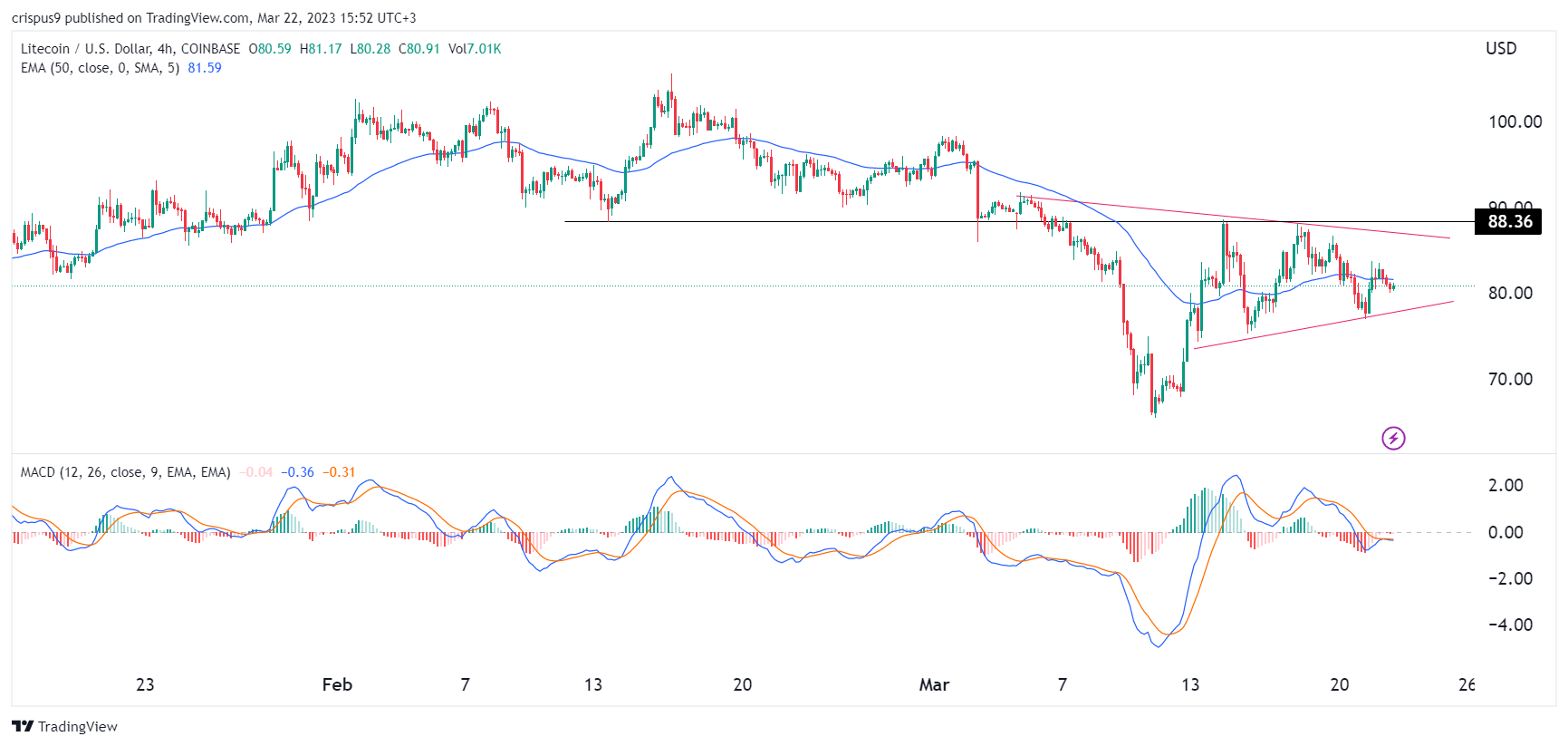
The four-hour chart shows that the LTC price has moved sideways in the past few days. In this period, it has formed a symmetrical triangle pattern that is shown in red. The coin has moved slightly below the 50-period exponential moving average (EMA). 

Litecoin is also below the important resistance level at $88.36, the lowest point on February 13. The MACD has moved slightly below the neutral point. Therefore, there is a possibility that Litecoin’s price will have a bearish breakdown after the Fed decision. If this happens, the next reference level to watch will be at $70.

How to buy Litecoin

eToro

eToro is a global social investment brokerage company which offers over 75 cryptocurrencies to invest in. It offers crypto trading commission-free and users on the platform have the option to manually invest or socially invest. eToro even has a unique CopyTrader system which allows users to automatically copy the trades of popular investors.

Buy LTC with eToro today

Bitstamp

Bitstamp is a leading cryptocurrency exchange which offers trading in fiat currencies or popular cryptocurrencies. Bitstamp is a fully regulated company which offers users an intuitive interface, a high degree of security for your digital assets, excellent customer support and multiple withdrawal methods.

Buy LTC with Bitstamp today

The post Litecoin price prediction: LTC outlook ahead of Fed decision appeared first on CoinJournal.

Avalanche price forecast after gaining 60% YTD

  • Avalanche gained 60% in less than three months
  • Despite the returns, the bearish bias persists
  • For bulls to have a case, the price should break out of a falling wedge pattern

The cryptocurrency market investor had a rough 2022 as the market tanked. But as bearish as the price action was last year, as bullish it is in 2023 so far. 

With a little over a week before the first quarter’s end, leading cryptocurrencies have rallied hard from their lows. Avalanche, for instance, gained 60% YTD, rallying together with Bitcoin. 

60% is a tremendous return over any period, let alone over less than three months. Yet, delivering such returns is not unusual for the cryptocurrency market. 

So where will AVAX/USD go from here? Will the bull run continue, or should investors book their profits and wait for the next opportunity?

AVAXUSD chart by TradingView

The bearish bias persists while a falling wedge remains intact

Avalanche found strong support at the $10 area and then rallied in 2023. But despite the returns delivered so far in the year, the bias remains bearish. 

Bulls are probably encouraged by a falling wedge pattern currently in the making. Indeed, a falling wedge is a bullish pattern, as it appears at the end of bearish trends. 

However, the signal to trade the market to the upside comes after the price breaks above the upper edge of the pattern. In other words, until then, it is just speculation, as the reversal pattern may be invalidated anytime. 

Therefore, those that bought Avalanche at the start of the trading year may find it wise to book some partial prices and wait for the price to move above the upper trendline. That is, above $20. 

The next level of resistance should be the $30 area, and from then on, the target is half the distance it took the pattern to form. On the flip side, if the price drops below $10, the reversal pattern gets invalidated, so that is the exit for any bullish setup. 

The post Avalanche price forecast after gaining 60% YTD appeared first on CoinJournal.