Here’s why the Nasdaq 100 and Bitcoin correlation has faded

  • Bitcoin price has crashed by about $6,000 from its highest point this year.

  • Nasdaq has moved into a strong bull market because of AI.

  • The Federal Reserve will conclude its two-day meeting on Wednesday.

Nasdaq 100 and Bitcoin prices have moved in the opposite direction in the past few weeks. The tech-heavy Nasdaq 100 index has soared to the highest level since April last year. In all, it has jumped by almost 40% from the lowest level this year. 

Bitcoin price, on the other hand, has been stuck at the important support level at $25,200. It has dropped by more than $6,000 from its highest level this year. In the past, Nasdaq 100 and Bitcoin had a close correlation because they are often seen as high-risk assets.

Regulatory concerns

The main reason why the Nasdaq 100 and Bitcoin price correlation has faded is the ongoing crackdown in the United States. On Monday last week, the Securities and Exchange Commission (SEC) filed a major lawsuit against Binance, the biggest company in the industry.

The agency accused the company of deceptive practices, commingling funds, and offering its services in the United States illegally. Then on Tuesday, the SEC filed a lawsuit against Coinbase, the biggest company in the US. It accused Coinbase of listing unregistered securities to American customers.

The regulatory crackdown comes at a time when the crypto industry has gone through a challenging period. Last November, FTX, a major crypto exchange filed for bankruptcy, costing invetors billions of dollars. 

Crypto companies argue that the SEC and other policymakers have not issued clear guidance about the crypto industry. For example, Coinbase questioned why the SEC allowed it to go public if it offered illegal products.

Why Nasdaq 100 index is soaring

On the other hand, the Nasdaq 100 index is soaring because of FOMO and the ongoing artificial intelligence hype. A closer look at the top movers in the Nasdaq 100 index shows that they have a thing to do with AI.

Nvidia share price has jumped by more than 180% this year, giving it a market cap of over $1 trillion. Tesla, which is also investing in AI, has soared by over 110% while Broadcom, Amazon, and Palo Alto Networks have risen by more than 70%.

Therefore, there is a likelihood that investors are rotating from the high-risk crypto industry to invest in stocks. Stocks are widely seen as being less risky than cryptocurrencies. 

Still, there is a likelihood that cryptocurrencies will bounce back later this month as the regulatory concerns ease. As we have seen in the past, these cases tend to take years to conclude. 

How to buy Bitcoin

eToro

Buy BTC with eToro today

CEX.IO

Buy BTC with CEX.IO today

The post Here’s why the Nasdaq 100 and Bitcoin correlation has faded appeared first on CoinJournal.

Bitcoin consolidates ahead of the Fed’s decision; is it safe to buy it here?

  • The Federal Reserve of the United States is expected to keep the funds rate on hold 
  • A dovish message would spell trouble for the US dollar 
  • Bitcoin may overcome resistance seen at $30,000

Today is a big day for financial market participants because the Federal Reserve of the United States will announce its monetary policy decision. The consensus is that the Fed will “skip” a rate hike at its June meeting, but it will have a hawkish tone suggesting that another rate hike may come in July.

Therefore, the message to market participants might be mixed. On the one hand, by pausing the rate hikes, the Fed sends a dovish message. On the other hand, by suggesting another hike will come in July, the message turns hawkish.

In other words, today’s decision might have something for both bulls and bears. For Bitcoin, the dollar’s direction matters because, lately, Bitcoin has moved together with the dollar.

For example, the dollar peaked last October when US stocks bounced from their lows. So did Bitcoin, albeit the rally started only in 2023.

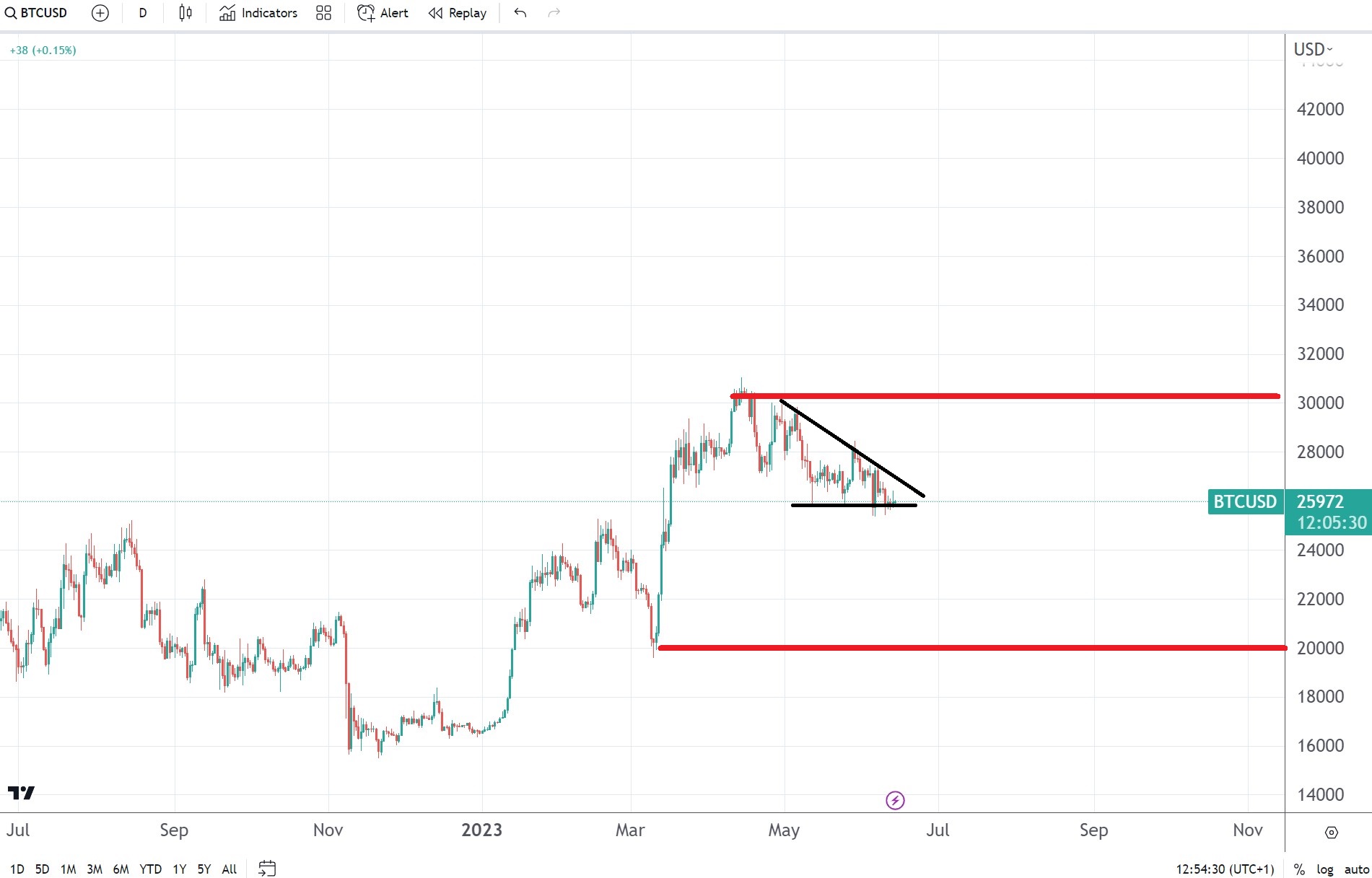
Bitcoin chart by TradingView

Bitcoin trapped between two round levels

Round numbers are important levels in technical analysis because people tend to take profits around such levels. In the case of Bitcoin, two levels are very important in 2023 – $30,000 to the upside and $20,000 to the downside.

The former offered resistance, and because the market is close to it, it suggests that the consolidation seen in the last months may just be a continuation pattern. Therefore, Bitcoin would likely rally some more if bulls manage to overcome resistance.

On the flip side, one may spot a possible descending triangle. A clear break below support should open the gates to further weakness towards $20,000.

All in all, the bias remains bullish while Bitcoin trades near the $30,000 level. On a dovish Fed, resistance might be easily broken.

The post Bitcoin consolidates ahead of the Fed’s decision; is it safe to buy it here? appeared first on CoinJournal.

Crypto is losing touch with institutional cash


Key Takeaways

  • Crypto.com this week shut down its institutional exchange in the US, citing a lack of demand
  • The regulatory climate has worsened significantly in the US, meaning crypto is becoming less practical for institutions 
  • The macro picture and scandals across the space last year have also contributed, writes our Head of Research, Dan Ashmore

Two months ago, I put together a piece analysing institutional money and crypto. Specifically, it asked whether institutional cash had fled the industry. 

This weekend, we got the latest demonstration of quite how stark the exodus of institutional money has been. Crypto.com announced they were shutting down their institutional exchange in the US, blaming a lack of demand. While the retail platform will stay open, the institutional platform will no longer be operational. 

This is no surprise. Neither is the timing, as the announcement comes amid the increasingly hostile regulatory crackdown that is occurring in the US. Both Binance and Coinbase were sued by the SEC last week, with fears increasing that crypto will be pushed offshore. 

But while it is a key factor, the reasons for institutional cash jumping ship are not just limited to regulation. 

Macro environment

During the pandemic boom, we saw Tesla announce they were purchasing Bitcoin to hold on their balance sheet (before later selling most of that Bitcoin). We saw fund managers on TV seemingly daily, discussing the heightened demand from their clients to offer Bitcoin investment vehicles. A Bitcoin spot ETF was rumoured as imminent. 

Fast forward eighteen months, and things are slightly different. Despite a run-up of 55% this year, Bitcoin remains 60% off its peak as markets across the financial system have struggled. 

This follows a transition to tight monetary policy – the first regime of its kind during Bitcoin’s lifespan, which was launched in 2009 into what would become a decade of basement-level interest rates. 

The increasing interest rates have pushed institutions back on the risk curve. T-bills today offer 5%, a viable alternative, unlike the near-zero rate offered for most of the last fifteen years. This alternative and the syphoning of liquidity out of the system, with the hope of curtailing rampant inflation, has suppressed the price of all risk assets. The tech-heavy Nasdaq demonstrates this well, losing a third of its value last year. Bitcoin is even more risk-on than tech, and it has struggled to attract funds as a result. 

Reputation

While the macro picture is outside of the crypto industry’s control, perhaps the most concerning development is the damage to its long-term reputation. Last year saw the spectacular collapse of the UST stablecoin, part of a once-thriving $60 billion Terra ecosystem. Then followed Celsius, Voyager Digital and a host of crypto lending institutions who were caught up in the contagion. 

But perhaps it was FTX’s shocking demise in November, led by disgrace Sam Bankman-Fried, which was the cherry on top. The exchange’s kingpin had lobbied on behalf of the industry for congress, appeared on the front page of magazines, and had Wall Streeters swooning over his charisma and drive to take crypto the top. 

It was all a lie. For some, it may have been the straw that broke the camel’s back. You know when Bitcoin bull Cathie Wood is concerned over the fallout for institutions that there is a problem (she is sticking by her $1 million price prediction for Bitcoin).  

“The one thing that will be delayed is perhaps institutions stepping back and just saying, ‘OK, do we really understand this?’”, Wood said in an interview with Bloomberg last year. 

Regulation

Regardless of whether institutions see crypto’s reputation as sullied, or whether the macro picture dents its attractiveness for managers, the issue of regulation is a pressing one. Even if institutions want to buy, the crackdown in the US could make it significantly harder to do so. And the greater the friction, the less likely mass pickup is. 

There is very real concern that the American crypto industry is being curtailed to such a degree that companies will be forced to migrate elsewhere. As I wrote last week, I don’t think certain counterparties in the crypto industry have helped themselves (and that ties into my point earlier on reputation), but whether it is deserved or not is kind of beside the point. It’s happening, and that is all that matters. 

For institutions, that means it’s only getting harder and harder to buy. What funds are going to be willing to load up on Ethereum while nobody is sure whether it is a security, and while the exchanges through which they want to buy it are fighting lawsuits from the SEC?

Final thoughts

There is nothing particularly groundbreaking in this piece. All these developments are plain to see. There are no charts, minimal data, and not much beyond some obvious surmising. But in a way, that is kind of the point. The change in the space over the last year, especially regarding institutional attitude (and that means beyond the crypto bubble!), is striking. 

The crypto landscape has had many ups and downs over the years, but the conwern this time is that, while the percentage decline may be similar, the previous bear markets did not happen on such a big stage. The dollar amounts of bigger, but the reputational blow is too. This was crypto’s big time in the lights. Institutions were genuinely looking towards this as a reputable asset class elbowing into the mainstream. 

While this could help Bitcoin separate itself from the crowd and carve out its own niche (even more so than it has already done), it has still been a setback. But the true concern is more with the rest of crypto, which faces a much tougher battle to regain any semblance of legitimacy.

The post Crypto is losing touch with institutional cash appeared first on CoinJournal.

Hedera, Fantom, XRP, Filecoin prices rise as US inflation dips

  • The headline consumer price index dropped to 4.0% in May.

  • The data came as the FOMC prepares to conduct its June meeting.

  • Economists expect that the bank will leave interest rates unchanged.

Altcoin prices jumped on Tuesday after the US published encouraging consumer inflation data. Hedera Hashgraph price has jumped by about 4% in the past 24 hours. Similarly, other altcoins like Fantom, XRP, Filecoin, and Uniswap have jumped by over 4% in the past 24 hours.

US inflation retreats

Bitcoin and other cryptocurrencies have jumped in the past few hours after the encouraging US consumer price index data. According to the Bureau of Labor Statistics (BLS), the headline consumer price inflation dropped from 4.9% in April to 4.0% in May. This was a bigger decline than what analysts were expecting. It was also the biggest decline in several months.

These numbers are important because they came on the same day that the Federal Open Market Committee (FOMC) is set to start its two-day meeting. As a result, the committee will be comfortable to leave interest rates unchanged at 5.25%. It has delivered interest rate hikes in the past ten meetings straight.

A Fed pause and an eventual pivot will be good news for risky assets like cryptocurrencies and stocks. This explains why the stock-focused fear and greed index has jumped while key indices like the Dow Jones and Nasdaq 100 have gained by double-digits this year.

Regulatory concerns remain

For cryptocurrencies like Hedera Hashgraph, Filecoin, Fantom, and XRP, these inflation numbers are welcome. However, the biggest risk in the crypto industry is that regulators in the US and the UK have gone to war with these assets. 

Last week, the SEC filed a major lawsuit against Binance and Changpeng Zhao. On the following day, the agency filed another one against Coinbase, the biggest exchange in the United States. A common allegation in the lawsuit is that they offer unregulated products.

Some of these unregulated products are proof-of-stake tokens that have a yield element. The SEC has already sued Ripple alleging that it is an unregulated cryptocurrency. It has also identified several tokens it believes are securities.

As a result, we could see exchanges that serve American customers start delisting these tokens, which could hurt many of them. 

The post Hedera, Fantom, XRP, Filecoin prices rise as US inflation dips appeared first on CoinJournal.

Crypto volumes continue to lag, Bitcoin & Ether fees down for fourth consecutive week


Key Takeaways

  • On-chain activity for Bitcoin and Ethereum has fallen for the fourth consecutive week
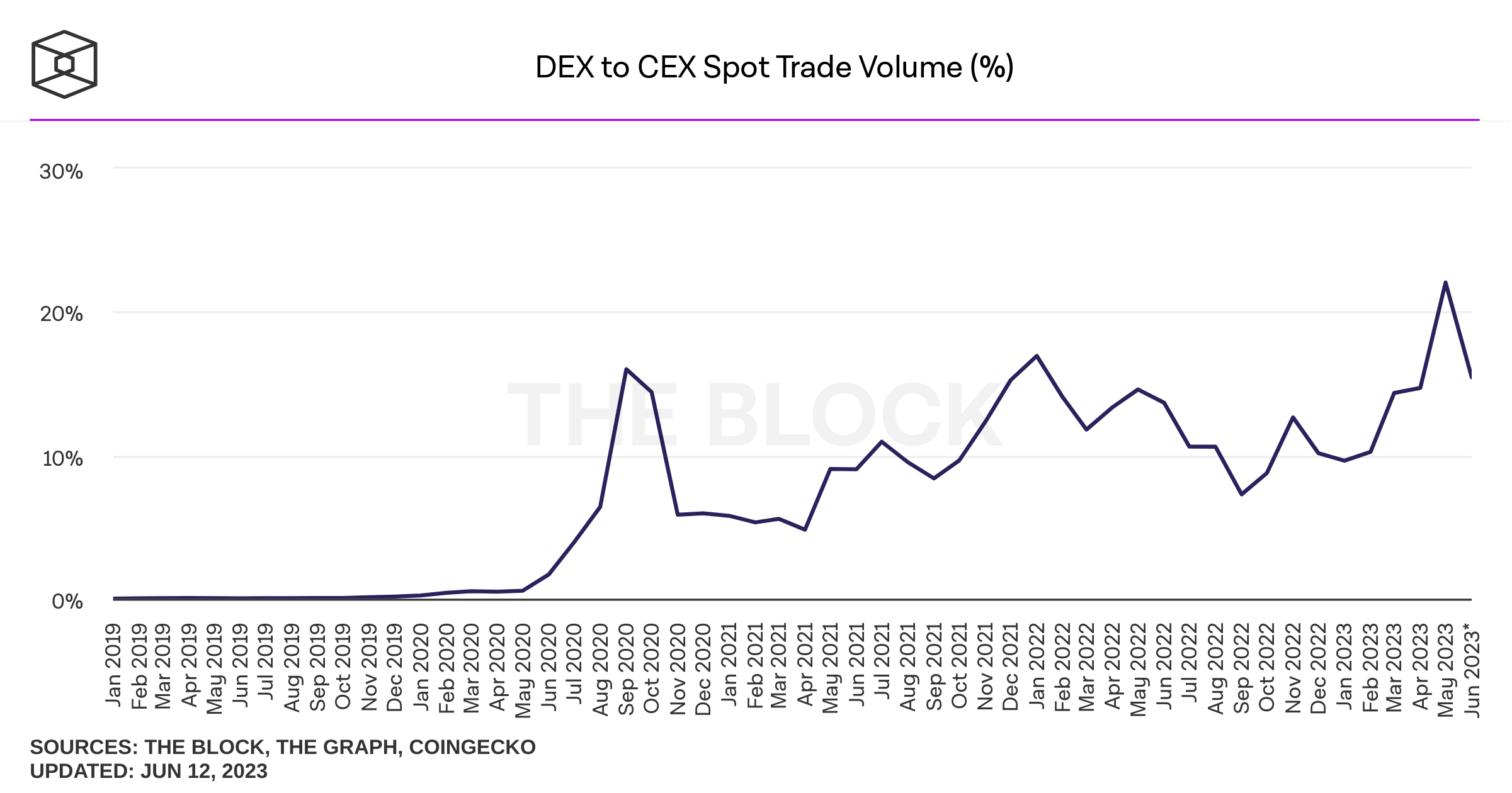
  • DEX share of trading volume had jumped up from 14% to 22% last month amid regulatory crackdown on centralised exchanges
  • DEX volume has fallen back again since, however, and entire crypto space is seeing thin liquidity


Many speculate the regulatory crackdown in the US will push crypto two ways: offshore and/or into the decentralised realm. For the former, that doesn’t need much explanation. Tightening the noose on crypto companies in the US will force those same companies to move abroad if they want to continue their operations at the same capacity (or at all).

But whether this will push activity on-chain presents as a more interesting debate. Decentralised exchanges took off during the pandemic hysteria, however their volumes fell drastically throughout 2022. While volume also fell for centralised exchanges (CEXs), the ratio of the volume of DEX trading to CEX volume fell from 16.9% at the start of 2022 to 9.6% twelve months later, showing DEXs fell further than their more conventional counterparts.

Could the regulatory travails of Coinbase, Binance and other centralised exchanges reverse this trend? The below chart shows that there was indeed an increased portion of activity accounted for by DEXs in May, with DEX trading capturing 22.1% of volume, compared to 14.7% the prior month. However, the share has dropped back down to 15.4% through the first twelve days of June.

Binance was sued on June 5th and Coinbase on June 6th, which is curious when looking at the above trend as the DEX share has dropped since. Then again, these lawsuits may have been largely priced in. Coinbase was served with a Wells notice a few months ago, while Binance was (and still is) facing numerous investigations from different lawmakers. The price of Bitcoin will tell you all you need to know – it fell only 5% on news Binance had been formally sued, while the Coinbase news didn’t budge it much at all.

In truth, whatever the reasons, it is hard to draw conclusions from the above data. Volume remains incredibly thin, as I have discussed in-depth previously. In fact, on-chain activity and fees have actually fallen for the fourth consecutive week for Bitcoin, the immense spike in activity caused by the Ordinals protocol and BRC-20 tokens fading into the rear window. Despite this fall, however, it should be noted that fees are still significantly higher than the start of the year.

It is not just Bitcoin. Fees and activity are dwindling across the crypto space. The below is the same chart but for Ethereum, which has also seen four straight weeks of declining fees. In contrast to Bitcoin, the activity is inching down closer to where it was in January, however.

All in all, volume in the cryptocurrency space remains incredibly thin. This is due to a variety of factors. The first is the collapse in prices. When prices fall, people invariably trade crypto less. And with Bitcoin still 60% off its peak from late 2021, the hysteria and jammed order books feel a long way off.

But regulation is also a key factor. This has suppressed enthusiasm for the space immeasurably, with particular implications for institutions. We saw a telltale sign of that over the weekend, with Crypto.com suspending its US institutional exchange. While its retail platform will remain operational, the company cited limited demand from institutions as the reason behind the decision.

A cocktail of freefalling prices and an increasingly punitive regulatory regime is the worst possible scenario for the industry, and it is not hard to see why institutions have pulled back from the space.

The jump in DEX volume portrayed by the above on-chain data may seem promising at first glance, but that trend seems to have reversed. Additionally, for institutional capital to flow significantly into the space, centralised exchanges provide a vital function. So many were optimistic of these institutions pouring in only a couple of years ago, when companies like Tesla were stashing Bitcoin on balance sheets, but that feels a long way off now.

The post Crypto volumes continue to lag, Bitcoin & Ether fees down for fourth consecutive week appeared first on CoinJournal.