Crypto price prediction: Solana, Zilliqa, Fantom (FTM)

  • Bitcoin price remained slightly above $30,000 this week.

  • There was no major cryptocurrency news during the week.

  • We explain what to expect from Solana, Zilliqa, and Fantom.

Cryptocurrencies had another muted week as volumes from the United States remained low because of the Independence Day celebrations. Also, there was no major crypto news during the week. As a result, Bitcoin price remained at $30,000 while the total market cap of all coins dropped to $1.17 trillion. 

Solana price prediction

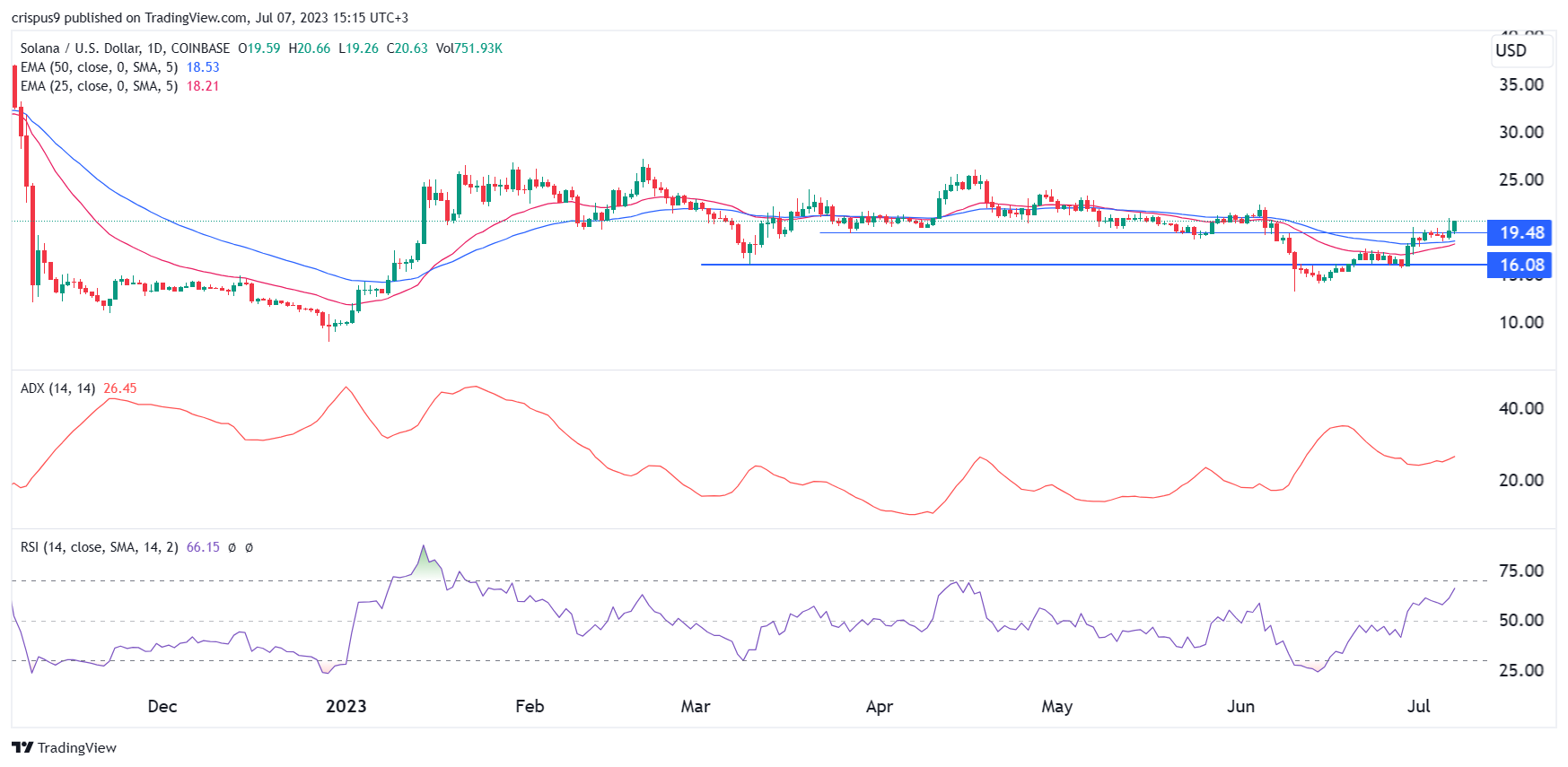
Solana had a relatively strong performance this week. The coin jumped to a high of $21, the highest level since June 5th of this year. It has soared by more than 56% from the lowest level this year.

As the coin jumped, the coin managed to flip above the important resistance level at $16, the lowest level on March 10th. SOL price also flipped the crucial resistance level at $19.48 into support.

Solana price has jumped above the 25-day and 50-day moving averages. The Average Directional Index (ADX) has moved to 26, signaling that the momentum is rising. At the same time, the Relative Strength Index (RSI) has moved slightly below the overbought level.

Therefore, Solana crypto price will likely continue rising as buyers target the next key resistance level to watch at $25. This price is about 22% above the current level.
How to buy Solana

eToro

eToro is a multi-asset investment platform with more than 2000 assets, including stocks, ETF’s, indices, commodities and Cryptoassets. eToro offers over 60+ Cryptoassets to invest or invest in their CryptoPortfolio where investors can benefit from the accumulated growth of Bitcoin, Ethereum, XRP, Litecoin and other leading cryptocurrencies. eToro users can connect with, learn from, and copy or get copied by other users.

Buy SOL with eToro today

Binance

Binance has grown exponentially since it was founded in 2017 and is now one of, if not the biggest cryptocurrency exchanges on the market.

Buy SOL with Binance today

Zilliqa price prediction

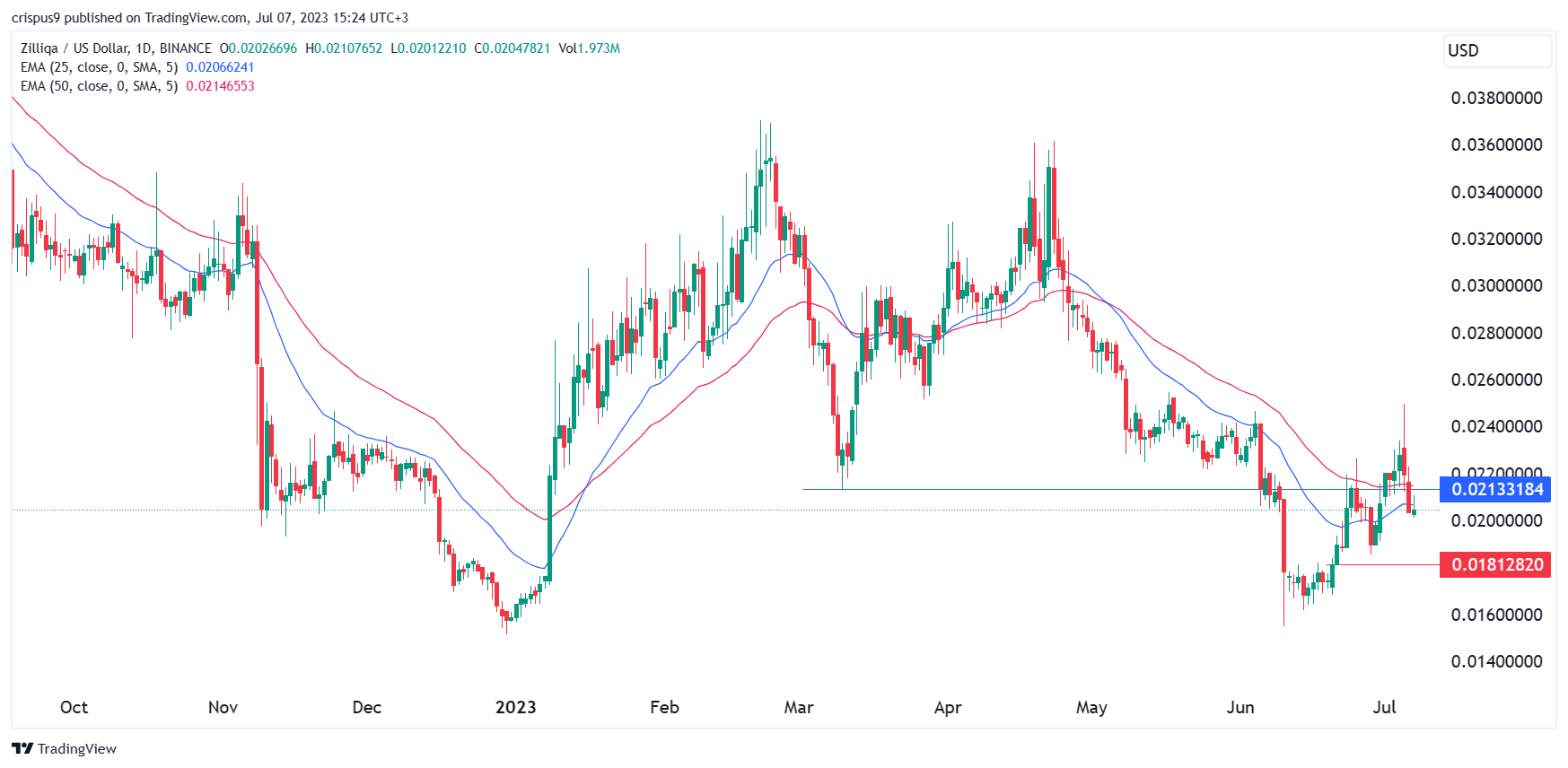
Zilliqa price had a tough week as demand for the coin eased. After rising to a high of $0.0249 on Tuesday, the coin plunged by almost 20% to $0.020. The coin has dropped below the important support level at $0.0213, the lowest level on March 10th. This price was also the neckline of the double-top pattern.

Zilliqa has moved below the 25-day and 50-day moving averages. The coin also formed a shooting star pattern, which is usually a bearish sign. Therefore, ZIL crypto price will likely continue falling as sellers target the next key support level at $0.018.

How to buy Zilliqa

Binance

Binance has grown exponentially since it was founded in 2017 and is now one of, if not the biggest cryptocurrency exchanges on the market.

Buy ZIL with Binance today

OKX

OKX is a world-leading cryptocurrency exchange, providing advanced financial services to traders globally by using blockchain technology.
Buy ZIL with OKX today

Fantom price forecast

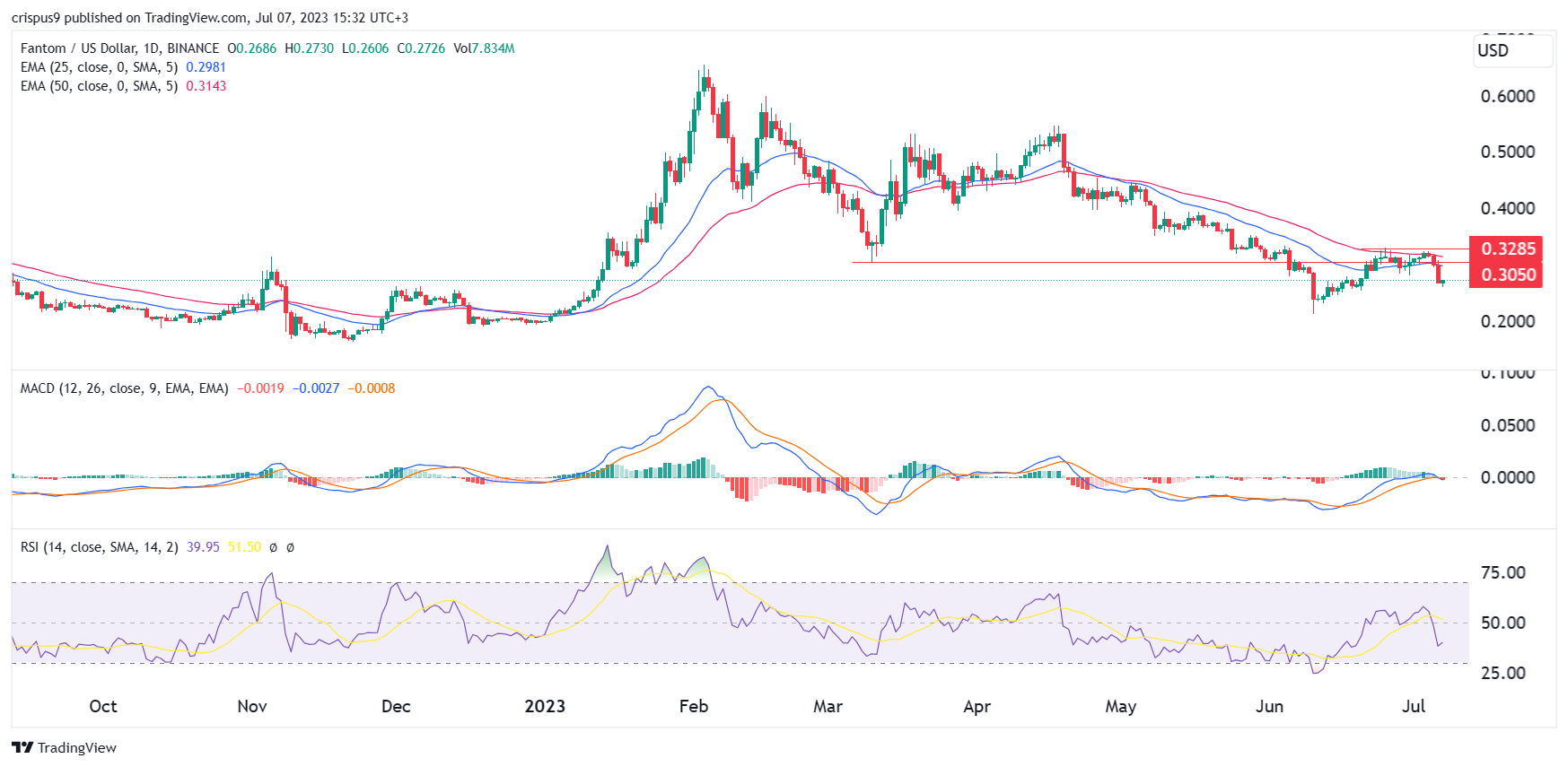
Fantom was also in the red this week as demand for crypto tokens waned. The token peaked at $0.3285 on June 25th and then retreated this week. It has moved below the important support level at $0.3050, the lowest point on March 10th.

FTM crypto price has dropped below the 25-day and 50-day moving averages. At the same time, oscillators like MACD and the Relative Strength Index (RSI) have drifted downwards. Therefore, the outlook of the Fantom price is bearish, with the next key level to watch will be at $0.20, whic is about 20% below the current level.

How to buy Fantom

eToro

eToro is a multi-asset investment platform with more than 2000 assets, including stocks, ETF’s, indices, commodities and Cryptoassets. eToro offers over 60+ Cryptoassets to invest or invest in their CryptoPortfolio where investors can benefit from the accumulated growth of Bitcoin, Ethereum, XRP, Litecoin and other leading cryptocurrencies. eToro users can connect with, learn from, and copy or get copied by other users.

Buy FTM with eToro today

Binance

Binance has grown exponentially since it was founded in 2017 and is now one of, if not the biggest cryptocurrency exchanges on the market.
Buy FTM with Binance today

The post Crypto price prediction: Solana, Zilliqa, Fantom (FTM) appeared first on CoinJournal.
Stay away from Grayscale Bitcoin Trust despite discount narrowing to 10-month low


Key Takeaways

  • The Grayscale Bitcoin Trust (GBTC) has persistently traded at a discount to its net asset value
  • The discount has narrowed to its lowest mark since September off hope the fund is more likely to be converted to an ETF
  • The entire GBTC debacle represents the mess that is the institutional regulatory climate in the US
  • Spot ETFs are a question of when rather than if, and such investment vehicles will then be a thing of the past
  • That won’t assuage frustration of GBTC investors, who have been caught badly as alternative Bitcoin investment vehicles have come online and demand for the trust has dried up

Among the interesting aspects of the fallout from the slew of recent spot Bitcoin ETF filings is how it affects the controversial Grayscale Bitcoin Trust (GBTC). 

The trust has been flying, up 56% in the three weeks since Blackrock’s ETF filing was announced. 

Notably, this means it has significantly outpaced its underlying asset, Bitcoin. That sounds like a good thing, but it really summises the problem with this investment vehicle that has done nothing but frustrate investors in recent years, but we will get to that in a moment. 

I have plotted the movement of the GBTC against Bitcoin itself in the next chart, highlighting the outperformance the Trust has had since the ETF filing, with Bitcoin itself up “only” 21%. 

Grayscale discount to net asset value narrowing but still enormous

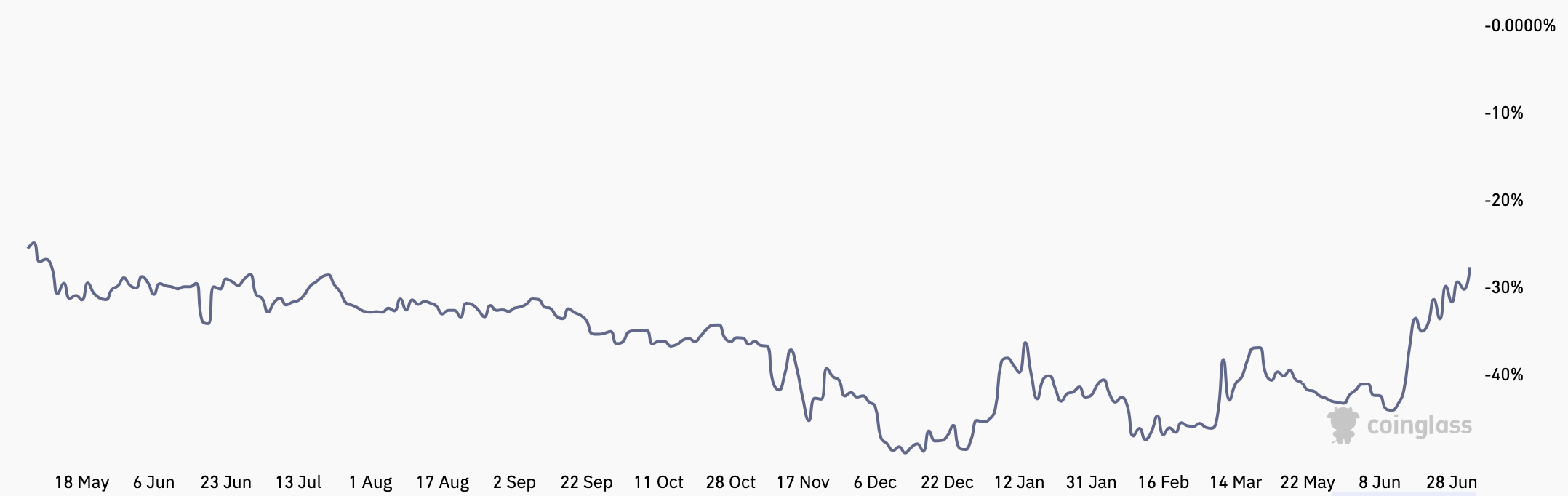
The trust’s discount to net asset value has also narrowed to its smallest mark since September, now below 30%. This comes as investors bet the trust is now more likely to finally be allowed to convert to an ETF.

 Should this conversion occur, the discount would narrow to near zero, as funds would then be allowed to flow in and out of the vehicle without affecting the underlying assets. For the time being, while it remains a trust, there is no way to get Bitcoin out of GBTC. This, coupled with steep fees (2% annually) means that a heavy discount has persisted. 

In truth, the very existence of the Grayscale trust is a black mark on the sector. The discount it trades at is farcical – even following the recent narrowing, a 30% delta is an enormous chasm, one that is hurting investors. 

The outsized assets under management – essentially trapped due to the closed-fund nature – feels like a throwback to the days when anyone and everyone wanted to get exposure to Bitcoin through whatever means necessary. Grayscale was the only shop in town, and such was the demand for Bitcoin, coupled with that monopolistic power, that it even traded at a premium for much of its early history.

However, as more mediums through which Bitcoin exposure can be had have come online, the premium has flipped to a discount, and that discount has become large. It is probably fair to say that investors displayed a lack of due diligence for how the fund works, another throwback to the up-only bull market of days gone by. 

Without donning a captain hindsight outfit, there was always going to be competitor firms coming online and the premium was bound to come under pressure. An investment in GBTC essentially amounted to two things: a bet on Bitcoin, and a bet that the trust would be converted into an ETF quickly. 

But at that, perhaps sympathy can be shown to investors. Investment management firm Osprey Funds has a similar product, and earlier this year sued Grayscale, alleging that its competitor misled investors about how likely it was that GBTC would be converted into an ETF. This, they allege, is how they captured such a share of the market. 

“Only because of its false and misleading advertising and promotion has Grayscale been able to maintain to date approximately 99.5% market share in a two-participant market despite charging more than four times the asset management fee that Osprey charges for its services”, the suit alleges. 

Whether Grayscale knew of the regulatory difficulty it would face or not, it has tried and failed for years to convert the vehicle into an ETF. Last year, it sued the SEC itself, declaring the latest rejection “arbitrary”.

Institutional climate turning

My thoughts on the trust overall remain the same. I believe it represents a terrible investment (obviously), and its mere existence is only a byproduct of the regulatory travails that the sector has struggled with. There is no reason to even consider buying this unless there is quite literally no other vehicle through which to gain Bitcoin exposure. 

There will come a day when all this squabbling over trusts and ETFs will likely be nothing but a throwback of a more uncertain time. But time is a luxury that many investors don’t have, and Grayscale has been a horrendous investment, typical in a lot of ways of the travails the space has had in bridging the gap to become a respected mainstream financial asset. 

Not only is the discount jarring as it is, but it widened beyond 50% in the aftermath of the FTX collapse as it emerged that crypto broker Genesis was in deep trouble. Genesis’ parent company is Digital Currency Group (DCG), the same parent company of Grayscale. Genesis eventually filed for bankruptcy in January. 

This sparked concern around the safety of Grayscale’s reserves, something which they company did not exactly comfort investors about when it refused to provide on-chain proof of reserves, citing “security concerns”.  

While the furore over reserves has quietened down, the episode is yet another stark reminder of the oft-repeated (but perhaps not often enough) phrase: “not your keys, not your coins”. 

The problem for institutions to date is that they have had trouble accessing Bitcoin directly for a variety of reasons, primarily regulatory-related. While spot ETFs will also technically violate the “not your keys” mantra, with prudent regulatory oversight and a strong custodian, this should be a safe way for institutions to gain exposure to Bitcoin. 

That would end all this nonsense (and that really is the right word) such as trusts trading at 30% discounts, and give investors a secure avenue through which to put their views on Bitcoin into conviction. That may still be a long way off, but if demand for these products remains, it’s only a matter of time.

The post Stay away from Grayscale Bitcoin Trust despite discount narrowing to 10-month low appeared first on CoinJournal.

Coinbase stock could sink all the way back to $60 – analyst says

  • Piper Sandler downgraded Coinbase Global Inc on Wednesday.
  • Analyst Patrick Moley cited regulatory uncertainty for dovish view.
  • Coinbase stock has gained close to 60% over the past thirty days.

Coinbase Global Inc has been an absolute delight for shareholders over the past thirty days but a sharp downturn is likely moving forward, as per a Piper Sandler analyst.

Avoid Coinbase stock due to regulatory uncertainty

On Wednesday, Patrick Moley downgraded the crypto exchange to “neutral” and lowered his price target as well to $60 that signals a 25% downside from here.

The analyst turned dovish primarily because the U.S. Securities and Exchange Commission sued the Nasdaq-listed firm last month for operating as an unregistered exchange (read more).

In a research note today, he attributed the recent surge in Coinbase stock to prominent asset managers filing for a Spot Bitcoin ETF and the consequent benefit to crypto prices but said:

Rising crypto prices have not translated to increased trading volumes for COIN in recent quarters and the timing of a Spot Bitcoin ETF approval is anyone’s guess.

Coinbase Global will report a weak second quarter

Moley expects the crypto company to report monthly transacting users and trading volumes at a two-year low in its second financial quarter.

The Piper Sandler analyst agreed that Coinbase Global will eventually emerge as a major player within the crypto space but said:

We’d like to see more progress on regulatory front and a convincing turnaround in underlying fundamentals of the business before becoming more positive on Coinbase stock.

Despite the regulatory crackdown, though, Coinbase increased its market share last month to a new high since January 2023, as per data from Kaiko – a digital assets data provider.

The post Coinbase stock could sink all the way back to $60 – analyst says appeared first on CoinJournal.

Bitcoin Cash price moved to a bear market: Buy the dip?

  • Bitcoin Cash price has moved to a bear market after falling by 22%.

  • The coin has more short-term downside as it moves from the overbought zone.

  • Some investors believe this is a good time to dollar cost average (DCA)

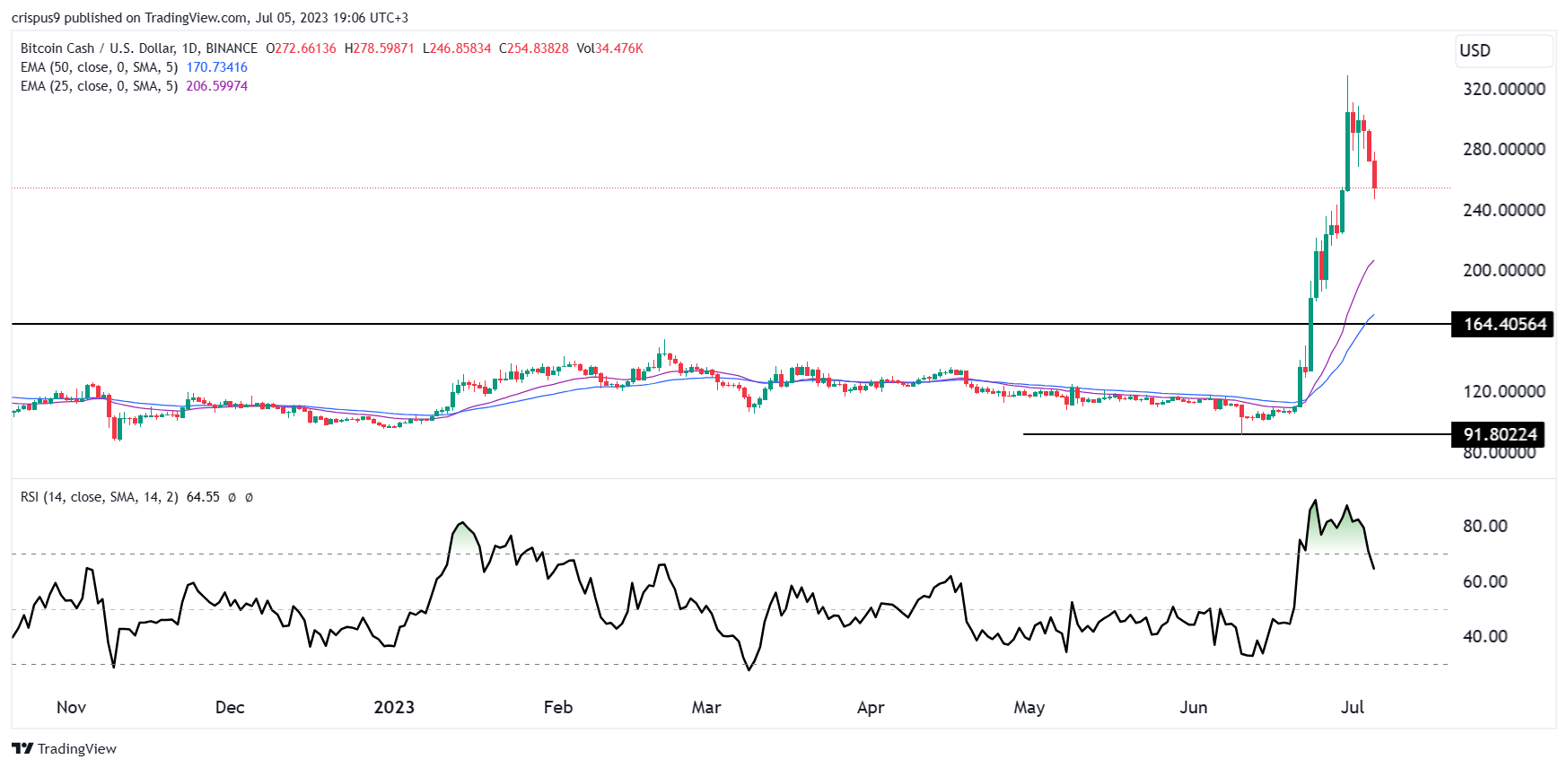
Bitcoin Cash price has moved into a bear market as investors start taking profits after the spectacular performance in June. The coin retreated to a low of $250 on Wednesday, about 22% below the highest level in June. 

BCH enters a bear market

Bitcoin Cash had one of the best period in June as investors moved to proof-of-work cryptocurrencies after the SEC lawsuit on Binance and Coinbase. Investors believe that coins like BCH, Verge, and Litecoin will benefit if the SEC decides to move to war against crypto tokens like Solana and Cardano.

Bitcoin Cash price has now moved into a bear market by falling by over 20% from its highest level in June. This decline is mostly because of profit-taking since BTC was up by more than 250% between the lowest and highest points in June. 

Historically, investors tend to exit an asset after rising sharply in a certain period. When it drops, the so-called Fear of Missing Out (FOMO) situation reverses and people who bought during the uptrend starts to exit.

BCH price also retreated as Bitcoin price struggled to move above the upper side of the bullish flag pattern that has been forming. BTC is hovering at $30,300 and there is a possibility that it will move below $30,000 soon. 

Further, BCH also dropped as American stocks retreated after the Independence Day holiday. The Dow Jones index retreated by 50 points while the Nasdaq 100 fell by about 20 points.

Bitcoin Cash price forecast

On the daily chart, we see that the BCH price has retreated in the past few days. This retreat started after the coin moved to the extreme greed zone. The coin has now formed three black crows pattern, which happens when three red candles follow each other.

Bitcoin Cash remains much higher than the 50-day and 100-day moving averages while the Relative Strength Index (RSI) moved below the overbought level. Therefore, I suspect that Bitcoin Cash price has some more downside in the near term before making an eventual comeback.

This pullback will likely see it drop to the next key support at $210, which is the 25-day moving average. Therefore, dollar cost averaging, where a trader buys the coin as it drops could be a good idea since it will ultimately bounce back.

How to buy Bitcoin Cash

eToro

eToro is a multi-asset investment platform with more than 2000 assets, including stocks, ETF’s, indices, commodities and Cryptoassets. eToro offers over 60+ Cryptoassets to invest or invest in their CryptoPortfolio where investors can benefit from the accumulated growth of Bitcoin, Ethereum, XRP, Litecoin and other leading cryptocurrencies. eToro users can connect with, learn from, and copy or get copied by other users.

Buy BCH with eToro today

Bitstamp

World’s longest-standing crypto exchange. Since 2011 Bitstamp has been providing a secure and reliable trading venue to over four million individuals and a range of institutional partners.

Buy BCH with Bitstamp today

The post Bitcoin Cash price moved to a bear market: Buy the dip? appeared first on CoinJournal.

Crypto prices rising and sentiment flipping but liquidity & macro picture are ominous


Key Takeaways

  • Crypto prices are rising sharply, with Bitcoin up 20% in the last three weeks
  • The filing of a number of high-profile Bitcoin ETFs has pushed optimism in the market
  • Under the hood, liquidity remains low and some worrisome trends emerge, however
  • The regulatory woes are still present, with Coinbase and Binance facing a murky future
  • The macro picture also remains uncertain, with the prospect of a lagged impact via tightening monetary policy looming large

It wouldn’t be like crypto markets to get overly excited. In the past couple of weeks, positivity has returned to the space, led by the seminal filings for a Bitcoin spot ETF by two of the world’s biggest asset managers, Blackrock and Fidelity. 

Additionally, Fidelity were among a cohort of large trad-fi operators, including Schwab and Citadel, to back the new exchange EDX, which offers trading for Bitcoin, Ether, Litecoin and Bitcoin Cash. 

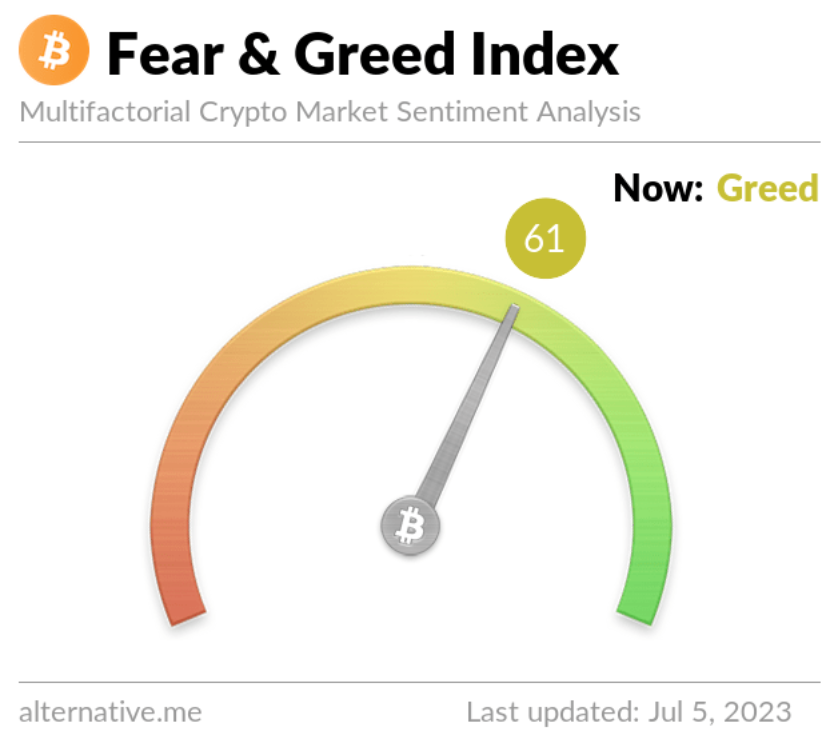
Bitcoin is up 20% in the last three weeks, breaching past the $30,000 mark, while Ether is up 16% in the same timeframe, approaching the $2,000 mark once more. A glance at the Fear and Greed index, an interesting metric which gauges overall sentiment in the space, shows it is markedly in the “greed” sector with a score of 61 (0 represents extreme fear, 100 represents extreme greed). 

And yet, a look under the hood betrays some concern. Firstly, if the filing of the ETFs is the reason for the recent ramp, as it appears to be, is a 20% jump justified? The SEC has declared the recent filings as “inadequate”, according to the WSJ, informing the Nasdaq and CBOE (who filed the paperwork on behalf of the asset managers) that there is not enough detail with respect to “surveillance-sharing agreements”. The SEC had previously said that sponsors of a Bitcoin trust are required to enter into a surveillance-sharing agreement with a regulated market of significant size.
While the applications can be updated and refiled (and the CBOE did indeed refile theirs since, with Nasdaq likely soon to follow) the development hints at how difficult it has been to get the much-coveted spot ETF over the line. There is no guarantee that these are approved, despite the big names involved – the SEC even rejected an application from Fidelity in the past, turning it away in January 2022. 

In truth, it feels inevitable that Bitcoin spot ETFs will one day be traded freely, but a 20% jump on a mere filing in the last couple of weeks is a massive ramp when considering what else has happened in the space, and the state of markets, which we will delve into now. 

Liquidity

Liquidity continues to lag, a factor which cannot be overstated – and indeed one which the eventual approval of spot ETFs should help.

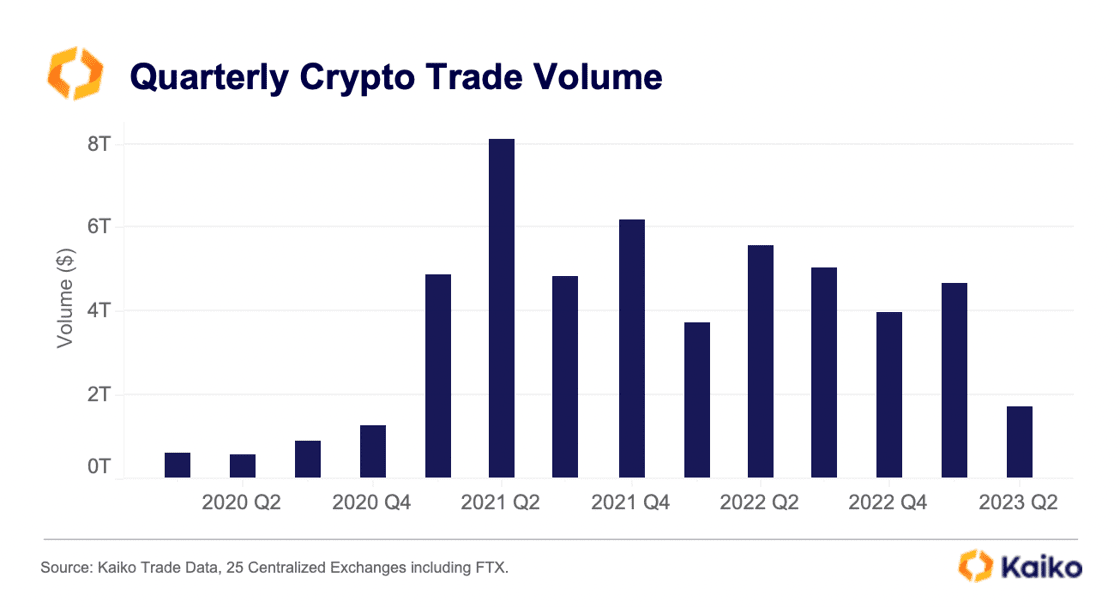
Looking at centralised exchanges per data from Kaiko as we close out the second quarter of 2023, volume over the past three months was lower again, coming in at the lowest number since 2020, before Bitcoin and crypto embarked on their inexorable price rises and took the financial world by storm. 

But with lower liquidity, moves to both the upside and downside are exacerbated. This has perhaps contributed to Bitcoin’s steep rise in the past few weeks, and also year-to-date, with it currently up 83%. 

But liquidity and volumes being so low should be alarming for market participants. Much of the inroads made during the pandemic, with regard to Bitcoin taking its place next to bona-fide asset classes from a trading perspective, have slowed if not reversed – at least from a liquidity perspective. 

As further evidence of this, in the below chart, I’ve presented the total balance of stablecoins across exchanges, which has fallen a staggering 60% in the past six months – an outflow of $26 billion. 

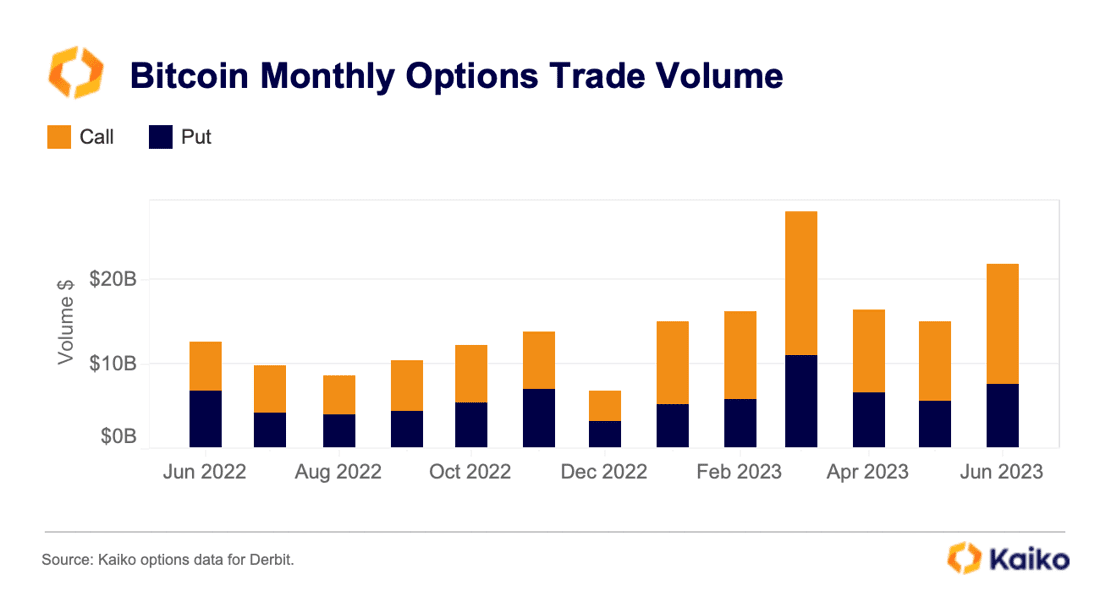
Having said that, there are pockets of optimism which hint at a brighter future if/when these spot ETFs do get approved. Looking at volume in derivatives markets, it has been rather consistent. In fact, it is markedly up on the second half of 2022. Perhaps this means the spot market has been greater affected by the regulatory crackdown. Either way, it’s a less gruesome picture than what we are seeing in spot markets. 

Regulation

Right now, with regard to crypto-specific risk, it really all comes back to regulation. We have discussed the ETF filings, but June also brought two seminal moments: formal charges brought against Coinbase and Binance. 

The two cases are extremely different, mind you. Binance’s lawsuit could not be less surprising, with the exchange constantly skirting guidelines and laws. The charges amount to a laundry list of different offences, including trading against customers, manipulating trade volume, encouraging users to circumvent geographical restrictions and securities violations. 

It is the latter charge which is the centre of the suit against Coinbase, however, and the most pivotal of the lot. It is also why the Coinbase suit is far more intriguing. Do not forget that the allegations are coming from the SEC, the same body which presided over Coinbase’s IPO in April 2021. Why did the SEC let an unregistered securities exchange float on a US stock exchange? You tell me. 

But let’s get back to the point: what this all means for crypto markets. While Bitcoin appears to be carving its own place out in the eyes of the law, a slew of other tokens were named as securities by the SEC. Despite this, they have risen sharply since off the Bitcoin ETF news. Does this make sense? 

Conclusion

At the end of the day, crypto is going to crypto. Prices move, and trying to pinpoint reasons is often a fool’s errand. The last month, however, feels like we have seen an extremely aggressive price rise despite some bad news on the regulatory front. 

Additionally, the macro picture has not changed much, even with the pause at the last Fed meeting. Fed chair Jerome Powell’s comments made it clear that this was a pause rather than an about-turn in policy. 

“Looking ahead, nearly all committee participants view it as likely that some further rate increases will be appropriate this year,” Powell said when announcing the pause. 

The market believes him. I backed out probabilities from Fed futures in the next chart, which show that there is currently an 86% chance of a 25 bps hike at the next Fed meeting in three weeks time, with only a 14% chance of rates being left unchanged again. I have presented this next to the same probabilities conveyed by the market exactly a month ago (Bitcoin is up 20% in the time since), showing softer forecasts do not explain the sharp price (the chance of no hike has actually come down). 

As I said, crypto going to crypto. But with assets as notoriously volatile as what we see in this sector, it would be wise to stop and think about whether the sudden wave of positivity is justified. When considering the liquidity picture and the regulatory trouble, there are plenty of reasons to hesitate. 

Then when one layers in the macro picture, the picture becomes murkier again. Let us not forget that we are in the midst of one of the swiftest rate hiking cycles in modern history, with rates rising all the way from zero to above 5%, and the prospect of them rising even further later this month. 

Monetary policy operates with a lag, and the scale of that tightening is enormous. Sentiment may feel like it has flipped dramatically, but there is a long road ahead yet. 

The post Crypto prices rising and sentiment flipping but liquidity & macro picture are ominous appeared first on CoinJournal.