
Huge anticipation as Shiba Memu clocks nearly $1.7M in presale

  • New meme sensation Shiba Memu has raised $1.697 million

  • Shiba Memu gears to be a sustainable meme cryptocurrency

  • The token has a huge potential of up to 50x

There is a lot of enthusiasm around the launch of a new meme cryptocurrency, Shiba Memu. The lovely puppy of a cryptocurrency has caught the eye of investors looking for a meme out of the ordinary. Unlike its siblings like Shiba Inu, Shiba Memu is an AI-led meme cryptocurrency. As such, it has greater capabilities, making it a worthy rival with huge potential. That partly explains the fast-selling presale, which has raised $1.697 million in a few weeks.

Leveraging the power of AI through Shiba Memu

Shiba Memu is unique to other meme cryptocurrencies in that it incorporates AI. AI enables Shiba Memu to maintain momentum and be a sustainable project. That’s due to the fact that Shiba Memu doesn’t rely on human-led PR to increase popularity. It can sniff out the best creative ideas in advertising, generate hype and drive growth. 

Shiba Memu also grows and becomes better each day. As an autonomous marketing machine, Shiba Memu can learn from its successful marketing interventions. It can also improve its own strategies and apply marketing strategies that align with new trends. 

But Shiba Memu can also forecast trends and tailor its marketing. It does it through its predictive analytics capabilities, which make the puppy move with time. As you may be aware, the meme landscape generates a lot of online chatter and sentiment. Shiba Memu can use its sentimental analysis to distinguish between important and unimportant messages. This way, it can craft objective responses to keep its community informed.

Finally, Shiba Memu can build positive interactions with users. It does so through an AI dashboard. Users can ask questions, provide feedback, and get informed on the latest in creative advertising. The engagement could drive hype for the project and allow Shiba Memu to remain sustainable. 

The unique Shiba Memu presale

Forget those endless weeks or months of presale. Shiba Memu’s presale occurs in eight weeks. After this, the presale will close with whatever amount is raised and tokens released to the holders. 

However, the best part is that the price of SHMU increases daily at 6 PM. By the end of the presale, the price will be $0.0244, up from the initial $0.011125. With this price dynamic, Shiba Memu generates value for investors daily.

What is the price potential of Shiba Memu?

Given the early subscription for the project, it is interesting to think about the potential of Shiba Memu. As a snapshot, meme cryptocurrencies rose from a valuation of $0 in early 2020 to $20 billion in early 2022. Investors see them as vehicles for quick gains, a task they have delivered.

Shiba Memu enters the meme space, riding on the momentum that started in 2020. In the past, meme cryptocurrencies have risen by up to 1000% in a few days after going live. Shiba Memu stares at a similar potential once it launches on exchanges. 

But Shiba Memu could go the extra mile. AI is fast growing and is hype in itself. Shiba Memu could ride on the meme and AI hype to become an overnight sensation. 

There is also the question of the future potential of which other meme cryptocurrencies have fallen short. With the capability of AI, Shiba Memu could tap into more use cases to sustain growth. This means the potential for Shiba Memu to become a 50x investment is nearly an expectation.

Should you invest in Shiba Memu now?

A lost opportunity to invest in a good project could haunt. As we saw with the meme tokens of the past, procrastination always brings lamentation. These tokens have returned big to its early movers.

Any ideal investment like Shiba Memu is best taken when the project is launching. This is when the price is low and demand is locked. Thus, investing in the meme token could be right now than when the token has been listed.

The post Huge anticipation as Shiba Memu clocks nearly $1.7M in presale appeared first on CoinJournal.
What will happen to Ethereum’s staking yield?


Key Takeaways

  • Ethereum completed its long-awaited Merge upgrade in September 2022
  • Stakers are currently earning approximately 4% APY from their Ether tokens
  • 19% of the total Ether supply is staked, the lowest ratio of any of the leading coins
  • Staking rewards are divided among stakers, meaning the APY earned decreases as more users stake
  • Demand on the network increases gas fees and ultimately contributes to more APY, meaning there are several factors at play when trying to assess where the yield may land
  • All in all, it remains up for debate as to where the yield is headed, despite many analysts predicting basement-level yields of 1%-2% are inevitable


The fundamentals of Ethereum were entirely transformed in September 2022 when the Merge went live, the blockchain officially becoming a proof-of-stake consensus. The implications for this are many, however one of the more fascinating aspects is that investors can now earn a yield from staking their Ether tokens.

Let’s dive into how popular staking has been, where it’s trending going forward, and speculate about where the all-important APY may land.

Ethereum stakers are increasing

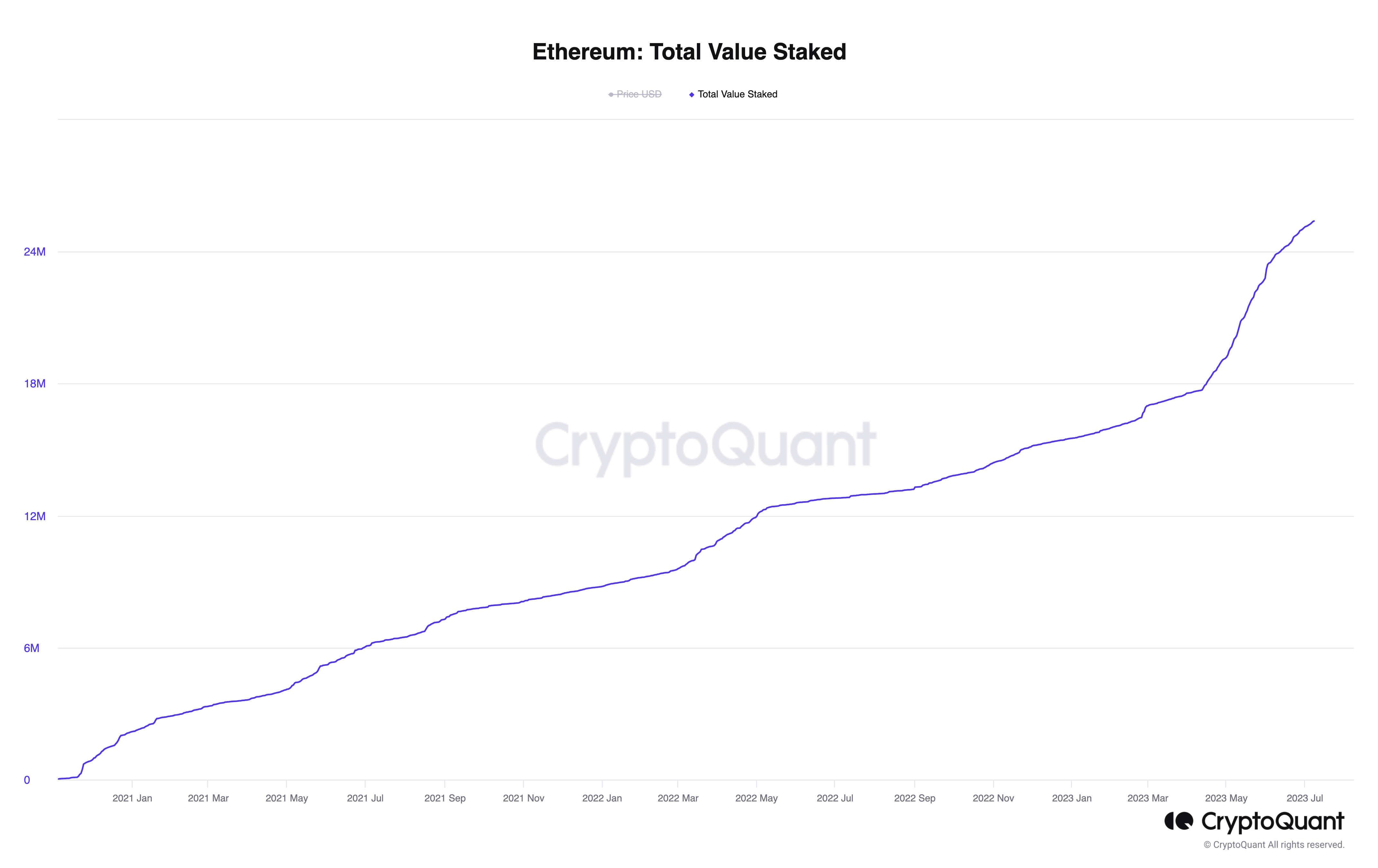
Ethereum staking has proved wildly popular. There is currently almost 18.75% of the total supply staked. The below chart from CryptoQuant shows that not only has the increase been consistent, but the rate of increase has steepened noticeably since the Shapella upgrade in April.

Shapella finally allowed staked Ether to be withdrawn, with some early stakers having had tokens locked up since Q4 of 2020. There was hence some concern that Ether would be withdrawn en masse once the Shapella upgrade went live, the subsequent sell pressure bound to dent the price. Not only has this happened, but staking has only become more popular since the upgrade.

Despite the popularity of Ethereum staking, and the lack of withdrawals sparked by Shapella, the network’s staked tokens as a percent of the total supply still pale in comparison to other proof-of-stake blockchains.
The chart below highlights Ethereum in yellow, its 19% ratio far below the other major proof-of-stake coins. Assessing the rest of the top 10 by staked market cap, these coins average a 53% stake ratio, with only BNB Chain remotely close to Ethereum, sitting at 15%.

If we then shift the chart to assess the total market cap of the staked portion of coins, Ethereum’s dominance is clear. Its 19% staked tokens carry a value of $43 billion – more than the other nine cryptos’ staked market caps combined.

Ethereum’s low staked ratio implies that it should have more, at least if other coins can be used as a benchmark. This is especially true when considering recent bullish developments on the Ethereum network which suggest it may be solidifying its place as the market-leading smart contract platform. Most notable of these could be discussion around potential Ether futures ETFs, as well as the announcement that PayPal is launching a stablecoin on the network this week.

So, what happens to the staking yield if the amount of staked Ether does indeed continue to increase? Remember, the total annual yield paid out to stakers is calculated as follows:

[(gross annual ETH issuance + annual fees*(1-% of fees burned)]

These total staking rewards are then divided by the average ETH staked over the year to commute the APY.

In other words: The amount of ether staked is in the denominator of the fraction. So as the amount staked gets bigger, the APY shrinks. This effect can already be seen in what has happened to date. Analysts had predicted a yield of 10%-12% ahead of the Merge, however today it is closer to 4%.  And that is 4% with its staking ratio completely out of whack compared to other proof-of-stake coins, as mentioned above.

What happens next?

With the amount of Ether staked increasing incessantly, is the yield therefore primed to collapse?

Some analysts believe it is headed towards 1%-2%; some even think less. The reality is that nobody really knows because, as always, demand relies on a variety of factors.

We need to remember, as we often say in these columns, that speculating on the future of crypto is so difficult because we have such little data to work with. This is true for Ethereum as a whole, which only launched in 2015, but especially so regarding the yield, as the Merge has only been live since September (or since April if you count the “true” completion date as post-Shapella).

Hence, it is a challenge to forecast the staking yield going forward. We have focused on the impressive growth of staking thus far, and while this will drive the yield down, demand on the network will increase the numerator of the aforementioned formula and kick the yield up.

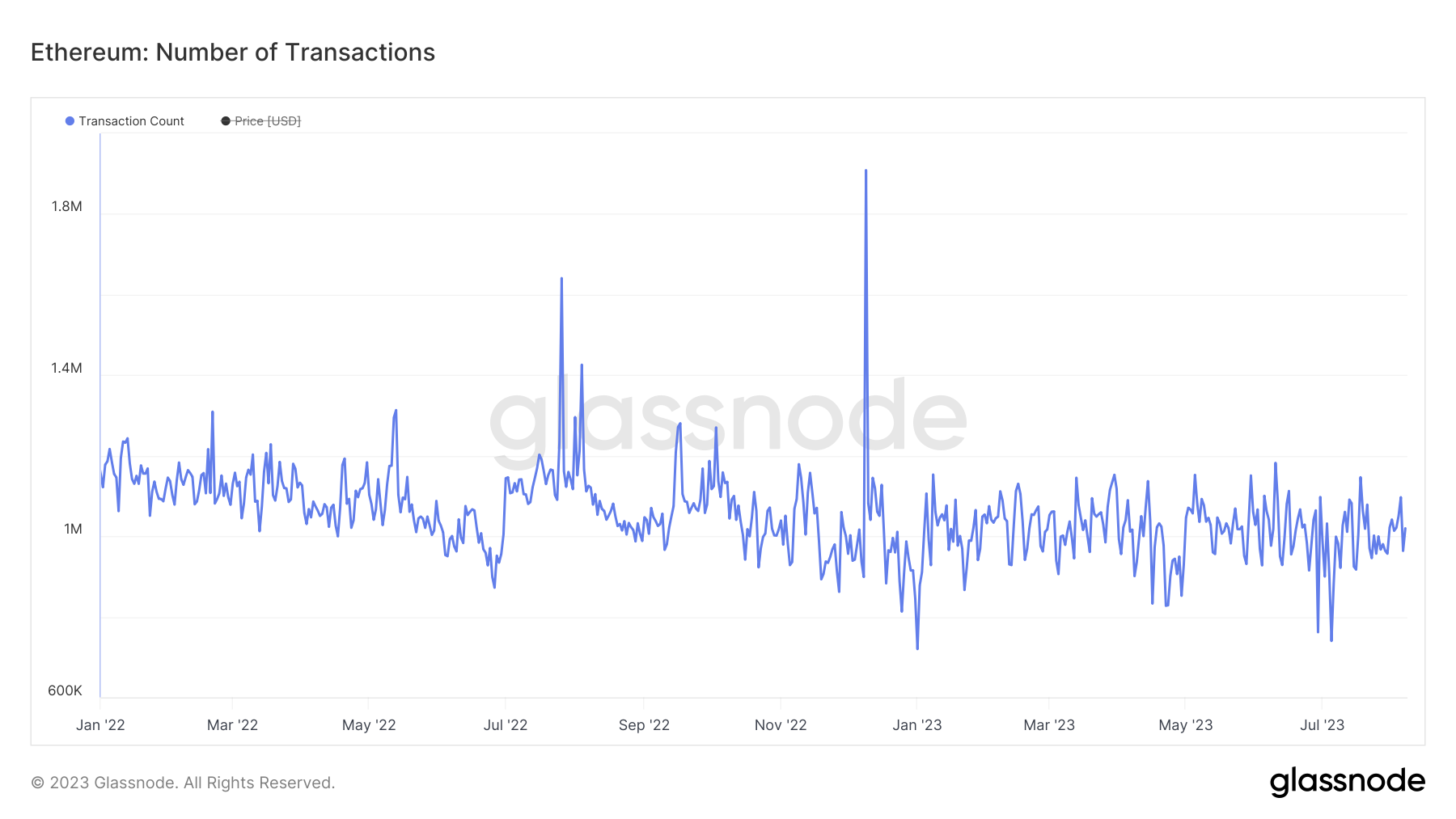
Indeed, looking at total transactions, the rate has been quite resilient throughout the last eighteen months, despite the bloodbath in the sector last year.

Then again, crypto is changing quickly. It remains difficult to foresee how regulation, infrastructural development (restaking and Eigeanlayer spring to mind as an example) and the macro landscape, just to name a few factors, will affect the climate going forward.

Speaking of macro, there is also the matter of trad-fi yields. Currently, the Fed funds rate is 5.25%-5.5%, having been near-zero prior to March 2022. Backing out probabilities from Fed futures implies the market is expecting the end of the cycle is near. Not to mention, with the mammoth amount of debt in the current system, rates cannot stay high forever.

Could falling trad-fi yields affect demand for staking yield? Perhaps – while it is hard to separate the overall liquidity drain and suppressing of risk assets that occurs out of hiked rates, the superior (and risk-free) return is definitely a key reason why capital has flooded out of DeFi in the last year. While previously-dizzying DeFi yields have collapsed, trad-fi yields have rocketed as the Federal Reserve has scrambled to rein in rampant inflation.

Furthermore, if yield does fall down towards 1%-2%, stakers could begin to pull out and search elsewhere for income. This would therefore create a reflexive relationship with regard to the yield.

All in all, it remains too early to speculate about where the Ethereum staking yield is ultimately headed, at least with any degree of confidence; it depends on too many factors and the sample space is too brief to date. It does seem likely, if not inevitable, that the yield will decline to some degree, but the question of how much is a difficult one to answer. While many are adamant the APY will cascade downwards to uber-thin levels – and for the avoidance of doubt, it may do – we have presented here at least some points of consideration as to why the situation may not be as clear cut.

The post What will happen to Ethereum’s staking yield? appeared first on CoinJournal.

Here’s why Pepe and Shiba Inu prices are soaring

Pepe and Shiba Inu prices bounced back on Wednesday as cryptocurrencies drifted upwards. Shiba Inu jumped by more than 10% in the past 24 hours to $0.000010 meaning it has soared by 62% from the lowest level this year.

Pepe, on the other hand, rose by 12% in a high-volume environment. The token rose to a high of $0.0000012, the highest level since August 2nd. This rally happened as the volume jumped to over $195 million in the past 24 hours. Most of this volume came from centralized exchanges like Binance and KuCoin.

There was no immediate trigger for the meme coin rally. A likely reason is that big coins like Bitcoin and Ethereum drifted upwards. Bitcoin jumped above $29,500 after it found a strong support level at $28,800, where it struggled to move below in the past few weeks.

Some analysts pointed to technicals, which pointed to a sustained Pepe price rally. In a tweet, a popular analyst noted that the token’s TD Sequential indicator had turned positive on the daily chart. TD Sequential is a popular indicator that identifies the exact time of trend exhaustion and price reversal. The indicator pointed to further gains to $0.0000159.

https://twitter.com/ali_charts/status/1689178342329593856

Shiba Inu price, on the other hand, rose as investors waited for the upcoming Shibarium launch. Shibarium will be a layer-2 network that will solve the speed and cost factors in the ShibaSwap ecosystem.

Shibarium is one of the ways that Shiba Inu is using to build an ecosystem. For it to succeed, the developers believe that building an independent layer-2 network will lower transaction costs and boost speeds. 

Shiaba Inu price also jumped as the network’s Shiboshis NFTs saw higher demand as transactions in the ecosystem rose.

https://twitter.com/LucieSHIB/status/1688913948773588993?ref_src=twsrc%5Etfw

How to buy Shiba Inu

eToro

eToro offers a wide range of cryptos, such as Bitcoin, XRP and others, alongside crypto/fiat and crypto/crypto pairs. eToro users can connect with, learn from, and copy or get copied by other users.

Public

Public is an investing platform that allows you to invest stocks, ETFs, crypto, and alternative assets like fine art and collectibles—all in one place.

The post Here’s why Pepe and Shiba Inu prices are soaring appeared first on CoinJournal.

Should you own Bitcoin, given the growing adoption of digital currencies?

  • Cryptocurrencies keep growing in popularity
  • Bitcoin’s price dynamics changed with institutional investors’ adoption
  • Bitcoin is now correlated with assets in the traditional financial market

Since digital currencies exist, the industry evolved exponentially in a little more than a decade. Currently, more than 22,000 cryptocurrencies are part of one of the most dynamic markets in the world. 

The huge number of currencies brings a few challenges to traders and investors. First, crypto exchanges find it difficult to list all cryptocurrencies; thus, investors may miss some opportunities. 

Second, many projects in the crypto space failed. Statistics say that nine in ten blockchain projects will fail. 

For example, in 2023 alone, 83 coins disappeared for various reasons, such as failing ICO, no purpose, scams, or they had no volume. 

Therefore, to avoid being caught in projects doomed to fail or to be scammed, many investors prefer cryptocurrencies with a large market capitalization and well-established in the investing community. In other words, if a cryptocurrency becomes part of institutional investors’ portfolios, the chances are that it will still exist in the medium and long term. 

Bitcoin is such a digital currency. 

Bitcoin’s dynamics changed with the growing adoption of digital currencies

As the investing community embraced digital currencies, Bitcoin became part of more and more institutional investors’ portfolios. 

But the adoption came with some costs. 

Bitcoin chart by TradingView

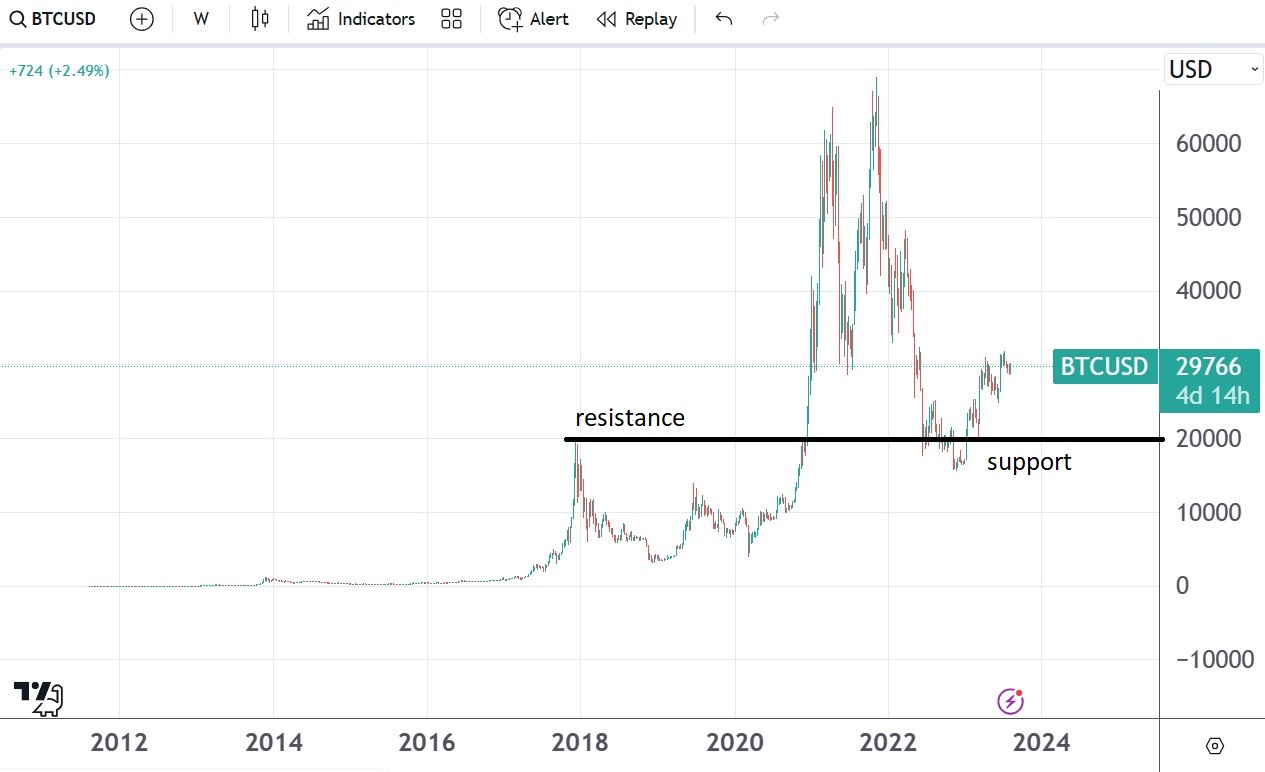
Take the chart above. It shows Bitcoin’s price evolution since its inception. 

When it first traded above $1,000, Bitcoin caught everyone’s attention. Then, when it reached $20,000 for the first time, everyone talked about a bubble. 

So strong was the resistance level that it took Bitcoin a few years to overcome it. Respecting the interchangeability principle, resistance has become support recently. 

But such ample moves are unlikely to be seen in the future. Because Bitcoin’s correlation to traditional financial markets increased, it is unlikely for the price to triple or double without similar moves elsewhere. 

Summing up, Bitcoin may be a good investment for the long term, but the rising adoption of cryptocurrencies will make it more and more difficult for the price to move the way it did before. 

The post Should you own Bitcoin, given the growing adoption of digital currencies? appeared first on CoinJournal.

AltSignals’ stage two presale tops $1.2M: Should you invest now?

Key takeaways

  • AltSignals’ stage two presale has already raked in over $1.2 million.

  • The presale continues to move forward despite the recent market events. 

The cryptocurrency market has had a positive week so far, with the prices of most coins and tokens up by more than 1% over the last few days. 

Bitcoin, the world’s number one cryptocurrency by market cap, has been up by more than 2% in the last 24 hours. At press time, the price of Bitcoin stands at $29,798 per coin.

With the market currently in a positive trend, AltSignals’ presale is also moving excellently. The team has broken another funding record, with more than 50% of the funding required in the stage two presale already generated.  

What is AltSignals?

To invest in the project, you need to understand what the project represents and the problem they intend to fix within the Web3 ecosystem. 

AltSignals is a Web3 project that targets traders, within the crypto space and beyond. The team wants to tackle some of the challenges traders face when trading cryptocurrencies and other financial assets. 

In their whitepaper, the AltSignals team explained that they would develop a platform that generates trading signals for stocks, forex, indices, cryptocurrencies, and CFDs. 

Technical analysis remains the biggest stumbling block for many aspiring traders. Knowing when to enter and exit trades is challenging for many.

AltSignals’ focus is to help traders in this aspect by leveraging blockchain technology and AI. The funds raised from presales will be channelled towards developing the AltSignals trading platform. 

The platform will be powered by ASI, its native token. At the moment, ASI is currently going for 0.01875 per token and could increase ahead of the next presale event. 

The AltSignals team also explained that they would use the funds generated from the funding rounds to develop ActualizeAI, the trading solution designed to make it easier for more people to enter the cryptocurrency trading scene. 

ActualizeAI is an automated solution that handles technical analysis on behalf of traders. 

Visit the official AltSignals website to learn more about their presale.

AltSignals’s stage two presale rakes in over $1.2M

The cryptocurrency market has had a positive week so far, with the Fear and Greed Index indicating that investors are becoming bullish about Bitcoin’s price.

With the market experiencing an improved performance this week, AltSignals’ presale event continues without a hitch. 

The AltSignals team has raised more than $1.2 million in the stage two presale so far. Over 55% of the tokens allocated for the stage two presale have been sold. The project is still in its early days and could gain massive adoption among traders. 

The broader crypto market has performed well since the start of the year, and that could serve as an incentive for more investors to enter the market.

Some investors might be looking to invest in new projects, and AltSignals could be one of the projects that investors might consider. 

Should you purchase ASI tokens in the presale?

One of the best times to invest in a project is during the presale or private sales. The tokens are usually sold at a discount during that period, and early investors could go on to rake in thousands of percentages in ROI once the projects launch and gain the needed level of adoption. 

It could be best to invest in AltSignals now that the project is in its presale stage. With Bitcoin’s price up by nearly 50% year-to-date, the broader crypto market could embark on a Bull Run soon.

If the Bull Run commences, ASI could become one of the biggest winners. AltSignals is an interesting project that could attract thousands of traders to the cryptocurrency market. 

The development of ActualizeAI is crucial to the success of the project. If the development team deliver on their products, AltSignals could become a leading project in its niche. 

The post AltSignals’ stage two presale tops $1.2M: Should you invest now? appeared first on CoinJournal.