
Coinbase stock: bouncing back but a disaster for investors to date


Key Takeaways 

  • Coinbase went public in April 2021, close to the top of the crypto market and near a $100 billion valuation
  • Despite a stout 141% rise thus far this year, it remains 77% off its IPO price
  • It has underperformed Bitcoin significantly
  • Regulatory issues cloud picture but hope remains that it can establish itself as largest fiat on-boarder

Coinbase stock is having a bumper year. The cryptocurrency exchange is up 141% year-to-date, far exceeding both Bitcoin and the Nasdaq, which have risen 77% and 31% respectively.  This year-to-date gain comes despite a 24% fall over the last month. 

And yet, despite the boisterous performance thus far this year, for those who invested in Coinbase a couple of years ago, it has been nothing but pain. The stock remains 76% below its IPO price from April 2021. At one point flirting with a $100 billion valuation, today it has a market cap of $19 billion. 

The travails of the stock sum up the struggles in the wider cryptocurrency industry over the last eighteen months. Booming during the pandemic as stimulus cheques flowed and interest rates were non-existent, the music stopped last year once inflation began to spiral. Central banks were forced to hike interest rates, with the US Federal Reserve particularly aggressive. Today, rates are north of 5%, with risk assets pulling back severely last year as a result. 

Trouble within crypto

In addition to the harsh macro climate, the crypto sector has done itself no favours. There have been several startling collapses which triggered mass contagion across the industry. The first was the death spiral of the UST stablecoin, taking down the entire Terra ecosystem and leading to a host of bankruptcies, including hedge fund Three Arrows Capital.

Crypto lender Celsius were among the other firms to follow, but it was the demise of FTX, the Bahamas-based exchange, that was the cherry on top. Bitcoin fell to $15,500 and the entire industry was in disarray. For Coinbase shareholders, despite the evaporation of a key competitor, the stock price suffered further, such was the damage to the ecosystem. 

In retrospect, Coinbase went public right at the top, walking into an oncoming storm. Marking their IPO on a Bitcoin price chart below shows how poignant the timing was. 

Yet even with bad timing, it has underperformed Bitcoin. While the two assets have been highly correlated, since the start of 2022 (roughly coinciding with the start of the crypto bear market), Coinbase has headed lower than the world’s biggest crypto. 

Regulation

A big part of the issue is regulation. US lawmakers are cracking down on the cryptocurrency industry, and Coinbase is squarely in the line of fire. The exchange was sued in June for securities violations. 

“(The SEC) came back to us, and they said . . . we believe every asset other than bitcoin is a security,” Brian Armstrong, CEO of Coinbase, said. “And, we said, well how are you coming to that conclusion, because that’s not our interpretation of the law. And they said, we’re not going to explain it to you, you need to delist every asset other than Bitcoin.” 

“We really didn’t have a choice at that point, delisting every asset other than bitcoin, which by the way is not what the law says, would have essentially meant the end of the crypto industry in the US,” Armstrong continued. “It kind of made it an easy choice . . . let’s go to court and find out what the court says.”

The court case will be pivotal not only for the future of Coinbase’s business, but the entire crypto industry in the US. Yet despite the regulatory troubles, Coinbase is arguably the most reputable major exchange. Its legal trouble centres on securities violations, a far cry from the laundry list of accusations against the biggest exchange, Binance. Changpeng Zhao’s company faces charges of trading against customers, manipulating volume, circumventing AML and KYC laws, and more. 

Institutional on-boarder

Additionally, many of the spot ETF applications which have been lodged with the SEC recently outline Coinbase as a proposed custodian. This, in addition to its cleaner reputation as mentioned above, highlights an angle that Coinbase could exploit if it does manage to fight its corner in court successfully: institutional money. 

If or when institutional capital is allowed to flow freely into crypto, Coinbase – at least right now – appears well placed to vacuum up all that volume and offer as a vital on-boarding into the on-chain world for all this trad-fi capital. 

It is difficult to forecast how the legal case will play out, and in any case, it will not be resolved quickly. On the positive side for COIN investors, last month’s ruling in the landmark Ripple security case provided hope, even if it was only a partial win, with the result also pushed back against by the SEC.

Whatever happens with that case, COIN investors will hope that the future brings more positive results than the past, as the stock has been a disaster for most. Perhaps the best way to sum it up is this: had investors put their money in FTX, and if FTX creditors end up securing 24 cents on the dollar or greater, they would be better off than Coinbase investors. Obviously, that is a silly comparison and assumes Coinbase trades flat from here (not to mention the fact that bankruptcy proceedings will take years), but it does indicate quite how badly Coinbase stock has performed since those dizzying days of 2021. 

The post Coinbase stock: bouncing back but a disaster for investors to date appeared first on CoinJournal.
Does Litecoin’s halving provide clues ahead of Bitcoin’s next April?


Key Takeaways

  • The next Bitcoin halving is slated for April 2024, the fourth of Bitcoin’s existence
  • Litecoin has just undergone its fourth halving, but the price effects of Litecoin halvings in the past have not been as strong
  • Sample size is small meaning it is hard to conclude with confidence whether halvings have tangible price effects in the short-term
  • Bitcoin is a very different proposition to Litecoin, but the price action going forward of the latter will be interesting to track as we approach Bitcoin’s next halving in April 2024

Whether Bitcoin halvings are priced in has become a fervent topic of debate among the community. We put together an analysis of this question a few weeks ago, as we now fast approach the fourth halving of Bitcoin’s young life. 

Slated for April 2024, the halving will cut the Bitcoin block subsidy from 6.25 Bitcoins to 3.125 Bitcoins per block, halving the issuance rate of newly created supply.

We will not rehash (pun intended!) our aforementioned analysis of the upcoming halving here. Instead, we will focus on another coin: Litecoin. One of the world’s first altcoins, it is a derivative of Bitcoin and, intriguingly, just underwent the fourth halving of its life. 

Can Litecoin therefore be seen as a guinea pig ahead of Bitcoin’s own halving next year? Well, not really, but we may be able to gain certain insights. 

First, let us examine Litecoin’s performance through past halvings. Price data is quite illiquid prior to 2015, so the below chart omits the first halving. 

The log scale of the chart somewhat obscures it, but the second halving in 2015 preceded strong price performance for Litecoin. On the other hand, the third halving in 2019 saw falling prices, before the trend reversed after COVID struck in 2020, when the entire crypto sector surged into the mainstream. 

It is too soon to draw conclusions regarding the fourth halving, which occured just over a week ago on August 5th. Nevertheless, Litecoin’s halvings don’t offer compelling evidence of a strong relationship thus far at least. Furthermore, like most questions in crypto, the sample size is so small that even if they did precipitate aggressive price rises immediately, that would not necessarily mean there is causation.  

Bitcoin is not Litecoin, but again, we may be able to derive clues from the pattern in ascertaining the effect of halvings on the former, even if we can’t be confident given the sample size issues. First, let us now look at Bitcoin’s price action while marking the halving events:

The pattern is clear. Typically, we have seen outsized volatility in the months leading up to a halving, before strong outperformance on the other side. The outperformance has also grown smaller with each halving, perhaps unsurprising given the market cap has grown so much in the four years between each event.  

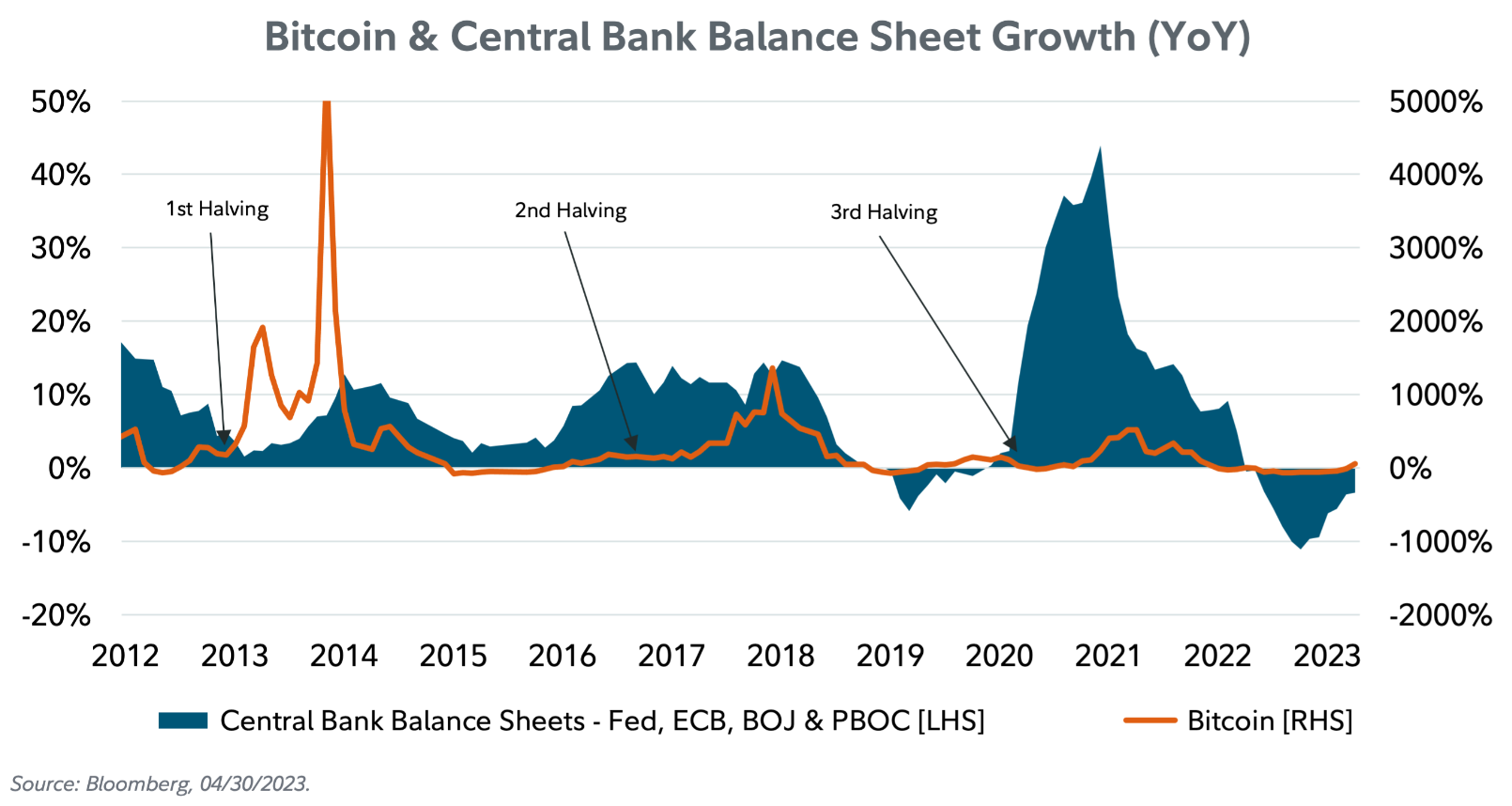
So, why has the effect of halvings on Bitcoin been, at least optically, larger than the same events on Litecoin? The first theory takes us to the heart of the debate on whether halvings are really priced in: while previous events have preceded steep inclines for Bitcoin, they have also lined up well with global liquidity cycles. 

The below chart from Fidelity shows this well. There is perhaps no greater influence on the valuations of risk assets than central bank balance sheets, and the halvings have lined up incredibly well with the expansion of those same balance sheets. 

The thing is, the next halving could well line up with an expansion in liquidity again. The previous eighteen months have seen one of the fastest rate-hiking cycles in recent history, with the Fed funds rate now above 5%. Now, looking at probabilities implied by the futures market, the market is anticipating that the hikes are coming to a close (if they haven’t done so already). 

Looking further forward towards the time period around the halving (April), futures imply that rate cuts could come into play. Not to mention, when we look at the yield curve, it is currently at the deepest level of inversion since the early 80s. The bottom line is this: the fourth halving, through sheer chance, could again line up miraculously well with global liquidity cycles. 

Of course, the macro situation has been changing incessantly, and there is every chance that forecasts around the liquidity cycle could flip, and the halving won’t line up as well as it has done in the past. 

This is where Litecoin may come in. With its halvings landing at different dates to Bitcoin in the past, yet not boosting prices as much as the orange coin saw, perhaps it is just a timing thing, whether macro-related or other? Looking at Litecoin’s price action compared to Bitcoin, the duo are tightly correlated, like many altcoins in the space. If Litecoin’s halving does not cause a slight outperformance this time compared to Bitcoin or other coins, what would be the explanation? 

Ultimately, like we keep saying, the sample size is small. Bitcoin has only experienced three halvings, and one could even argue that it was only the recent event in 2020 that occurred while the asset was trading with sufficient liquidity. 

Litecoin’s less explosive price action after its own halvings do perhaps throw further doubt on the theory that a 50% cut to the new supply issuance will inevitably kick up the price. And yet, Litecoin is not Bitcoin, so the debate will rage on. 

Either way, revisiting Litecoin’s price performance around the time of Bitcoin halving will be interesting, because by then it will have had around eight months post-halving and may present a more relevant reference point.

The post Does Litecoin’s halving provide clues ahead of Bitcoin’s next April? appeared first on CoinJournal.

Litecoin price pattern points to an 18% plunge to $64

  • Litecoin has dropped by more than 30% from its highest level this year.

  • Focus now shifts to the upcoming FOMC minutes.

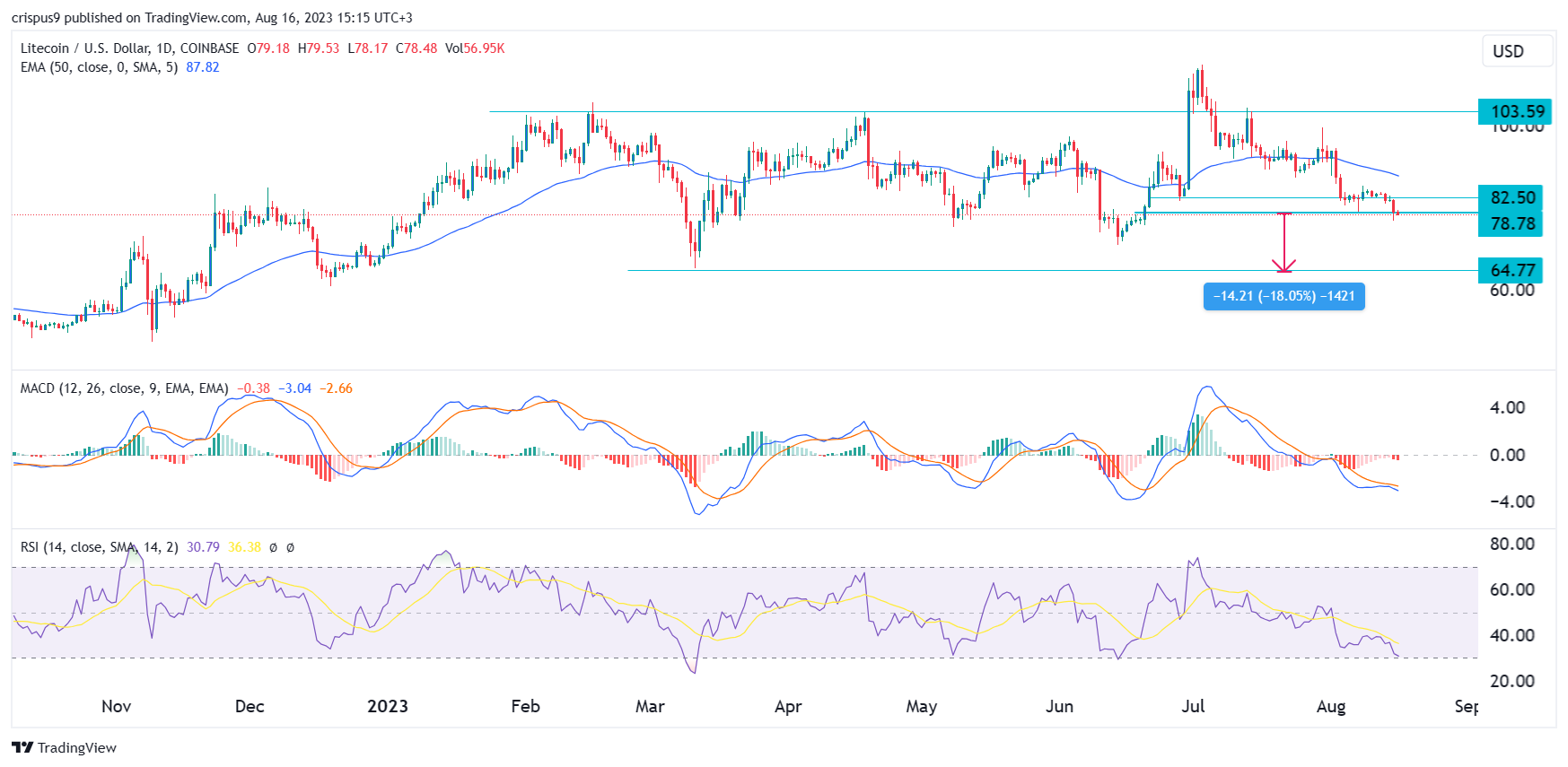
Litecoin price continued falling on Wednesday as focus shifted to the upcoming FOMC minutes. LTC plunged to a low of $78.78, the lowest level since June 20th. The coin has fallen by over 32% from its highest level in July. Other coins like Bitcoin, Ethereum, and XRP have also retreated.

FOMC minutes ahead

Litecoin has lost momentum in the past few weeks as the hype of the recent halving event faded. In most periods, cryptocurrencies tend to do well ahead of a major event and plunge shortly thereafter. This is known as buying the rumour, selling the news.

The next key catalyst that will move the LTC price will be the upcoming FOMC minutes. These minutes will show the deliberations that happened in the last meeting. In it, the bank decided to hike interest rates by 0.25%.

In the past, Fed minutes have moved key financial assets like cryptocurrencies and stocks. However, there is a likelihood that LTC and other cryptocurrencies will react mildly to the minutes.

Besides, they have failed to react positively to important events recently. For example, Litecoin and Bitcoin remained in a consolidation mode after last week’s US inflation data. The numbers showed that US inflation, except housing, is falling at a quicker rate than expected. 

Therefore, there is a likelihood that the Fed will pause hiking rates. Some analysts believe that the bank will even start cutting rates in the first quarter of 2024 since risks are rising. 

Bitcoin and Litecoin also ignored important news on China. The country has published weak economic numbers recently. For example, its imports and exports have slipped while retail sales and industrial production rose at a slower pace than expected.

Litecoin price forecast

The daily chart shows that LTC price has been in a downward trend after peaking at $114 in July. It has already dropped below the 50-day moving average and the crucial support at $82.50, the lowest point on June 28th. 

The two lines of the MACD indicator have moved to almost minus 3 while the Relative Strength Index (RSI) has moved to the oversold level. It also remains below the important resistance at $103.60, the highest point in February and March.

Therefore, Litecoin has more downside going forward, with the next level to watch being $64.77, the lowest swing on March 11th. This price is ~18% below the current level.

How to buy Litecoin

eToro

eToro is a multi-asset investment platform with more than 2000 assets, including stocks, ETF’s, indices, commodities and Cryptoassets. eToro offers over 60+ Cryptoassets to invest or invest in their CryptoPortfolio where investors can benefit from the accumulated growth of Bitcoin, Ethereum, XRP, Litecoin and other leading cryptocurrencies. eToro users can connect with, learn from, and copy or get copied by other users.

Skilling

Skilling is a regulated Forex and CFD broker that allows traders to access 800+ financial instruments, including 10 popular cryptocurrency CFDs with competitive pricing and fast execution time. Skilling offers a selection of trading platforms, including the proprietary Skilling Trader and popular, industry renown cTrader and MetaTrader 4 platforms, which can suit the needs of customers with different levels of trading experience.

The post Litecoin price pattern points to an 18% plunge to $64 appeared first on CoinJournal.

Shiba Memu’s presale is nearly $2 million. Is the token set to explode?

  • Shiba Memu has raised $2 million in a fast-happening presale

  • Investors have been thrilled by Shiba Memu’s AI capabilities set to make it a marketing powerhouse

  • Shiba Memu has a potential higher 1,000% price increase as the project gains popularity

Shiba Memu (SHMU) buyers are shy of the $2 million mark regarding the value of tokens bought. Since launching the presale a few weeks ago, token buying has been unstoppable. At this point, it is fair to say that buyers have huge bets for the new meme kid on the block. That positions the token to a potential price surge after listing. Investors can purchase the token via the project’s website. 

Is Shiba Memu the best meme cryptocurrency of 2023?

There are notable crypto names in the meme scene. Dogecoin and Shiba Inu have been the top dogs for quite a while. Still, new names like PEPE debuted in 2023 and became instant sensations. Undoubtedly, the meme space has been growing fast. The market hit a market cap of $20 billion in early 2022 from $0 in early 2020.

Nonetheless, there has been a notable challenge for most, if not all, meme cryptocurrencies. They have yet to replicate gains and remain sustainable to generate lasting returns. For Dogecoin and Shiba Inu, a prolonged bear market has caught up with the assets.

The search for a meme token likely to remain powerful and deliver lasting returns is on. Shiba Memu looks like that alpha edge investors have been looking into meme investments.

Against the backdrop of enjoying the privileges of being a meme, Shiba Memu aims to be sustainable. The project is built with an artificial intelligence angle. With AI, the focus is to make Shiba Memu powerful and intelligent, capable of doing more than humans. Shiba Memu will write its own PR, devise a marketing strategy, and generate FOMO for itself. After all, meme tokens are mostly driven by hype. 

But think of what AI can do in creative advertising. It can crawl the web and find the best ideas in marketing. The AI can then package the information in a fun, friendly, and understandable manner. As an AI-led project, Shiba Memu will feature these capabilities. 

The added advantages of AI in Shiba Memu make the project one of the best in crypto right now. As such, Shiba Memu could be the unlikely hero of 2023 while the rest of the sector sleeps.

Is Shiba Memu a 10x investment? 

It is highly speculative how much potential a newly launched token could rise. However, a 10x increase in value is an understatement, as meme tokens have risen up to 50x. 

So far, Shiba Memu has been a presale king, hinting at how much potential the token has. Thus, the future of the token is huge, which could start to get realised after listings in 2024. 

The possible price drivers for the token are hype due to ingenious self-marketing and demand. As the world evolves through AI, we could see more demand being unlocked for Shiba Memu. 

The project also allows users to interact with the software through an AI dashboard. They can ask questions, give suggestions, and be informed of the latest in creative advertising. This could unlock demand and make Shiba Memu a more than 10x investment.

What are the benefits of buying Shiba Memu in the presale?

Shiba Memu’s presale is quite unique. The price started at $0.011125 and is now at $0.020575. The price of the token will be $0.0244 when the presale ends. The increases have been due to SHMU tokenomics. The tokenomics will see SHMU value double by the end of the 8-week presale period.

Essentially, Shiba Memu’s price increases daily at 6 pm GMT. This allows buyers to see investment increases for their tokens daily and have a meme vibe. At the end of the presale, investors will receive their tokens and be set for huge benefits as SHMU lists.

The post Shiba Memu’s presale is nearly $2 million. Is the token set to explode? appeared first on CoinJournal.

Only 8% of people are familiar with Web3 – what has happened?


Key Takeaways

  • Google search interest in the metaverse is down 92% from its peak, highlighting the fall from grace for the concept
  • 92% of respondents globally said that they have heard of crypto, but only 8% considered themselves to be very familiar with the concept of Web3
  • Web3 often has trouble defining exactly what it is, with abstract and shifting goals frequently changing with time
  • Collapse of token economy and pullback in wider crypto space has curtailed enthusiasm
  • Web3 is not the metaverse, but there are valuable lessons to be had for tokens with regard to lofty goals and abstract descriptions 

Lockdowns, stimulus packages, social distancing – the year 2021 could not seem more different when looking back on it today. 

The same holds true within crypto. The year saw Bitcoin sail past $68,000, El Salvador declare the orange coin as legal tender, cartoon monkey pictures sold for millions of dollars, and a doggy token by the name of Dogecoin at a valuation of $88 billion.

Among the hysteria, a virtual world was touted more and more as the future. A future world where everybody could work, hang out and more, built on top of blockchain rails. They called it the “metaverse”. The only problem is, that clamour has become a whisper, as data for the search term “metaverse” on Google shows below, which is down 92% from its peak. 

Web3 has also pulled back

While the metaverse may be low hanging fruit to target, the more ubiquitous- and somewhat related – concept of Web3 has also struggled to maintain the excitement levels of the pandemic. 

Despite lofty predictions that Web3 was on the verge of a parabolic rise, in a recent survey conducted by YouGov and Consensys, the results suggested this was nowhere near. While 92% of respondents globally said that they have heard of crypto, only 8% considered themselves to be very familiar with the concept of Web3. 

With so many aware of crypto yet so few familiar with what Web3 is, it may suggest two things. The first, quite simply, is that Web3 has had trouble catching on; the results not delivering on the lofty promises, the protocols struggling to deliver utility amid a declining crypto environment. 

The second is a long-running criticism of Web3; namely, it has trouble defining exactly what it is, at least without venturing into an overly abstract realm. 

Interestingly, the same survey indicated enthusiasm around solving problems which proponents of Web3 claim it aims to fix. For example: 

  • 79% want more control over their identity on the Internet
  • 83% think data privacy is important
  • 67% believe they should own the things they make 

For some enthusiasts, this may be optimistic, as it highlights interest in the problems which Web3 aims to solve and an inevitable target market. And yet, in another way, it sums up the exact problem. These issues are extremely broad and vague. In a survey, it is not surprising that the majority say that they believe they should own the things they make, or that data privacy is important. 

Just because people are interested in these things does not necessarily mean that Web3 protocols built with the supposed goals of tackling these “problems” will succeed. As we have seen, once token prices fall, the climate shifts rapidly. 

Facebook rebranding to Meta sums up struggles

Perhaps there is no better way to sum up the popping of the bubble quite like Facebook’s decision to rebrand as Meta. On last month’s earnings call, CEO Mark Zuckerberg was forced to outline that the company’s determination to focus on the metaverse remains intact. 

“We remain fully committed to the Metaverse vision as well,” Zuckerberg said. “We’ve been working on both of these two major priorities (AI and the metaverse) for many years in parallel now, and in many ways the two areas are overlapping and complementary.”

Meta’s metaverse ventures have hurt shareholders. Last year, its Reality Labs unit, in charge of the Metaverse project, lost $13.7 billion. The year before, a further $10.2 billion was lost. 

“I can’t guarantee you that I’m going to be right about this bet. I do think that this is the direction that the world is going in,” Zuckerberg added. 

Thus far this year, Meta has performed strongly in conjunction with the bouceback in the tech sector. However, the rebound comes after the stock significantly underperformed the Nasdaq, with the underperformance widening after the company’s Meta rebrand in October 2021 (not that it is necessarily indicative, but it is interesting all the same). 

Looking back, the timing of Meta’s rebrand was unfortunate. Its public commitment to the metaverse and company name change came on October 28th 2021, only thirteen days before the Bitcoin price peak and the pinnacle of the COVID-driven crypto bonanza.

Of course, the pertinent counterpoint of this is that Meta represents the exact antithesis of what many Web3 believers desire. A dominant big tech company with a questionable history and public image, to say the least. And besides, the metaverse is not Web3 – although this inability to define it in tangible and actionable terms is part of the issue. 

Obviously, the entire crypto sector is hurting badly, not just metaverse and Web3 tokens. Bitcoin remains over 55% off its high. The macro environment has been problematic and risk assets have struggled across the board, with interest rates hiked north of 5% following so many years of treading water near zero.

In a more direct comparison, even interest in Bitcoin from the mainstream is down, with search volume for Bitcoin falling to two-year lows. And yet the damage with regard to the metaverse has been worse. Looking at the coins classified as metaverse on CoinMarketCap, the top currencies are all down at least 84%, with an average 92% drop.

It’s been a rough ride for all of crypto. But for metaverse, it has nearly decimated the still-nascent concept. While the metaverse is not Web3, there are many tokens and projects leaning on the promises of the latter while creating nothing of genuine utility. For the projects still around in the space, examining the travails of metaverse coins could be a valuable lesson. 

If you use our data, then we would appreciate a link back to https://coinjournal.net. Crediting our work with a link helps us to keep providing you with data analysis research.

Notes

Consensys and YouGov survey Link

The post Only 8% of people are familiar with Web3 – what has happened? appeared first on CoinJournal.