
Crypto price prediction: XDC Network, Cronos, Astar

  • Cryptocurrencies moved sideways this week as Bitcoin remained below $26,000.

  • XDC Network, Cronos, and Astar were among the biggest gainers.

Cryptocurrency prices had a relatively muted performance this week as a sense of fear spread in the market. Bitcoin was stuck at $26,000 while American indices like the Dow Jones, Nasdaq 100, and S&P 500 retreated. The US dollar index (DXY), on the other hand, staged a strong recovery as it soared to the highest level in five months.

XDC Network price forecast

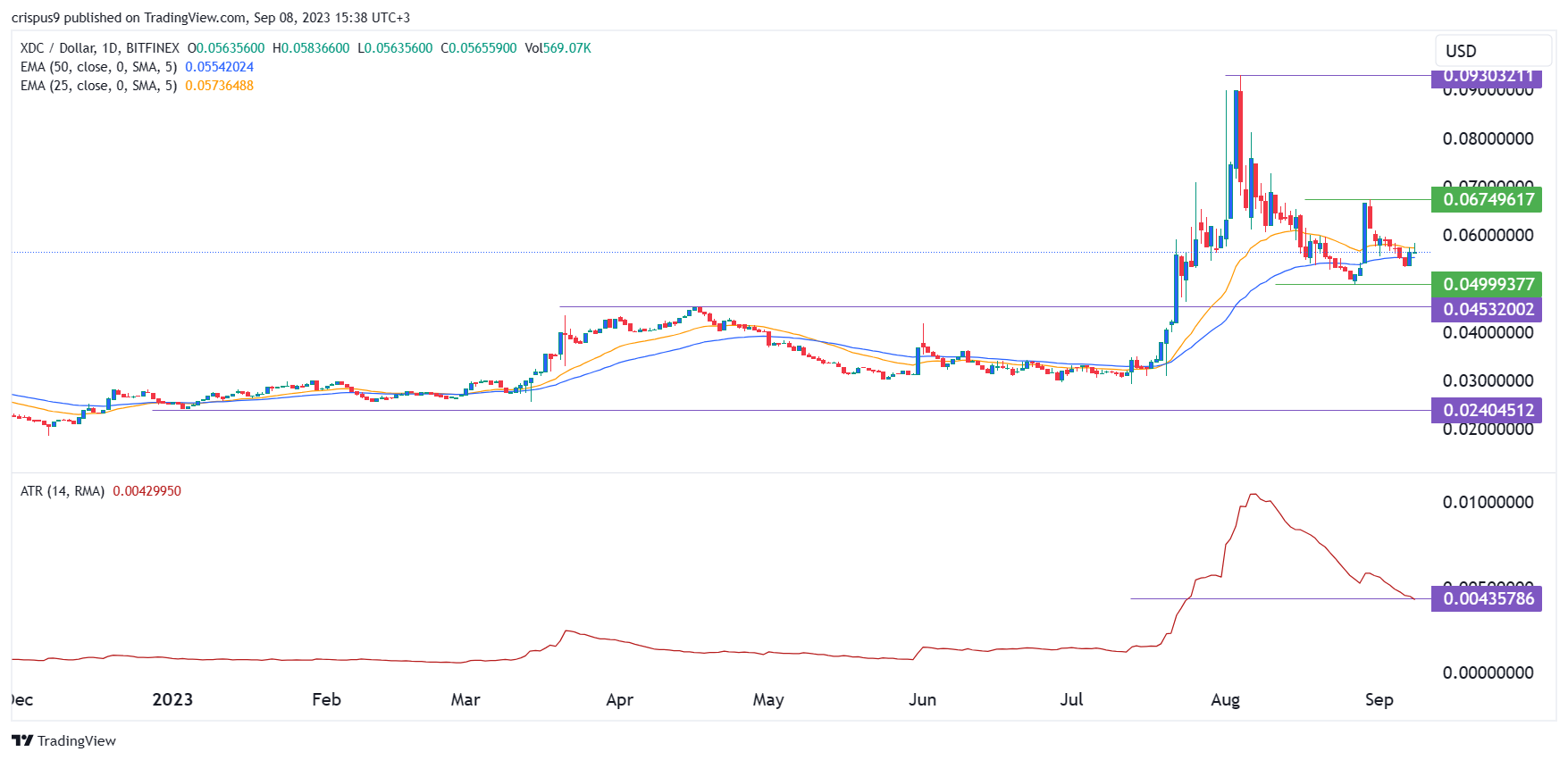
XDC Network has had one of the best performances this year. It jumped from a low of $0.024 in January and peaked to a high of $0.093 in August. Recently, however, the token has pulled back and is now ~40% below the highest level this year. It is now consolidating at the 25-period and 50-period exponential moving averages. 

The token has also moved slightly above the important support level at $0.045, the highest level in April this year. At the same time, its volatility has slumped, as evidenced by the falling Average True Range (ATR) indicator, which has fallen to the lowest level since July 25th. 

Therefore, the outlook for the XDC Network is bearish, with the initial support being $0.50, the lowest level on August 26th. Traders should focus on the resistance at $0.067 since a move above that level will see it continue its bullish trend to $0.08.
Cronos price prediction

Cronos, formerly known as Crypto.com coin, has been in a bearish trend as demand for the coin wanes. Its DeFi ecosystem has also seen outflows as the total value locked (TVL) slipped from over $4.4 billion to less than $500 million. Tectonic and VVS Finance are no longer the popular DeFi protocols they were earlier on.

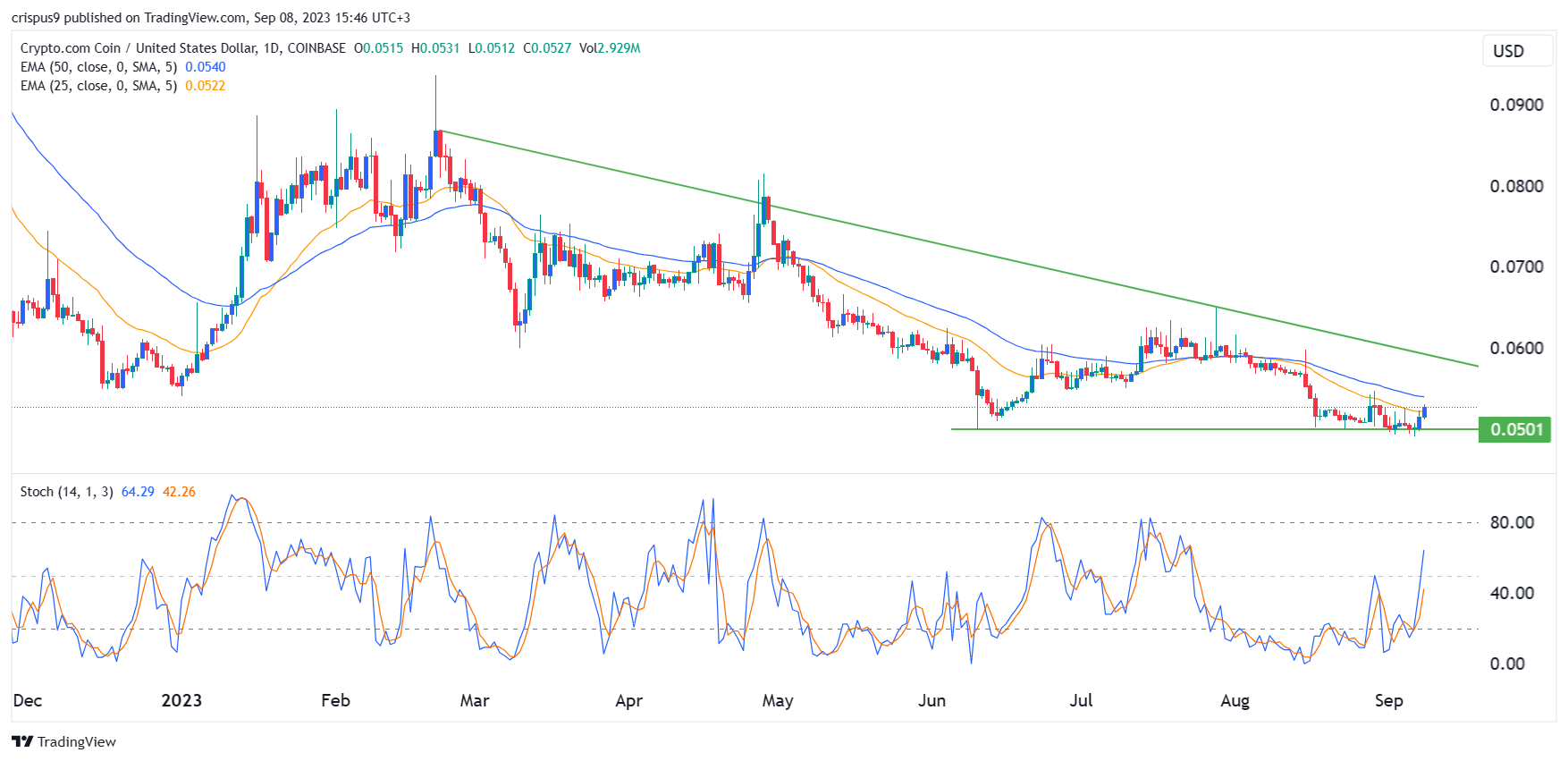
Cronos price found a strong support at $0.050, where it struggled to move below in June and August of this year. It remains below the 50-day moving average and the descending trendline shown in green. The Stochastic Oscillator has also tilted upwards. 

Therefore, the CRO price outlook is neutral for now. More downside will be confirmed if the price drops below the support at $0.05. If this happens, the next level to watch will be at $0.45. The alternative scenario is where it rises and retests the descending trendline at $0.057.
How to buy Cronos

AVATrade

Ava Financial Ltd operates the AvaFX and AvaTrade forex brands and all business associated with them. The company has a branch office in Dublin, Ireland, which enabled it to get an operational license from the Irish authorities.

LiquidityX

LiquidityX offers over 300 desirable financial assets to choose from. At LiquidityX, you can dive into global markets, and trade CFDs on Cryptocurrency assets ranging from the most popular coins like Bitcoin, Dogecoin and more.

Astar Network price forecast

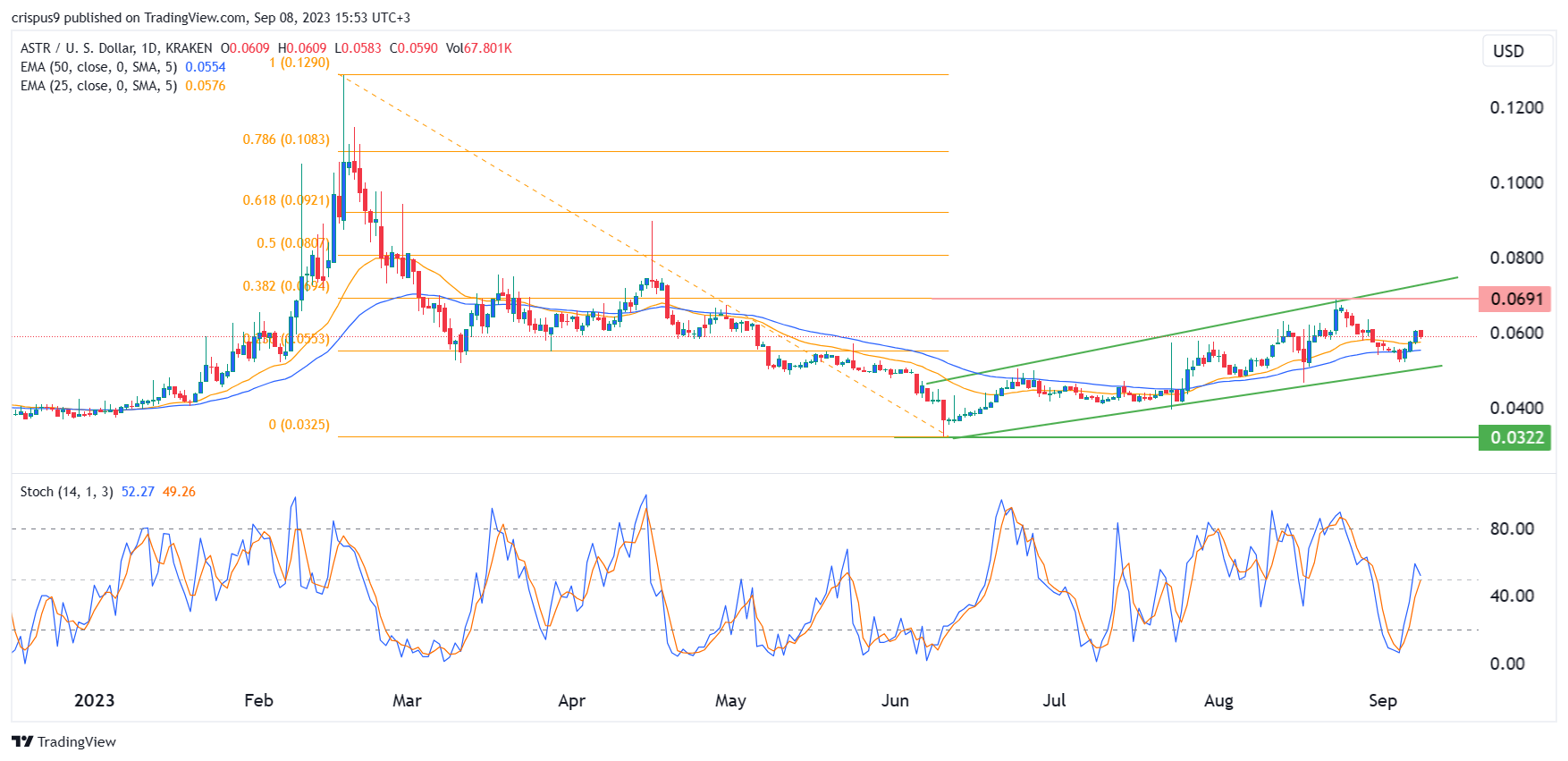
Astar Network is a leading blockchain on Polkadot’s ecosystem. Recently, the ASTR token has been in a bullish trend after it bottomed at $0.0322 on June 10th. Precisely, the coin has jumped by more than 70% to the current $0.06. 

Along the way, the coin has formed an ascending channel shown in green. It has also jumped above the 23.6% Fibonacci Retracement level while the Stochastic Oscillator has drifted upwards. Therefore, the Astar token price will likely continue rising as buyers target the key resistance point at $0.070, the highest point on August 23rd, and the 38.2% retracement level.
The post Crypto price prediction: XDC Network, Cronos, Astar appeared first on CoinJournal.
Ethereum volatility falls below Bitcoin as volume lags


Key Takeaways

  • Volatility has picked up in the last two weeks but remains low compared to normal levels
  • Ethereum’s realised volatility has now dipped below Bitcoin’s
  • Suppressed trading volumes are a big reason why volatility is lacking
  • August brought the lowest trading volume since October 2020

Ask anybody to describe the cryptocurrency markets, and there is a strong chance that the word “volatile” will be mentioned. 

The nascent asset class is well known for aggressive price moves. However, it has not lived up to that reputation this year. Despite Bitcoin having increased 55% since the new year, the rise has been characterised by a slow and steady climb rather than sudden jumps as we have seen so often in the past. 

A glance at its volatility, plotted on an annualised basis over a rolling 30-day window, shows this below. While the volatility has risen in the last two weeks amid news of the positive ruling on Grayscale’s case against the SEC, as well as other ETF-driven narratives, it is still lagging far below what we have come to expect from Bitcoin. 

To be clear, realised volatility in the mid-30s is still extremely elevated when compared to other asset classes, so nobody is arguing that Bitcoin is now stable. Yet when compared to what we have seen over the years from Bitcoin, it is certainly unusual. 

Perhaps the best way to sum up the placid nature of the crypto market is to compare the volatility of Bitcoin and Ethereum. Bitcoin tends to lead the crypto market, with altcoins trading like levered bets on the world’s largest crypto. While Ethereum may be too large at this point to qualify as an altcoin, it has nonetheless tended to display higher volatility than its bigger cousin. This gap has come down in 2023, however, as the below chart shows. 

In fact, Ethereum’s realised volatility is actually currently below that of Bitcoin. The next chart zooms in the 2023 period, showing this “flippening”. 

It is the fourth time this year that Ethereum has printed volatility below Bitcoin. The previous three times saw a swift regression, so it may happen again. Either way, the gap has been oscillating close to zero since the start of the year.

Why is volatility so low?

For many, Bitcoin – and crypto as a whole – must shed its habit of violent volatility. Should the asset achieve its goals of becoming a reputable store of value or a digital equivalent of gold, its value cannot fluctuate as much as it has for much of its existence. 

Hence, it may be tempting to paint the dropoff in volatility in a positive light. However, that may be misguided. In truth, volatility and volume move hand in hand. And crypto volume has collapsed in the last two years. 

August exchange volume came in at $423 billion, less than half of what it was at this time last year. 

The $423 billion of volume last month was the lowest of any month since October 2020, before Bitcoin exploded into mainstream consciousness with a relentless run-up past its then-all-time high of $20,000. 

The next chart shows exchange volume going back over the last two years, with volumes around $2 trillion at this time in 2021 – 5X last month’s figure. 

While the earlier points regarding Ethereum trading with lower volatility may be dismissed by some as an argument that Ethereum is maturing and separating itself from the rest of the non-Bitcoin market, the suppressed volume is undoubtedly concerning for the market as a whole. It is also part of the reason why volatility is so low. 

It feels inevitable that volatility and volume will pick back up. This is where ETFs, macro clarity, sentiment pickup and an overall brightening of the picture will help. And more likely than not, these will all occur, it is just a matter of when. With April 2024 now only seven months away, there is also Bitcoin’s fourth halving coming down the tracks – although it remains to be seen what effect that may have. 

But for the moment, volatility and volume are both trickling along, far below what we had come to expect from this corner of the financial markets. remains to be seen

The post Ethereum volatility falls below Bitcoin as volume lags appeared first on CoinJournal.

Riot, MARA, Argo Blockchain stocks at risk as BTC forms death cross

  • Bitcoin mining stocks have dropped sharply from their highest levels this year.

  • Bitcoin price is about to form a death cross pattern on the daily chart.

  • The US dollar index is forming a golden cross pattern.

Riot Platforms and Marathon Digital stock price remained under pressure as Bitcoin and other cryptocurrencies retreated. The RIOT shares were trading at $11.13 on Thursday, ~45% below the highest level this year. Similarly, MARA shares retreated to a low of $12.14, ~38% below the YTD high.

Bitcoin mining stocks have been in a downward trend in the past few days as concerns about cryptocurrencies continued. Precisely, they have dropped sharply as Bitcoin has dropped from the year-to-date high of $31,000 to $26,000.

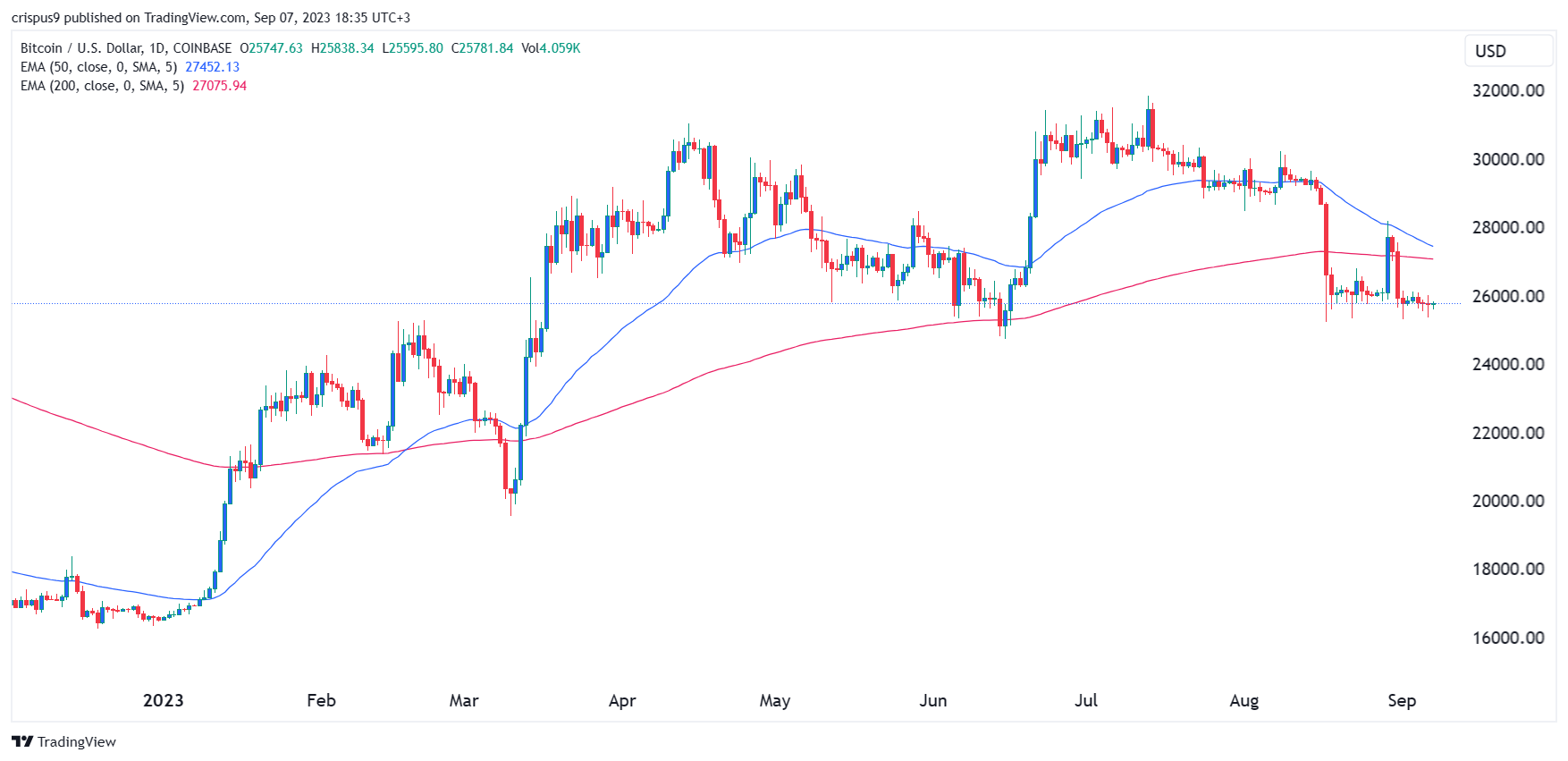
Sadly, the situation could get worse since Bitcoin is about to form a death cross pattern. This pattern happens when an asset’s 200-day and 50-day exponential moving averages (EMA) are about to make a crossover. In most periods, the death cross is usually followed by more downsides.

Notably, the US dollar index (DXY) is also about to form a golden cross pattern, pointing to more upside in the near term. If this happens, it means that the dollar index will rise to over $106. Historically, Bitcoin has an inverse relationship with the US dollar.

The dollar index has jumped as investors predict a more hawkish Federal Reserve in the coming months. That’s because economic data from the US have been better than expected. For example, the services PMI figure rose at a faster pace in August.

Further, as shown below, Bitcoin has formed what looks like a bearish flag pattern. In price action analysis, this pattern is also a bearish one. It is characterized by a long line followed by some consolidation.

Therefore, there is a high possibility that Bitcoin will soon have a bearish breakout. If it happens, the next level to watch will be $20,000. If this happens, mining stocks like Riot Platforms, Marathon Digital, and Argo Blockchain will likely continue falling.

The likely catalyst for Bitcoin price will be a decision by the SEC to provide a greenlight for a spot Bitcoin ETF.

How to buy Bitcoin

eToro

eToro is a multi-asset investment platform with more than 2000 assets, including stocks, ETF’s, indices, commodities and Cryptoassets. eToro offers over 60+ Cryptoassets to invest or invest in their CryptoPortfolio where investors can benefit from the accumulated growth of Bitcoin, Ethereum, XRP, Litecoin and other leading cryptocurrencies. eToro users can connect with, learn from, and copy or get copied by other users.

Binance

Binance has grown exponentially since it was founded in 2017 and is now one of, if not the biggest cryptocurrency exchanges on the market.

The post Riot, MARA, Argo Blockchain stocks at risk as BTC forms death cross appeared first on CoinJournal.

ETF season continues as Ether application lodged while markets plod along


Key Takeaways

  • The crypto market has seen increased volatility off the back of ETF developments in the last couple of weeks
  • Grayscale secured a positive ruling in its case against the SEC regarding its ETF application
  • Markets subsequently fell as the regulator pushed out the approval date of all ETF applications
  • Cathie Wood’s ARK Invest has now filed for a spot Ether ETF
  • Market is largely anticipating the approval of a futures-based Ether ETF before mid-October
  • ETFs are inevitable, and while the headlines may be repetitive, there is little volatility coming from anywhere else these days

The crypto markets are still enduring uncharacteristically low volatility, but there has been at least a little pickup in recent weeks. 

Most of it is due to ETFs, whether one way or another. Last week saw Grayscale secure a landmark decision against the SEC, with a federal court ruling that the SEC was wrong to reject an application from Grayscale Investments to convert its trust into an ETF. The judge said the regulator failed to “offer any explanation” following its decision. 

This sparked a fresh wave of optimism that not only would Grayscale secure ETF approval, but the slew of other applications currently on the waitlist would also be successful. 

However, markets gave back most of those gains when the SEC announced shortly thereafter that it was pushing out the decision on all ETFs until October. 

This delay aside, however, the regulatory picture is brightening significantly for crypto. Only a few months ago, the future of the entire industry seemed to be under threat in the US. While there remains serious concern over large swathes of the space (the myriad allegations against Binance alone could prove seismic), it is beginning to feel inevitable that ETFs are simply a matter of time. 

Not only that, but hope is now swelling that Bitcoin may not be the only asset to achieve the ultimate stamp of approval. Cathie Wood’s Ark Invest and 21Shares have filed for a spot Ethereum ETF, the first attempt to list such a fund in the US. 

While this represents the first spot ETF attempt, there have been several applications on the futures side for Ether. Bloomberg reported in August that the regulator would likely approve these products, which number nearly a dozen – an expectation that most around the industry are in line with. 

The SEC’s hesitance regarding spot ETFs has centred around the fact that there is not a regulated crypto market of sufficient size to prevent market manipulation. While many decry this refusal to approve the ETFs as unjustified, it is easy to see their hesitance when looking at the state of liquidity. Spot volumes have been decimated this year, while futures and derivatives have fared far better.

In truth, when the approval does come, it should bolster liquidity itself, in somewhat of a chicken and egg problem. And with demand increasing for these products, there is only so long that the SEC can resist approving these products. 

The macro situation may also play a role here. Interest rates have been hiked from near-zero to north of 5% in the US in what amounts to one of the swiftest tightening cycles in modern history. Accordingly, investors have retreated along the risk curve. Crypto is about as risky as it gets, with prices crashing as a result. Despite Bitcoin rising 55% thus far this year as inflation softened quicker than anticipated and expectations around the future path of interest rates became more optimistic, it is still over 60% off its high from Q4 of 2021. 

Yet the market is now anticipating only one more (if even) rate hike still to come, something which may spur more investors to move back into the space and liquidity to bounce back. There is also the matter of the halvening in April 2024, although it remains too soon to declare with confidence what the effect of that event will be. 

We will likely look back upon these days as low-level, bureaucracy-driven table setting for what lies ahead. Even already, the various ETF news is not having quite the same effect as some of the earlier stories this year – the Ethereum ETF application barely moved markets an inch. But it’s all necessary for this nascent asset class. And in recent times, it has been about the only source of volatility at all.

The post ETF season continues as Ether application lodged while markets plod along appeared first on CoinJournal.

Bitcoin volatility increases but remains far off historic levels


Key Takeaways

  • The last two weeks have seen increased volatility in the crypto markets
  • Bitcoin fell from $29,000 to $26,000 two weeks ago before bouncing back briefly, only to fall again
  • Thin liquidity means the market is ripe for big moves, but trading volume remains suppressed
  • The future should see a return to the volatility the market has come to expect

The year 2023 has been a strange one for crypto. The extreme volatility the sector has become so well known for has been lacking. 

This is despite the price of Bitcoin being up 55% thus far this year. Yet rather than the usual spikes and freefalls, it has been a slow and gradual increase. 

In the last couple of weeks, however, volatility has picked up. It is not quite at the levels we are accustomed to seeing, but it is no longer at all-time lows, either. Two weeks ago, Bitcoin fell from $29,000 to $26,000, including a 7% fall in a ten-minute span. 

Last Thursday, it then jumped 6%, back up to $27,700. Two days later, it had given up those gains, trading at $25,900. 

While the price action of the last two weeks is not dramatic by Bitcoin’s standards, it at least represents a closer picture to what we have come to expect from the asset. 

The boost last week was led by a positive court ruling regarding the Grayscale Bitcoin Trust. A three-judge panel of the District of Columbia Court of Appeals in Washington ruled that the SEC was wrong to reject Grayscale’s proposed Bitcoin ETF without explaining its reasoning. 

However, those gains have since been given up. The SEC said late Thursday in a series of filings that more time was needed to consider the slew of ETF applications which have been lodged in recent months. 

As we said, rampant volatility has been one of the calling cards of this asset since it was launched fourteen years ago – and even this recent bout is relatively minor and seems to be driven by the ETF news. That is why 2023 has been unusual- it was the absence of volatility before the last couple of weeks that is more surprising than its recent abrupt increase. 

Volatility should return to prior levels

Again, however, this bout of volatility is hardly anything to write home about by Bitcoin’s standards. Furthermore, studying the market structure suggests that we should not expect subdued activity for too long. 

One of the prime reasons for this is liquidity. Order books are as thin as they have been in quite some time on Bitcoin markets. This means less capital is required to move prices, amplifying moves to both the upside and downside. 

Looking across the space shows that while prices have rebounded this year, volumes remain at multi-year lows and capital continues to flow out of the space. 

Trading volume and volatility come hand in hand. It makes sense, therefore, that we have seen the latter drop as investors have pulled capital, retreating on the risk curve amid tough macro conditions. 

However, the liquidity situation, combined with the inherent nature of the crypto markets – and the fact that volatility has never gone away for long – means that it would not be a surprise to see the subdued markets ramp back up. The last two weeks have seen a move in this direction, but in the grand scheme of things, it is nothing compared to what we have seen in the past, nor what we may see once more in the future. 

The post Bitcoin volatility increases but remains far off historic levels appeared first on CoinJournal.