Autonomous agents and their growing role in fostering a better DeFi economy

  • DeFi growth expected to gather steam with projections that its revenue could hit $376.9M in 2025.
  • Autonomous Agents are expected to play a crucial role in the growth of the DeFi ecosystem.
  • Autonomous agents execute trades fast, operate 24/7, and adapt to markets.

Navigating the DeFi realm has become increasingly more sophisticated in recent years replete with a large number of protocols, chains, and strategies.

The DeFi market projected to generate a revenue of $376.9 million by 2025 seeing that its TVL hit $138 billion this past December. As the market grows, the scale of potential opportunities on offer is matched only by the cognitive demands placed on its participants.

This has created a perfect storm for automated trading tools to enter the fray, helping allay many of the human limitations currently permeating this sector. For instance, these tools are capable of executing trades in seconds or milliseconds, an aspect crucial in volatile markets where timing can mean the difference between booking a major profit or loss.

Perhaps more importantly, these entities can operate continuously, allowing participation in a global market that never sleeps. Lastly, by eliminating emotional decision-making and adhering to predefined strategies, they can enhance both profitability and risk management by a huge margin.

Looking beyond basic automation

Historically speaking, one can see that the first generation of DeFi automation tools focused primarily on simple task execution, i.e. basic trading bots that followed predetermined rules and yield optimizers that automatically moved funds between protocols based on static parameters.

While these tools were undoubtedly resourceful, providing users value in the form of time savings and consistency, they lacked the intelligence to adapt to rapidly changing market conditions or execute truly sophisticated cross-protocol strategies.

Following this there was the advent of yield optimizers (like Yearn Finance) that helped pioneer the automation of capital allocation across lending protocols, automatically moving funds to maximize returns. Subsequently, trading tools evolved from simple grid and arbitrage strategies to more complex algorithms incorporating technical indicators.

That being said, these solutions still required significant user oversight, and technical knowledge to configure effectively — alongside frequent manual adjustments to respond to changing market conditions.

Most recently, the market’s innovation has resulted in the birth of ‘Xenocognitive’ finance tools whose utility, as suggested by their name, extends beyond human cognitive limitations while preserving user sovereignty. At the forefront of this technological realm stands Giza.

Unlike basic automation offerings that execute simple predefined tasks, Giza’s autonomous agents continuously analyze market conditions across protocols, allowing clients to execute complex yield strategies, and adapt to changing conditions without requiring any external intervention.

At the heart of Giza’s approach lies ARMA, its first autonomous agent. With thousands of user-controlled agents managing substantial sums of money across different lending protocols, ARMA offers up a vision of how purpose-built DeFi intelligence — with its verifiable decision-making patterns — can deliver market-leading yields while maintaining complete security and user sovereignty.

Features galore. Here’s what’s on offer!

From the outside looking in, Giza’s architecture addresses many of the core challenges associated with agent-driven finance using three integrated components. The ‘semantic abstraction layer,’ for instance, transforms complex protocol interactions into standardized operations that agents can naturally reason about and execute, enabling sophisticated cross-protocol strategies without requiring protocol-specific interfaces.

Similarly, the ‘agent authorization layer’ builds on the platform’s smart account infrastructure to enable non-custodial agent operations using a granular permission management module. As a result, users can maintain complete control of their assets while granting agents specific operational authority through session keys and programmable authorization policies.

Working alongside these interfaces is Giza’s ‘decentralized execution layer’ which provides the system with crypto-economic guarantees — thanks, in large part, to its integration with EigenLayer which allows network operators to stake native GIZA tokens as collateral.

All of this creates quantifiable costs for malicious behavior while incentivizing correct execution through protocol rewards. Not only that, by making use of this comprehensive framework, autonomous agents can bypass pervading cognitive barriers and eventually unlock sophisticated strategy participation across protocols that would otherwise be impossible for human operators.

The result is systemic market improvements ranging from enhanced capital efficiency to improved price discovery to reduced systemic risk (through atomic distribution of strategies).

The autonomous future of financial markets

A quick look at some of the numbers available online, one can see that the growth trajectory for automated trading tools seems to be quite exponential, with one report expecting the crypto trading bot market to reach $41.61 billion by 2033.

This expansion seems primed to be fueled by advancements in AI and ML that can enable systems to analyze vast amounts of data, predict market trends, and execute sophisticated strategies at unprecedented speeds.

Therefore, as these technologies mature, the boundary between automation and true market intelligence will most likely continue to blur, reshaping how individuals and institutions engage with digital assets. Amidst this, agent-driven platforms like Giza stand to reshape the DeFi trading paradigm by operating as an extension of human intent.

The post Autonomous agents and their growing role in fostering a better DeFi economy appeared first on CoinJournal.

BTC dips to $86k for the first since November amid market sell-off

Key takeaways

  • BTC dipped to the $86k level for the first time since November 2024.
  • The Bitcoin Pepe presale has surpassed $3.5m as investors eye stage six.

Bitcoin falls to a three-month low as total crypto market cap dips below $3T

The cryptocurrency market has been bearish since the start of the week. Bitcoin is down by nearly 4% in the last 24 hours and briefly touched the $86k level on Tuesday. The dip was BTC’s lowest level in three months as the broader crypto market experienced a massive sell-off.

At press time, the price of Bitcoin stands at $88,752 and could continue with its recovery if the bulls regain control. The total cryptocurrency market cap also dropped below $3 trillion as Ether and other altcoins underperformed. 

What is Bitcoin Pepe?

Bitcoin and other major cryptocurrencies have been underperforming over the last few days. However, investors could consider the dip as an opportunity to purchase more tokens before a possible market recovery. 

Investors also continue to push funds into new and exciting projects. Bitcoin Pepe is one of the projects gaining ground in its presale thanks to its unique value proposition to investors. 

Bitcoin Pepe is a project seeking to leverage the liquidity and security of the Bitcoin blockchain. The project will use Bitcoin’s position in the market to introduce memecoins to its ecosystem. 

According to the official website, Bitcoin Pepe is a layer-2 network building on the Bitcoin blockchain. This project is a meme-specialized layer-2 solution built on top of Bitcoin, bringing Solana-style scalability to the Bitcoin network.

The layer-2 network will enable Bitcoin Pepe to become home to all memecoin trading and move all this economic activity to the BTC ecosystem. It will unlock decentralized finance (DeFi) and meme trading on top of BTC.

Bitcoin Pepe is also the first-ever meme initial coin offering (ICO) on the Bitcoin blockchain, making it the perfect fusion between BTC’s security and the unstoppable force of memecoins. 

The project will make it easy for BTC Maxis to trade memes. Combining high levels of trust (BTC) with high levels of performance (SOL) will lead to high levels of retail mass adoption.

Bitcoin Pepe presale to enter stage six, raises over $3.5m

The Bitcoin Pepe presale is two weeks old and has raised over $3.5 million so far. The presale will enter the sixth stage in the coming hours or days, with the $BPEP price set to slightly increase. 

$BPEP, Bitcoin Pepe’s native token, can be purchased using various cryptocurrencies, including ETH, USDT, USDC, BNB, and SOL. In this fifth presale stage, $BPEP is going for $0.0255 and is set to increase to $0.0268 in the next stage. The Bitcoin Pepe presale could be an opportunity to purchase $BPEP at a discount. 

Will Bitcoin Pepe improve the Bitcoin ecosystem?

Bitcoin Pepe will unveil products and services that would make memecoins available on the Bitcoin blockchain. While Bitcoin is the leading cryptocurrency in the world, its blockchain isn’t as versatile as Ethereum or Solana.

This project wants to change this narrative by introducing new utilities to the Bitcoin blockchain. With Bitcoin Pepe, memecoins can launch on the Bitcoin blockchain with ease. Introducing memecoins on the Bitcoin blockchain will enable it to become home to a crazy high-octane meme experience. 

Bitcoin Pepe is set to unlock $2 trillion in dormant BTC capital and make it available for memecoin trading. This layer-2 network will provide the necessary infrastructure for all memes to migrate to BTC, ensuring security and liquidity for investors and users. Its native $BPEP token will power several activities within the Bitcoin Pepe L2 network. 

Should you buy the $BPEP token ahead of the sixth presale stage?

The Bitcoin Pepe presale is heading into its sixth stage in the coming hours or days, with the token price set to increase slightly. This could be an excellent opportunity to get in on the project as presales allow investors to gain early exposure to projects. 

Bitcoin Pepe is working hard to become the leading L2 network on the Bitcoin blockchain, offering users security and liquidity. By ushering in the era of memecoins, Bitcoin Pepe could become one of the most important projects within the Bitcoin ecosystem. The presale allows investors to purchase its native token at a discount before it goes live on trading platforms.

The post BTC dips to $86k for the first since November amid market sell-off appeared first on CoinJournal.
Weekly price analysis: prices range on uncertain economic outlook

  • Crypto prices traded within a range last week as crypto takes is relegated to the back burner in the wake of economic uncertainties
  • Exchange-traded fund (ETF) inflows were negative as Bitcoin ETFs logged net outflows of $62.9 million while Ethereum ETFs logged $8.9 million in outflows

Bitcoin

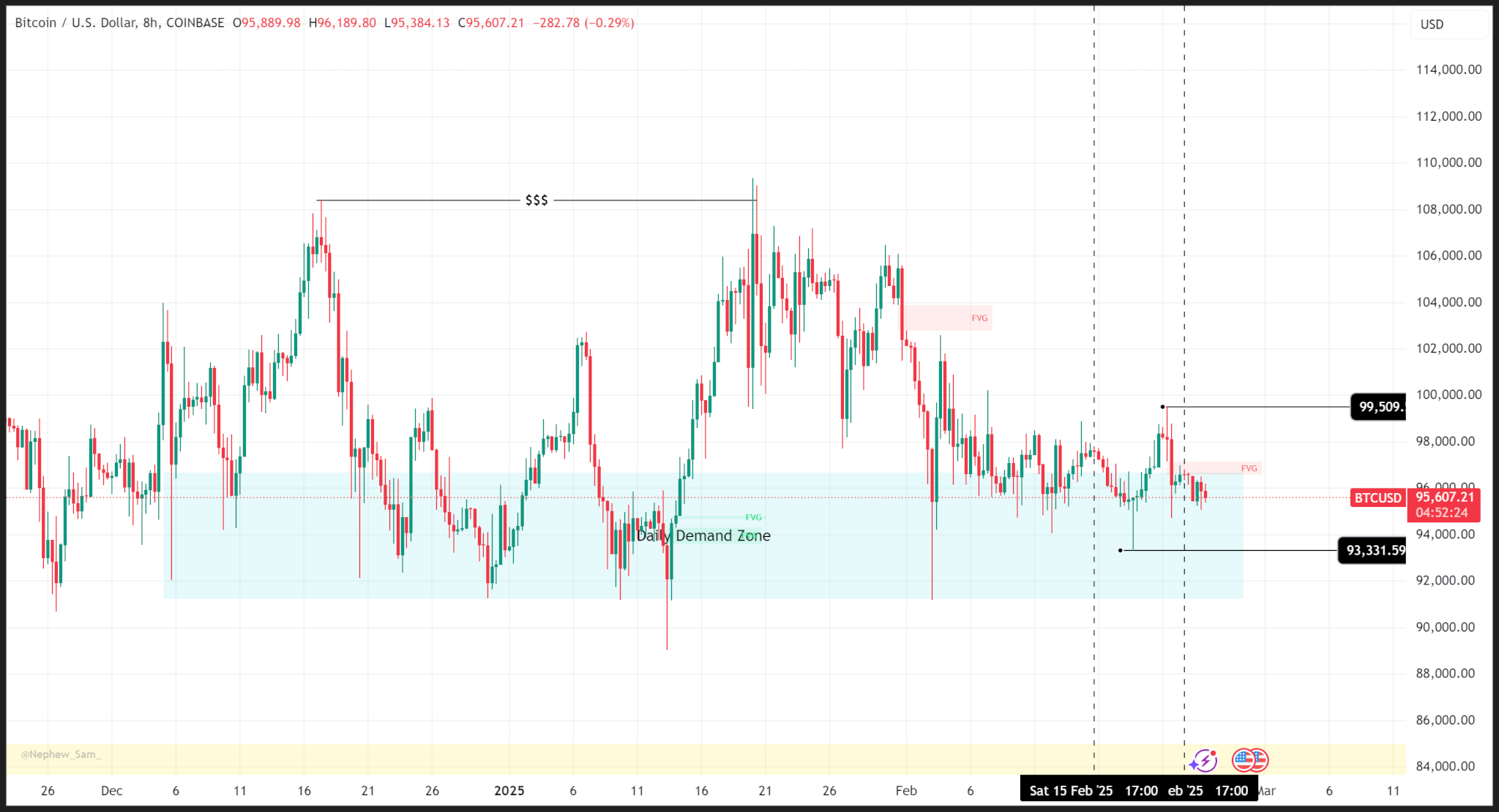
Bitcoin’s price action continued trading rangebound, with weekly highs and lows of $99,509 and $93,331, as uncertainty looms around inflation, US President Donald Trump’s policies, and geopolitical events.

Zooming out, we see that price action has ranged at the daily support level for the last three weeks as current market conditions lack sufficient catalyst to push prices to new highs.

BTC/USD chart by TradingView

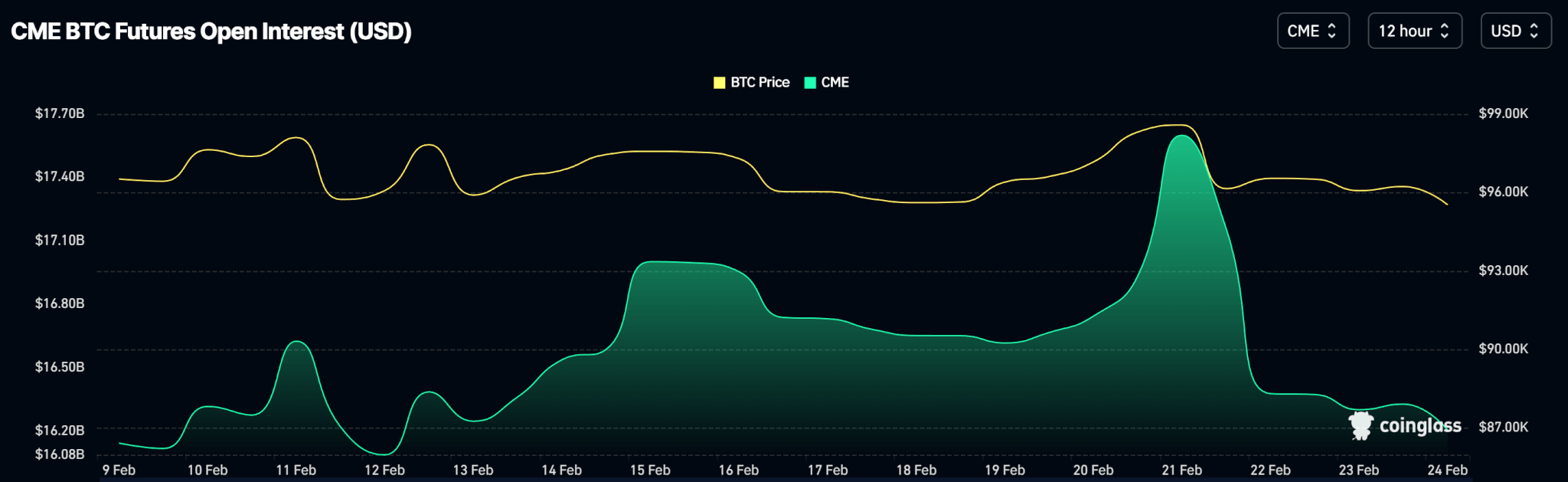
Open interest mimics price action as the week began with a reduction in the volume of open contracts which picked up on Wednesday, February 19, congruent with price action.

CME BTC Futures Open Interest (USD) chart by Coinglass

Outlook

Bitcoin must remain above the daily support of $90,673 to remain in bullish territory. A close below this level on the daily time frame could trigger a fall to the $84,000 level.

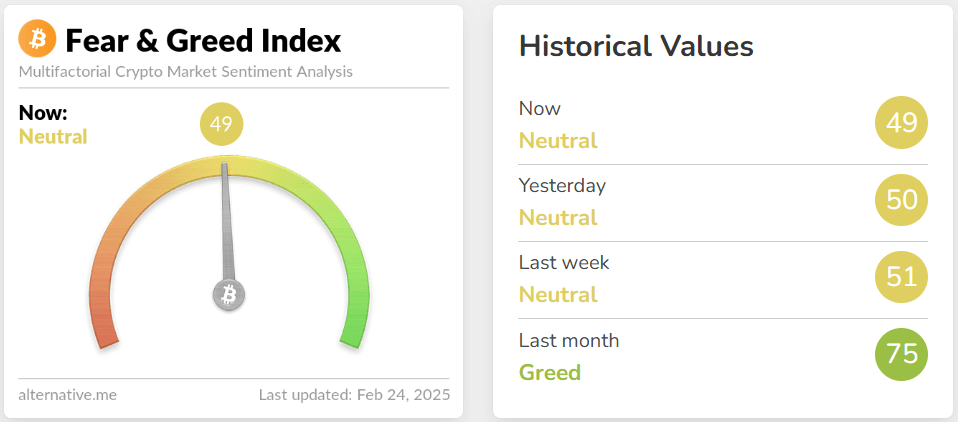
Meanwhile, market sentiment has cooled significantly over the last month and is in neutral territory.

Bitcoin trades at $87,900 as of publishing.

Ethereum

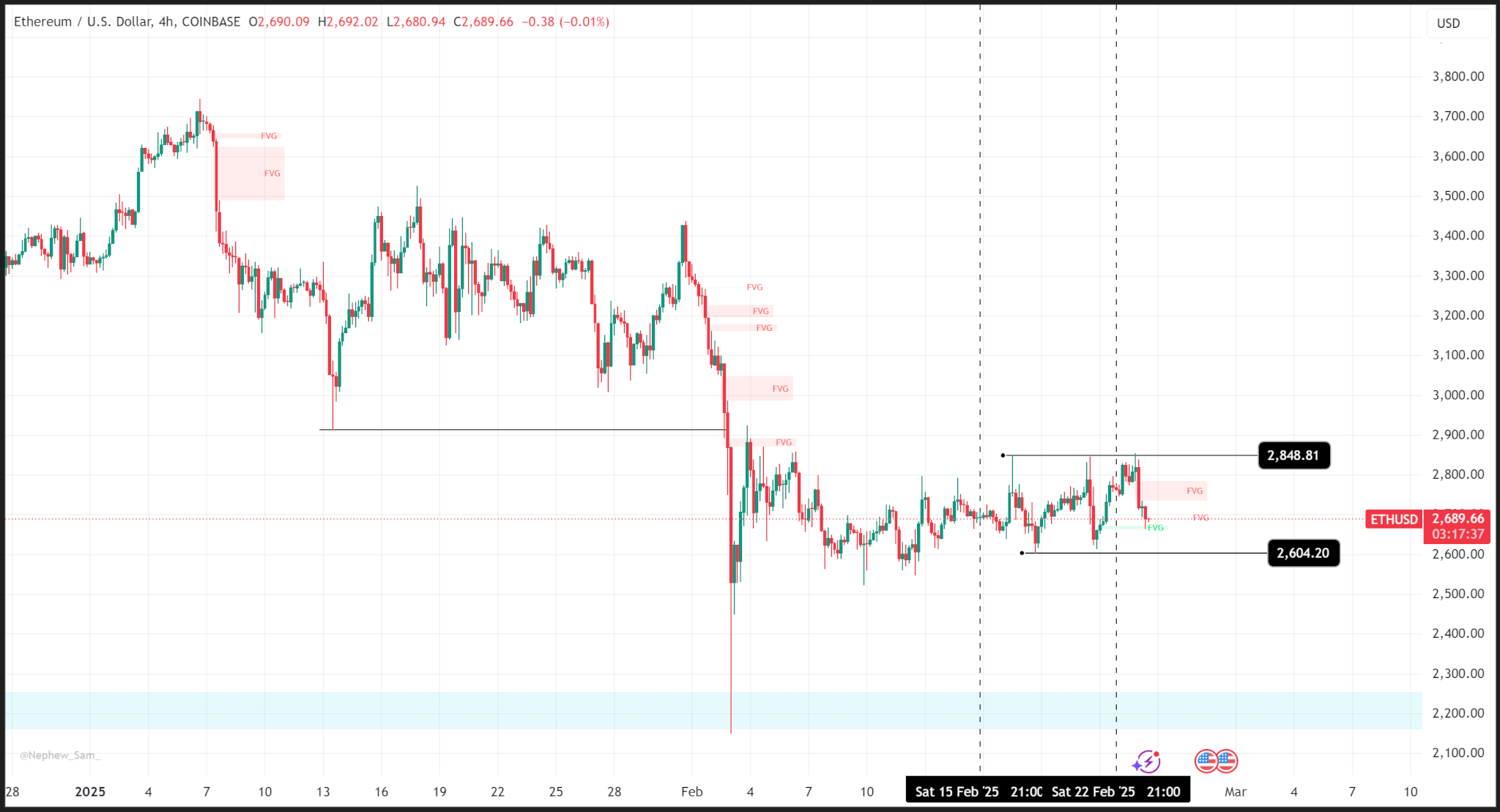
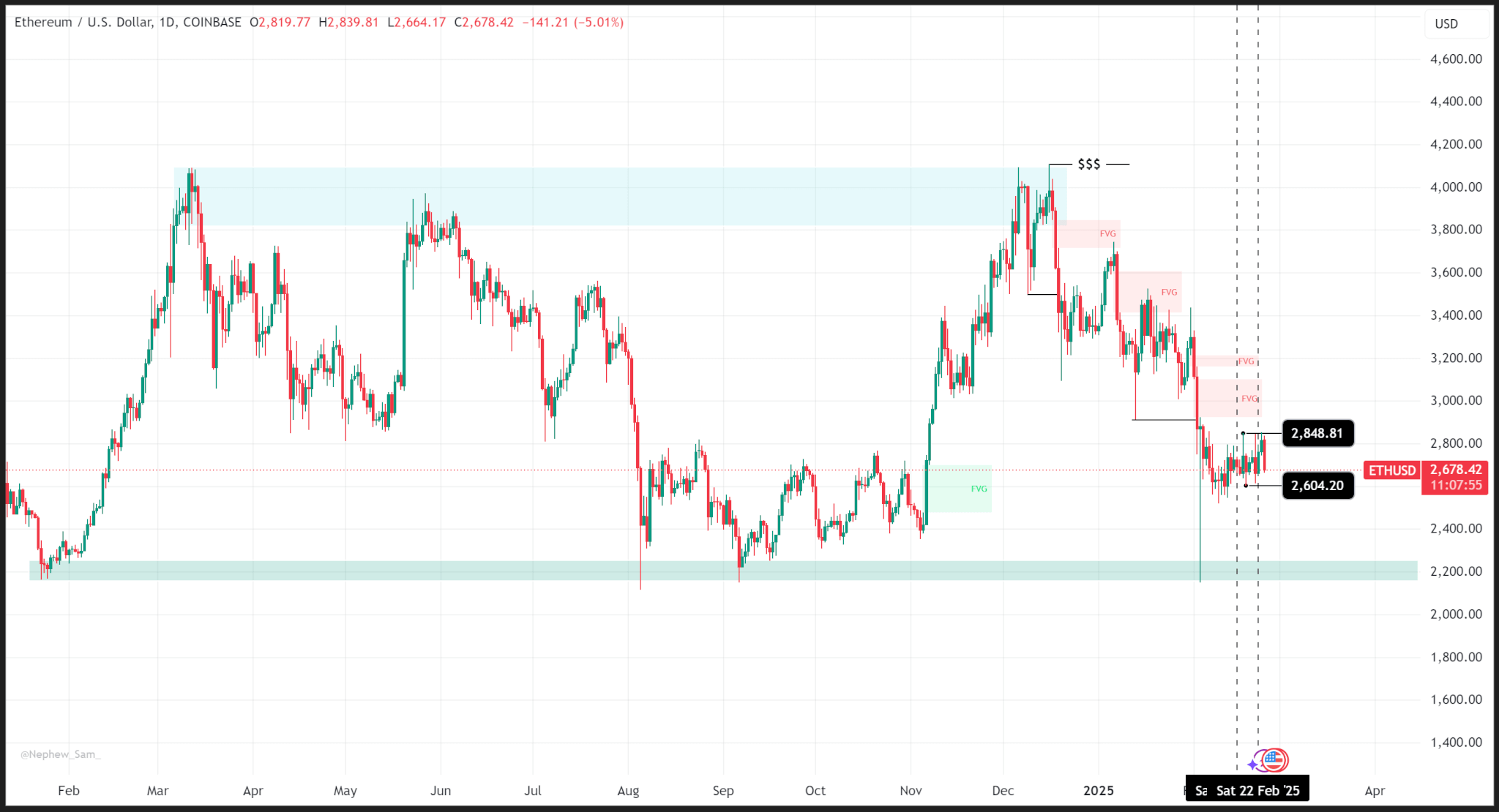
Ethereum’s price action ranged last week logging a weekly high and low of $2,848 and $2,604 despite last week’s news of the Bybit hack.

ETH/USD chart by TradingView

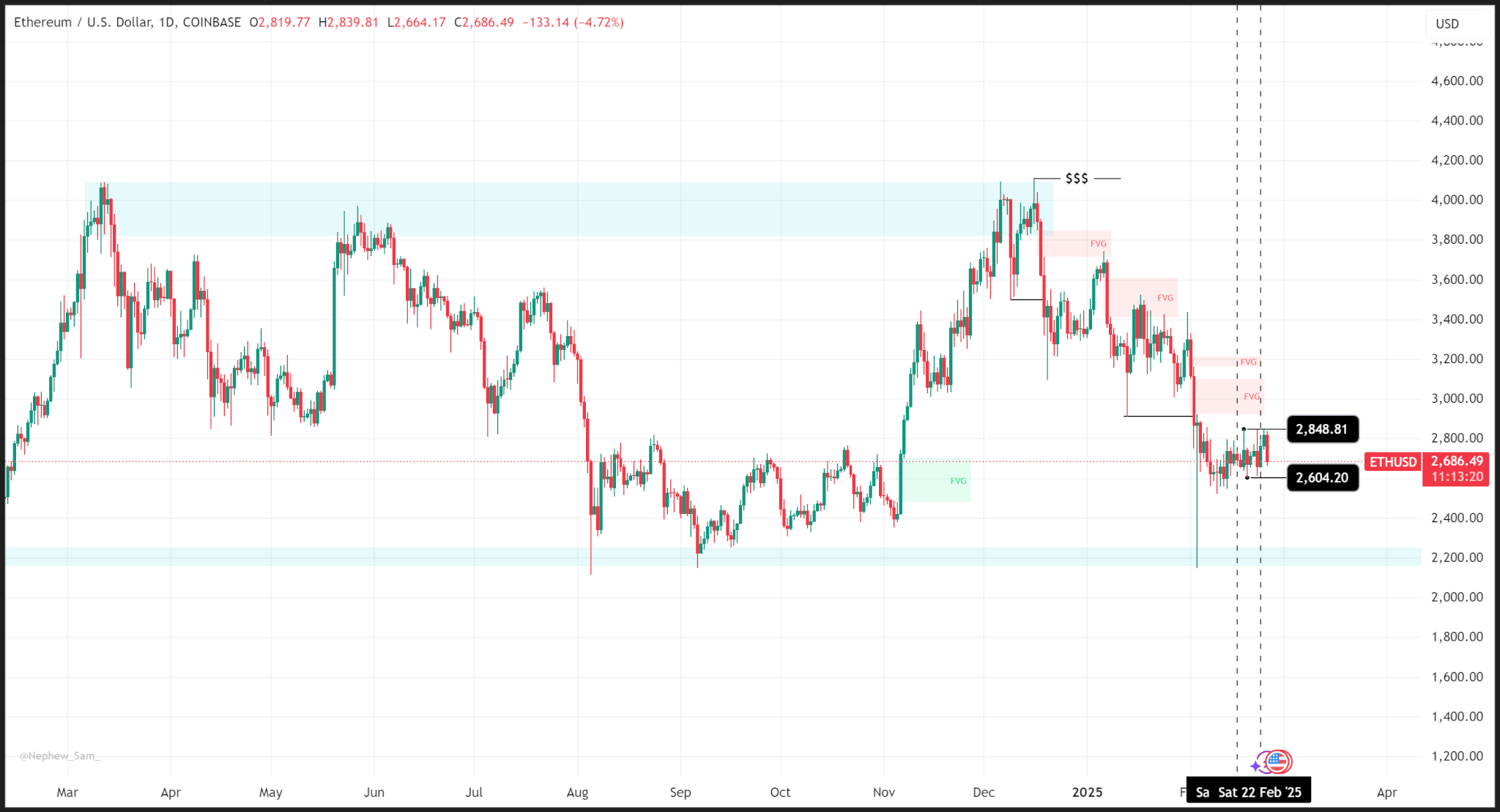
Zooming out, we see a bleaker picture as ETH has been trending lower since December 09 after failing to break above its March 2024 high.

ETH/USD chart by TradingView

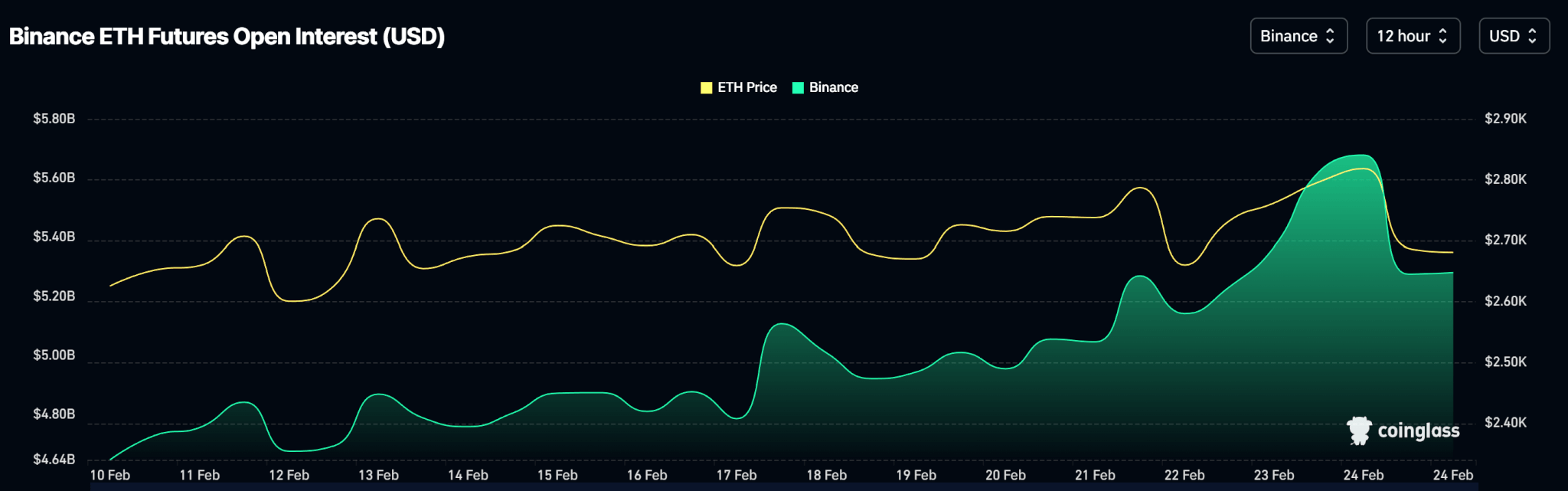
Open interest data shows a steady rise in contract volume throughout the week though price traded rangebound.

Binance ETH Futures Open Interest (USD) chart by Coinglass

Outlook

We reckon the next major support zone for ETH is the $2,500 level which has proven to be a strong liquidity level in the past.

ETH/USD chart by TradingView

ETH trades at $2,384 as of publishing.

Solana

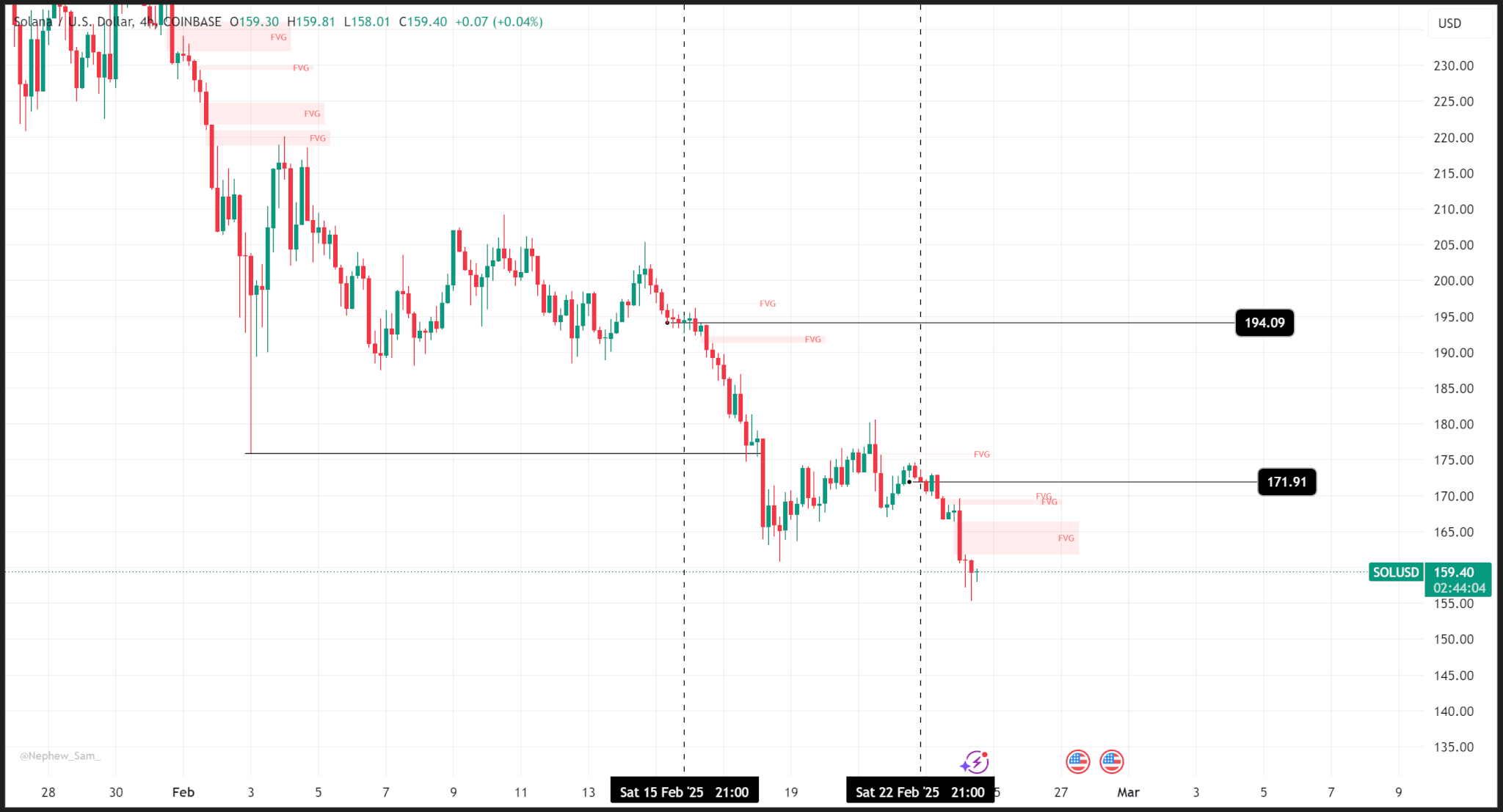
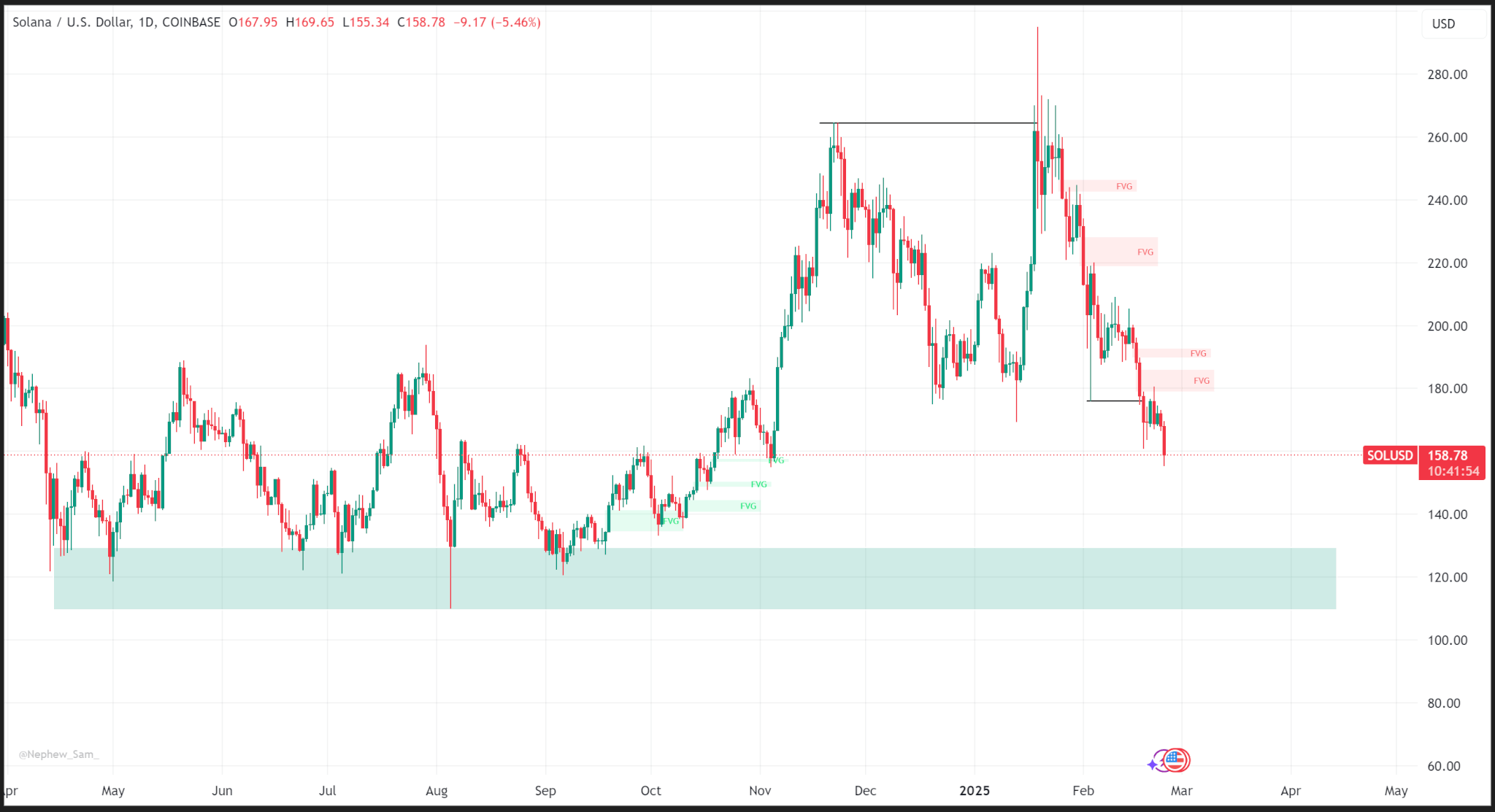
Like Ethereum, Solana’s price has been declining since it failed to swing higher and form new candles above the last all-time high on the daily time frame.

SOL/USD chart by TradingView

Unlike Ethereum, last week’s price action was bearish as the price fell from a weekly open around $194 to a close around $171.

SOL/USD chart by TradingView

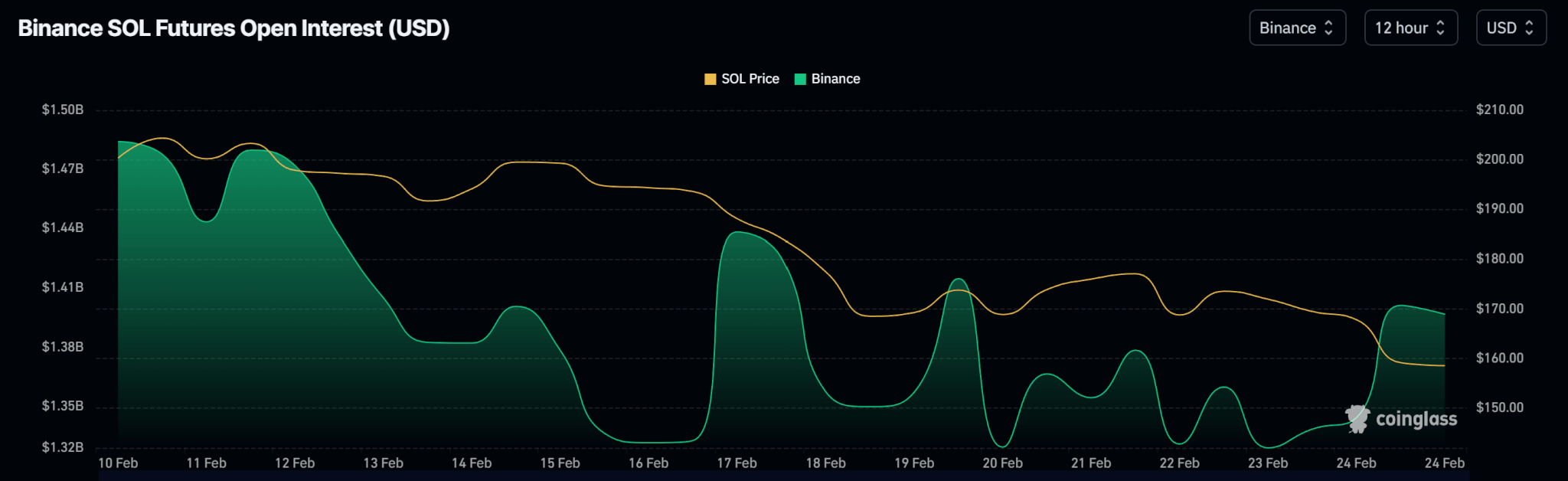
Open interest charts show topsy-turvy movement in open contract volumes as the price falls.

Binance SOL Futures Open Interest (USD) chart by Coinglass

Outlook

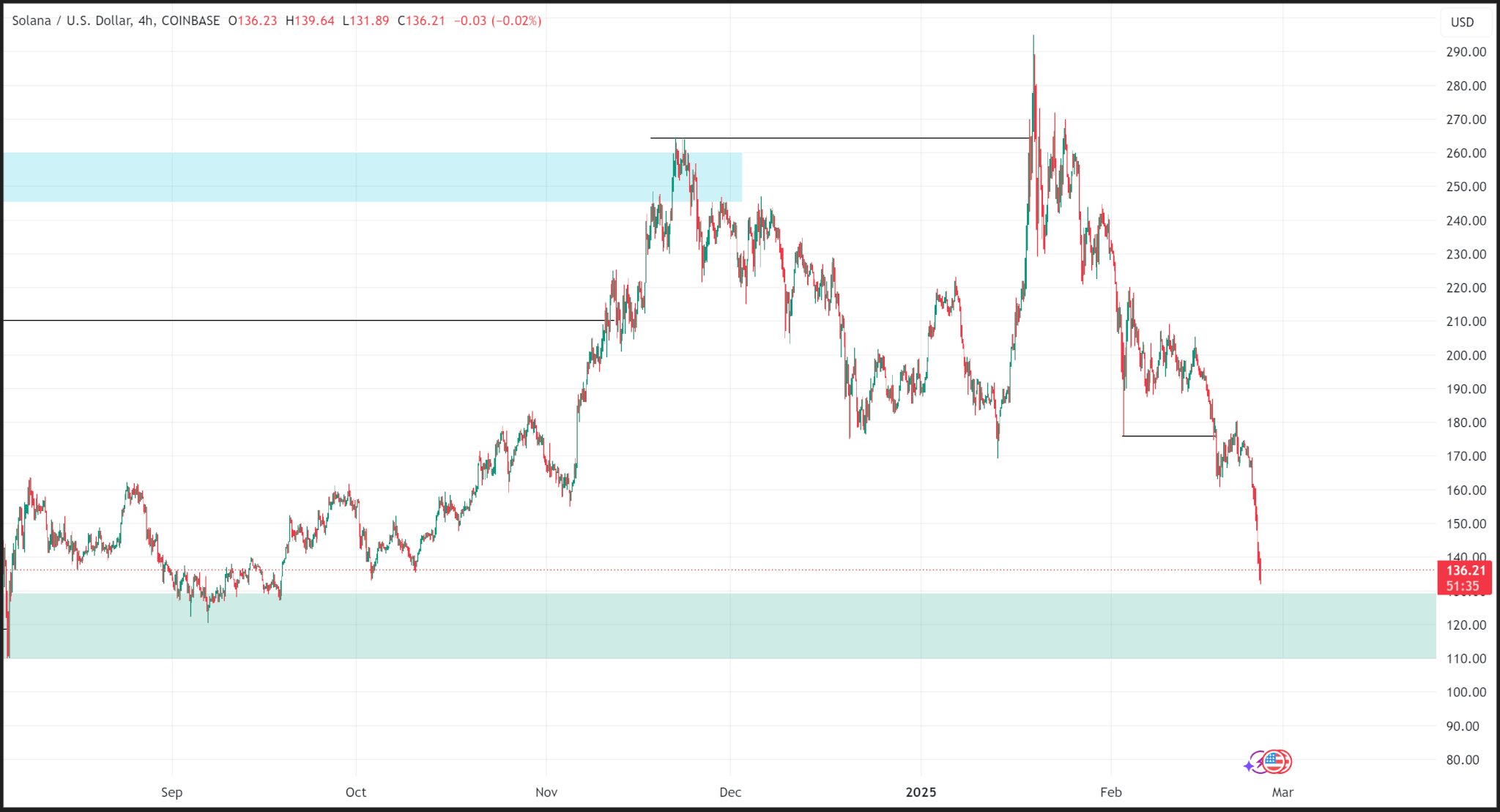
The next major support zone for Solana is at the $129 level. However, we may see smaller rallies as price trends lower overall.

SOL/USD chart by TradingView

The post Weekly price analysis: prices range on uncertain economic outlook appeared first on CoinJournal.