
Die EZB wirbt abermals für eine europäische Zentralbank-Digitalwährung, die besonders angesichts der strategischen Bemühungen der USA um Stablecoin-Führerschaft in den Fokus rückt.

Finanzmittel Info + Krypto + Geld + Gold
Krypto minen, NFT minten, Gold schürfen und Geld drucken
Die EZB wirbt abermals für eine europäische Zentralbank-Digitalwährung, die besonders angesichts der strategischen Bemühungen der USA um Stablecoin-Führerschaft in den Fokus rückt.

Die Nasdaq ersucht bei der SEC die Freigabe für einen neuen Avalanche-ETF von VanEck.
Block Inc., the parent company of Cash App, has agreed to a $40 million settlement with the New York Department of Financial Services (NYDFS) following findings of compliance shortcomings tied to its crypto services.
The settlement follows a state investigation that uncovered weaknesses in anti-money laundering (AML) controls, including failures to detect suspicious activity and monitor high-risk Bitcoin transactions.
Block, co-founded by Jack Dorsey, resolved the matter without admitting wrongdoing, stating the issues stemmed from legacy systems within Cash App’s historical compliance programme.
Block’s compliance failures included insufficient customer due diligence, weak transaction monitoring, and inadequate screening of high-risk crypto activity.
The NYDFS concluded that the company’s systems were not robust enough to detect suspicious patterns tied to Bitcoin usage.
Block had been under investigation since 2023, and the company disclosed the probe and related negotiations in regulatory filings with the US Securities and Exchange Commission.
The $40 million settlement comes just months after Block paid $80 million in penalties to multiple state regulators earlier this year, also tied to AML compliance.
The back-to-back fines have renewed scrutiny on fintech platforms offering crypto services as regulators increase oversight of digital assets.
Despite facing multiple compliance challenges, Block continues to grow its crypto and banking offerings through Cash App.
The platform, which has enabled Bitcoin purchases since 2018, integrated tax-reporting software TaxBit in 2023 to support users managing their crypto liabilities.
As of early 2024, Cash App had more than 57 million monthly active users and generated $1.38 billion in gross profit in the fourth quarter alone.
Block’s financial health remains strong, reporting $6.03 billion in revenue for 2024, up 4.5% year-on-year, and per-share earnings of $0.71—an increase of 51%. The company’s gross payment volume grew 10% to $61.95 billion.
However, investors remain wary. Block’s share price has fallen 32% since the beginning of the year and more than 80% since its 2021 high.
As Block faces pressure from regulators, it is also confronting challenges in turning Cash App into a full-service banking platform.
The company has launched marketing efforts in major US cities and introduced services such as high-yield savings accounts, debit cards, short-term loans via Cash App Borrow, and buy now, pay later products through Afterpay.
The direct deposit feature reached 2.5 million users by December, an important milestone for broader financial services uptake.
Still, building trust remains a hurdle. In early 2024, the Consumer Financial Protection Bureau ordered Cash App to refund up to $120 million to users over deficiencies in fraud investigations.
Analysts are questioning whether Cash App can compete with fintech players like Robinhood, which have begun offering higher-interest accounts and more comprehensive banking products.
Block’s efforts to reposition Cash App as a digital bank come at a time when regulatory scrutiny of fintechs is intensifying, particularly around cryptocurrency compliance and fraud prevention.
While the company has avoided admitting guilt in its settlements, the multiple investigations have raised questions about its readiness to scale its financial services model within a tightly regulated environment.
The post Block settles $40 million crypto investigation linked to Cash App appeared first on CoinJournal.
In a major development for the decentralised wireless network sector, the US Securities and Exchange Commission (SEC) has dismissed its case against Helium with prejudice, marking a rare reversal in crypto enforcement policy.
The decision ends a long-standing legal cloud over the regulatory status of Helium’s three key tokens—HNT, IOT, and MOBILE.
It also signals a broader shift under the Trump administration’s SEC chair Paul Atkins, confirmed on 10 April, who is known for his pro-crypto stance.
While Helium celebrated the dismissal as a “major win” in its 11 April blog post, court records reveal that its parent company, Nova Labs, quietly agreed to pay a $200,000 penalty to settle separate securities fraud allegations.
The SEC formally dropped charges alleging that Helium’s core tokens were unregistered securities, stating that the case would be dismissed with prejudice—effectively barring any future prosecution on similar grounds.
This decision closes a chapter of uncertainty that had cast a shadow over the Decentralised Physical Infrastructure Network (DePIN) space.
Helium’s post attributed the outcome to the SEC’s updated approach to Web3 projects, especially those involving hardware and community-driven incentives.
It said the ruling “brings clarity” to a sector often caught in a legal grey zone, where distributing tokens for user engagement was frequently seen as a securities issue.
While this dismissal may serve as a precedent for similar decentralised infrastructure ventures, it does not offer immunity from other compliance risks.
Although the SEC case regarding token classification is closed, Nova Labs remains tied to a $200,000 civil penalty issued over alleged fundraising misconduct.
The penalty resolves accusations that Nova Labs misrepresented partnerships with major firms including Nestle, Salesforce, and Lime during a 2021–2022 capital raise.
The SEC alleged that Nova Labs used those inflated claims to boost its valuation to $1 billion, luring in investors under false pretences.
The settlement, finalised without an admission or denial of guilt, ensures the company will not face further regulatory action on those claims, but it remains a cautionary tale for other crypto startups seeking funding.
The case dismissal is part of a wider change in tone at the SEC under Paul Atkins, a known supporter of digital asset innovation.
His confirmation on 10 April follows several agency reversals, including the dropping of lawsuits against Coinbase, Kraken, and Consensys.
This emerging trend points to a deliberate pivot in the SEC’s enforcement strategy—one focused more on regulatory clarity and less on litigation.
Industry analysts suggest this could embolden more crypto infrastructure firms to scale without fear of blanket regulatory action, provided they maintain transparency in investor communications.
The timing of the Helium case dismissal—just one day after Atkins’ appointment—reinforces the view that the Trump administration is prioritising blockchain innovation over punitive measures.
While this could revive confidence in DePIN and similar sectors, critics argue that enforcement gaps may still persist without new legislative frameworks.
Despite the positive outcome for Helium, the broader DePIN landscape remains a work in progress when it comes to compliance.
Many projects operate at the intersection of telecommunications, finance, and decentralised governance—areas where existing US rules remain ill-suited.
The SEC’s clarification in the Helium case—that selling hardware and distributing tokens for network growth does not automatically make those tokens securities—could offer temporary relief.
However, lawyers warn that this does not remove the need for careful disclosures, especially during token sales or equity fundraising rounds.
As tokenisation and decentralised infrastructure continue to merge with traditional industries, the Helium ruling provides a key legal benchmark—but not a complete solution.
Stakeholders across crypto, telecoms, and regulation will now look to see whether this softer stance will translate into durable legal clarity or further policy reversals in the months ahead.
The post SEC dismisses Helium case as Trump-era crypto rules take shape appeared first on CoinJournal.
Onyxcoin (XCN) has defied a dip for Bitcoin, Ethereum, and top altcoins with an impressive 97% over the past 24 hours.
In a price rally that put it on top of the daily gainers’ list, XCN shot up to an intraday high of $0.017.
The performance bucks the downward pressure that has seen Bitcoin (BTC) and Ethereum (ETH) pare gains from a day ago with dips below $80k and $1.5k, respectively.
The XCN token’s standout performance sees it outpace Flare, Kaspas, and Walrus, among other notable gainers.
According to data from CoinMarketCap, XCN is currently trading at $0.017, with its volume up 1,230%.
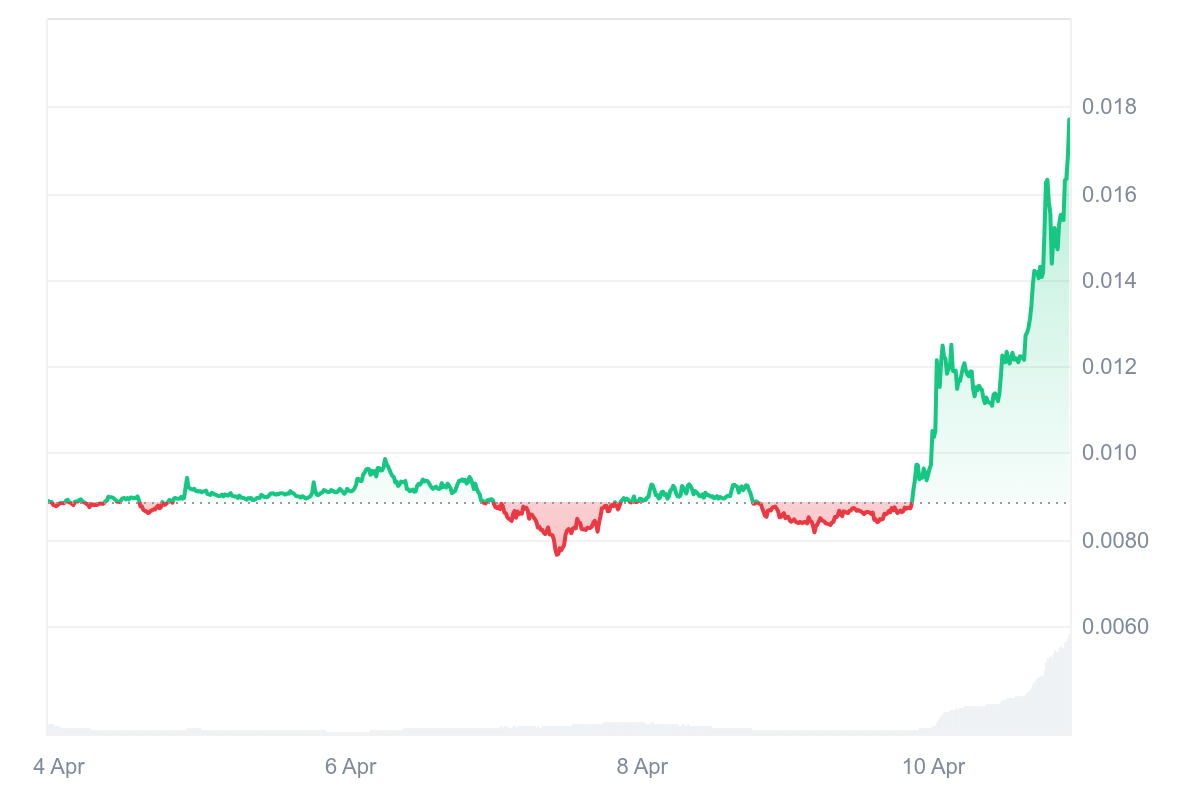
The token’s market, though tiny at $531 million, is up 97% and puts Onyxcoin in the top 100 by market cap.
XCN has flipped Floki and CORE, which currently rank 100th and 99th by market cap, respectively.
Onyxcoin’s massive spike comes despite a broader risk market downturn in the past 24 hours.
BTC, ETH, and other coins’ dip has seen the global cryptocurrency market cap drop by 3.9% to $2.52 trillion.
Volume is down 20% to about $127 billion as crypto mirrors losses on Wall Street.
Crypto and the stock market rose sharply on Wednesday after US President Donald Trump changed his tariffs stance.
His announcement of a 90-day pause sent risk assets skyrocketing, with Bitcoin’s price breaking to above $82k.
S&P 500 and the Dow Jones Industrial jumped, rising by historic single-day gains.
However, the S&P 500 and Dow opened lower on Thursday and looked to close lower with 3.2% and 2.4 %, respectively.
Dow was down more than 900 points.
On Thursday, Trump announced an additional 25% tariff on China, bringing this to 145%.
After excluding it from the 90-day pause, analysts say the trade war will continue to hurt optimism.
This looks to be the case as stocks sold off despite the latest inflation report that showed CPI dropped to 2.4% against an expected 2.6%.
While this sees many turn to the Federal Reserve for expectations of interest rate cuts, analysts are pointing to “sticky” prices and tariff impact for likely pressure on equities and crypto. Analysts point to a potential bull trap.
Peter Schiff said via a post on X:
“I’ve never seen such a mass selloff of US assets. The US dollar, bonds, and stocks are all getting killed. I can’t remember when the dollar lost 3.5% against the Swiss franc in one day. America’s ride on the global gravy train is about to come to a screeching halt. Buckle up.”
The post XCN defies Bitcoin and Ethereum slump with 97% spike appeared first on CoinJournal.