Apecoin’s RSI divergence could trigger a 20% rally

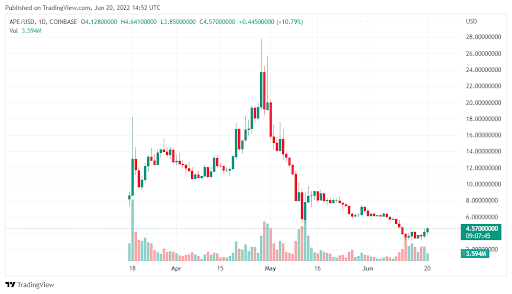
Apecoin is currently seeing a relief rally after crashing considerably last week. This came after the coin set a new low of $3.13. APE has also seen a sharp fall from its May and April highs which were, at some point, well above $20. However, there are some signs that a short-term upswing could be on the cards. Here are some points:

  • APE has surged in the past 24 hours with a 15% gain

  • The coin has established a descending trendline with dynamic resistance

  • Consolidations above $3.2 could provide a decisively bullish trend reversal
Data Source: TradingView 

Apecoin price analysis

After dropping nearly 70% over the past month or so, APE finally sees some demand. The coin is coming from a bottom price of $3.13, which is its new 2022 low. However, a descending trendline in the price action has established dynamic resistance at around $3.2. 

So far, APE has managed to hold this and is in fact rallying today. The coin could see an upswing of at least 20% before any pullback. However, there is also reason to believe that the current momentum could in fact push further. The key for APE bulls would be to reclaim the $5.1 support.

Although this won’t be easy, looking at the kind of resilience APE has shown, it is probable. A surge above $5.1 will trigger massive buying pressure and could see APE settle at around $7. This would be almost double the current price. Nonetheless, if the coin falls below $3.2 in the coming days, this analysis becomes invalidated.

How to play this APE setup

The key is the $3.2 support. As long as the price stays above this, then the downside risk remains limited.

Also, there is a case to be made for a surge above $5.1. In case you don’t want to take risks, you can buy once APE hits $5 and exit at around $7.2 in the short term.

The post Apecoin’s RSI divergence could trigger a 20% rally appeared first on CoinJournal.

Michael Saylor says a ‘parade of horribles’ are hurting Bitcoin

MicroStrategy CEO Michael Saylor says there’s a whole list of aspects and practices that are hurting Bitcoin. Referring to these as a “parade of horribles” 

Bitcoin has plummeted more than 70% since hitting an all-time high of $69k in November 2021. Over the past seven days, the cryptocurrency’s value has dropped more than 30%, with BTC currently near $20,000 per coin. It traded at lows of $17,600 over the weekend. 

Saylor says Bitcoin would experience less volatility were it not for a number of negative factors within the crypto market. He made his remarks during a discussion with Northman Trader’s Sven Henrich.

Saylor’s “parade of horribles”

Saylor, one of Bitcoin’s most high-profile bulls, things contributing to the high volatility in BTC price and thus unattractiveness to most institutional investors include widespread wash trading and too many unregistered exchanges with questionable practices.

 “The crypto exchanges, offshore and onshore, are unregistered, unregulated and offer 20x leverage,” he said, adding that these exchanges do not have “mature Chinese walls” and thus they launch tokens, leak listing information and enable all sorts of practices that affect the market.

Then there is that blot of 19,000 unregistered securities whose trading is “cross collateralized with Bitcoin.

“What you have is a $400 billion cloud of opaque, unregistered securities trading without full and fair disclosure, and they are all cross-collateralized with Bitcoin,”

What about “wildcard” crypto banks that are now collapsing? He says crypto funds are betting billions of customer deposits on suspect projects, with the resultant problems hitting the Bitcoin market. According to him, that’s what happened with some of the crypto projects currently facing liquidity problems and potential collapse.

To the public, Saylor offers a caution:

 “The general public shouldn’t be buying unregistered securities from wildcat bankers that may or may not be there next Thursday.” 

The post Michael Saylor says a ‘parade of horribles’ are hurting Bitcoin appeared first on CoinJournal.