
Bitcoin und die großen Altcoins haben die Zuwächse der letzten Woche wieder leicht verloren. Der Rückgang auf unter 20.000 US-Dollar am 29. Juni deutet darauf hin, dass die Bären weiter aktiv sind.

Finanzmittel Info + Krypto + Geld + Gold
Krypto minen, NFT minten, Gold schürfen und Geld drucken
Bitcoin und die großen Altcoins haben die Zuwächse der letzten Woche wieder leicht verloren. Der Rückgang auf unter 20.000 US-Dollar am 29. Juni deutet darauf hin, dass die Bären weiter aktiv sind.

Decentralized Science (DeSci), much like decentralized finance (DeFi), is a recent development in the push to decentralize science principles.
It’s a movement within the realm of using new technologies like blockchain and Web3 to advocate for a paradigm shift in scince. It’s adopting decentralization principles over centralized ones that, to a large extent, only succeed in stifling scientific progress.
The world as we know it keeps changing with technological and scientific advancements, many of which have helped shape human interaction, development and generally how we live.
However, it’s not always that what starts as a noble science-related development or tech revolution has ended up working to the best of humanity. Most of the problems, so to speak, lie with the massive centralization that has over the years engulfed science.
For example, the science world has too much power concentrated within the control and purview of very few journal publishers, private organizations and government-controled bodies. These, in one way or the other, centralize everything – be it in how funding is secured and used, access to research and data or even collaboration.
These are fundamental negations that emerge from centralized approaches to science – and thus the push for a more decentralized science space.
One of the top gains achieved via decentralized science is the elimination of meritocracy, with scientists able to work more freely and with broader support for their projects.
While scientists still adhere to set standards, access to aspects such as research and peer-reviewing are more widely accessible via democratized channels.
For example, the DeSci project VitaDAO provides access to DAO funding initiatives and targets early-stage projects focused on longevity. It’s one of the areas with limited funding and siloed access, but with open financing, more can be achieved in the area of human health.
The Science DAO is another blockchain-based initiative supporting decentralized science via a decentralized incubator and accelerator platform. Here, scientists, innovators and investors collaborate on projects in medicine, nutrition, renewable energy and natural science, with funding available through decentralized governance.
There has been tremendous growth in the world of science since the dawn of time, with human life generally benefiting from advancements made over time.
However, centralization has not helped open up the space to what could be exponential growth. This could change with the emergence of decentralized science – which is seeing more movement amid further adoption of blockchain and Web3.
By and large, smart contracts and decentralized autonomous organizations (DAOs) are democratizing funding and collaboration, while non-fungible tokens (NFTs) are helping promote IP ownership. Much more is being achieved via various blockchain projects.
The post How Decentralized Science Can Usher in a New Paradigm of Human Progress appeared first on CoinJournal.

Christopher Giancarlo, der bei der Zulassung der ersten Bitcoin-Futures federführend war, erhält unter anderem für seine Bemühungen bei der Krypto-Regulierung den französischen Verdienstorden.

Für den einflussreichen Krypto-Hedgefonds 3AC scheint die Zeit nun abgelaufen zu sein, nachdem zuletzt die Kryptobörse Voyager Digital beträchtliche Rückzahlungen eingefordert hat.

Robinhood listed Chainlink’s LINK on Tuesday.
LINK’s price rose by 9% but has lost by a similar percentage.
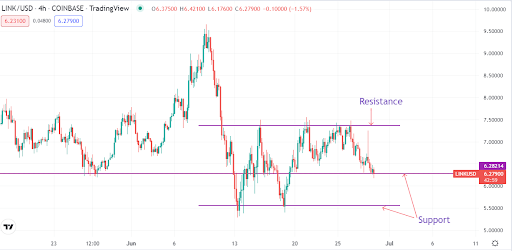
LINK sits at support, but bearish pressure is on.
On June 29, Robinhood announced that it had listed Chainlink’s token LINK/USD. The price popped up to 9% following the announcement. However, since then, LINK has lost by a similar margin.
Chainlink’s LINK price reaction underlies the innate volatilities of cryptocurrencies. It shows that cryptos are yet to escape the bear territory. Thus, investors would be better off trading short-term opportunities. Besides, listing at Robinhood comes when the brokerage firm is under pressure. Trading volumes on the online trading platform have crashed together with the bearish market. We find that the listing has little fundamental significance as long as weak sentiment remains.
Chainlink is a decentralized blockchain with nodes or oracles for data transfers. The network enables data and information transfers from off-blockchain sources to on-chain smart contracts. The process solves the reliability issues faced if a single centralized data source is used.
Just like any other cryptocurrency, Chainlink’s LINK has faced volatility. It is safe to say that the crypto has failed to replicate prior gains. The token’s high remains at $52 in May 2021, while the current trading is at $6.2. In early June, the blockchain announced its long-term road map called Chainlink Economics 2.0. The road map highlights a new era of security and growth, including introducing staking. LINK’s price recovered strongly, but weakness persists.
 Source – TradingView
LINK sits at support of $6.2 after shedding Tuesday gains. Bearish pressure remains as the Robinhood listing fails to give lasting impacts. We do not recommend a buy at the current level.
Chainlink’s LINK rose and fell again after listing at Robinhood. The crypto token is bearish at key support. Buyers should be aware that the token could fall further.
The post How likely will Robinhood’s listing support Chainlink’s token as price pumps? appeared first on CoinJournal.