Crypto mining stocks see massive gains amid Bitcoin rebound

Marathon Digital Holdings and Hut 8 Mining were among the biggest daily gainers after double-digit rallies on Monday.

Bitcoin mining firms saw their stocks make huge moves on Monday following Bitcoin’s breakout to prices above $22,000.

The stocks of top Bitcoin (BTC) mining firms jumped as positivity around the crypto industry seeped into the sector. As BCT/USD rose to retest price levels above $22,200, the shares of top miners opened higher and ripped.

MARA leads gainers

Marathon Digital Holdings Inc. (MARA) rose to intraday highs of $10.97, outperforming Bitcoin as gains amounted to close to 36%. The stock however hit resistance and slipped below $10.00, although it still closed more than 21% higher at $9.76.

Another stock to see massive gains was Riot Blockchain Inc. (RIOT), which surged to intraday highs of $6.88 to accumulate over 23% in gains at the intraday peak. Despite cooling off into the close, RIOT stock still closed double digits in the green at $6.23 (+11.85%).

Shares of Bitfarms, Core Scientific Inc. and Hut 8 Mining Corp. also registered impressive gains at the start of the week. Hut 8 ended Monday’s session nearly 8.7% up, Core Scientific was 8.3% higher and Bitfarms managed +4%.

Coinbase (COIN) and MicroStrategy (MSTR) also registered significant gains, with the Coinbase stock closing more than 9% higher and MicroStrategy at +5%.

The post Crypto mining stocks see massive gains amid Bitcoin rebound appeared first on CoinJournal.

Solana is crypto to watch as the price remains bullish at key resistance

  • Solana blockchain is regarded as an Ethereum killer 

  • Solana’s SOL has returned 19% in a week

  • The cryptocurrency is about to break past a resistance zone

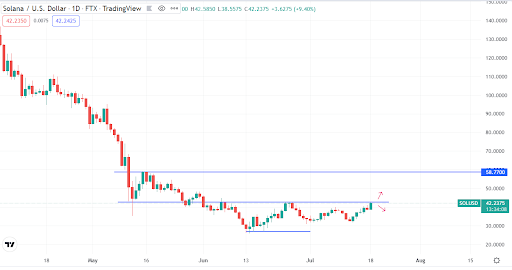
Solana SOL/USD has returned a massive 19% in the past week. As of the time of writing, the cryptocurrency was up 5% in the last 24 hours. SOL now trades at a resistance level of $42, but bulls look likely to win.

Solana blockchain has often been touted as an Ethereum killer. The name has originated from its similarities to Ethereum. The blockchain offers faster transaction speeds and is less costly than Ethereum. For this reason, investors believed that Solana was a true rival of Ethereum.

However, a series of exploits have raised doubts about the potential for Solana. The exploits, together with the bear crypto sentiment, saw SOL token touch a bottom of below $30. That compares to an all-time of $260 in November 2021 at the height of the crypto boom. SOL is still showing that it can reclaim higher levels as crypto sentiment suddenly improves. We believe this week will be monumental for investors looking to add positions to the Solana token.

SOL trades at resistance with the potential for a breakout 

Source – TradingView

SOL’s established resistance is at $42. That is the same level as the current price, suggesting that a breakout could occur. 

A break above the $42 resistance builds a bull case for SOL. The price could rise to find the next resistance, which is established at $58. Still, we need to watch the crypto sentiment to ascertain the viability of $58. A breakout will, however, make $42 the reference support for SOL. 

If SOL fails to break past $42, it could slide back potentially to $32. Nonetheless, with the crypto sentiment improving suddenly, there is a high chance SOL will break past the resistance. We need to watch how that pans out this week.

Summary

SOL is bullish at $42 resistance. Investors should watch for a potential breakout. The next resistance to watch is $58.

The post Solana is crypto to watch as the price remains bullish at key resistance appeared first on CoinJournal.

Harvard professor says central banks are ‘behind the curve’ on crypto regulation

Kenneth Rogoff, a Harvard University professor of economics and public policy, says central banks are “way behind the curve” in the push to regulate cryptocurrencies.

The former International Monetary Fund (IMF) economist said this during an interview with Bloomberg Surveillance on Monday.

Rogoff wondered why the US central bank – the Federal Reserve – was pursuing a central bank digital currency (CBDC). He contends that whatever the government may want to achieve with the digital currency can “accomplish” these same things by tweaking the current monetary system.

A crypto skeptic, including of CBDCs, the economist says having a successful retail rollout by the central bank would result in “massive disintermediation” that the government is “probably not ready to handle.”

For him, the motivation for some of the “smaller central banks” in wanting a CBDC is the hope that they can eat into some of the transactions that are currently being seen on crypto platforms.

Crypto ‘doesn’t want to be regulated’

In a comment that reflects the overall misunderstanding of cryptocurrencies, Rogoff notes digital currencies “general idea” revolves around making it difficult for one to be tracked. He added:

“I think central banks are way behind the curve, and governments in general, in regulating cryptocurrencies. They throw out the idea of having CBDCs to distract the conversation.”

Despite there being numerous calls from the crypto industry for regulatory clarity, and government’s recognition of the same, Rogoff thinks the crypto industry is pushing back against regulation.

Comparing the crypto industry today to the financial technology pioneers of the 90s and early 2000s, the Harvard professor says the mantra of “catch me if you can, regulate me if you can” is wrong. He also says crypto is lobbying and pushing back against regulation by throwing around money – the Super Bowl ads is an example.

He also appeared to criticise states like Florida and Colorado for their warm crypto regulatory environment, saying it’s like such states want to be the next El Salvaldor.

The post Harvard professor says central banks are ‘behind the curve’ on crypto regulation appeared first on CoinJournal.