
Vor dem lang ersehnte Merge setzen die Investoren wieder verstärkt auf Ethereum, was sich bereits auf den Kurs auswirkt, doch ist der Effekt auch nachhaltig?

Finanzmittel Info + Krypto + Geld + Gold
Krypto minen, NFT minten, Gold schürfen und Geld drucken
Vor dem lang ersehnte Merge setzen die Investoren wieder verstärkt auf Ethereum, was sich bereits auf den Kurs auswirkt, doch ist der Effekt auch nachhaltig?
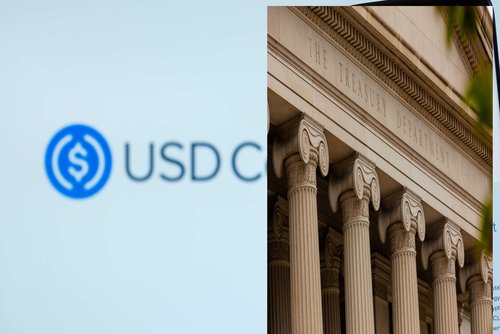
Circle is blocking USDC transactions connected to the Tornado Cash decentralised application, a move that is seen by many as a clear danger of centralisation.
Earlier this week, the United States Treasury Department added more than 40 cryptocurrency addresses allegedly connected to controversial mixer Tornado Cash to the Specially Designated Nationals list of the Office of Foreign Asset Control, or OFAC.
Following this latest development, Circle, the issuer of the USDC stablecoin, reportedly froze over 75,000 USDC worth of funds linked to the 44 Tornado Cash addresses sanctioned by OFAC.
Marius Ciubotariu, the co-founder of Hubble Protocol, commented that Circle’s move shows the danger of centralisation. Ciubotariu said;
“Circle’s decision to follow along with the US Treasury and ban users of Tornado from buying or selling USDC tokens is an extremely worrying development that threatens the integrity of cryptocurrency, and decentralized finance in particular.
An estimated $437 million of assets have been blocked as a result of this decision, one that will surely impact all manner of users of the cryptocurrency mixing service. More importantly, though, it underlines how dangerous it is to have one centralized company managing over $54 billion of assets in crypto.”
Ciubotariu pointed out that the precedent that this could set for the future of Ethereum Virtual Machine (EVM) smart contracts is also alarming. In the future, it could be possible to see these contracts written with an opt-in clause that would allow node validators to decide not to process a transaction due to a black/watchlist.
Stefan Rust, CEO of Laguna, pointed out that Circle’s action is a wake-up call to the cryptocurrency industry as it shows the danger of centralisation. Rust said;
“Circle’s move to ban users of the Tornado cryptocurrency mixing service from trading USDC sets an extremely dangerous precedent and should be a wake-up call for everybody working in the cryptocurrency industry. While much is being said of Tornado’s links to the North Korean state-backed hacking group Lazarus, the likelihood that North Korean users make up anything more than a tiny fraction of a percent of Tornado’s users is small.”
Rust added that the blacklist capability could be (and is) written into Ethereum Virtual Machine (EVM) token contracts is a huge vulnerability and point of coercion for the industry.
He added that people warned about the consequences of this feature being added to the USDC contract from day one. Rust added that;
“Now we have a centralized company at the mercy of US regulation running the fourth largest cryptocurrency in the world – and over $55 billion of market cap is on the line. This is truly a scary move. Imagine having a business where your closest competitor could shut you down by adding one row to a database it has complete control over?”
The CEO of Lugana added that while the US Treasury claims their move is due to Tornado Cash allegedly helping to launder $7 billion of money gained from cybercrimes, there are no doubt innocent users caught up in this that have used Tornado for totally legitimate privacy reasons.
Some of the biggest stablecoins, including Tether (USDT), USDC, and BUSD, are issued by centralised entities.
The post USDC’s blacklist of Tornado dApp shows the danger of centralisation appeared first on CoinJournal.

Im Bereich zwischen 22.000 – 24.800 US-Dollar sorgen die Großinvestoren momentan für beträchtlichen Widerstand, der einen Ausbruch aus der geltenden Preisspanne verhindert.

Mit Gregory Dwyer hat nun auch das letzte Mitglied der ehemaligen Geschäftsführung von BitMEX etwaige Verstöße gegen das Geldwäschegesetz eingestanden.
Litecoin price has crawled back in the past few days as the crypto industry and stock market rebounded. LTC was trading at $61.74 on Tuesday, which was about 52% above the lowest level this year. Its market cap stands at more than $4.4 billion.
Litecoin and other cryptocurrency prices bounced back recently as signs of greed in the market started to emerge. For example, the US dollar index has slipped from the year-to-date high of $109.3 to about $103. The falling USD is a sign that investors have embraced a risk-on sentiment.
Further, the closely watched volatility index (VIX) has dropped to the lowest level in months. This is a sign that volatility in the market has eased slightly.
Meanwhile, the fear and greed index that is tracked by CNN Money has risen from the extreme fear level to the current point at 52. This is a sign that investors are getting a bit greedy.
Historically, stocks and cryptocurrency prices tend to do well in a period of greed in the market. This also explains why the Nasdaq 100 index is close to exiting its bear market.
At the same time, LTC has jumped as investors predict that the sell-off that took place earlier this month has faded. For one, the contagion that most people were expecting following the crash of Celsius, Voyager Digital, and Three Arrows Capital has not happened.
Further, on-chain data shows that activity in litecoin’s network has continued rising in the past few days. For example, the number of LTC addresses has jumped in the past few weeks although they remain substantially below their highest point in 2021.
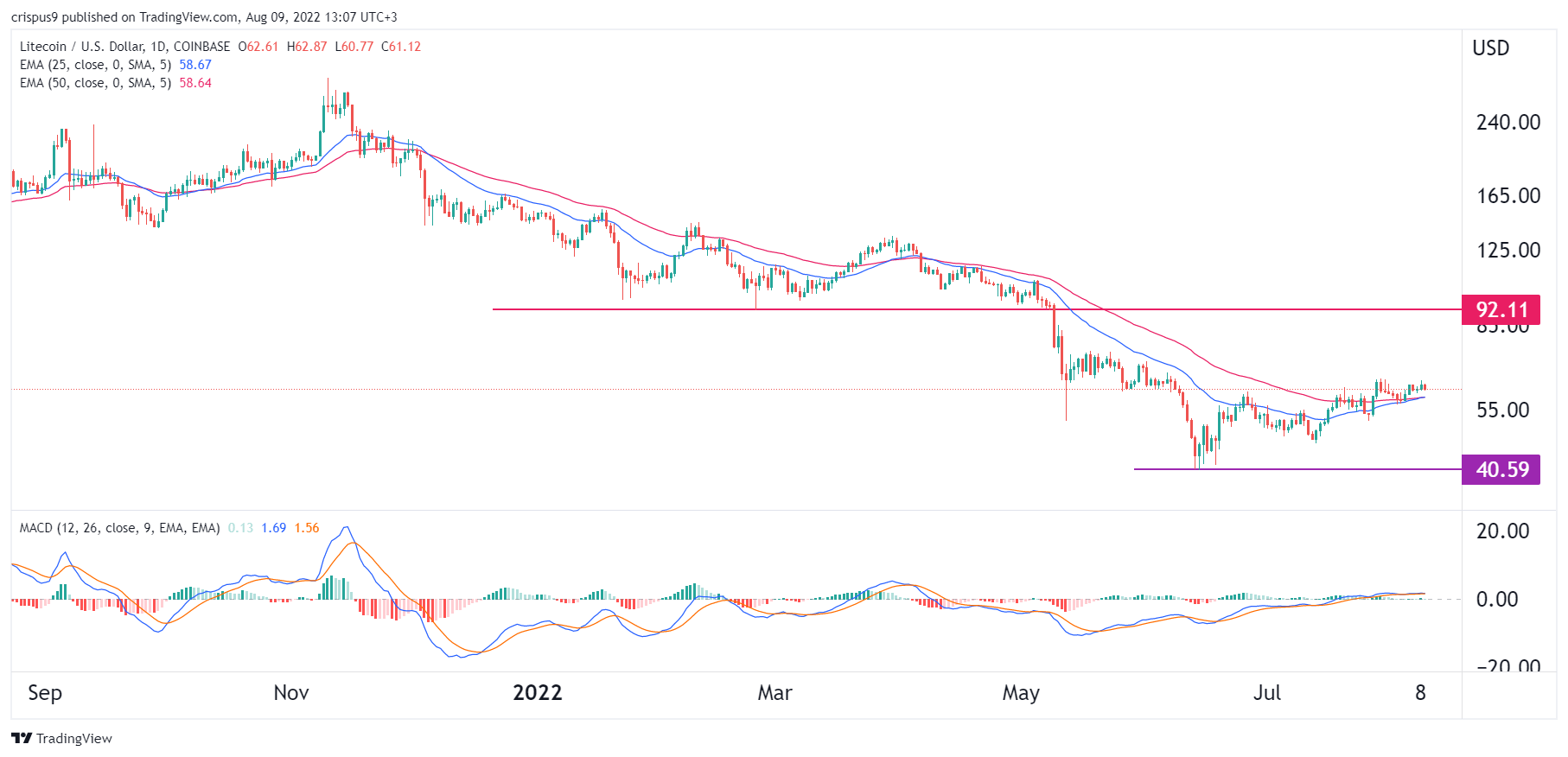
The daily chart shows that the LTC price has made a strong recovery in the past few weeks. This recovery started when the coin dropped to a low of $40.59 this year. It has now managed to move slightly above the 25-day and 50-day moving averages while the MACD has moved above the neutral point. The two moving averages have even made a bullish crossover.
Therefore, the coin will likely continue rising as bulls target the important resistance point at $92.11, which was the lowest level since April this year. A move below the support at $50 will invalidate the bullish view.
The post Litecoin price forecast as the fear and greed index recovers appeared first on CoinJournal.