
Bitcoin’s choppy pattern continues. Here is why the next breakout could be catastrophic

Since breaking below $19,000, Bitcoin (BTC/USD) has been unable to recover to the crucial psychological level. As of press time, the cryptocurrency trades slightly above $16,000, the level it bottomed at post-FTX collapse. It’s nearly two weeks now, and the price of BTC has been consolidating at this yearly low. Can it recover in the next few days?

It is hard to tell if BTC will find a bullish footing as crypto sentiment remains weak. Besides the FTX-inspired crash, BTC remains a key barometer of global economic health. Central banks are tightening the belts with rate increases to tame high inflation. With the situation looking gloomy, it could take a while before we find the right balance to take BTC higher. 

Once again, BTC’s decline below $19,000 indicated its bottom still needs to be found. Is $16,000 the likely bottom, or could we see a further decline below this level? A potential breakout is imminent that could help answer the question. Let’s turn to the technical levels and price action:

BTC eyes a potential bearish inside bar breakout at $16,000
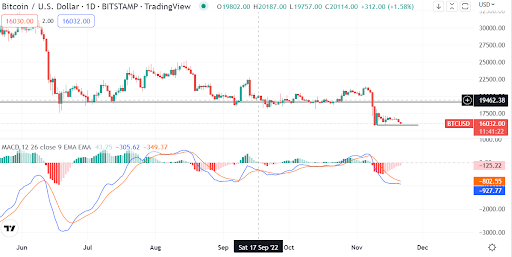
BTC/USD Chart by TradingView

On the daily chart, BTC trades with weakening momentum at the support of $16,000. The MACD indicator shows a strong bear market for BTC. Multiple pin bars formed at the level, indicating indecision in the market.

What’s likely to happen for BTC?

Two possible scenarios are likely for the BTC price in the coming days. If bulls defend the $16,000 level successfully, it will set BTC for a recovery to $19,000. An improved market outlook or momentum will strengthen a bullish market. A bullish signal at the crucial support zone will be needed to confirm an upside. 

On the flip side, Bitcoin could fall to $11,000 if bulls fail at the $16,000 level. This is a more likely outcome, given the weak momentum at the current BTC price. In the bear scenario, a bearish breakout of the inside bars formed at $16,000 will be confirmed. That will give bears control to take BTC lower.

Where to buy BTC    

eToro

eToro is a global social investment brokerage company which offers over 75 cryptocurrencies to invest in. It offers crypto trading commission-free and users on the platform have the option to manually invest or socially invest. eToro even has a unique CopyTrader system which allows users to automatically copy the trades of popular investors.

Buy BTC with eToro today

Skilling

Skilling is a Scandinavian based cryptocurrency broker which has a desktop website as well as apps for iOS and Android devices. It supports over 50 cryptocurrencies and it has a demo account to allow users to gain familiarity with the platform. Skilling has no hidden fees, it is an officially regulated broker and it supports a wide range of payment methods.

Buy BTC with Skilling today

The post Bitcoin’s choppy pattern continues. Here is why the next breakout could be catastrophic appeared first on CoinJournal.

OKX kicks off NFT Football Cup as FIFA World Cup begins in Qatar

OKX, among the world’s leading platforms for dApps, DeFi and GameFi, wants to make this year’s FIFA World Cup a memorable one for fans.

The OKX Football Cup, part of ‘The OKX Football Festival’, is giving millions of fans a chance to earn from a great prize pool as they support their favourite teams.

Simply, OKX is offering an NFT experience where one can enjoy the World Cup even more with free a NFT mint of their preffered team. With the free NFTs, its easier to predict  matches and stand a chance to win huge prizes. How does it work? 

Stake 0.01 ETH, mint and win great prizes

Football fans can win with OKX by predicting the winning teams in the group stage, the knockout rounds and the third-place match. To participate, you need to grab the free NFTs of your teams by connecting your wallet.

From here, it’s pretty simple for users to get their hands on the team NFTs by going to the OKX NFTs page and navigating to OKX Football Cup for a free mint. To get the other two free NFT mints, users need to use the OKX App. 

Notably, fans can mint all three team NFTs all at once on the app to save on gas fees. Alternatively, one can buy team NFTs on the OKX NFT Marketplace.

Each NFT mint requires users to stake 0.01 ETH, with up to 3 football teams mintable before the end of the group stages on 3 December.

20,000 USDT prize pool for the group round

The OKX Football Cup group stage matches begin on 21 November 2022 to 3 December 2022, with each match offering a fixed prize pool of 20,000 USDT. OKX adds 10 USDT for every NFT minted, thereby growing the prize pool.

Every day, just before a match begins, the OKX system will take a snapshot of NFT teams’ owners. 

NFT owners whose teams win the given match will share the $20k in USDT. However, if teams draw, the opposing sides will each have 10,000 USDT to be shared amongst NFT holders who backed the two teams.

Users will have the option of redeeming their full stakes at the end of the event.

The post OKX kicks off NFT Football Cup as FIFA World Cup begins in Qatar appeared first on CoinJournal.

Cardano’s algorithmic stablecoin to go live on mainnet in January 2023

Djed, Cardano’s over-collateralized algorithmic stablecoin, will be live on mainnet in January 2023 following a successful full audit. The scheduled launch is a great milestone coming days after Shahaf Bar-Geffen’s announcement about the stablecoin on the main stage at the Cardano Summit.

Making the announcement, COTI’s CEO Shahaf Bar-Geffen said:

“Djed going to public mainnet is a great achievement, following a lot of hard work from IOG and COTI. Recent market events have proven again that we need a safe haven from volatility, and Djed will serve as this safe haven in the Cardano network. Not only do we need a stablecoin, but we need one that is decentralized, and has on-chain proof of reserves. Djed is just that and I see it becoming the top stablecoin on the Cardano network, considering all of the integration partnerships already signed for it.”

Cardano remains prudent as the launch approaches

Following the Terra LUNA crash that resulted from the de-pegging of their native algorithmic stablecoin Terra USD (UST), Cardano has assured investors that they have been very prudent in the way they approach the release of their stablecoin. One of the things that they have had to do is ensure that a thorough audit took place besides other rigorous stress tests before the stablecoin is launched on the mainnet.

Cardano has also said that it will adopt a gradual and slow approach to providing ADA liquidity to the Djed smart contract. This will allow Cardano to pace themselves and carefully grow the stablecoin.

Once the Djed is launched, it will be integrated with select top Cardano partners to allow for more use cases.

Djed stablecoin features

Djed ($DJED) is an over-collateralized algorithmic stablecoin, built on Cardano and powered by COTI. It will be pegged to USD and backed by ADA.

It will use SHEN as its reserve coin.

$DJED’s algorithm is based on a collateral ratio within the range of 400%-800% for $DJED and $SHEN in order to ensure there’s enough $ADA in the pool.

The post Cardano’s algorithmic stablecoin to go live on mainnet in January 2023 appeared first on CoinJournal.

Tether’s USDT issuance protect’s the stablecoin from FTX-Alameda’s crisis

The collapse of FTX and Alameda Research hasn’t affected the USDT stablecoin, thanks to Tether’s issuance policy.

Tether, the company issuing the USDT stablecoin, has revealed that the recent collapse of the FTX exchange and its Alameda Research hedge fund, doesn’t have a negative impact on its ecosystem.

According to Tether’s latest blog post, the company’s issuance policy protects it from Alameda’s failure. Alameda Research is one of the leading issuers of the USDT stablecoin.

Tether explained that its USDT stablecoins are issued when institutional parties send USD to Tether. The company issues the USDT on a 1:1 basis corresponding to the amount of USD sent to Tether. 

Tether added that it converts the USD into reliable, liquidity and conservative collateral ( US Treasuries, etc.). This implies that all USDT stablecoins are fully collaterised by Tether’s reserves, and every USDT can be redeemed 1:1 with USD.

As a large issuer of USDT, Alameda Research sent Tether USD, and Tether issues USDT. The USD from Alameda Research remains in Tether’s custody, but they are not on Alameda’s balance sheet. The collateral backing Alameda’s USDT is not on Alameda’s balance sheet, Tether added. 

Tether revealed that Alameda can still redeem any USDT they have  USD via Tether’s redemption facility. The company further added that it doesn’t have any outstanding loans of USDT, of Tether’s reserves, or of any other funds whatsoever. Tether wrote that;

“The main problem countless other companies are facing is that they recklessly lent Alameda various assets relying on extremely illiquid collateral. Since Alameda cannot repay those loans at this time, those companies have a hole in their balance sheet. This is not how USD₮ issuance works and is not behavior Tether engaged in with Alameda in any way.”

Tether also clarified its lending process. The stablecoin issuer said the only time it engages in lending is when it is based on over-collaterisation with extremely liquid assets. 

Some cryptocurrency lenders, including Voyager Digital and Celsius, have been struggling in recent months. Binance US is preparing another bid to acquire Voyager Digital following FTX’s bankruptcy proceeding. 

Tether pointed out that it believes the approach of many lenders in this industry has been reckless, lending huge quantities of money, and accepting FTT (and other illiquid assets) and pinky swears as collateral. 

Despite the struggles of some companies like Alameda Research and Celsius, Tether said its operations were not disrupted. 

The post Tether’s USDT issuance protect’s the stablecoin from FTX-Alameda’s crisis appeared first on CoinJournal.