
Das Unternehmen würde bei diesem Deal zu einem Hoster für Bitcoin-Mining-Geräte werden.

Finanzmittel Info + Krypto + Geld + Gold
Krypto minen, NFT minten, Gold schürfen und Geld drucken
Das Unternehmen würde bei diesem Deal zu einem Hoster für Bitcoin-Mining-Geräte werden.
The crypto winter continues to take victims. The latest to succumb to Chapter 11 bankruptcy is Bitcoin miner Core Scientific.
Bitcoin’s plummeting price has quelled revenues significantly and, while cashflow is still positive, the revenue is not enough to cover operational costs. The goal is for the company to restructure under the Chapter 11 process rather than entirely liquidate.
Core Scientific has been struggling all year, in line with miners across the industry as they get squeezed on both ends – falling revenue in the form of Bitcoin prices and rising costs as a result of surging electricity costs across the globe.
The stock was trading at a market cap north of $4 billion last summer, but has now fallen 98% from all-time highs, its current market cap $70 million.
The share price did triple in short order last week when financial services company B. Riley offered to provide the company with $72 million in non-cash financing. The stock has since given up some of those gains.
Across the entire industry, miners are finding it tough. Electricity costs and the Bitcoin price are the two most vital inputs for the bottom line of a bitcoin miner, and both have moved significantly against them this year.
So too has the hash rate, with it straddling near all-time highs for a lot of the year. A higher hash rate means more computing power is demanded to verify transactions on the Bitcoin blockchain. While a higher hash rate is thus seen as a positive because it increases the security of the network – it would cost more energy and time to take over the network – it also weighs on miners’ profit margins.
When the hash rate hit another all-time high of 250 TH/s in early October, blockchain analytics company Glassnode warned that “miners are somewhat on the cusp of acute income stress”. This latest story about Core Scientific proves that.
Looking at miner reserves, the number of bitcoins held by the large mining pools has also been steadily decreasing this year.
It’s a poignant reminder that with these mining companies’ revenue denominated in Bitcoin, they are obviously extremely volatile stocks. Unfortunately, this year has brought the perfect storm giving rise to not only falling Bitcoin prices, but rising costs in the form of electricity, meaning miners have been hit twice as hard.
Looking at share prices, many companies have fallen further than the price of Bitcoin, which as I write this is trading at $16,800, down 64% on the year. Many mining companies are seeing losses that dwarf that in 2022.
They’ll hope that 2023 will bring better fortunes. But for Core Scientific, the road head is murkier. Now embroiled in the Chapter 11 process, it will hope to restructure and weather the storm, but there is no getting around the fact that the market for miners is likely to remain torrid in the short to medium term, at least.
The post Why are Bitcoin miners struggling so much? Core Scientific file for bankruptcy appeared first on CoinJournal.

Für Bitcoin und Aktien ist kein Licht am Ende des Tunnels zu sehen: Die US-Zentralbank wird im Jahr 2023 die Zinsen nicht zurücknehmen, so der Analyst Jim Bianco.
AVAX price has dropped to an all-time low.
DeFi volume declined to $1.7 billion from a record high of $20 billion.
Avalanche price has been in a strong sell-off in the past few months as demand for the AVAX token weakened. The token plunged to a low of $11.81, which was its all-time low. It has plunged by more than 91% from its highest level on record, giving it a market cap of more than $3.6 billion.
Avalanche is a leading blockchain that seeks to become the best alternative to Ethereum. It is a proof-of-stake network that is well-known for its blazingly fast speeds and low transaction costs. It also has more throughput features.
Avalanche has been adopted widely in key industries like decentralized finance (DeFi), gaming, the metaverse, and non-fungible tokens. Some of its top apps in its ecosystem are Benqi, Aave, and Trader Joe.
AVAX price has dropped recently as interest in tokens plummet following the spectacular collapse of leading platforms like Terra and FTX. As I wrote in this report, crypto investors have pulled more than $11 billion from Binance, the biggest exchange in the world.
Avalanche has also seen activity in its network crash. For example, the total value locked (TVL) in its DeFi apps has crashed from over $20 billion to just $1.7 billion. Most dApps in its ecosystem like Wonderland, Trader Joe, Stargate, and Platypus Finance have seen withdrawals.
Monetary policy also has had a role in the collapse of Avalanche prices. While America’s inflation dropped in November, it remained above the Fed’s target of 2.0%. As a result, the Federal Reserve decided to hike interest rates by 0.50% and signaled that it will continue hiking in the coming months.
This explains why cryptocurrencies and stocks have plunged after the Fed meeting while bond yields have risen sharply.
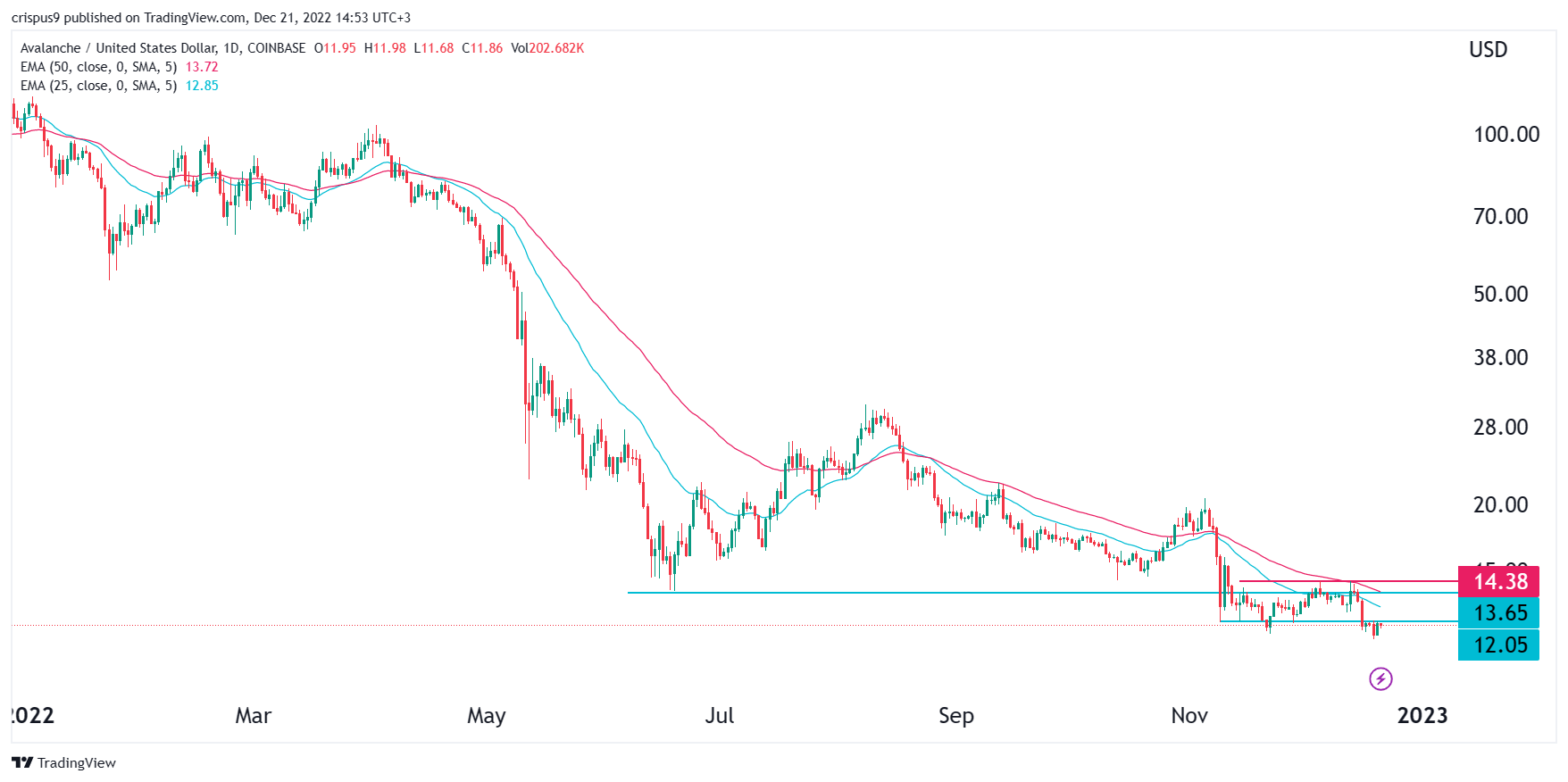
The daily chart shows that the AVAX price has been in a strong bearish trend in the past few months. As it dropped, the coin managed to move below the important support level at $13.65, which was the lowest level on June 19.
Avalanche also dropped below all moving averages while oscillators like the MACD and the Relative Strength Index (RSI) continued falling. Therefore, AVAX price will likely continue falling as the crypto bubble continues bursting. If this happens, the next key level to watch will be at $10. A recovery above $14 will invalidate the bearish view.
eToro is a global social investment brokerage company which offers over 75 cryptocurrencies to invest in. It offers crypto trading commission-free and users on the platform have the option to manually invest or socially invest. eToro even has a unique CopyTrader system which allows users to automatically copy the trades of popular investors.
OKX is a top cryptocurrency exchange which offers over 140 cryptocurrencies to invest in. OKX takes customer security very seriously, they store almost all of their clients‘ funds in cold storage, and the exchange is yet to be hacked. On top of this, the exchange offers very low fees and customers can even use their crypto as collateral for loans on the platform.
The post Avalanche Price Plunged to All-Time Low: Where to Next? appeared first on CoinJournal.
The bankrupt crypto lender Celsius Network is set to hold an auction of its assets on January 10 and it has already received 30 potential bidders. The auction was originally set to be held on December 15 this year but has since been pushed to next year.
With the bidding deadline of December 12 already passed, 125 parties have been contacted so far and 30 potential bidders have already signed non-disclosure agreements.
The assets set to be auctioned include Celsius retail platform and mining business.
The crypto lender has received several bids proposing different business structures and potential transactions from bidders looking to acquire its assets. For example, some have suggested migrating Celsius customers to the acquirer’s platform along with the assets.
Celsius also revealed that it has received a number of single-asset bids.
As of November 25, Celsius company held crypto assets worth about $2.6 billion. However, even with that many assets, Celsius is still $1.2 billion short of being able to pay off its debts even if it were to combine its crypto assets with its non-crypto assets.
Despite filing for bankruptcy on July 13 this year, the Celsius mining operations have been successful, generating positive operating cash flow every month this year as the company continues to deploy additional mining rigs.
On December 20, bankruptcy judge Martin Glenn approved a motion that Celsius had filed on September 1 and allowed the company to reopen withdrawals for some of its customers.
The assets that will be eligible for withdrawal are “ineligible Withhold Assets,” the amounts less than $7,575 held in the custody program, and funds that were transferred from the Earn or Borrow Program into the custody program within 90 days of Celsius filing for the Chapter 11.
The post Celsius to return customer funds as January auction attracts 30 bidders appeared first on CoinJournal.