
Die Regulierungsbehörde soll unbeabsichtigt 650 Namen und E-Mailadressen in einer E-Mail an Green im Rahmen einer Untersuchung preisgegeben haben.

Finanzmittel Info + Krypto + Geld + Gold
Krypto minen, NFT minten, Gold schürfen und Geld drucken
Die Regulierungsbehörde soll unbeabsichtigt 650 Namen und E-Mailadressen in einer E-Mail an Green im Rahmen einer Untersuchung preisgegeben haben.
According to a recent report by Cornerstone Research, the US Securities and Exchange Commission (SEC) has overseen 127 crypto-related enforcement actions since 2013. 82 of the actions so far have been litigations and 45 of them administrative proceedings.
The US Securities and Exchange Commission (SEC) has recently come under heavy criticism after cryptocurrency exchange FTX collapsed. For the most part, many have questioned the regulatory watchdog’s tendency to swing into action after events that see the ordinary public suffer huge losses in the market.
And no doubt, the SEC swiftly charged former FTX CEO and founder Sam Bankman-Fried following his arrest. Also charged were Alameda’s Caroline Ellison and FTX’s Gary Wang. Just a few days ago, as we highlighted, the agency filed charges against crypto platforms Gemini and Genesis.
It’s a pattern that falls in line with what has been labelled as “regulation by enforcement.”
Indeed, even as the crypto market navigates the crypto winter, regulatory clarity remains a long way off. However, enforcement actions have increased rapidly since the SEC’s first such move in July 2013.
In 2022, the securities market watchdog filed 30 enforcement actions touching on 79 market participants, including the February charge against crypto lender BlockFi.
Per the Cornerstone Research report, the enforcement actions in 2022 were against 56 individuals representing 71% of the allegations and 23 were against firms (29% of the actions). The total enforcement actions over the past year was double the actions filed in 2021, the report noted.
In terms of monetary penalties, settlements with the agency hit $242 million in 2022 – with the total fines since 2013 amounting to $2.61 billion as of 31 December 2022. As CoinJournal reported in October, the SEC fines include the $1.3 million levelled against celebrity Kim Kardashian for her promotion of the crypto project EthereumMax.
The post SEC’s crypto-related penalties hit $2.6 billion in 2022 appeared first on CoinJournal.
Polkadot, the scalable heterogeneous blockchain ecosystem, is currently one of the crypto industry’s most robust networks, and has a new feature to boot.
According to Polkadot founder Gavin Wood, the interoperability blockchain’s “cross-consensus message” formar (XCM) version 3 is finally deployed. Wood, who also founded Kusama, Ethereum and Parity Technologies, announced on Tuesday that XCM v3 had been in development for fifteen months.
After exactly 15 months in development, @polkadot XCM version 3 is merged. This enables bridges, cross-chain locking, exchanges, NFTs, conditionals, context-tracking and more. https://t.co/dqcLXOmDa9
— Gavin Wood (@gavofyork) January 17, 2023
XCM started with cross-chain communication between different chains at its core, before the shift to cross-consensus message – the aim of which is to avail a language by which different consensus systems can communicate.
The XCM design offers instructions on how to compose, send, and interpret messages across chains. The destination chain is the one that executes the instructions, with support for programmable, trustless and rich data.
Basically, XCM is standard through which protocol developers can define data and origins that their particular chains can send to or receive from. For instance, a developer can leverage XCM to allow for communication between Bitcoin (a proof-of-work network) and Polkadot (a proof-of-stake network).
But XCM v3 deployment does more than just to enable cross-consensus communication between chains. It can work across smart contracts, bridges, pallets, exchanges, and non-fungible tokens (NFTs).
An example is where message format allows interoperability between parachains, removing the need to use bridges.
The post Polkadot’s XCM v3 finally merged after 15-month development appeared first on CoinJournal.

Caroline Pham stellt fest, dass die Bemühungen außerhalb der USA bezüglich einer gemeinsamen Krypto-Regulierung bereits weiter fortgeschritten sind.
Key Takeaways
Coinbase has been in a world of pain recently.
Just last week, the exchange announced it was laying off 20% of its workforce, having already cut 18% last June. I wrote a piece analysing what this meant for the company, which was trading at a market cap below $10 billion, 90% down from the price at which it went public in April 2021.
This came after CEO Brian Armstrong unloaded 2% of his stake in the company in October, after which I wrote a deep dive analysing what it all meant for a company that has been viewed as the torch-bearer to carry crypto into mainstream circles once and for all following its high-profile floating on the Nasdaq.
But today, more bad news came. The exchange announced it is halting all operations in Japan, citing “market conditions”.
Despite the onslaught of bad news, Coinbase’s share price has been a big winner in the early weeks of 2023, up 48% in just 18 days.
This comes amid the biggest crypto rally in 9 months, which has seen prices surge across the board. While the bounceback in Coinbase’s share price is great news for investors, it also ironically sums up exactly what the problem is – Coinbase’s correlation to the crypto market.
There are few things more volatile than crypto, so it is not good news to be tied at the hip to its price action. But Coinbase’s performance is dependent on the crypto market because as the price falls, transaction volumes and interest in the industry, and by extension Coinbase, plummets.
During the pandemic, this was a great thing. The money printer was on maximum power, interest rates were low and retail investors were all aboard the FOMO train, armed with a healthy curiosity about crypto and a fat stimulus cheque.
But with the changing macro environment, the crypto industry has freefallen from $3 trillion to $800 billion, before this recent surge popped it back above $1 trillion.
Despite the pleasant pump this past few weeks, zooming out tells you that Coinbase has shed 85% of its value since going public, gone through two rounds of layoffs, seen its CEO sell 2% of his stock in October and now is ceasing operations in Japan.
All Japanese Coinbase customers will have until February 16th to withdraw their holdings from the platform. If they fail to do so, the remaining assets will be converted to Japanese yen. Coinbase had worked hard during the previous crypto winter to expand into the Japanese market, so the abrupt departure is a shame.
But Coinbase is not the only exchange to make this move, with rival Kraken also announcing it was ceasing Japanese operations last month. Also like Coinbase, Kraken had cut a large chunk of its workforce, laying off 30% of employees after the FTX collapse shook the market. The plight of Coinbase’s extreme correlation with the crypto market is once facing exchanges across the industry.
Coinbase Q3 results revealed that transaction volume fell 44% from Q2. The fall in volume and interest ultimately is what has caused the plummeting share price, layoffs, and now ceasing of Japanese operations, with a glance at Google Trends all you need to see the scale of the dropoff in the public’s attention to the exchange.
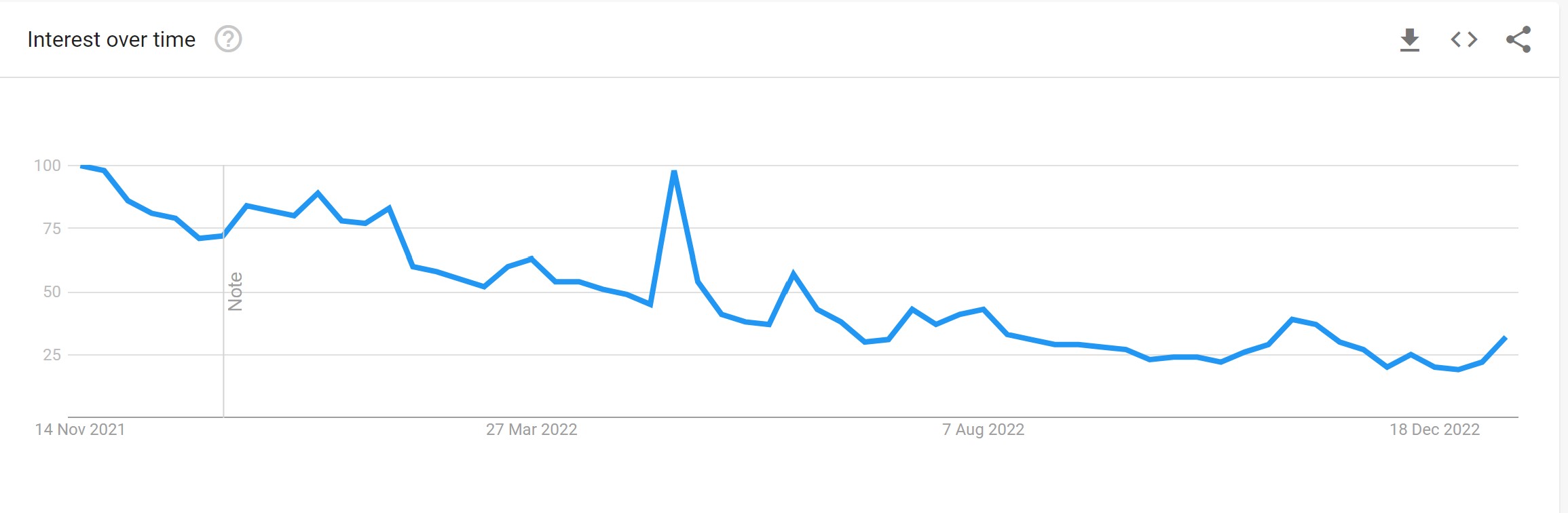 For $COIN investors, they will hope that the last few weeks of softer macro data and a crypto bounceback are an omen of things to come, otherwise this share price rally will be short-lived.
The post Coinbase terminates Japan operations, why is share price still up 50% in two weeks? appeared first on CoinJournal.