
Die Klage der New Yorker Staatsanwaltschaft gegen KuCoin ist zugleich der erste Fall, in dem Ethereum explizit als Wertpapier eingestuft wird.

Finanzmittel Info + Krypto + Geld + Gold
Krypto minen, NFT minten, Gold schürfen und Geld drucken
Die Klage der New Yorker Staatsanwaltschaft gegen KuCoin ist zugleich der erste Fall, in dem Ethereum explizit als Wertpapier eingestuft wird.
HT, the native token of Huobi Exchange, crashed by over 90% on Thursday dropping to $0.31 from $4.6 in just 10 minutes.
Although the price has since recovered, the token was trading at $3.81, 21% down in the past 24 hours at press time.
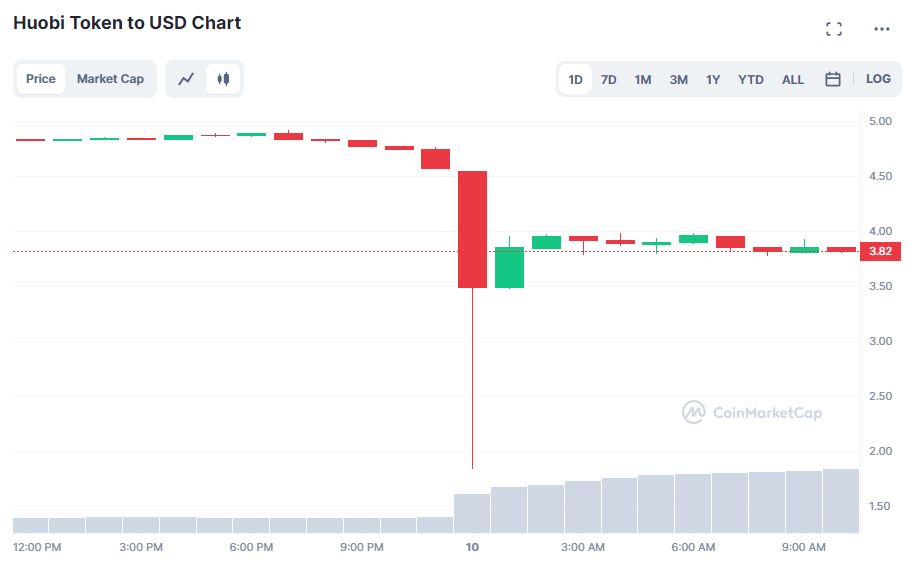 Huobi price Chart: Source CoinMarketCap
According to transaction data from Kaiko’s research analyst, Riyad Carey, more than $2 million HT tokens were sold on Huobi in the minutes leading to the HT crash. Justin Sun was also reported to have moved $60 million in USDT from Huobi to Aave.
Interestingly, Tron’s founder Justin Sun is the largest holder of HT tokens and serves as an advisor to the Huobi crypto exchange.
In the same period when HT price dropped by 90%, Tron’s token, TRX price dropped by 12% from $0.057 to $0.066.
Commenting on the spontaneous price plunge Justin Sun said:
“Few users triggering a cascade of forced liquidations in the spot and HT contract markets… We will continue to improve the liquidity depth of main cryptocurrencies and HT token, strengthen leverage risk warnings and liquidity capabilities.”
Sun also dismissed the price drop as a normal market occurrence and assured the Huobi community that Huobi operations are safe. He also said that he will create a $100 million liquidity fund for those impacted by the leveraged liquidation. He actually confirmed via Twitter that he has transferred $100 million in USDC stablecoin to Huobi.
The post HT, Huobi’s native token, price crashed by 90% on Thursday: here’s why appeared first on CoinJournal.
Letitia James, the New York state Attorney General, has announced that she has filed a lawsuit against KuCoin for issuing crypto services in New York without registration.
James says that she was able to buy and sell cryptocurrencies on the Seychelles-based cryptocurrency exchange despite the fact that it has not been registered in New York as a securities broker or dealer.
In the suit filed on March 9 at the Supreme Court of the State of New York County, James also alleges that KuCoin violated securities law by selling and offering to sell and purchase and purchasing cryptocurrencies that are securities and commodities to New Yorkers without first seeking registration.
In addition, the lawsuit also alleges that KuCoin error by selling its KuCoin Earn product. The AG has labelled this product as a security that has not been registered.
There are also allegations that KuCoin misrepresented itself since it hasn’t registered itself as one to be allowed to function as one.
I’m suing cryptocurrency platform @kucoincom for illegally operating in New York without registering with the state.
This is our eighth action to rein in shadowy cryptocurrency platforms that disregard our laws and put New Yorkers at risk.
— NY AG James (@NewYorkStateAG) March 9, 2023
The New York AG’s suit also states that under the state and federal authority, LUNA, UST and ETH are categorized as commodities under the state’s Martin Act and that KuCoin filed to register as a commodities broker.
It is the first time the AG has referred to Ethereum’s Ether (ETH) as a security although there have been similar allegations by people in other regulatory authorities in the US.
The price of KCS, the native token of KuCoin, has plunged 5.78% partly buoyed by the recent developments.
KuCoin is ranked the fifth largest cryptocurrency exchange if found guilty could be liable to a fine as was the case with Kraken, one of the leading US-based cryptocurrency exchanges, which was fined by the Commodity Futures Trading Commission (CFTC) for offering unregulated crypto investment products.
The post New York State Attorney General files a lawsuit KuCoin appeared first on CoinJournal.
Hut 8 Mining Corp (TSE: HUT) is trading down this morning after reporting disappointing results for its fourth financial quarter.
Digital assets the Toronto-headquartered firm produced in Q4 were 698 versus a much higher 789 in the same quarter last year. In the earnings press release, CFO Shenif Visram said:
We continued to fastidiously manage our finances through the fourth quarter, which allowed us to navigate sustained bitcoin price suppression, fluctuating power prices and increased network difficulty.
The crypto company’s installed hashrate currently sits at about 2.5 EH/s. Wall Street currently has a consensus “overweight” rating on the Hut 8 Mining stock and sees upside in it to $3.38 on average – about a 75% premium on its current price.
Last month, Hut 8 Mining said it will merge with US Bitcoin Corp in an all-stock transaction. According to CEO Jaime Leverton said:
We’ll continue to uphold our operating principles as we work to close business combination with USBTC and begin operating as a US-domiciled, digital asset mining, hosting organisation.
Versus its year-to-date high, Hut 8 Mining stock is now down more than 40%.
The post Hut 8 Mining swings to adjusted EBITDA loss in its fiscal Q4 appeared first on CoinJournal.
Gate.io parent company the Gate Group has announced a planned launch of a new Visa debit card as it looks to promote further adoption of cryptocurrencies in Europe.
The new venture, Gate Visa debit card, will be run via the company’s Lithuania-based subsidiary Gate Global UAB, and will be open to users within the European Economic Area (EEA), the Gate Group said in a press release.
Gate plans to help crypto holders easily and seamlessly pay with cryptocurrencies, including in-store and online at more than 80 million merchant locations across the world.
Apart from being able to easily spend their crypto assets, card holders will benefit from complete autonomy, with the capacity to track and manage spending via the Gate Card app.
Dr. Lin Han, the founder & CEO of Gate Group said in a statement that the launch of the Visa card is one way of bridging crypto with everyday life. The card will also be key to ensuring greater financial inclusion, Han added.
Cuy Sheffield, the head of crypto at Visa, also commented on the partnership between the payments giant and the cryptocurrency platform. According to him, the collaboration helps Visa in its goal of bringing crypto to its merchants and financial institutions.
Visa’s partnership with Gate.io comes a few weeks after the company’s strategic deal with crypto payments platform Wirex. However, this also follows news reports that Visa had decided to pause all crypto-related deals.
As CoinJournal highlighted, Visa was ostensibly taking a break to assess the landscape amid the market uncertainty and increased regulatory pressure.
The same outlook was given by Mastercard, although both companies noted they would continue to pursue their respective blockchain strategies.
The post Gate.io announces plans for new Visa debit card in Europe appeared first on CoinJournal.