
Crypto market stalls as investors weigh debt ceiling talks: Should you buy Metacade now?

Key takeaways

  • The cryptocurrency market has stalled its movement over the past few days as investors consider their positions.

  • Investors are keenly observing the ongoing debt talks, with the United States’ debt now above $31 trillion.

  • With prices now down, this could be an excellent opportunity for investors to purchase cryptocurrencies like Metacade. 

The cryptocurrency market has been in a consolidating stage this week, with prices of most cryptocurrencies currently in the red zone. 

Investors have been keenly observing the ongoing debt ceiling talks in the United States, with many of them conservative in their approach. This has led to a poor performance from the crypto market this week. 

As the prices of most cryptocurrencies declined this week, could this be a perfect opportunity to purchase more coins and tokens like Metacade? 

The debt ceiling and how it could affect the cryptocurrency market

Treasury Secretary Janet Yellen recently stated that the United States could surpass its debt ceiling by June 1st. If that happens, market experts believe that the US could default on its debt.

According to the official data obtained from the US Treasury Fiscal Data website, the US’s current debt stands at $31.46 trillion. The debt limit is the highest amount the United States government can borrow to service the economy.

Due to the ongoing talks, the cryptocurrency market has underperformed this week. Bitcoin, the world’s largest cryptocurrency by market cap, continues to trade below $27k. At press time, the price of Bitcoin stands at $26,884, down by 1% so far today.

The total cryptocurrency market cap also stands at $1.13 trillion, down by 1% over the last 24 hours.

What are experts saying about the debt ceiling? 

Some market experts believe that the US will not default on its loan but will likely print more dollars. This will effectively weaken the dollar and strengthen assets such as cryptocurrencies and commodities.

Jesse Meyers, the chief operating officer of investment firm Onramp, believes that the US government will print more money, resulting in a 2020-like rally by Bitcoin and other cryptocurrencies. He stated that;

“When the debt ceiling is lifted, and credit-contraction leads to an economic crisis. They will have to print money on a massive scale. Bitcoin was the winner during the last round of stimulus.“

Market analysts are predicting that Bitcoin and other major assets could experience a boost if the US government prints more dollars to service its debts, as there would be liquidity available for investors to purchase BTC and other cryptocurrencies. 

How does this affect projects like Metacade? 

Bitcoin’s rally is usually duplicated by other cryptocurrencies. Metacade could be one of the projects that could be a big winner if the market experiences another bull cycle soon.

At press time, the price of Metacade stands at $0.02002, down by 10% over the last 24 hours. The token is down by 56% from its all-time high price of $0.04569. This could represent an excellent buying opportunity for investors. 

What makes MCADE one of the tokens investors could consider is the potential of the Metacade project. 

Metacade is a web3 project that is powered by the Ethereum blockchain. The development team is working to improve the existing play-to-earn (P2E) ecosystem, allowing users to enjoy new web3 experiences. 

With Metacade, players will be able to play, connect, build, and earn seamlessly. In addition to that, Metacade will transition into a decentralised autonomous organisation (DAO) by 2024, giving token holders control over the ecosystem. With such plans in motion, MCADE could be one of the biggest winners in the upcoming Bull Cycle. 

Is Metacade a good investment now?

Down by more than 50% from its all-time high, MCADE could be trading at a discount at the moment. Investors looking to take advantage of the project’s potential could purchase MCADE tokens now. 

After raising $16 million during the presale event, the Metacade team is working hard to list the token on several cryptocurrency exchanges and roll out its GameFi platform. 

These events could ultimately lead to a surge in the value of Metacade over the next few months and possibly years. 

The post Crypto market stalls as investors weigh debt ceiling talks: Should you buy Metacade now? appeared first on CoinJournal.

Anthony Pompliano: Bitcoin may be world’s largest insurance company

  • Pompliano argues that Bitcoin’s unique properties make it an attractive insurance asset for a variety of reasons.
  • He says Bitcoin provides insurance against a variety of risks, including, currency debasement and sovereign default.
  • Bitcoin critics however point to things like the volatile nature of crypto assets and meagre adoption as reasons why it might not be the global insurance company.

Anthony Pompliano, a venture capitalist and popular Bitcoin advocate, argues that BTC could be considered the largest insurance company in the world.

The investor says the idea was proposed to him at a breakfast meeting with two investors, whose point suggested that the world’s largest insurance company may not “look like” the typical insurance company.

Why Bitcoin could be the insurance

Pompliano’s argument, published in the latest edition of The Pomp Letter, is based on the idea that Bitcoin provides insurance against a variety of risks, including, currency debasement, sovereign default, undisciplined monetary and fiscal policy, and economic censorship. 

He explained:

“Just as there are different insurance policies that serve different purposes, Bitcoin is different things to different people. And just as most policyholders don’t want to ever have to use their insurance, most bitcoiners realise that bitcoin’s success will likely come on the heels of major issues in the legacy financial world.”

On what exactly makes Bitcoin an insurance, the entrepreneur listed a number of reasons.

He says Bitcoin is a one-time purchase, and it comes with certain advantages. Unlike traditional insurance policies, BTC doesn’t require ongoing premiums. If you buy early, Bitcoin comes as a cheap premium and much more expensive when done later.

The second reason is that cryptocurrency is a decentralised asset that is not subject to the control of any one entity, which makes it more reliable than traditional insurance companies. It also has an inverse relation to catastrophe in traditional finance, the latest example being when BTC price rose amid the US banking crisis.

Also, Bitcoin is a global asset that can be accessed by anyone, anywhere in the world, which makes it more accessible than traditional insurance products. As an insurance, its programmatic nature means holders don’t need to submit claims and wait for someone to judge whether to honour it or not.

Bitcoin critics may disagree, but…

Although Bitcoin continues to see major adoption across the globe, the argument such as the one highlighted by Pompliano has not escaped crypto critics.  

For some, BTC remains too volatile to be considered a reliable insurance asset. Another argument is that the digital asset hasn’t achieved the adoption levels that would make it a practical insurance choice for most people.

Pomp says the idea is still a viable one, especially with the possibility that Bitcoin can be an insurance against events like inflation and economic collapse. Most of these events have largely been “uninsurable.”

“No insurance company is going to write you a legitimate policy against high inflation. They won’t write you a policy against government seizure of your assets. The insurance companies historically have not covered hyperinflation or economic collapse,” the investor argued.

He also thinks one doesn’t need to hold huge amounts of BTC to tap into the benefits. Putting about 1-3% of investment allocation into bitcoin can be an effective hedge against negative impact of economic risks.

The post Anthony Pompliano: Bitcoin may be world’s largest insurance company appeared first on CoinJournal.

Less than $20 billion of stablecoins left on exchanges as capital continues to drain


Key Takeaways

  • Nearly $24 billion of stablecoins have left exchanges since FTX collapsed last November
  • The total marketcap of stablecoins has dipped $16 billion in that time
  • Liquidity continues to fall in the crypto space, with capital moving elsewhere despite rising prices
  • Strict regulatory climate in the US, high yields in trad-fi and uncertainty may be contributing to the pattern

Crypto prices have risen since the start of the year, but capital continues to flow out of the space. Last week brought the news that two prominent market makers, Jane Street and Jump Crypto, were scaling back operations in the US amid the continued regulatory crackdown on the sector. 

For markets that have already been suffering from thin liquidity since the Alameda insolvency last year, the news amounts to the latest blow. While rising prices may have brushed the problem under the carpet for the time being, Bitcoin markets getting drained of capital is undoubtedly a hurdle that needs to be overcome for an asset that has ambitions of establishing itself in the mainstream. 

Indeed, with liquidity so low, prices have been able to move up more rapidly, with less capital needed to shift the shallow order books on exchanges. In the short-term, this has been a boon. As inflation has come down and forecasts around the future path of interest rates have softened in the last six months, crypto has thus surged upward with less resistance in its way, Bitcoin expanding over 60% this year. 

In the long-term, however, this is not a bullish development. Thin liquidity means amplified moves downward as well as upward. And looking at the regulatory climate, things only seem to be getting worse for crypto firms based in the US, which happens to be the centre of the financial world. 

The SEC is on a warpath with the entire entire industry, clapping back at accusations that it is the lack of regulatory clarity that is causing so many issues, but rather “mass non-compliance” on the part of crypto firms. 

The money is talking. We have discussed the recent announcements of market makers, but a glance at the liquidity on exchanges also reveals the capital flight that is occurring. This week, the total balance of stablecoins on exchanges dipped below $20 billion. At the start of the year, that figure read $37.7 billion. When FTX fell in November, it was $43.5 billion. 

We have published research on this exodus before. But the flood shows no sign of drying up, and we are now at a place whereby 55% of the stablecoins on exchanges have departed since FTX and Alameda went poof in November. 

This 55% outflow represents a funnelling out of nearly $24 billion, a massive chunk when considering the entire stablecoin market cap is currently only $130 billion. Interestingly, the market cap was $146 billion when FTX went down, meaning the total stablecoin drawdown has “only” been $16 billion.

This suggests stablecoins are being moved elsewhere in the blockchain world, as well as fleeing the crypto space altogether. But with T-bills yielding an easy 5% while the regulatory climate around crypto continues to worsen, it is not a surprise to see investors’ heads turned. When considering the fear around custody of assets after FTX collapsed, and the fact the macro climate remains uncertain, this makes more sense again. 

Whatever happened, the main point here is that liquidity in the crypto space continues to be drained. Most order books are as shallow as they have been in over two years, and Bitcoin’s volatility remains high (even with the last couple of weeks feeling relatively serene, Bitcoin has still dropped 12%). As for other cryptos, the effect is even more pronounced. If this liquidity issue doesn’t change, crypto will have a tough time establishing itself as a force on the mainstream stage. 

The post Less than $20 billion of stablecoins left on exchanges as capital continues to drain appeared first on CoinJournal.

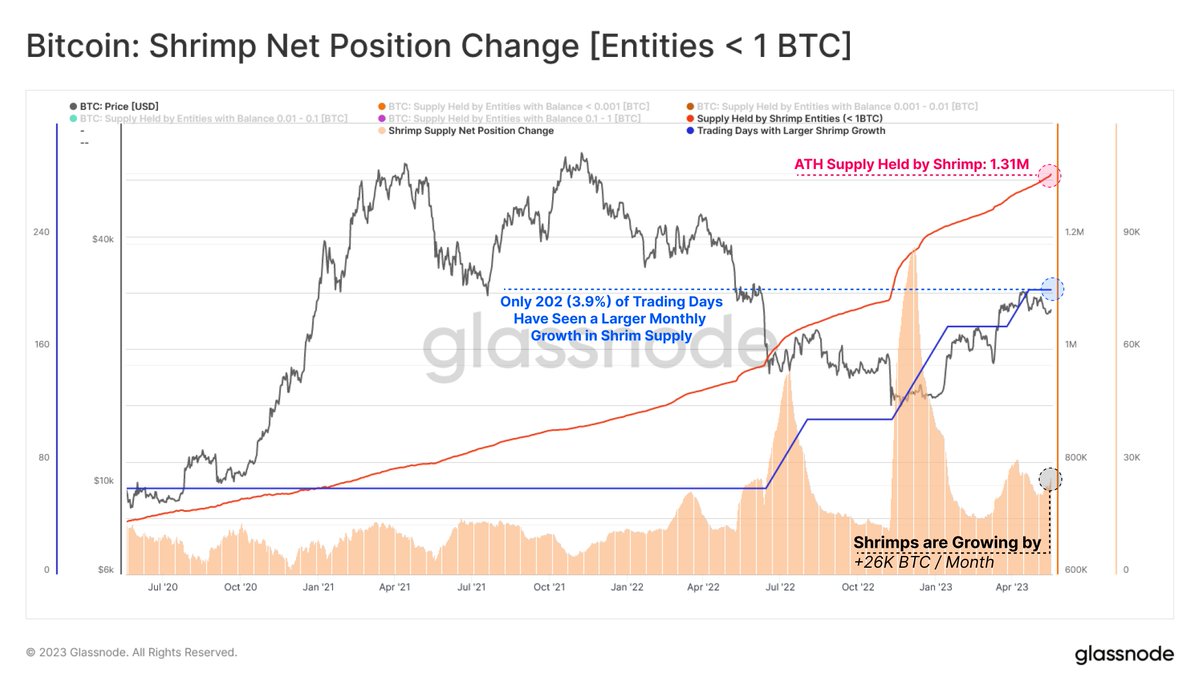
Bitcoin supply held by shrimps hits all-time high of 1.31 BTC

  • Bitcoin wallets with less than 1 BTC now hold an all-time high of 1.31 million coins.
  • Shrimps have been adding an average of 26,000 BTC every month, data shows.
  • The growth of the shrimp cohort is a positive development for the Bitcoin network.

The amount of Bitcoin held by “shrimps” – those wallet entities that currently hold less than 1 BTC) has reached a new all-time high.

According to data from Glassnode, shrimps have increased their total holdings to 1.31 million BTC. The cohort has witnessed the gradual increase in holdings over the past several months.

Shrimps grow holdings by +26,000 BTC every month

Per data Glassnode shared via Twitter, the shrimp cohort has experienced a significant expansion of their holdings in 2023. This followed a similar trend last year, with the buying among this group coming despite the greater volatility that hit the market.

Specifically, shrimps have added 26,000 or more Bitcoin every month. Since July 2020, only 202 (3.9%) trading days have recorded a larger monthly growth.

The suggestion from this is that retail investors have been aggressive in accumulating BTC, with the dips seen during the bear market providing investors with an opportunity to buy Bitcoin at low prices.

The chart below shows the growth in the amount of BTC held by wallet addresses with less than 1 bitcoin. As you can see, the amount held by these entities has increased significantly in June/July 2022 and again in November/December and January 2023.

Increase in small holders is a positive for the long-term health of Bitcoin’s network as the metric suggests retail investors are confident in the cryptocurrency’s growth and long term potential.

The post Bitcoin supply held by shrimps hits all-time high of 1.31 BTC appeared first on CoinJournal.