
DOT/USD technical analysis – will the bottom hold?

  • Polkadot hodlers are underwater
  • A bullish scenario remains valid if the lows hold
  • A move above $7 should lead to more gains

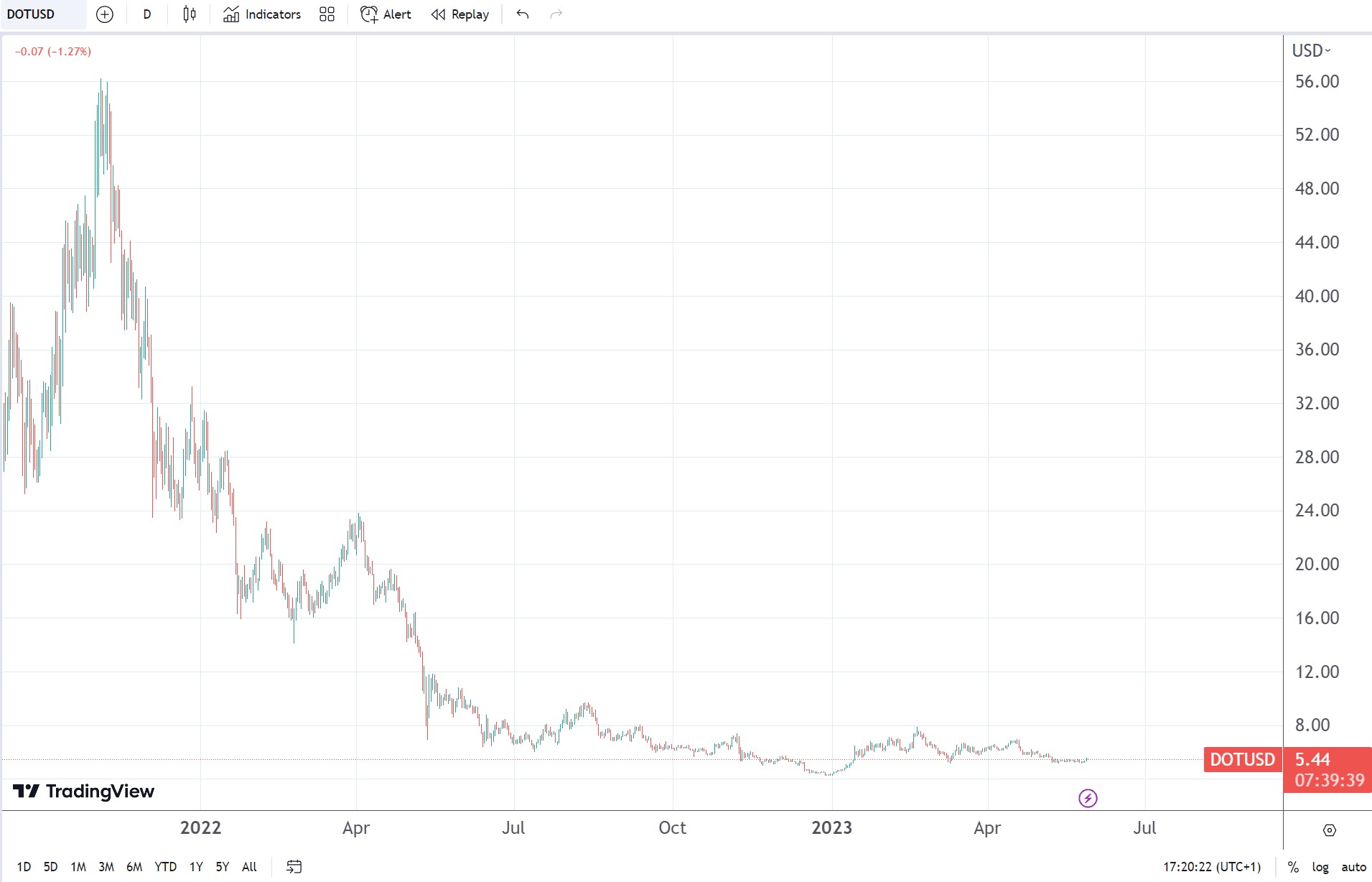
It has been a tough period for long-term holders of Polkadot. The DOT/USD exchange rate has moved South relentlessly after peaking at $56 in late 2021.

From $56 to $5, it was a straight decline. It took only one year for Polkadot to frustrate bulls.

And even now, as cryptocurrencies have rallied in 2023, one should be scared looking at the daily chart. After all, the bounce from the lows looks so small when interpreting the bigger picture that it is difficult to find a bullish argument.
Polkadot chart by TradingView

Polkadot should overcome $7 resistance area for bulls to be in control

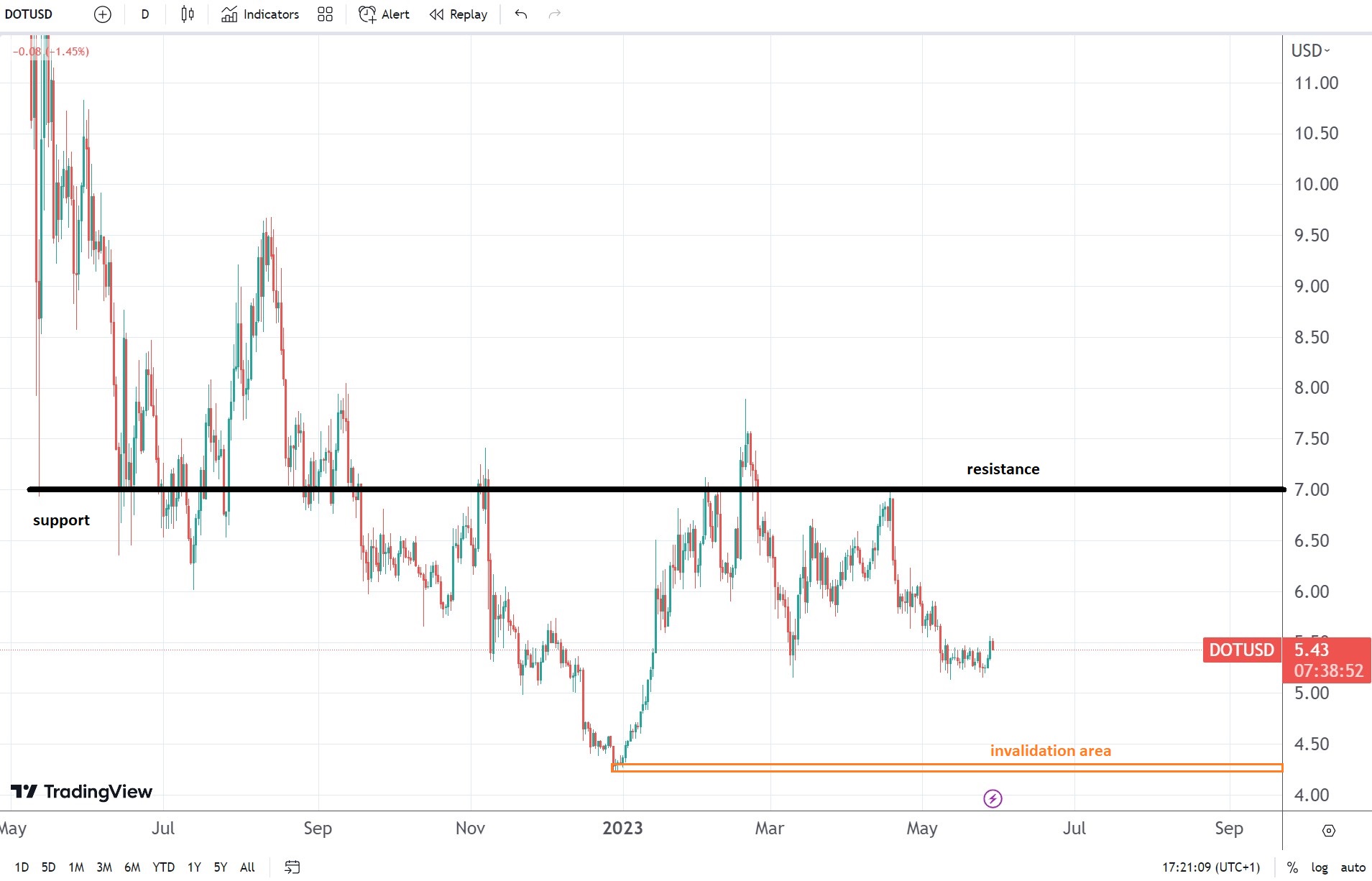
Zooming in, one may see the 2023 rally that brought back optimism in the cryptocurrency market. Sure enough, Polkadot already gave back more than half of its YTD gains.

But the invalidation level for a bullish scenario still holds. Effectively, it means that the recent price action might be nothing but a correction part of a bigger-degree bullish trend.
Polkadot chart by TradingView

The Elliott Waves theory states that an impulsive move (i.e., the one that began at the start of the year) is followed by a corrective structure, an a-b-c.

This a-b-c that corrects a bullish trend should have two waves moving in the opposite direction (i.e., waves a and c), and one that moves in the main trend’s direction.

It means that one may easily say that the move from the 2022 lows is an impulsive structure, and the decline from the 2023 highs is the a-b-c. In this case, the implications are bullish for Polkadot and bearish for the US dollar.

However, only a move above the pivotal $7 level would cement the bullish Elliott Waves scenario. Until then, bulls might wish for the price action to hold above the invalidation area shown on the chart above.

The post DOT/USD technical analysis – will the bottom hold? appeared first on CoinJournal.

Miner earnings from Bitcoin fees decline 90% from peak of BRC-20 frenzy

  • Bitcoin miners’ revenue from fees dropped 90% since the BRC-20 peak, from $17.8 million daily to $1.7 million per day as of 29 May, 2023.
  • However, current levels remain within historical levels with only 310 out of 4674 trading days having seen greater fees.
  • In 2018, transaction fees were higher than recent highs only on two trading days.

Bitcoin miner revenue from transaction fees has declined significantly since the BRC-20 frenzy that drove network activity higher earlier in the month.

Bitcoin mining is a key component of the flagship cryptocurrency’s network operations and miners earn from the set subsidy as well as transaction fees. BRC-20 tokens are a type of fungible tokens created on the Bitcoin blockchain. They are ordinal inscriptions that can are used to represent a variety of things, including digital assets and loyalty points.

Miner revenue from fees falls sharply after BRC-20 frenzy

According to data from Glassnode, a leading on-chain and financial markets data platform, miners were earning roughly $17.8 million from transaction fees per day. This happened as Bitcoin price traded near the YTD highs and as the BRC-20 craze hit the industry. 

However, as of May 29, 2023, the earnings had declined considerably and miners were taking home just $1.7 million from network fees per day.

Miner earnings from fees has thus fallen by about $16.1 million, or 90.85% from that recent peak, Glassnode highlighted on Monday.

But as the platform noted, miners’ revenues from fees dropping to latest levels still sees the figures near historical ones seen in most trading days. Only 310 out of 4,674 days, or 6.7% of BTC trading days have seen higher miner revenue from fees.

Glassnode noted:

“At the peak of the BRC-20 frenzy, Bitcoin miners were earning $17.8M in transaction fees, with only 2 trading days across the 2018 peak recording a larger fee revenue. Currently, miners are earning $1.7M in fee revenue, a -$16.1M decline from the recent peak. However, this remains significantly elevated when compared to historical precedence, with only 310 / 4674 (6.7%) trading days recording greater fees.”

The Bitcoin network recently saw a massive surge in activity as the demand for BRC-20 tokens soared. The result, as highlighted here, was network congestion as the rush to inscriptions helped fees to spike to year-to-date highs. It proved a bumper season for miners as Glassnode data shows.

In 2018, when Bitcoin fees also spiked significantly, only 2 trading days had recorded transaction fees higher than the $17.8 million miners earned recently.

The post Miner earnings from Bitcoin fees decline 90% from peak of BRC-20 frenzy appeared first on CoinJournal.

Bybit gets “in-principle” approval to begin operations in Kazakhstan

  • Bybit has been in the process of expanding its service offerings.
  • Bybit received “in-principle” approval from the Astana International Financial Centre to begin operations in Kazakhstan.
  • The exchange will begin operating as a digital asset trading facility and as a custody services provider in the country.

Bybit has announced that it has received an “in-principle” approval from the Astana Financial Services Authority (AFSA) to start operating as a digital asset trading facility and as a custody services provider in Kazakhstan.

Commenting on the achievement, the co-founder and CEO of Bybit, Ben Zhou, stated that the Commonwealth of Independent States (CIS) as a region provides promising potential for the crypto industry.

Bybit expansion drive

Bybit has been in the process of expanding its service and product offering over the past few months.

The most recent move was its announcement on May 2 that it will start offering crypto lending services.

In March this year, Bybit announce a partnership with Mastercard for a new debit card to allow crypto payments.

Kazakhstan and cryptocurrencies

In February, local officials in Kazakhstan announced new regulations requiring 75% of the revenue made from crypto mining to be sold through a crypto exchange as the country cracks down on tax evasion in the industry.

Kazakhstan recently announced that it had collected about $7 million in crypto taxes in 2022. The country is also in the pilot phase of its digital current development.

The post Bybit gets “in-principle” approval to begin operations in Kazakhstan appeared first on CoinJournal.