
Germany’s Deutsche Telekom set to become a Polygon validator

  • Germany’s Deutsche Telekom is one of Europe’s largest telecommunications companies.
  • Deutsche Telekom provides consulting and software development services.
  • Polygon has about 100 validators providing staking and validation services for the network.

Germany’s Deutsche Telekom is set to leverage its infrastructure in Web3 to become a Polygon Network validator. The Ethereum scaling protocol Polygon has about 100 validators providing validation and staking services for the network and the Polygon Supernets solution.

Deutsche Telekom provides consulting and software development services while also using its infrastructure to boost network security and explore new revenue streams as a validator for several blockchain protocols. Besides Polygon, Deutsche Telekom is a validator for Celo, Q, Flow, Ethereum, and Chainlink blockchains.

Deutsche Telekom as a Polygon validator

Polygon has grown into an important layer 2 within the Ethereum ETH ecosystem, offering a wide range of scaling solutions including side chains, data availability, and the zero-knowledge rollups whose holy-grail beta recently hit the mainnet.

By operating as a Polygon validator, Deutsche Telekom MMS will help secure Polygon’s proof-of-stake sidechain and Sepernets chain resulting in improved security, decentralization, and governance of the protocol.

The company will run a full node, produce blocks, and validate transactions while also committing checkpoints to the Ethereum mainnet.

Speaking to one of the popular media outlets, Deutsche Telekom’s Blockchain Solutions Center head, Dirk Röde said:

“Deutsche Telekom is not only a renowned infrastructure provider for mobile and internet services but is also making significant commitments to expand its presence and reliability as an infrastructure provider in the web3 domain.”

The post Germany’s Deutsche Telekom set to become a Polygon validator appeared first on CoinJournal.

Metacade price prediction for June: buy the MCADE dip

  • Metacade price has pulled back slightly in the past few days.

  • The token has numerous catalysts in the coming days.

  • A break and retest pattern could see it rise to the key point at $0.30.

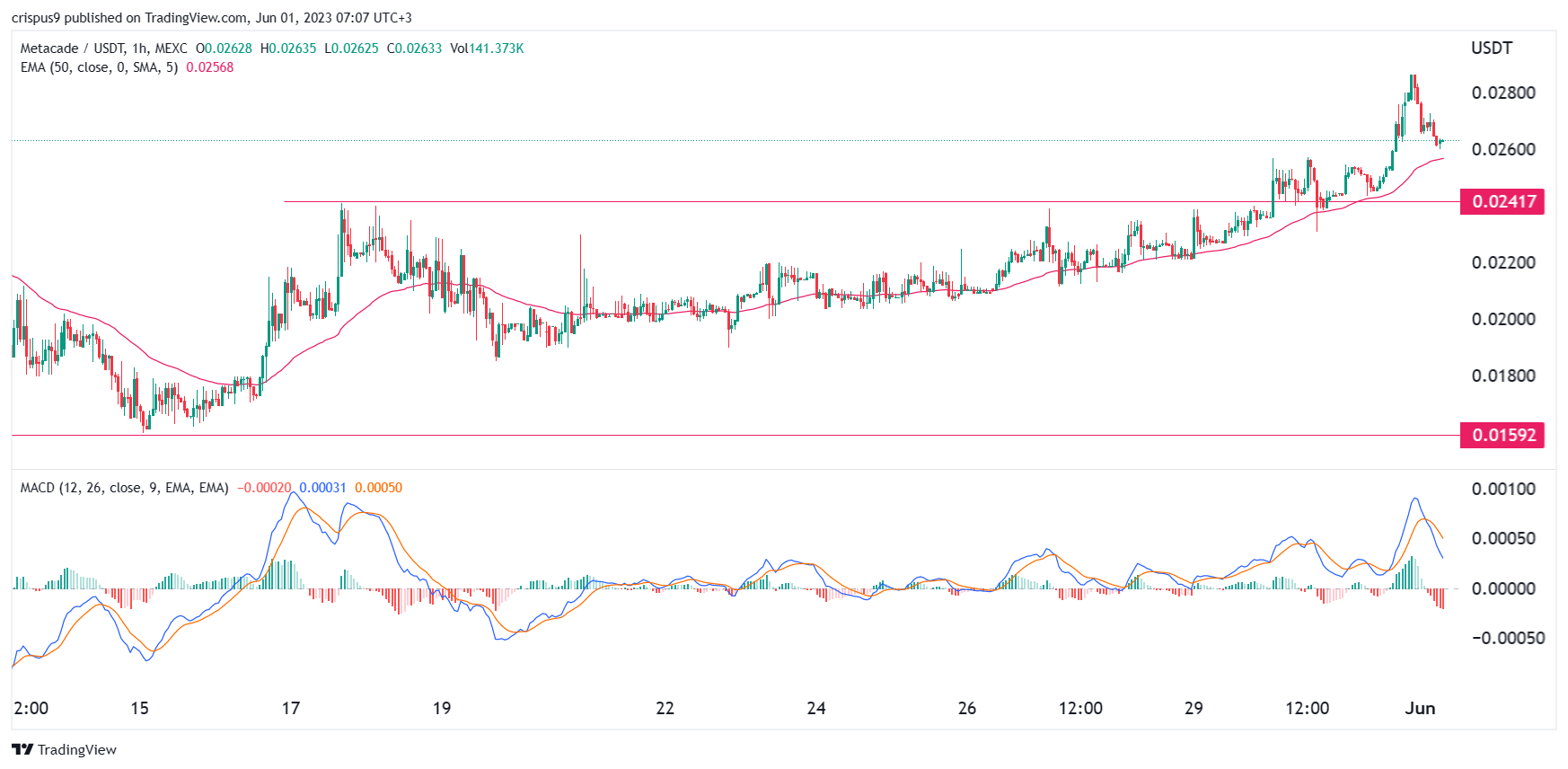
Metacade price has started to turn around the corner after pulling back to $0.01592 in June this year. MCADE rose to a high of $0.028 on Thursday, the highest level since May 10. This price was about 65% above the lowest level this year.

Bullish catalysts for MCADE

Metacade, a new and rapidly-growing cryptocurrency, continued rising as buyers focused on internal and macro catalysts. Broadly, the biggest catalyst for the token is the decision by the House of Representatives to pass a bill to expand the debt ceiling. The bill will see the US cap spending and implement some fiscal measures to reduce the deficit.

Economists believe that the US would have defaulted if it did not pass the deal by June 5. That would have been an unprecedented move that would push most assets, including cryptocurrencies like Metacade and Bitcoin prices much lower.

Internally, Metacade price has jumped because of several important catalysts in the network. First, the developers are planning to launch the lite version of the game soon. This launch will see people get their first look of what the company is working on. In most periods, cryptocurrencies rally ahead of a major product launch.

Second, Metacade will launch Metaseries on Thursday. This will be a video series where the developers talk about the product and what they are working on. Such a video series is important because it provides more people with information about the product. 

Meanwhile, the developers presented the fifth award of their $125k competition. Joaquin Solari was the fifth winner of $12.5k in a competition that is ongoing. Such competitions help to provide more traction to a crypto project.

Is MCADE a good investment?

Metacade has made a lot of progress in the past few months. As a result, Etherscan data shows that the number of holders has jumped to over 9,250, signaling that it will hit 10k soon. This is a remakable experience because Metacade is a relatively new project. 

Metacade developers are seeking to change the blockchain industry by developing a game that people will want to play. The play-to-earn game is being developed in collaboration with Metastudio, one of the leading developers out there.

According to Metacade creators, they are using the lessons learnt from first-generation gaming projects like Axie Infinity and Decentraland to build their ecosystem. 

I believe that Metacade is a good investment but this will depend on the quality of the game that the developers launch. If it will be a good game as predicted, there is a likelihood that token will continue surging.

Metacade price prediction

The chart above shows that the MCADE price has been in a strong bullish trend in the past few days. It has managed to move above the key resistance point at $0.024, the highest point on May 17th. The token is being supported by the 50-period moving average.

Therefore, I suspect that it will soon form a break and retest pattern, by dropping to a low of $0.024. In price action analysis, this break and retest is usually a bullish sign. Therefore, I believe that the token will bounce back to $0.030 in the coming days.

The post Metacade price prediction for June: buy the MCADE dip appeared first on CoinJournal.

Deutsche Telekom partners with Polygon, becomes POS validator

  • Deutsche Telekom has joined Polygon as a network validator.
  • The telecommunications giant’s subsidiary Deutsche Telekom MMS will offer staking services to Polygon POS and Supernets.
  • Deutsche Telekom MMS provides validation and staking services on Ethereum, Flow and Chainlink among other chains.

Deutsche Telekom, the Germany telecommunications giant that has recently been actively expanding its footprint in the blockchain technology space, has partnered with Polygon, the leading Layer-2 scaling platform for Ethereum.

On Wednesday, Deutsche Telekom announced its subsidiary Deutsche Telekom MMS, had joined Polygon as a validator – one of only 100 validators on Polygon’s POS network.

In this case, Deutsche Telekom MMS will participate in the Polygon ecosystem by providing staking services for both Polygon’s PoS sidechain and Supernets. This will be achieved through deployment of a full node and producing blocks as part of contributing to the network’s security, governance, and decentralization. 

As a validator, the company will also help strengthen the Ethereum network.

Deutsche Telekom supports Ethereum and other POS networks

The collaboration is a key step in Deutsche Telekom’s commitment to aid the blockchain adoption process, with Polygon the latest POS chain to add the company as a validator.

Deutsche Telekom MMS already provides validation services for multiple POS networks. As CoinJournal highlighted, the telco giant launched an Ethereum validator in September last year, with this coming after the “Merge”. Other blockchains it supports are Chainlink, Q, Flow, and Celo.

“The collaboration with Polygon is an important step for Deutsche Telekom MMS to fully exploit the potential of blockchain technology and enable applications suitable for mass deployment. Deutsche Telekom MMS also supports Polygon staking, contributing to the security and decentralization of the blockchain,” said Dirk Röder, the Head of the Blockchain Solutions Center at Deutsche Telekom.

Michael Blank, the Chief Operating Officer at Polygon Labs, said in a statement that the collaboration will see many more businesses tap into the benefits of Web3 and blockchain technology, with these businesses leveraging Polygon’s network to empower consumers.

As a leading scaling solution for Ethereum, Polygon’s suite of protocols include zero-knowledge rollups, sidechains, and app-specific chains.

The blockchain platform currently hosts tens of thousands of dApps, accounts for over three million daily transactions, and has $1.2 billion worth of assets in Total Value Locked (TVL). Some of crypto industry’s biggest projects, such as Uniswap, Aave, and OpenSea are live on Polygon.

The post Deutsche Telekom partners with Polygon, becomes POS validator appeared first on CoinJournal.

JPMorgan analyst sees ‘conditional’ upside to $45,000 in Bitcoin

  • Nikolaos Panigirtzoglou says BTC should be trading at $45,000.
  • His forecast is based on gold that’s currently near the $2,000 level.
  • Despite recent weakness, Bitcoin is up more than 60% year-to-date.

Nikolaos Panigirtzoglou – a JPMorgan analyst remains bullish on Bitcoin even though it has taken a hit in recent weeks.

A gold-based forecast for BTC

Last week, Panigirtzoglou said BTC should be trading at about $45,000. His forecast is hinged on gold that’s currently trading near the $2,000 level. In his research note, the analyst said:

$45,000 price for bitcoin is under the assumption that it equalizes gold in private investors’ portfolio in risk capital or [volume] adjusted terms.

Remember that the price of both assets are historically known to move in tandem.

It is also noteworthy that several whales saw the recent dip in Bitcoin as an opportunity and have accumulated about $100 million worth of BTC over the past 24 hours.

Bitcoin supply will halve in 2024

It is conceivable that strength of the U.S. dollar index and uncertainty, be it related to the federal debt, the rate hikes, or on the regulatory front, could continue to weigh on Bitcoin in the short-term.

Long-term, though, JPMorgan’s Panigirtzoglou is convinced of the upside especially as bitcoin halving next year sees the cost of producing a bitcoin hit $40,000.

Indeed, the previous halving events of 2016 and 2020 were accompanied by a bullish trajectory for bitcoin prices that had accelerated post the halving event.

Despite the recent dip, Bitcoin is up more than 60% for the year at writing.

The post JPMorgan analyst sees ‘conditional’ upside to $45,000 in Bitcoin appeared first on CoinJournal.