
Unternehmen, die generative KI-Tools verwenden, sollten Maßnahmen umsetzen, um die Öffentlichkeit vor Desinformation zu schützen.

Finanzmittel Info + Krypto + Geld + Gold
Krypto minen, NFT minten, Gold schürfen und Geld drucken
Unternehmen, die generative KI-Tools verwenden, sollten Maßnahmen umsetzen, um die Öffentlichkeit vor Desinformation zu schützen.
Most metaverse tokens rose sharply on Monday as cryptocurrencies retreated.
The jump happened ahead of Apple’s WWDC event on Monday.
Metaverse tokens like Decentraland MANA, Sandbox’s SAND, and Axie Infinity’s AXS were among the best-performing coins on Monday. Other metaverse tokens like Enjin Coin and ApeCoin were also in the green. Most of these coins rose by more than 1.5%, which is a better performer than other coins like Bitcoin and Ethereum.
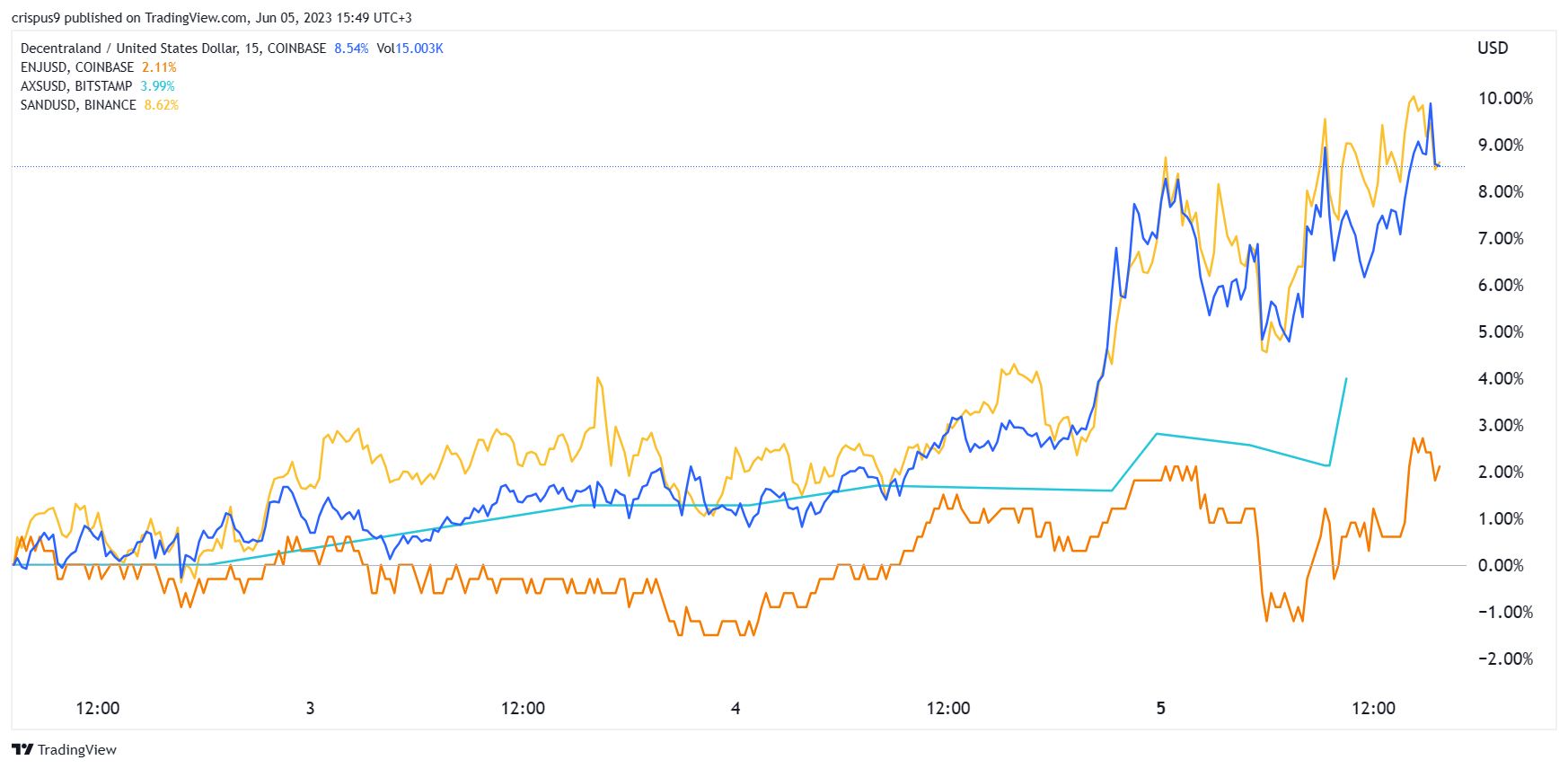
The main reason why metaverse tokens jumped on Monday is the upcoming WWDC event by Apple. Historically, this has been the biggest event in the tech calendar since the company usually unveils its key upgrades.
Apple is seen as the benchmark for key products. It made key products like iPhones, Apple Watch, and iPads cool. Today, other companies in the technology industry have come up with similar products.
Analysts believe that the WWDC event will see the company unveil its virtual reality set, which is its first major product in a decade. The company has been working on this product in the past seven years. In this period, the company has long believed that its product was not ready yet. According to the WSJ, the device will retail at $3,000, making it one of the company’s most premium products.
Experts believe that Apple’s entry in the industry will take the virtual reality industry mainstream. In the past, attempts by companies like Facebook and Microsoft to take them mainstream have failed. Today, only a handful of people use these products.
Therefore, metaverse tokens like MANA, SAND, Enjin Coin, and AXS token have risen because of the ongoing hype. There is a belief that this hype could rival that of artificial intelligence.
Decentraland MANA price jumped by more than 6% while Sandbox and Axie Infinity price soared by more than 5%. Similarly, Enjin and ApeCoin rose by over 4%.
However, I believe that these gains will not hold because of a concept known as buying the rumor and selling the news. This is a situation where an asset price jumps ahead of a major news release and then declines when the news happens.
In this case, these tokens will retreat possibly because Apple’s device will not have anything to do with these tokens and their ecosystem.
Skilling is a Scandinavian based cryptocurrency broker which has a desktop website as well as apps for iOS and Android devices. It supports over 50 cryptocurrencies and it has a demo account to allow users to gain familiarity with the platform. Skilling has no hidden fees, it is an officially regulated broker and it supports a wide range of payment methods.
eToro is a global social investment brokerage company which offers over 75 cryptocurrencies to invest in. It offers crypto trading commission-free and users on the platform have the option to manually invest or socially invest. eToro even has a unique CopyTrader system which allows users to automatically copy the trades of popular investors.
The post Here’s why the MANA, SAND, Enjin, AXS token prices are soaring appeared first on CoinJournal.

Auch der Meme-Rausch bei Bitcoin mit den Ordinals ist seit dem Höchststand im Mai wieder zurückgegangen.
The world’s biggest cryptocurrency exchange dominates the landscape. At the end of last year, CCData reported that Binance’s share of trading volume on centralised exchanges was a staggering 66%. Binance began 2022, when all was well in the crypto world and the phrase “bear market” had not entered the lexicon yet, with a 48% market share.
The surge in market share came despite overall trading volume falling 45% during the year 2022, spot trading coming in at $5.29 trillion on Binance. Nearly every other major exchange lost market share last year (with the exception of ByBit), showing that despite capital fleeing from the industry at large, Binance was eating up all before it. Second place went to Coinbase, toiling with far behind with an 8.2% share.
Fast forward to today, however, and Binance’s market share seems to be falling. According to CC Data, in February 2023, three months after Binance came in at a 66% share of volume, it was down to 57.5%. Today, it is down further again, to 43%.
The dropoff follows what has been a turbulent few months for Binance, to say the least. The exchange has found itself in hot water with regulators, right at the heart of an industry-wide crackdown in the US. In February, the SEC shut down the Binance-branded stablecoin, BUSD, over securities laws violations (deep dive on put together on that here). BUSD was issued by Paxos, a firm domiciled in New York. BUSD accounted for over a third of the company’s trading volume, the coin a vital part of the liquidity on the exchange.
The regulatory trouble has not stopped there. Shortly after, the Commodity Futures Trading Commission (CFTC), charged Binance and high level executives, including CEO Changpeng Zhao, for leading an “intentionally opaque common enterprise”. The complaint alleges that “even after Binance purported to restrict U.S. customers from trading on its platform, Binance instructed its customers – in particular its commercially valuable U.S.-based VIP customers – on the best methods for evading Binance’s compliance controls”. The charges are hefty, including alleging Binance “failed to implement basic compliance procedures designed to prevent and detect terrorist financing and money laundering”.
CEO Zhao also was forced to dispel concern around the company’s lack of transparency in the wake of the FTX collapse last November. Despite publicly pushing for proof of reserves declarations, Binance’s attempt to present finances to the world was lacking, omitting liabilities entirely. In truth, there is not much point proving reserves when the amount of liabilities are unknown, and the market did not react well to the omission. Zhao’s response to why liabilites were not publicised was that “liabilities are harder”, and simply said to “ask around” for proof that “we don’t owe loans to anyone”. Auditor Mazars, who oversaw the proof of reserves report, suspended work with Binance after this, citing a misunderstanding by the public on how they work.
For the crypto industry, collapsing prices of 2022 have subsided thus far in 2023, with Bitcoin up 63% year-to-date. Nonetheless, liquidity across the space has been decimated (deep dive on that here), with prices volume still a magnitude below the pandemic peaks.
While prices are currently stable, the space is fighting a growing battle for legitimacy in the US. SEC chair Gary Gensler slammed the industry for “mass non-compliance”, while Coinbase CEO Brian Armstrong has admitted his exchange may be forced offshore if the regulatory climate continues to worsen (Coinbase was issued with a Wells notice in March over potential violations of securities laws).
One silver lining to all this is that the sheer dominance of Binance cannot be good for the crypto industry, which was built upon the pillar of decentralisation. Binance, like it or loathe it, represents an enormous central point of risk for the space, given its importance to overall liquidity. Were anything to happen the exchange, it would have seismic consequences – this is part of the reason that there was so much concern towards the tail end of last year when Binance was under fire for its lack of transparency,
However, Binance’s struggles are predominantly for regulatory reasons, which are affecting the overall industry. Sure, the exchange is getting hit harder than most with a plethora of complaints and allegations, but the floor seems to be falling from beneath all crypto companies domiciled in the US.
Perhaps the biggest signal of Binance’s struggles this past few months is the round of layoffs that is coming. Many crypto companies pared down their workforces significantly over the past year, however Binance maintained that it was hiring through the downturn. That seems to have changed, although the company has not confirmed how many employees will be cut, with reports claiming up to 20% will go. Chief strategy officer Patrick Hillman insisted on Twitter that it was a resource reallocation rather than a downsizing, however he also hinted at the role that regulation has played.
“Regulators in almost every major market are also working overtime to provide greater clarity for their expectations of the industry and the asset class more broadly, which is putting even more pressure on orgs to adapt or fall by the wayside”, he said.
In conclusion, Binance’s grip on the number one spot may have loosened, but it remains incredibly dominant and clear of all competitors, at least for now. The dropoff in dominance is not a bad thing for crypto in itself, but the reasons that have led to it – regulators turning the screw and volume dipping across the space – certainly are issues. Prices may be trading flat over the last while, but the challenges facing the space remain plenty.
The post Is Binance’s dominance falling? appeared first on CoinJournal.

APPG-Vorsitzende Lisa Cameron betonte, wie wichtig der Bericht für die Sicherstellung der Führungsposition von Großbritannein im Krypto-Sektor und für den Verbraucherschutz sei.