Gold and Bitcoin – the perfect portfolio combination

  • A diversified portfolio with gold and Bitcoin makes sense as Bitcoin’s trading volume rises
  • Gold’s stability offsets Bitcoin’s volatility
  • This way, investors may participate in Bitcoin’s upside potential without compromising on risk parameters

Portfolio management deals with managing risk. All risk cannot be avoided, and a risk-averse investor would not want to take no risk.

Instead, a risk-averse investor would like higher risk-adjusted returns. Naturally, the higher the potential return, the higher the risk.

Investors build portfolios of different assets to find the best possible risk-adjusted returns. Ideally, the assets have a negative correlation, thus bringing diversification benefits to the investor.

But it also makes sense to build a portfolio with correlated assets. While the portfolio is riskier, some other asset properties may appeal to investors willing to take a bigger risk.

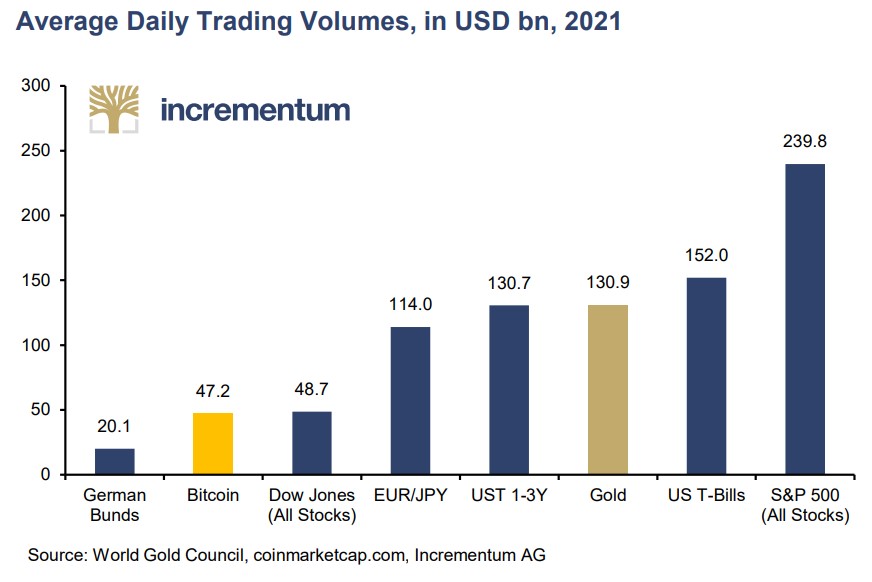
As Bitcoin’s average daily trading volume rises, such a diversified portfolio may contain gold and Bitcoin.

Why to add gold and Bitcoin to a portfolio?

Diversified portfolios spread the risk across uncorrelated assets. A portfolio manager’s challenge is finding that diversification level beyond which diversification brings no benefits anymore.

Traditionally, gold’s role in a portfolio is to bring stability. By adding Bitcoin to a portfolio, one may participate in the cryptocurrency’s upside potential and, at the same time, mitigate the risk associated with Bitcoin’s volatility by combining it with gold.

The post Gold and Bitcoin – the perfect portfolio combination appeared first on CoinJournal.

Binance’s BNB Chain launches a layer-2 network

Key takeaways

  • BNB Chain has introduced a new layer-2 chain powered by the Optimism OP Stack. 

  • BNB Chain hopes the new L2 chain will address the blockchain’s scalability challenges. 

BNB Chain introduces its new L2 chain

Binance-founded layer-1 blockchain BNB Chain announced on Monday that it had launched a new layer-2 chain. According to the BNB Chain team, the new L2 chain is designed to address the scalability challenges affecting the blockchain. 

The L2 is called opBNB, and it is a layer-2 scaling solution powered by the Optimism OP Stack. opBNB is set to add security and scalability to the Binance blockchain network. 

opBNB is an Ethereum Virtual Machine (EVM) compatible layer-2 chain. This implies that the L2 chain works with Ethereum-based smart contracts, networks and ERC-20 token standards.

Scalability remains one of the biggest challenges facing blockchain networks as it results in network congestion and high fees during times of increased network demand. 

At the moment, the BNB Chain processes around 2,000 transactions per second, with an average transaction cost of $0.10.

According to the development team, opBNB is set to support more than 4,000 transactions per second, with an average transaction cost below $0.005. 

In addition to that, the new L2 chain will enable the optimisation of data accessibility,  the caching layer, and adjust the submission process algorithm to allow simultaneous operations. These functions would allow the chain to increase the gas limit to 100 million per block from the 30 million Optimism currently allows.

opBNB to solve BNB Chain’s scalability issues

While commenting on this latest cryptocurrency news, Binance stated that opBNB is the answer to the scalability challenge that has limited the mass adoption of blockchain technology. 

Optimism leverages  Optimistic Rollups to scale transactions. It achieves this by automatically assuming the transaction data, which is processed off the root chain, is valid until it is invalidated. 

Data pulled from DefiLlama shows that BNB Chain is the third largest blockchain, behind Ethereum and Tron, in terms of DeFi total value locked. At the moment, BNB Chain has a TVL of $3.38 billion, with a 24-hour volume of $264 million and roughly a million active daily users. 

The post Binance’s BNB Chain launches a layer-2 network appeared first on CoinJournal.

Report: 33 straight days of net withdrawals from crypto exchanges


Key Takeaways

  • Regulators are clamping down hard on the US crypto industry, with recent lawsuits announced against Binance and Coinbase
  • Bitcoin’s correlation with stocks is at a 5-year low, with the latter soaring but Bitcoin’s price suppressed by concerns around future of industry in US
  • Exchanges have seen net outflows for 33 days in a row, but size of withdrawals are not particularly notable
  • Binance is seeing the largest withdrawals, 7.3% of its balance heading for the exit doors
  • Allegations against Binance go beyond securities violations which most centralised companies are facing

Binance’s war with the SEC goes on. As does Coinbase’s. As does, well, the entire cryptocurrency space, which suddenly faces a regulatory threat that feels existential for the crypto industry in the US. 

The market has responded, unsurprisingly, by selling. Bitcoin dipped below $25,000 for the first time in three months last week, before bouncing back to where it currently trades at $26,500. 

More notable, however, was that this came amid a time when the stock market is soaring. As I detailed in depth last week, the correlation between stocks and Bitcoin is now at a 5-year low. This is similar to the dip in correlation we saw in November when FTX collapsed while the stock market surged off softer-than-expected inflation numbers. 
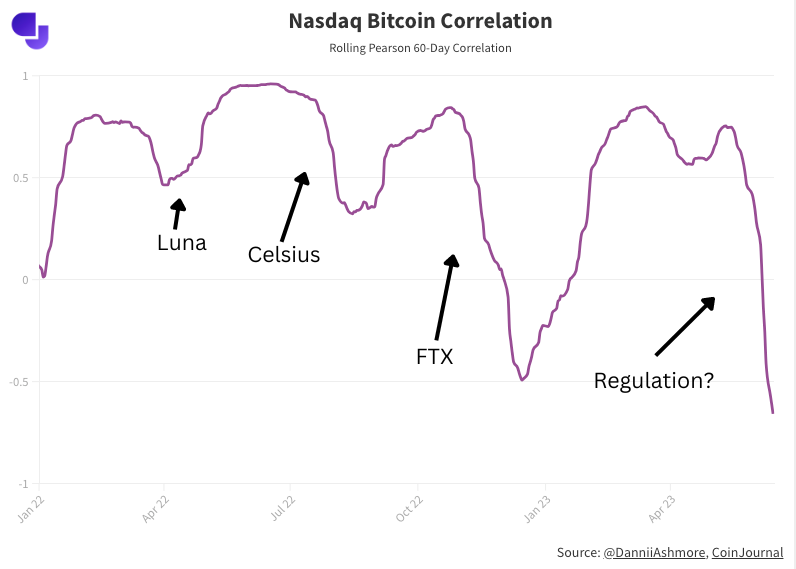
In such a way, while Bitcoin’s price decline seems minor on the face of things, it is underperforming relatively as the rest of the market is red hot.

Bitcoin on exchanges

But beyond price, how are markets reacting? Are people again concerned about storing their assets with these centralised exchanges?

Well, looking at the total amount of Bitcoin sitting in these exchanges, there has been net outflows for 33 days in a row. That is the longest streak since November 2022 amid the FTX scandal. 

The scale of withdrawals is not the same, however. Back in November, the last time we saw a consistent stream of net withdrawals, FTX was exposed as insolvent (and fraudulent) with $8 billion of customer assets gone. Fear was extreme and the entire market panicked, concerned that other exchanges could follow. Bitcoin ran for the exit doors, much of it sent straight to cold storage (or sold for cash). 

While the current developments are concerning for crypto in their own way, there appears to be no fear that customer assets are in danger. This is not a repeat of FTX, and the market reaction is also significantly more muted. 

Indeed, if we look at the total balance of Bitcoin across exchanges, we can see that the recent dip does not stand out in the context of the steep downtrend we have seen since the start of 2020. 

Is Binance different?

But what about Binance? Accusations levelled at the world’s biggest crypto exchange are certainly more sordid than merely securities violations. Binance and CEO Changpeng Zhao have been accused of trading against customers, manipulating trade volume, failing to implement adequate money laundering procedures, encouraging US customers and VIPs to circumvent location-based restrictions, and commingling customer funds. 

It is the latter accusation which is the headline one and throws up painful memories of FTX. While I have been critical of Binance for operating in an incredibly opaque manner (they have always refused to reveal their liabilities), there has been no evidence to date that customer funds have been misappropriated as they were in the FTX case. Again, this really has little in common with the FTX situation. 

On Saturday, a US court even approved an agreement between Binance and the SEC that would dismiss a temporary restraining order to freeze all Binance.US assets. 

“We are pleased to inform you that the Court did not grant the SEC’s request for a TRO and freeze of assets on our platform which was clearly unjustified by both the facts and the law,” Binance.US said on Twitter.

This appears to have assuaged the doomsday scenario, whatever chance there was of that to begin with. In looking at the flows on Binance specifically, however, it has seen more outflows than any other major exchange. 7.3% of its Bitcoin balance was withdrawn in the two weeks since the lawsuit was announced on June 5th.  That equates to 52,000 Bitcoin, or about 0.3% of the total circulating supply. 

For context, when Binance came under fire for its lack of transparency around reserves after FTX collapsed, 13.3% of its Bitcoin balance was withdrawn in a similar two-week period – evidently bigger as seen on the above chart, nearly double the flows of what have been seen thus far amid this SEC case. 

What does this all mean? Not very much, really. Binance has long operated in the shadows, and as I wrote here upon the SEC’s case being announced, it was a day that had long been coming. But there should not be a sudden uptick in concern around the safety of customer funds, and that is reflected in the relatively small flow of funds out of the platform. 

Nonetheless, the allegations against Binance are far more than merely selling unregistered securities, which is the main sticking point across the industry (and what Coinbase is being sued for). It is for this reason that funds have moved out of Binance at a faster pace than other exchanges, even if the size of these is no reason for alarm.

All in all, the reaction is not surprising. Nor were the news of these lawsuits, really.

The post Report: 33 straight days of net withdrawals from crypto exchanges appeared first on CoinJournal.

Bitcoin signals potential breakdown, top analyst says about BTC price

  • Bitcoin (BTC) is positioned for further downside as a new Weekly Close below the 200-week moving average signals.
  • BTC rejecting from above $26k would welcome bears to the party as double-confirmation of the breakdown.
  • According to crypto analyst Rekt Capital, the 200-week MA is a robust resistance zone. 

As Bitcoin bulls face rejection from above $26k, a top analyst has pointed out the benchmark cryptocurrency’s price faces fresh downside pressure.

BTC price is currently 2.4% up in the past week, but has failed to break past key resistance around $26,600. The breakdown to lows of $24,800 last week amid negative regulatory headlines appears to have only emboldened bears further.

Bitcoin positioned for downside

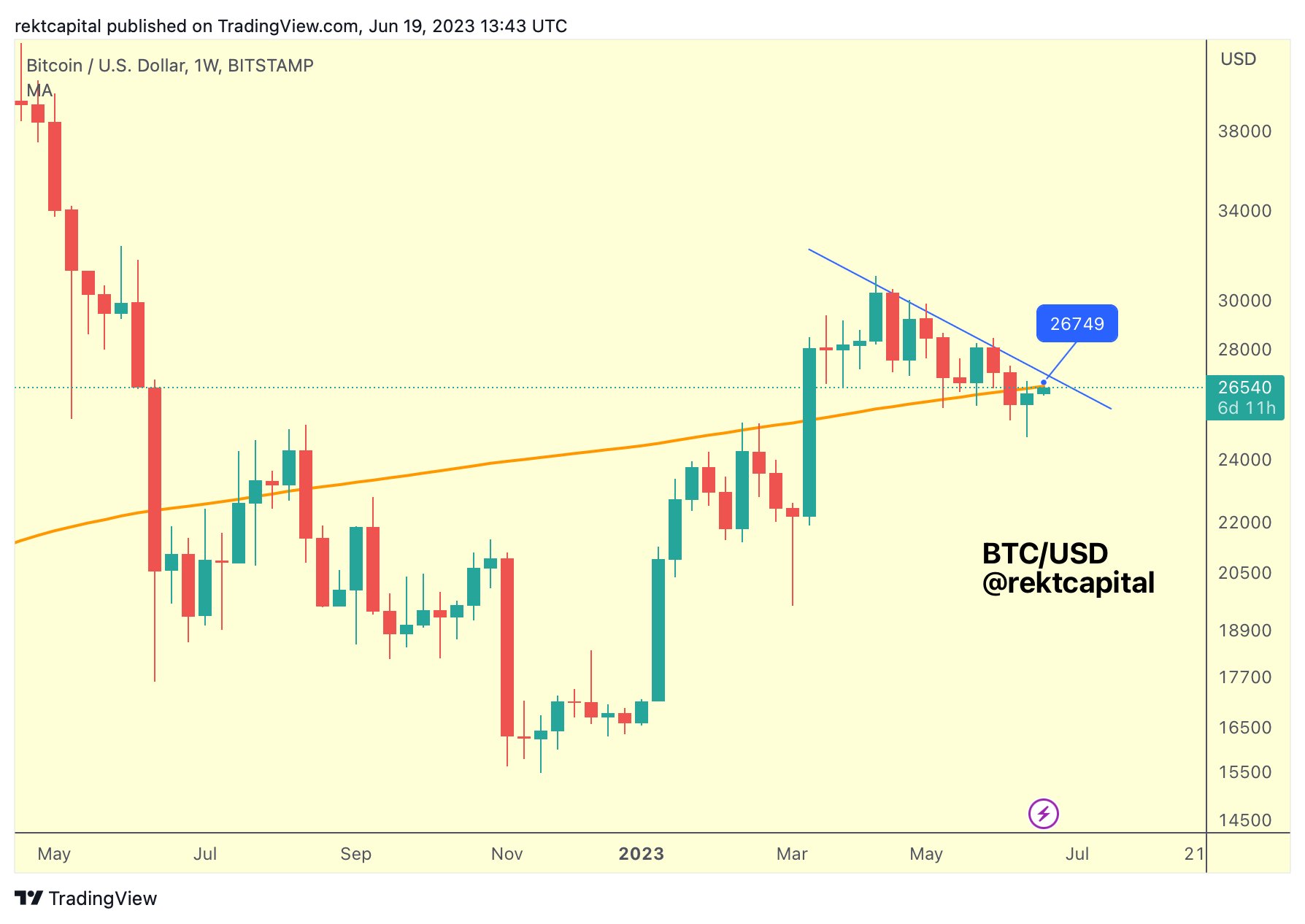
According to crypto analyst Rekt Capital, the technical outlook for BTC suggests more weakness is likely. This is after a new weekly close below the 200-week moving average, which signals a “double confirmation of [a] breakdown,” the analyst noted.

Last week, Bitcoin price recovered from lows of $24.8k after the market reacted sharply to the SEC’s lawsuits against crypto exchanges Binance and Coinbase. Commenting after the upside, Rekt Capital suggested that Bitcoin had “run straight into the 200-week MA”

He noted that if bears managed to turn this zone into new resistance, there was likelihood BTC could see a “two-step breakdown confirmation.” Such a price scenario was likely to result in further downside pressure.

“Technically, BTC is positioned for downside. Why? Because it has produced another, new Weekly Close below the 200-week MA. As a result, $BTC has shown double-confirmation of breakdown from the 200-week MA. Continued rejection here could send price lower,” he tweeted on Monday, pointing to last week’s prediction.

Here’s a chart the analyst shared, showing Bitcoin’s rejection at both a downtrend line and the 200-week MA.

If Bitcoin gives up the $26k level again, a run to June lows could open up room for more losses. However, as BitMEX founder and former CEO Arthur Hayes pointed out last week, its likely crypto will hit the pain of an extended sideways action before a new trigger sets up an “autumn rally.”

As CoinJournal reported, the BitMEX founder believes the trigger will be retail trading, and a big possibility is this next bull market is led by the Chinese trader. BlackRock filing for a spot Bitcoin ETF could also be a significant tailwind in coming months.

The post Bitcoin signals potential breakdown, top analyst says about BTC price appeared first on CoinJournal.