
Hex founder charged with offering unregistered securities offering

  • Richard Heart was charged with allegedly raising over $1B through unregistered securities offerings.
  • The SEC also charged PulseChain, PulseX, and Hex, alongside Richard Heart.
  • In addition, Heart and PulseChain have also been charged for using part of the offering proceeds to buy luxury goods.

The US Securities and Exchanges Commission (SEC) has charged the founder of the crypto project Hex, Richard Heart, with allegedly raising more than $1 billion through unregistered securities offerings. The SEC has also included three unincorporated businesses (PulseChain, PulseX, and Hex) in the charges.

PulseChain and Richard Heart are also both facing charges for purportedly using $12 million from the funds raised through the securities offerings to buy luxury goods, including a 555-carat black diamond christened “The Enigma.”

Details of SEC’s charges against Hex

The SEC’s lawsuit has been filed in the United States District Court for the Eastern District of New York.

The SEC complaint states that the HEX founder started marketing Hex in 2018 claiming that “it was the first high-yield ‘blockchain certificate of deposit,” and started endorsing Hex tokens as an investment designed to make people “rich.”

The SEC is particularly wary of a staking function on Hex that Heart claimed would provide returns of 38% and claims that Heart intentionally tried to break the law by advising Hex investors to “sacrifice” their cryptocurrency holdings rather than invest in them.

Director of the Fort Worth regional office, Eric Werner, also weighed into the matter saying that Heart urged investors to purchase securities backed by cryptocurrency in offerings that he neglected to register and then went ahead to use some of the cryptocurrency assets to purchase extravagant luxury items.

HEX price reaction

The price of the HEX token had dipped by more than 27% to trade at $0.006461 at press time following the news of the charges.

The Hex charge came as the SEC also asked Coinbase to only offer Bitcoin (BTC) stating that all the other cryptocurrencies are securities.

The post Hex founder charged with offering unregistered securities offering appeared first on CoinJournal.
Bitcoin volatility at three-year low as crypto markets lull


Key Takeaways

  • Crypto volatility has been dropping all year, with Bitcoin’s volatility now at three-year lows
  • Volume is also dropping, as the calm markets are not welcomed by traders
  • Despite downward-trending volatility, crypto remains highly volatile when compared to other asset classes

Crypto markets are known for violent volatility, capable of both spiking and collapsing in the blink of an eye. 

Thus far this year, however, that hasn’t been the case. Volatility has been trickling steadily downward across the space. Assessing the realised volatility of Bitcoin over a rolling one-month window, the metric is currently at a three-year low. 

This comes despite Bitcoin having had a bumper year thus far, the asset currently up 76%, treading water around the $30,000 mark. In the past, Bitcoin has oscillated wildly, but this run-up from the low of $15,500 late last year has been distinguished by a steady climb rather than the turbulent ups and downs we have come to expect. 

The pattern is not unique to the world’s biggest crypto, either – volatility is falling across the board. The easy way to illustrate this is by looking at Ether. Historically, the price of ETH has been more volatile than BTC, but the divergence has narrowed this year, and Ether is now trading with similar volatility to its big brother. 

This relative calm in crypto markets is good on one level, given one of Bitcoin’s most-cited criticisms is its extreme volatility, which most agree it will need to overcome should it ever take the status of a reputable store of value. 

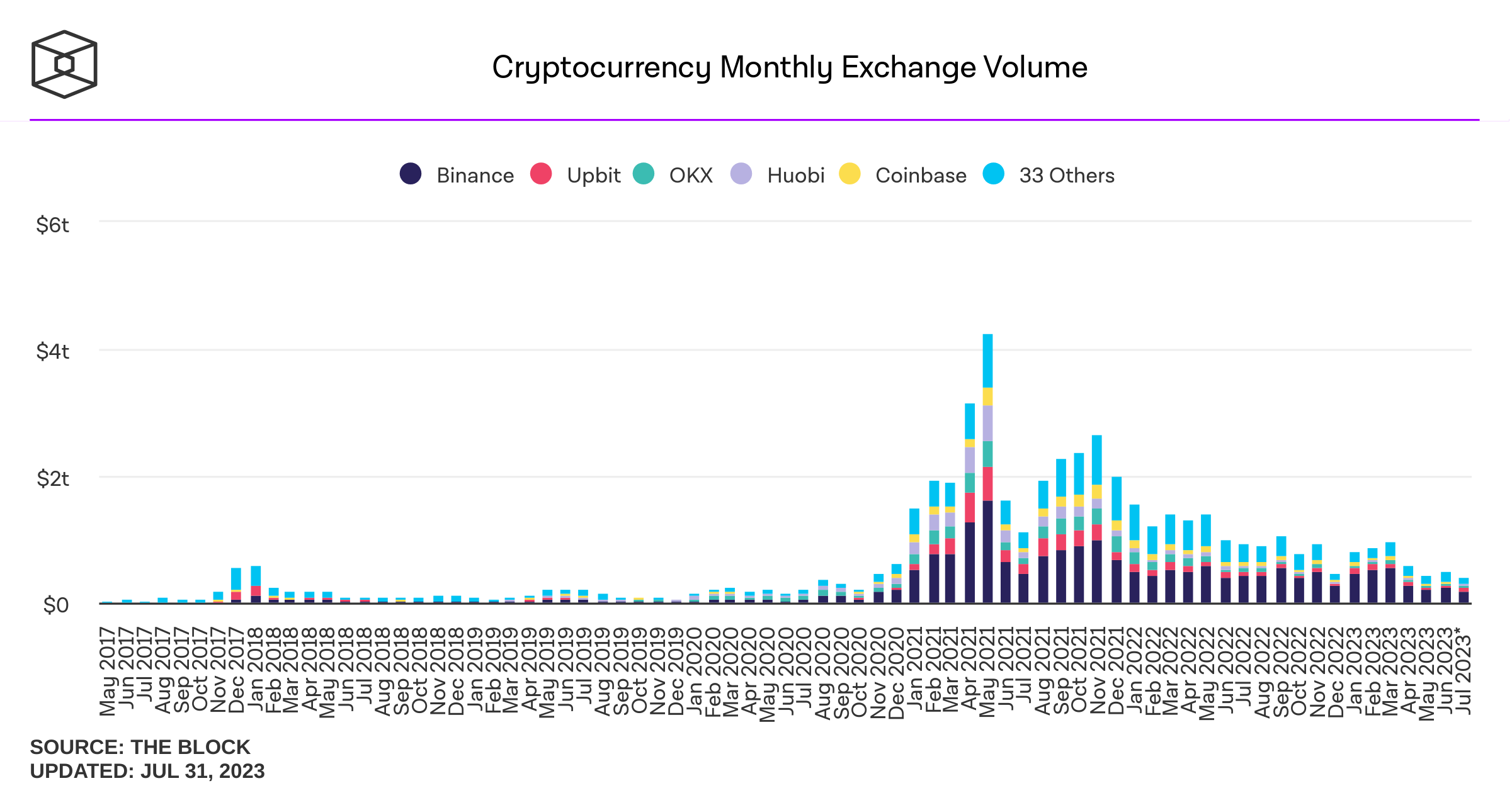
Not everyone is a winner, though. Traders rely on volatility and hence these serene times are not exactly a boon. If we look at spot trading volume, the drawdown has been steep. Granted, there are myriad factors at play here, including regulation, a drawdown in prices, lockdowns ending, scandals (FTX and the SEC lawsuits) and so on, but the lack of volatility is not helping. 

The below chart from The Block shows quite how far spot volume has fallen. 

Even derivatives trading volume, which had been more stout, has fallen off since April – likely a better gauge for traders than assessing spot volume. Liquidity is not as much of a concern in derivatives markets as it has become in spot markets, but the last few months have begun to see some thinning out there, too. 

While the falling volatility is notable, it should be noted that crypto remains a league above trad-fi markets with regard to this metric. Even this three-year low still translates to an annualised volatility of 25% for Bitcoin, which would not be deemed low-risk by any stretch of the imagination. 

To put this up in lights, comparing Bitcoin to gold is always illustrative. Gold is the store of value which has been around for thousands of years, the shiny metal known for its inflation-hedging abilities and lack of correlation to risk assets. For many, Bitcoin’s vision is to claim the title of some sort of digital gold. 

The below chart displays the current gulf between these assets – even after the dampening down in crypto volatility this year, it’s on a completely different planet to gold. 

Alternatively, one can simply compare the daily returns of the assets, which conveys the same thing. 

Thus, while crypto volatility is currently sluggish, it has a long way to go before it matches gold. More importantly, there is no guarantee that this volatility will stay low. Quite the opposite – given the low liquidity in the space, less capital is needed to move crypto markets than has been the case previously. 

In light of this, it feels like the downward trend in volatility (exacerbated in the last couple of months by a classic summer lull in trading) should return. Not to mention the fact that with the interest rate hiking cycle coming to a close, markets could be at an inflection point. It is always hard to predict the future in crypto, but it feels unlikely that digital assets’ volatility will stay at these uncharacteristically low levels for long. 

The post Bitcoin volatility at three-year low as crypto markets lull appeared first on CoinJournal.

Cardano network boost as Mithril protocol goes live on mainnet

  • Cardano’s network will benefit from more efficiency and fast bootstrap after Mithril went live on mainnet.
  • ADA price was flat, but could benefit from new bullish momentum across the market.

Cardano has achieved another milestone with the mainnet launch of the highly anticipated Mithril upgrade.

On July 30, an announcement by Cardano stake pool operator (SPO) Banksy revealed that Mithril was now live on the mainnet.

Network efficiency

Mithril is a stake-based network of nodes that enable the creation of snapshots and certificates of the Cardano Node, allowing for a fast bootstrap and restoration.

The development promises to bring several benefits to network users, particularly in boosting the efficiency of Cardano full node clients. The upgrade will also enhance user access to Daedalus and other network applications, with increased decentralisation achieved via the ability for any number of pools attesting to transactions through an aggregator and signer.

“With Mithril, SPOs give you regular certified snapshots of the Cardano state (more precisely the UTXO set i.e. the leaves of the graph formed by its transactions over time), so you can build services without running a node. Fast bootstrap is a first use case,” Romain Pellerin, the CTO of Cardano R&D company Input Output, noted via X (fka Twitter).

ADA price outlook

A reaction to the protocol’s launch saw the price of Cardano’s native token ADA jump to near $0.32. While broader malaise across crypto sees ADA hover within a tight range above $0.30, the potential for a sharp flip higher has been added to with the new network milestone.

Other network activity metrics, as shown by the count of github commits, suggests a breakout for ADA amid a wider market rally could see bulls target year-to-date highs of $0.45.

The post Cardano network boost as Mithril protocol goes live on mainnet appeared first on CoinJournal.

Binance becomes first exchange to secure operational MVP license in Dubai

  • Binance announced on Monday it had received the Operational Minimum Viable Product (MVP) license issued by Dubai’s Virtual Assets Regulatory Authority (VARA).
  • The exchange secured the landmark license via its subsidiary Binance FZE.
  • Binance will now offer cryptocurrency exchange services to qualified institutional and retail customers.

Binance has become the first cryptocurrency exchange to secure the Operational Minimum Viable Product license in Dubai.

According to an announcement the company published on Monday, the milestone was achieved through Binance FZE, the exchange’s Dubai-based subsidiary.

VARA-approved crypto license

The operational MVP license is issued by Dubai’s Virtual Assets Regulatory Authority (VARA) and will allow Binance to offer virtual asset exchange services to qualified customers.

 “We are honored to be the first exchange to be granted an operational Minimum Viable Product License by VARA — a result of over a year of due diligence, collaboration, and consistent demonstration of responsible intent – that now allows us to be able to leverage the potential of a progressive regulatory framework, enabling innovation while furthering user protection,” Richard Teng, Head of Regional Markets at Binance, said.

VARA issued the operational MVP license to the world’s largest crypto exchange by trade volume after approving the provisional and preparatory MVP licenses in March and September 2022 respectively.

Binance has underscored the importance of the license by noting that its commitment to the onboarding remediation outlined in the VARA regulatory framework, including in stringent Know-Your-Customer (KYC) and customer due diligence.

“With this operational MVP license, all users onboarded through this platform can expect access to a trusted and regulated service that prioritizes security alongside compliance with highly specialized, tier-one virtual asset regulations under VARA,” Alexander Chehade, the General Manager at Binance Dubai, said in a statement.

The strong footing Binance has in Dubai and the UAE adds to the exchange’s recent efforts to expand its services across the globe within the context of regulatory compliance. But the company has also been in the crosshairs of several regulatory bodies, including in the United States where the SEC filed a securities violations lawsuit against it and the CEO Changpeng Zhao.

Binance has also had to exit from a number of jurisdictions, including Canada and the Netherlands due to various regulatory hurdles.

The post Binance becomes first exchange to secure operational MVP license in Dubai appeared first on CoinJournal.