
Der Vermögensverwalter Valkyrie beantragt einen Ether-Futures-ETF bei der SEC und will damit der Konkurrenz zuvorkommen.

Finanzmittel Info + Krypto + Geld + Gold
Krypto minen, NFT minten, Gold schürfen und Geld drucken
Der Vermögensverwalter Valkyrie beantragt einen Ether-Futures-ETF bei der SEC und will damit der Konkurrenz zuvorkommen.
Asset management company Valkyrie has filed for an Ether (ETH) futures exchange-traded fund (ETF) with the US Securities and Exchange Commission (SEC). In accordance with the filing made on August 16, the application represents an expansion of the business’s prior decision to modify its Bitcoin futures ETF application which the SEC accepted in July.
According to the application, the fund will seek to buy several Ether futures contracts rather than making a direct investment in the cryptocurrency. Ether, the native token of the Ethereum blockchain, is utilized for decentralized network peer-to-peer transactions.
Valkyrie just filed for an Ether Futures ETF, which is in addition to their 497 filing to do name/strategy of $BTF to Bitcoin + Ether Futures to get out early. Perhaps this is sign SEC not letting them do the ‚ole $MJ maneuver, not sure.. ht @NateGeraci pic.twitter.com/OeyGuyJP3y
— Eric Balchunas (@EricBalchunas) August 16, 2023
According to the application document, “Ether may be regarded as a currency or digital commodity depending on its specific use in particular transactions. Ether may be used as a medium of exchange or unit of account, although a number of large and small retailers accept ether as a form of payment in the United States and foreign markets, there is relatively limited use of ether for commercial and retail payments. Similarly, ether may be used as a store of value […], although it has experienced significant periods of price volatility.”
The post Valkyrie just filed for an ETH futures ETF with the U.S. SEC appeared first on CoinJournal.
XRP price is down 5% in the past 24 hours to trade below $0.60, with bears threatening to wipe out all gains from the past month or two.
The win over SEC that catapulted the Ripple cryptocurrency higher has all but faded too. For XRP bulls, it’s all looking ominous with prices likely to retreat to a key support base. But could a reaction be in the offing even as the market ponders its next move amid widespread stagnation?
On August 4, blockchain payments provider BitPay released a major update – an impending worldwide support for XRP.
BitPay released worldwide support for XRP, allowing #BitPay users across the world to buy, store, swap and spend $XRP across all BitPay solutions.
Learn more about XRP:https://t.co/ndvp5M0Gdp pic.twitter.com/CBFztrBAVh
— BitPay (@BitPay) August 15, 2023
According to the company, adding the cryptocurrency to the list of supported coins (including Bitcoin, Ethereum, Litecoin and Dogecoin) would allow merchants to accept payments in XRP from across 100 wallets.
BitPay’s move means its customers can now buy XRP, store it or spend it on goods and services from anywhere in the world where merchants accept the top 10 altcoin.
The XRP market hasn’t seen significant upside reaction in the days following the news. Indeed, prices are down 10% in the past week. However, adoption news for XRP has been steady since Ripple’s triumph over SEC, and could see more bullish reaction if the regulator loses again. [Read more].
Looking at the charts, the daily RSI is heading deeper into the oversold territory and more room for sellers means prices could be poised for a retest of a previous support-turned-resistance zone at $0.55. A deeper rot to lows of $0.40 is possible.
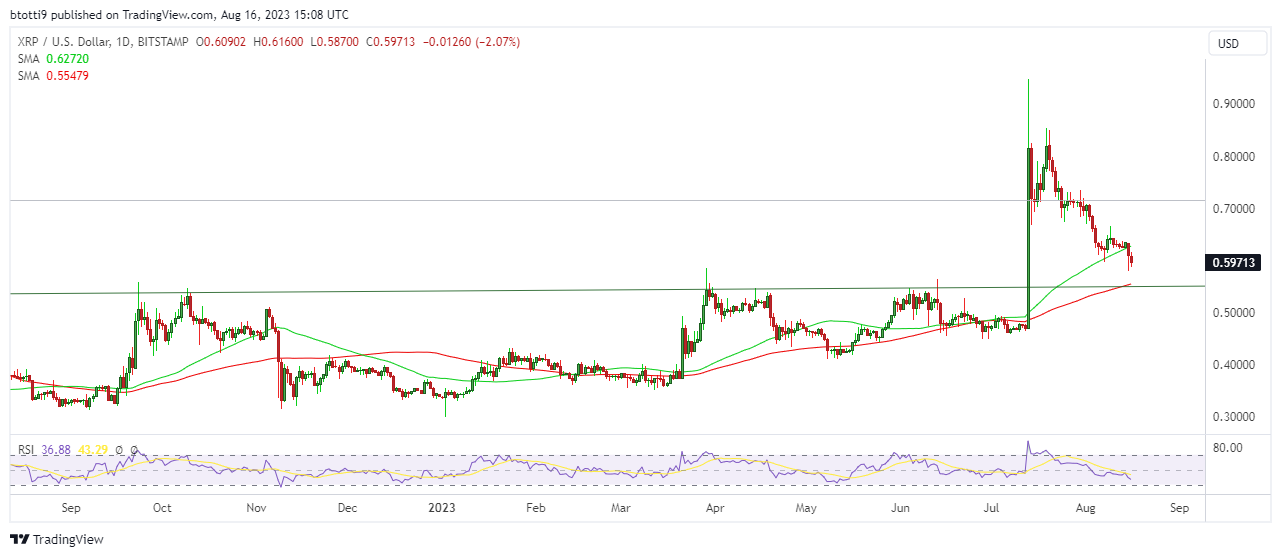 XRP price chart. Source: TradingView
However, the 100-day SMA is located here and could provide a robust buffer. A rebound in the short term could bring bulls to the 50-day SMA level – with the hurdle at round $0.62 – and highlight a return to above $0.70.
The psychological $1.00 remains the desired short-term play, before a retest of 2021 highs.
The post XRP boost as BitPay announces worldwide support – can bulls react? appeared first on CoinJournal.
Whether Bitcoin halvings are priced in has become a fervent topic of debate among the community. We put together an analysis of this question a few weeks ago, as we now fast approach the fourth halving of Bitcoin’s young life.
Slated for April 2024, the halving will cut the Bitcoin block subsidy from 6.25 Bitcoins to 3.125 Bitcoins per block, halving the issuance rate of newly created supply.
We will not rehash (pun intended!) our aforementioned analysis of the upcoming halving here. Instead, we will focus on another coin: Litecoin. One of the world’s first altcoins, it is a derivative of Bitcoin and, intriguingly, just underwent the fourth halving of its life.
Can Litecoin therefore be seen as a guinea pig ahead of Bitcoin’s own halving next year? Well, not really, but we may be able to gain certain insights.
First, let us examine Litecoin’s performance through past halvings. Price data is quite illiquid prior to 2015, so the below chart omits the first halving.
The log scale of the chart somewhat obscures it, but the second halving in 2015 preceded strong price performance for Litecoin. On the other hand, the third halving in 2019 saw falling prices, before the trend reversed after COVID struck in 2020, when the entire crypto sector surged into the mainstream.
It is too soon to draw conclusions regarding the fourth halving, which occured just over a week ago on August 5th. Nevertheless, Litecoin’s halvings don’t offer compelling evidence of a strong relationship thus far at least. Furthermore, like most questions in crypto, the sample size is so small that even if they did precipitate aggressive price rises immediately, that would not necessarily mean there is causation.
Bitcoin is not Litecoin, but again, we may be able to derive clues from the pattern in ascertaining the effect of halvings on the former, even if we can’t be confident given the sample size issues. First, let us now look at Bitcoin’s price action while marking the halving events:
The pattern is clear. Typically, we have seen outsized volatility in the months leading up to a halving, before strong outperformance on the other side. The outperformance has also grown smaller with each halving, perhaps unsurprising given the market cap has grown so much in the four years between each event.
So, why has the effect of halvings on Bitcoin been, at least optically, larger than the same events on Litecoin? The first theory takes us to the heart of the debate on whether halvings are really priced in: while previous events have preceded steep inclines for Bitcoin, they have also lined up well with global liquidity cycles.
The below chart from Fidelity shows this well. There is perhaps no greater influence on the valuations of risk assets than central bank balance sheets, and the halvings have lined up incredibly well with the expansion of those same balance sheets.
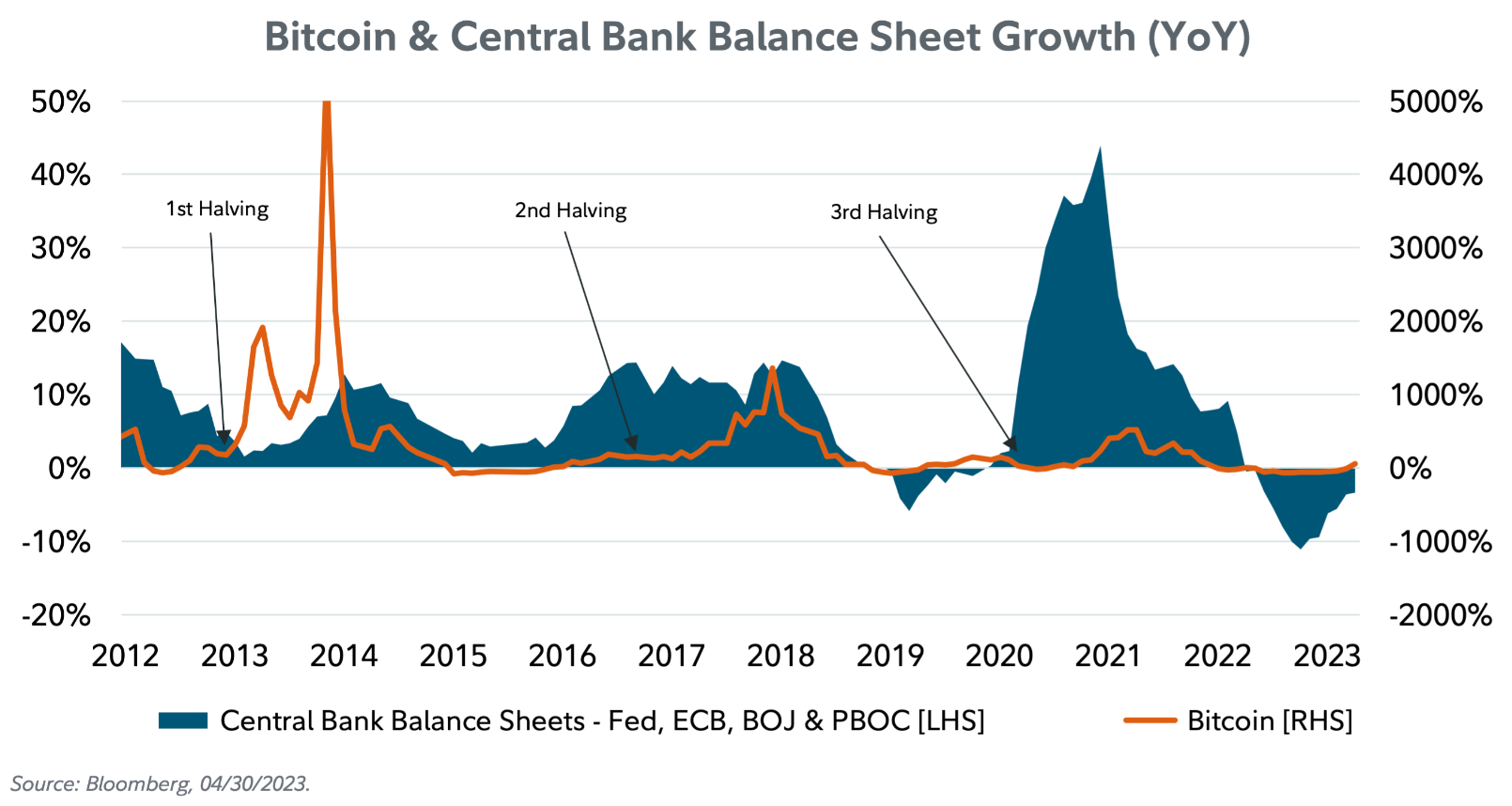
The thing is, the next halving could well line up with an expansion in liquidity again. The previous eighteen months have seen one of the fastest rate-hiking cycles in recent history, with the Fed funds rate now above 5%. Now, looking at probabilities implied by the futures market, the market is anticipating that the hikes are coming to a close (if they haven’t done so already).
Looking further forward towards the time period around the halving (April), futures imply that rate cuts could come into play. Not to mention, when we look at the yield curve, it is currently at the deepest level of inversion since the early 80s. The bottom line is this: the fourth halving, through sheer chance, could again line up miraculously well with global liquidity cycles.
Of course, the macro situation has been changing incessantly, and there is every chance that forecasts around the liquidity cycle could flip, and the halving won’t line up as well as it has done in the past.
This is where Litecoin may come in. With its halvings landing at different dates to Bitcoin in the past, yet not boosting prices as much as the orange coin saw, perhaps it is just a timing thing, whether macro-related or other? Looking at Litecoin’s price action compared to Bitcoin, the duo are tightly correlated, like many altcoins in the space. If Litecoin’s halving does not cause a slight outperformance this time compared to Bitcoin or other coins, what would be the explanation?
Ultimately, like we keep saying, the sample size is small. Bitcoin has only experienced three halvings, and one could even argue that it was only the recent event in 2020 that occurred while the asset was trading with sufficient liquidity.
Litecoin’s less explosive price action after its own halvings do perhaps throw further doubt on the theory that a 50% cut to the new supply issuance will inevitably kick up the price. And yet, Litecoin is not Bitcoin, so the debate will rage on.
Either way, revisiting Litecoin’s price performance around the time of Bitcoin halving will be interesting, because by then it will have had around eight months post-halving and may present a more relevant reference point.
The post Does Litecoin’s halving provide clues ahead of Bitcoin’s next April? appeared first on CoinJournal.

Coinbase darf nun den Handel mit Kryptowährungs-Futures für institutionelle Anleger in den Vereinigten Staaten anbieten.