
Mit einem deutlichen Abschwung rutscht BTC fast aus der mehrmonatigen Preisspanne und droht damit, die zuversichtlichen Prognosen der Experten zu unterlaufen.

Finanzmittel Info + Krypto + Geld + Gold
Krypto minen, NFT minten, Gold schürfen und Geld drucken
Mit einem deutlichen Abschwung rutscht BTC fast aus der mehrmonatigen Preisspanne und droht damit, die zuversichtlichen Prognosen der Experten zu unterlaufen.
Digital finance firm Republic has officially unveiled its self-custodial multi-chain digital wallet, opening crypto adoption to a global community of over three million customers.
More people looking to access digital assets can now tap into features of the Republic Wallet to buy, store and trade, the firm said in a press release shared with CoinJournal on Thursday.
Other than support for third-party wallets, Republic Wallet’s offers multi-chain capability with initial support for leading blockchains such as Ethereum, Avalanche, and Algorand. The wallet also plans to add Bitcoin and Polygon among others.
The wallet’s security has been tested and audited by Quantstamp. Meanwhile, integration of multi-party computation is aimed at providing an extra layer of protection for users.
Also key to the launch is the wallet’s potential to bring the benefits of tokenization to the global community, catering to retail investors interested in tokenized securities and real-world assets among other offerings.
Andrew Durgee, the head of Republic Crypto, commented:
“For millions of global retail investors, investing in private assets like startups, real estate, and fine art is opaque, highly illiquid, and mostly inaccessible. Tokenization solves all of these problems. It’s why we built Republic Wallet, a multisig, multi-chain digital wallet designed for a future where most private assets are tokenized.”
Over 5,000 holders of Republic’s digital security (Republic Note), will be the first to use the new wallet to receive, transfer and manage crypto assets. Availability will expand to more users, who will also earn passive income by staking rewards. Investors will also be able to trade private assets directly from their wallet.
Republic believes the wallet will play a key role in democratizing private investing worldwide, bringing tokenization and Web3 to millions of people. The company wants to be part of the ecosystem that drives growth in a market forecast to reach $24 trillion by 2027.
The post Republic launches its self-custodial multi-chain wallet for tokenized assets appeared first on CoinJournal.
Key takeaways
Stablecoin issuer has discontinued support for Omni and Kusama.
Omni was the first transport layer that Tether used in 2014.
Stablecoin issuer Tether announced on Thursday, August 17th, that it would discontinue support for Kusama, Bitcoin Cash SLP and Omni Layer.
This latest cryptocurrency news comes despite Tether supporting Omni since 2014. According to the stablecoin issuer, the decision was made as the company is making strategic changes to its operations.
Omni is a software layer built atop the Bitcoin blockchain and it enhances the features of the network by providing smart contract features.
Tether has been supporting Omni for nearly a decade but had to discontinue due to a lack of demand. The Tether team said;
“Over the years, the Omni Layer faced challenges due to the lack of popular tokens and the availability of USD₮ on other blockchains. This led many exchanges to favour alternative transport layers, leading to a decline in USD₮ usage on Bitcoin using the Omni Layer. As a principled organization, we must remain consistent and transparent, and adhere to open processes, even if it entails difficult choices.”
Tether has maintained its position as the largest stablecoin in the world. However, the stablecoin has had minor troubles in recent weeks.
According to an August report by CCData, the market cap of USDT fell 0.62% to $83.3bn, recording the first decline in end-of-month market cap for USDT since October 2022.
However, the market cap dominance of USDT rose to 67.1% from 66.7% with all of the top stablecoins registering a decline in market cap in August.
Tether said it will stop issuing its USDT stablecoin on Omni, Kusama and Bitcoin Cash from August 17, while users can continue to redeem their tokens on the networks for the next 12 months.
Furthermore, users can also swap USDT on those networks for other chains on platforms that support these assets.
The post Tether halts support for Kusama, Bitcoin Cash SLP and Omni Layer appeared first on CoinJournal.

Die Anwälte von Ripple sehen keine „außergewöhnlichen Umstände“, die eine vorzeitige Berufung in dem Verfahren um XRP rechtfertigen würden.
It’s all quiet on the blockchain front.
The crypto markets continue to plod along with volume, liquidity and volatility all extraordinarily low. All across the board, the numbers point to market participation lowering incessantly.
Even Bitcoin’s rise year-to-date, which is impressive thus far at 76%, has come through steady, methodical gains. This contrasts sharply with previous bull markets, which have seen the asset spike higher in very short time periods. Then again, the market seems unsure of whether this is a bull market, a bear market, or something in between.
The slow but steady incline this year has come amid a further fall in trading volume. Last year, volumes on centralised exchanges fell 46%. This came amid a vicious bear market, highlighted by several scandals, such as the FTX collapse, Terra’s death spiral and numerous bankruptcies.
The year 2023 has seen the trading slump continue lower, without even the dramatic episodes of volatility such as those aforementioned scandals. The Block’s data for July has trading volumes now at levels last seen in 2020: 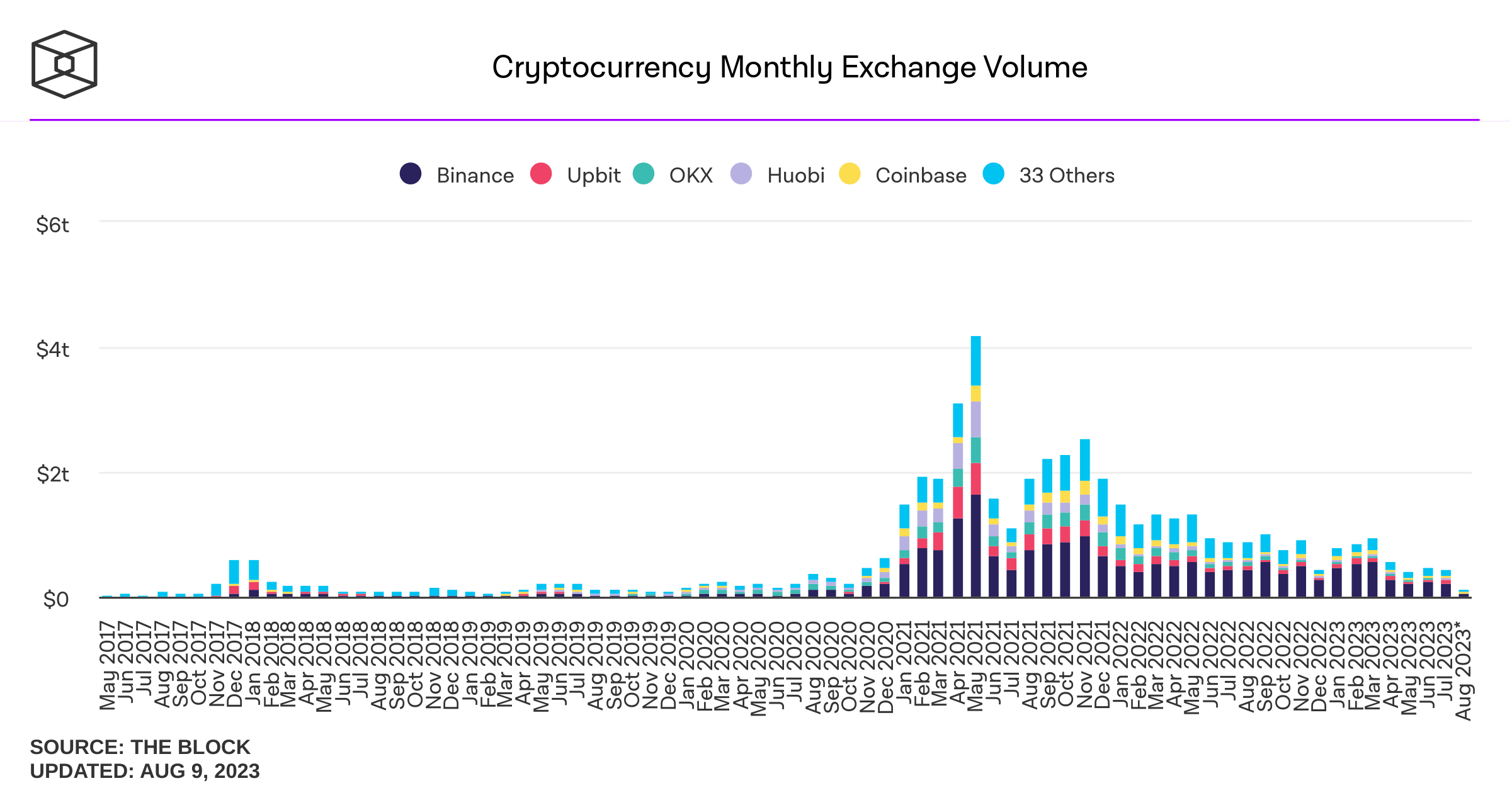
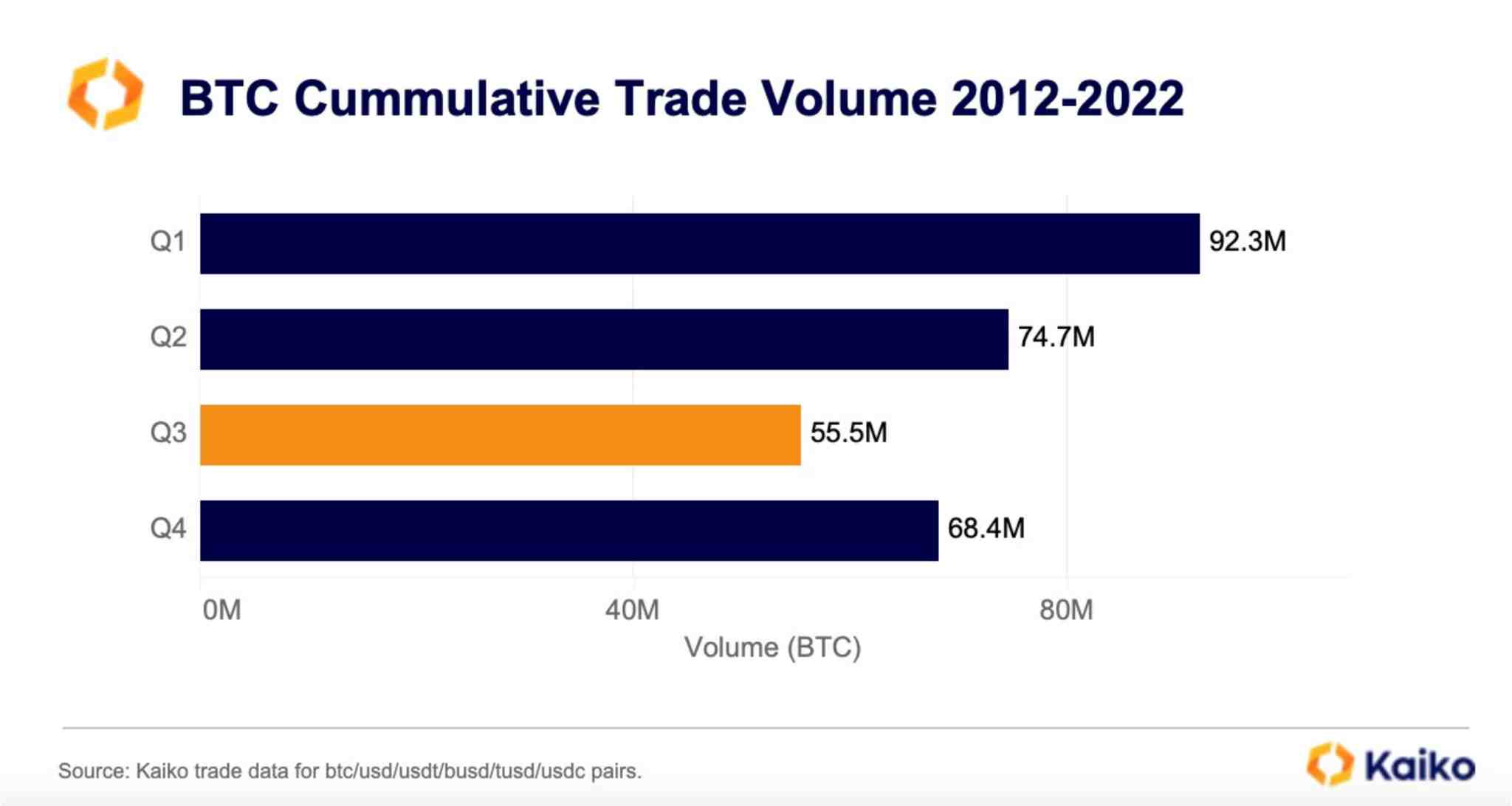
As we analysed here recently, this is partially a result of a typical summer trading lull, something which affects asset classes beyond crypto, too. The next chart from Kaiko shows this, with Q3 frequently yielding the lowest volume in Bitcoin’s short history. However, it is prudent to note that this is heavily skewed towards the last couple of years, with Bitcoin surging into mainstream consciousness and its liquidity therefore rocketing. Hence, blaming this lull on seasonality alone feels misguided.
Looking beyond Bitcoin, altcoins have also been quiet. There have been stories of the odd meme coin (Bald and Pepe, to name a couple) that have gained attention, but in comparison to previous years, the altcoin market has been devoid of the usual intrigue.
One way of looking at this is the notable rise of Bitcoin dominance, which measures the ratio of the Bitcoin market cap to the entire cryptocurrency market cap. It has risen above 50%, up from around 40% at the start of the year.
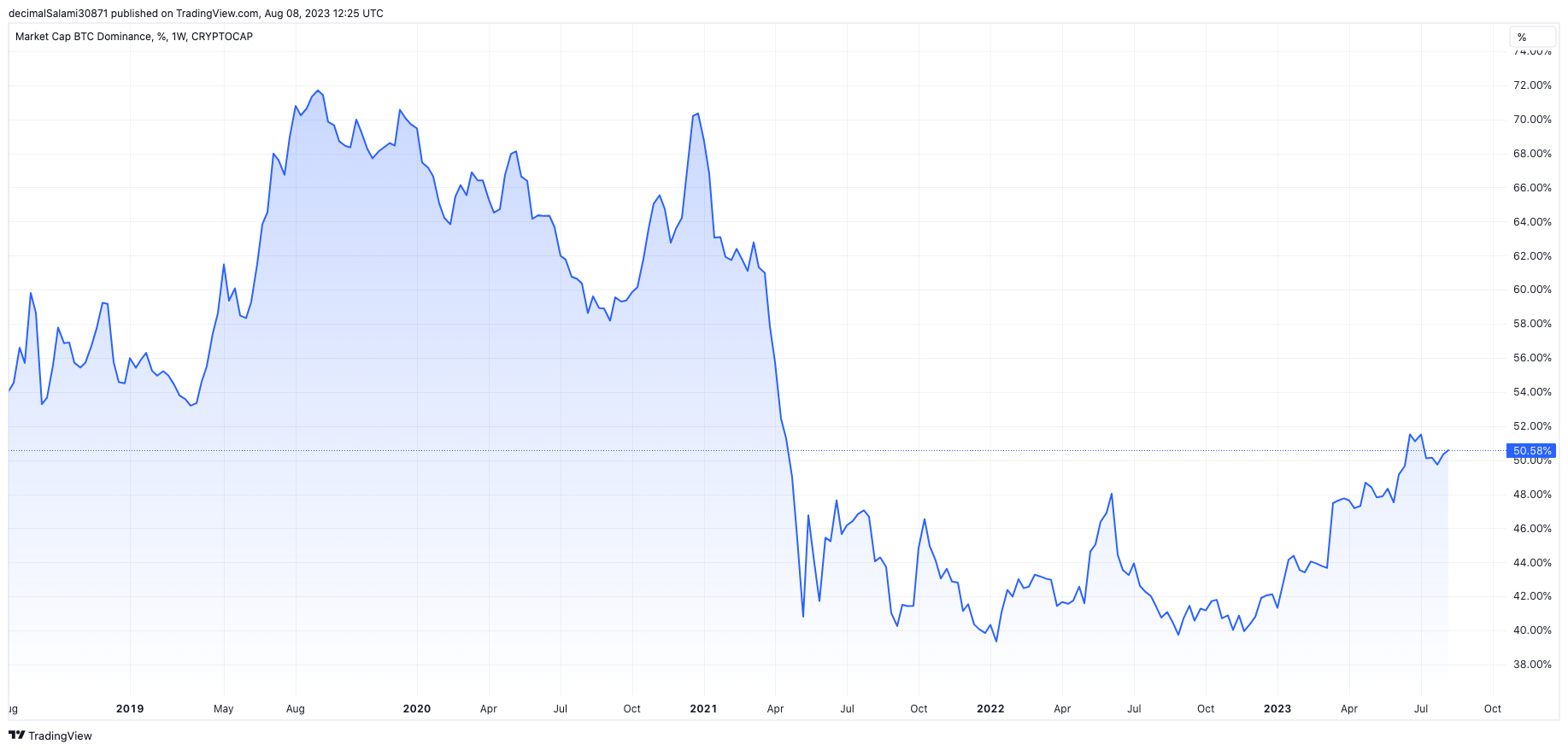 This rise in Bitcoin dominance is unusual because it has occurred during a period of price expansion across the industry. Previously, Bitcoin has tended to underperform alts in bull markets, with dominance therefore falling.
One factor in both the rise in Bitcoin dominance and the low market participation across crypto is the impact of the regulatory crackdown in the US. The SEC outlined several coins as securities, including Solana (SOL), Polygon (MATIC) and Cardano (ADA), and while Ripple secured an optimistic ruling in its own case against the SEC, the climate is undoubtedly more uncertain with regard to where all these tokens fit in.
Bitcoin, on the other hand, has largely been left out of the securities wars, and has even seen a slew of spot ETF applications lodged in recent months. Lawmakers very much seem to be dealing with Bitcoin as a separate genre of asset (as many in the sector have long done).
The regulatory crackdown on exchanges themselves has also been severe, and has certainly contributed to falling volumes across the space, Bitcoin or otherwise. Both Coinbase and Binance were sued in June, with Binance also the subject of a Department of Justice investigation, with some reports claiming charges may be imminent.
Moreover, we need to be careful when assessing the apparent trading volumes. One of the (many) accusations in the SEC case is that Binance manipulated trade volumes, meaning the true figures could be even lower.
Then there is the issue of, even if real, how much volume is meaningful. Binance ceased zero-fee trading for all Bitcoin pairs in March, and before this, zero-fee trading accounted for approximately 75% of volumes on the exchange. After the promotion ended, however, it promptly fell to 36%, with the majority through the stablecoin which Binance continued to promote zero-fee trading on: TrueUSD. Prior to this development, TrueUSD was seldom used with minimal liquidity.
With the fall in volume, it follows that there is also a fall in volatility. Traders live and die by volatility, and it is closely correlated with volume. In fact, volatility is currently around three-year lows.
The effects of the drain in market participation are being seen on volatility beyond Bitcoin, too. The below chart shows that Ethereum volatility has recently dipped to the level of Bitcoin’s, or even below it. That contrasts with what we have come to expect historically, with Ethereum typically trading with higher volatility than its big cousin.
The volatility is more notable when considering that liquidity is also so thin. Order books are as shallow as they have been in a long time. Liquidity took a particular fall in November when prominent market maker Alameda collapsed amid the FTX scandal. Since then, not only has its capital not been replaced on order books, but more US market makers have pulled out or scaled back operations in the wake of the regulatory climate.
All things considered, the crypto markets are showing remarkably low levels of liquidity, trading volume and volatility. This comes via a combination of factors, from investors retreating on the risk curve to other bear market-related factors. Regulation is also a key factor, however, and undoubtedly suppressing market activity while uncertainty is so high.
The turbulent price action will return. But for now, crypto charts are not throwing up their trademark chaos.
The post Crypto market participation continues to dip appeared first on CoinJournal.