Over a billion dollars liquidated in crypto’s worst day since FTX


Key Takeaways

  • Last week saw crypto suffered its worst 24 hours since FTX as over one billion dollars in derivatives were liquidated on Thursday
  • Derivative volume outstrips the extremely low spot volume, with cascading liquidations having the potential to exacerbate price moves
  • Volatility was sparked by sell-off in the bond market
  • Developments re-affirm how vulnerable Bitcoin is in the short-term to the highly unusual macro climate 

Following an extended period of rest in the crypto markets, the beast re-awakened last week. Crypto markets plummeted late Thursday and early Friday, led as always by Bitcoin. The world’s largest cryptocurrency shed 7% in what amounted to the largest one-day drop since the spectacular collapse of FTX last November. 

The year 2023 has been characterised thus far by the unusual fact that crypto’s rise has been slow and steady. Aside from a jump in March amid the regional bank crisis, Bitcoin has been perceptively devoid of the usual spikes and freefalls. 

The Bitcoin price displays this clearly in the next chart, as well as Friday’s trip south.

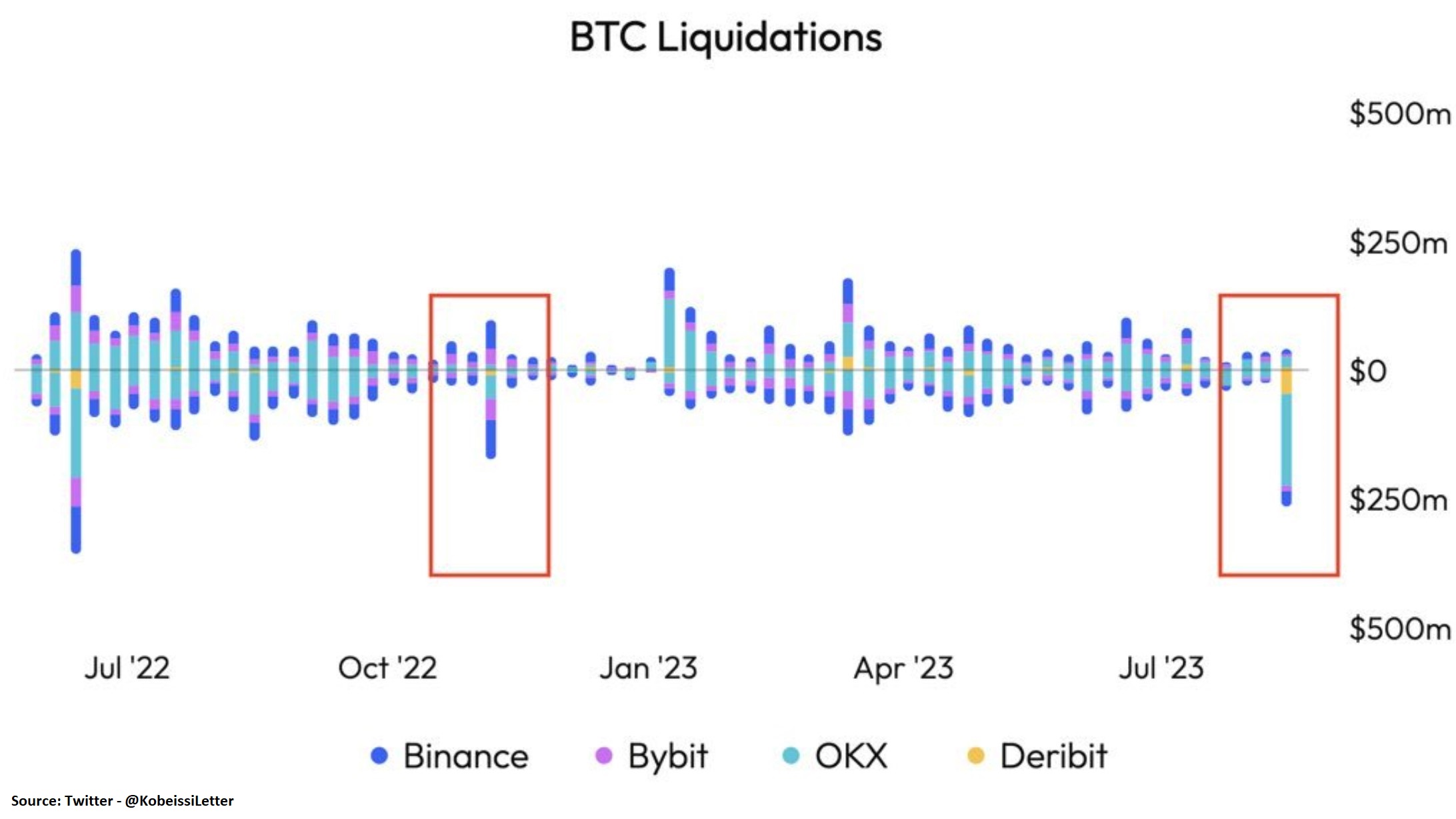
Digging further into last week’s price drop shows that, remarkably, Bitcoin fell 8% in just ten minutes from 9:35 PM GMT on Thursday evening. Looking at data from Coinglass, this contributed to a surge of liquidations. All in all, over one billion dollars was liquidated in what amounted to the biggest day of liquidations since the FTX demise (anytime the phrase “since FTX” is used in crypto, it rarely spells good news). 
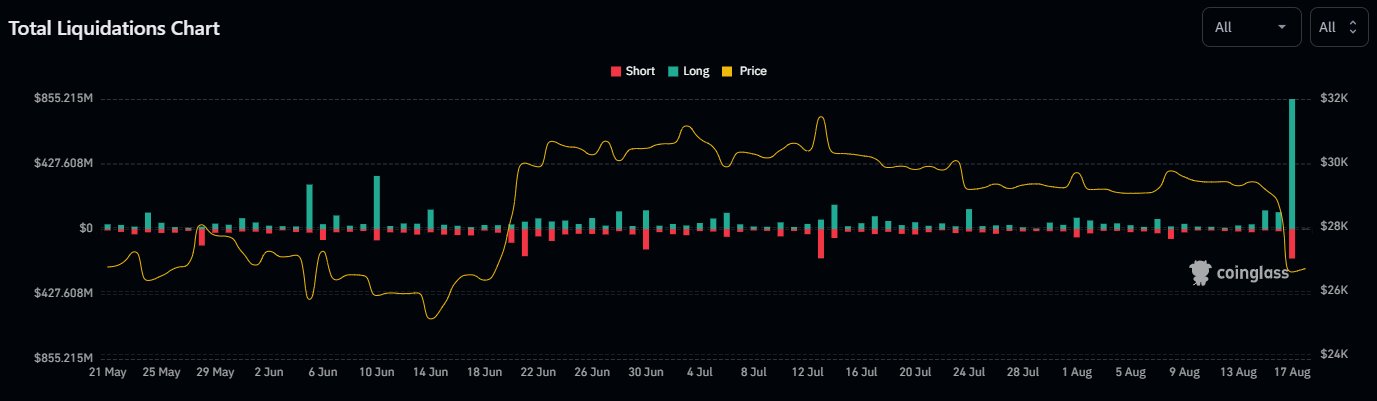
The flood of liquidations highlights how much greater the volume was in derivatives markets than spot, with the latter remaining extremely thin. Order books have been perceptibly shallow ever since Alameda evaporated amid the FTX debacle (liquidity was thin even before then). 

What caused the sell off?

The underlying cause of the volatility was a sell-off in the bond market, with yields spiking to multi-year highs. Yields on long-term US government debt neared their highest level since 2007, UK 10-year gilts rose to their highest yield since 2008, and Germany’s 10-year bund reached its highest yield since 2011. 

Higher yields spell trouble for risk assets, as we are well aware by now, with Bitcoin sent tumbling amid the tightening monetary environment last year. The recent move was borne out of investors betting that high interest rates will persist for longer than previously anticipated, or further hikes may not be as improbable as previously expected. 

The inverse relationship between Bitcoin and yields has been strong, demonstrated in the below chart. Hence, Bitcoin’s drop is not surprising in the context of the developments in the bond market last week. 

The sell-off reaffirms how vulnerable Bitcoin is to a macro situation that continues to perplex – high but falling inflation, while high interest rates contrast with record-low unemployment and relatively resilient economic data. 

Getting back to the derivatives market, the shift was further evident by looking at funding rates, with the Bitcoin OI-weighted funding rate dipping below -0.01% for the first time since March. 
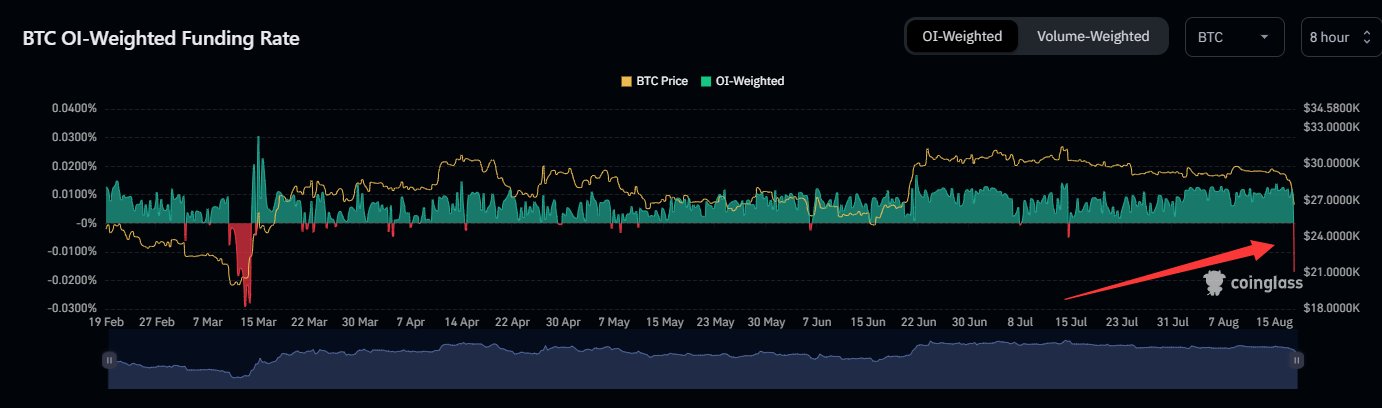
Finally, negative funding rates and freefaling open interest returned. It took a while, but volatility has returned.

What next for crypto?

What this spells going forward is up for debate. Some analysts affirm this is a mere blip, a drop sparked by complacent overleverage following a period of calm that felt like forever. A slight increase in hawkish sentiment going forward won’t ultimately change much, they argue, for an economy which seems increasingly ambitious about achieving a soft landing. 

On the other hand, some fear there could be a return to 2022-like conditions. While that may seem extreme, there is every change there is a recalibration away from the borderline-celebratory stance that interest rate hikes were complete and the soft landing was already guaranteed. 

If that were the case, this could mark the end of the bear market rally for crypto. Few assets are as sensitive to global liquidity as Bitcoin is, meaning a reversion towards the tightening seen last year would undoubtedly spell red candles on price charts.

This would be getting ahead of oneself, however. The macro climate remains largely unprecedented and very challenging to predict. Even the Federal Reserve’s language betrays this, with some notable see-sawing in recent meetings. 

Last Wednesday, meeting minutes said that there are “significant upside risks to inflation, which could require further tightening of monetary policy”. Going back to the meeting in July, minutes say that the Fed believed inflation was falling and risks “titled to the downside”, with Jerome Powell asserting that “given the resilience of the economy recently, (the Fed is) no longer forecasting a recession”. 

While these are not necessarily conflicting – one can have inflation and tightening without a recession, it is just quite difficult (but where we have been living for the last eighteen months) – it does highlight how uncertain the whole climate is. 

Bitcoin is again caught in the crossfire, a risk asset subject to the whims of the wider market as it grapples with this fast-changing environment. 

The post Over a billion dollars liquidated in crypto’s worst day since FTX appeared first on CoinJournal.
Bitcoin price tumbled last week on SpaceX liquidating stash

  • SpaceX’s Bitcoin liquidation triggered a massive drop in Bitcoin’s price
  • A double top pattern suggests more weakness might come
  • The measured move hints at further downside into the $20k area

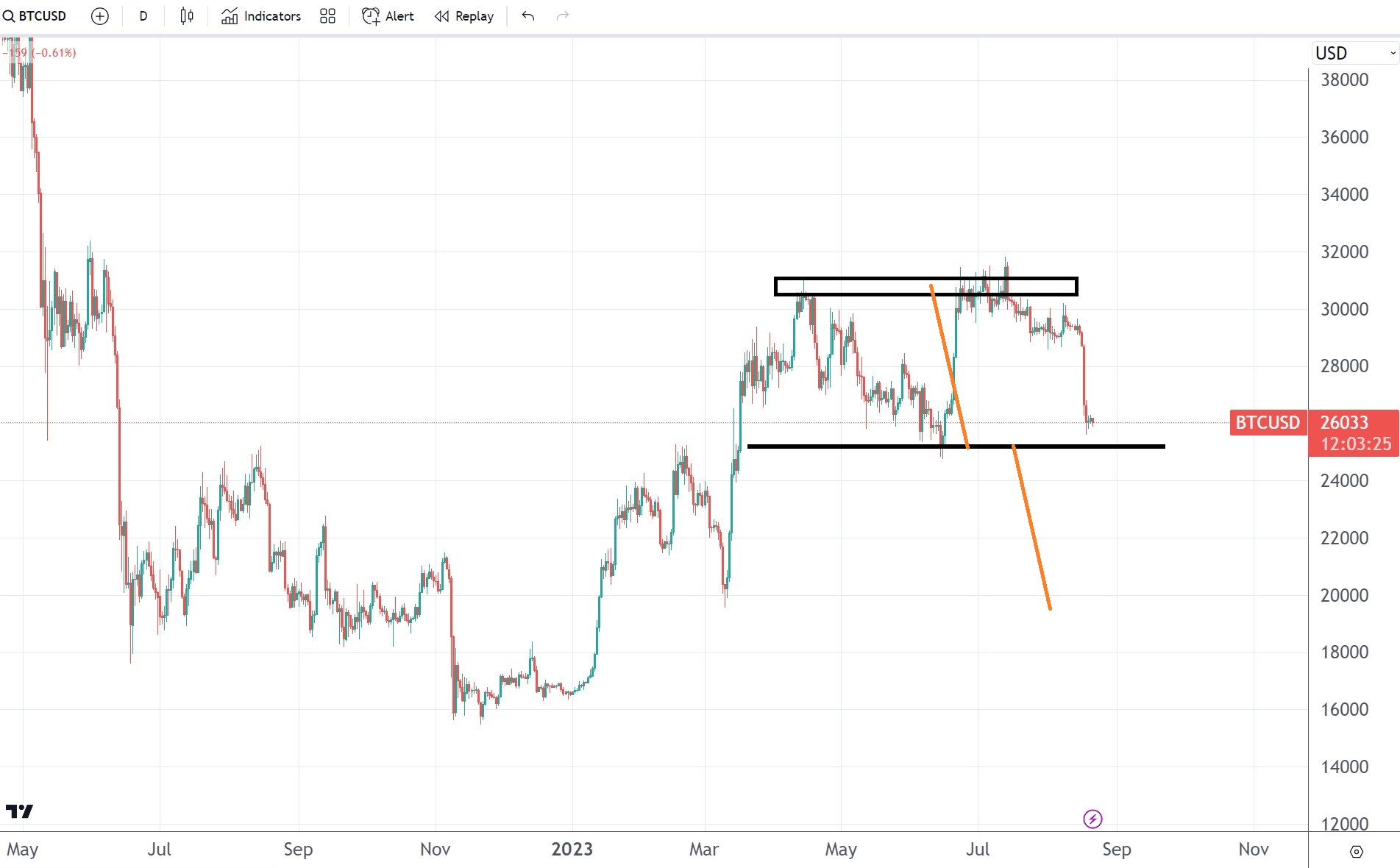
Bitcoin price failed at the $30k level twice this year. After rallying from $16k, it formed a possible double top pattern that should worry investors.

The latest sign of weakness came last week. News that Elon Musk’s SpaceX liquidated its entire Bitcoin stash sent the price lower. More precisely, SpaceX sold Bitcoin worth $373 million.

It was one of the largest daily liquidations by volume in history. In just 20 minutes, Bitcoin price crashed by more than 7% on outflows bigger than during the FTX collapse.

SpaceX sold its Bitcoin holdings after Tesla did the same last year. More precisely, Tesla sold last year 75% of its Bitcoin holdings.

So what does it mean for Bitcoin price, and can the market bounce back?

A double top pattern might have formed at $30k

Since the start of the year, Bitcoin price have doubled. The rally was so powerful that it triggered a wave of enthusiasm among cryptocurrency investors.

But the failure to hold above $ 30k led to the formation of a possible double top pattern.

Bitcoin chart by TradingView

A double top is a reversal pattern with a measured move equal to the distance from the top to the neckline, projected from the neckline. The chart above shows the two tops formed at the $30k area and the neckline at the $25k area.

Therefore, the measured move equals $5k and, if projected from the neckline, suggests that Bitcoin might see $20k sooner rather than later.

The only way for bulls to get back in control is for Bitcoin to break above the double top area (i.e., $30k). For now, however, the bias is bearish, and the focus is on a potential bearish breakout below the neckline.

The post Bitcoin price tumbled last week on SpaceX liquidating stash appeared first on CoinJournal.

Prediction markets tokens rise as other tokens dip: Gnosis, Augur price outlook

  • Bitcoin has suffered its worst weekly percentage loss since the collapse of FTX.
  • Some of the factors behind the dip include reports of SpaceX selling its BTC holdings and the Chinese property giant Evergrande bankruptcy filing.
  • Top prediction markets tokens have maintained a bullish trend amid the crypto meltdown.

In what has caught most crypto investors by surprise, the price of Bitcoin (BTC) has decreased by 11.2% to about US$26k. Last week has been the worst week for Bitcoin (BTC) since FTX’s demise in November 2022.

The market crash has not only affected BTC, seeing that the rest of the asset class has not fared any better. Ethereum (ETH) fell by approximately 9.5% to $1.7K and Binance-coin (BNB) dropped by about 9.8% to $217, just to mention a few of the top cryptocurrencies by market capitalization.

While most of the top cryptocurrencies experienced a price dip, popular prediction markets tokens like Gnosis (GNO), SX Network (SX), Kleros (PNK), and Augur (REP) registered significant gains. Chancer (CHANCER), a new prediction markets token is also gaining traction as its token presale continues to gain traction.

What caused the crypto market to drop?

The price decrease was caused by a number of causes. They included speculation that SpaceX wrote down the value of its Bitcoin assets, the collapse of the Chinese real estate firm Evergrande, and rising yields in the US.

SpaceX Bitcoin holdings

The Wall Street Journal published a report late last week stating that Elon Musk’s space exploration company SpaceX marked down the value of the Bitcoin it had on its books by US$373 million for the years 2022 and 2021. The report claims that the business also sold a portion of the BTC it had at one point over the previous two years. The WSJ has identified documents that it claims offer uncommon insights into the business’s finances.

However, the WSJ’s assertions cannot be independently verified because SpaceX is a privately held corporation. Musk acknowledged that SpaceX did acquire Bitcoin during a panel appearance in 2021, but it is unclear how much or when the commodity was purchased.

Evergrande bankruptcy 

In a disclosure made over the weekend, the Chinese real estate tycoon Evergrande filed for bankruptcy protection in the United States. The corporation reportedly took action to secure its assets while still trying to control its creditors.

Before proposing a comprehensive off-shore debt restructuring program in 2021, Evergrande experienced a public meltdown and went into default on its obligations. The business currently seems to be on life support.

Investors are worried that China’s enormous real estate market may become contagious. Country Gardens and other significant developers are not paying their debts either, and the industry—which is thought to account for up to 30% of Chinese GDP—is in serious need of government assistance.

US Treasury yields

US Treasury yields are skyrocketing and pushing away investors from risky markets like the crypto market and toward saving. As the US Federal Reserve gradually increased rates throughout the previous year to reach a target rate of slightly over 5%, bond yields increased.

As strong US economic data keeps coming out, yields have increased this week in anticipation that rate rises will continue. Since 2011, the 30-year US Treasury yield has never been higher. Treasury bonds give a high, secure yield, which is detracting from the value of other asset types like shares and cryptocurrencies.

Gnosis and Augur price prediction

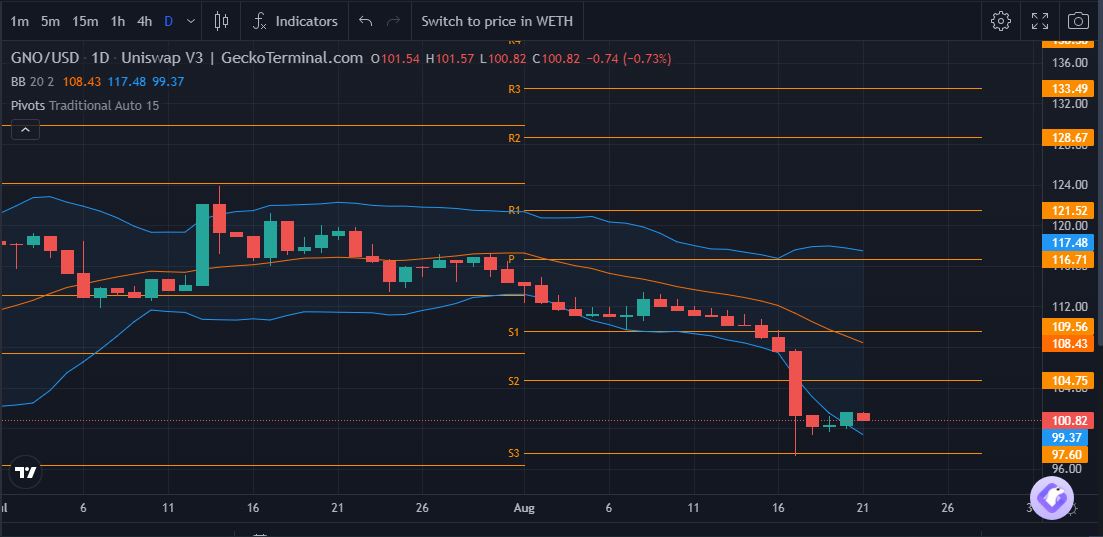
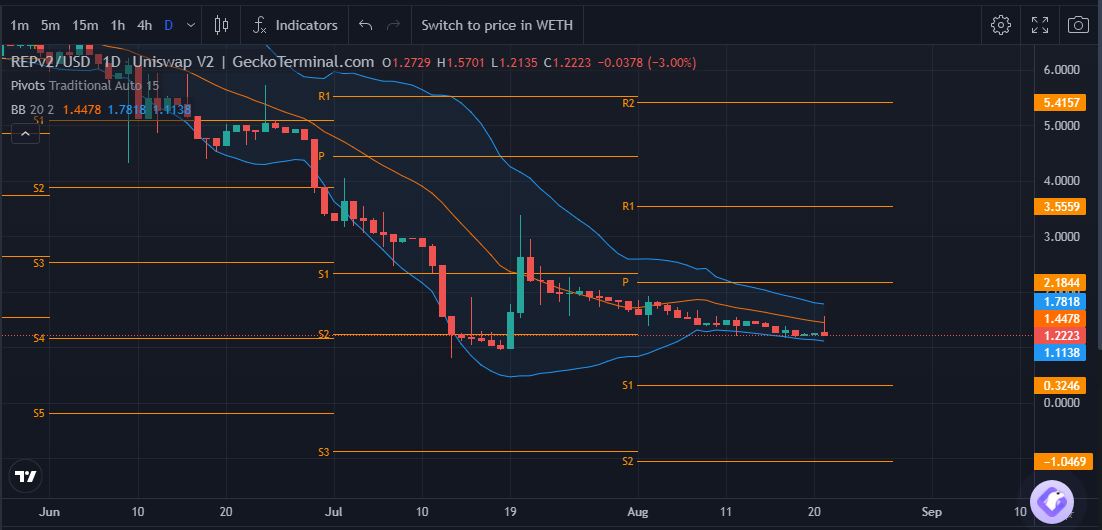
Gnosis has risen by 0.2% while Augur has registered a 1% surge after a bear week. In the past seven days, Gnosis dropped by 8.8% while Augur fell by 11.7%.

Gnosis price daily chart


Having bounced off the support at $97.60, the Gnosis (GNO) token is expected to test the resistance at $104.75. However, that depends on whether the current daily candlestick closes above the lower band line of the Bollinger Bands indicator.

Augur price daily chart


Augur, on the other hand, seems to have slid into consolidation after erasing most of the gains it made between July 19 and July 20. All eyes are on the support at $0.3246 and the resistance at $2.1844. If the REP price jumps above the upper Bollinger Bands line, it could test the $2.1844 resistance level and if it drops below the lower Bollinger Bands line, it could drop to the support at $0.3246.

The prediction markets tokens including Chancer, are expected to experience significant price gains as popular games including the English Premier League and the American MSL gather steam.

The post Prediction markets tokens rise as other tokens dip: Gnosis, Augur price outlook appeared first on CoinJournal.

Avalanche unlocks $103M AVAX this week: What’s the price outlook?

  • Avalanche traded at $10.65, down 1.5% in the past 24 hours.
  • The declines for AVAX, which has plummeted from highs near $16 in mid-July, come ahead of a $103 million token unlock.
  • Token Unlocks shows Avalanche is set to unlock 9.54 million AVAX tokens on August 26.

Avalanche is closer to unlocking a significant chunk of its native token AVAX, with this coming at a time a crypto sell-off has put pressure on prices. 

With AVAX price down nearly 14% in the past week and over 25% in the last 30 days, the impending token unlock is definitely one to watch for Avalanche.

Avalanche will soon unlock AVAX worth $103

Details on the platform Token Unlocks shows that the smart contracts platform is poised for a supply surge of 9.54 million AVAX tokens. That means over $103 million worth of AVAX tokens will soon be released into circulating supply. The event is scheduled for August 26 and will see the network add to its circulating supply by 2.77%.

The planned unlock has earmarked tokens for various Avalanche ecosystem players. About 2.25 million tokens will go to strategic partners, roughly 1.67 million to foundations and 4.5 million to teams. Another 1.13 million AVAX is set to be released via airdrops.

Avalanche has so far unlocked 379.79 million AVAX tokens, representing 53%. Another 340 million, or about 47%, remains locked.

AVAX price outlook

The core Avalanche team could see this as an opportunity for ecosystem growth. However, traders are inclined to keenly watch the market as the new supply enters the market. This is due to the potential impact of such a massive release on short term price performance, especially as selling pressure creeps in.

AVAX was at $10.65, down 1.5% in the past 24 hours at 6 am ET on Monday. According to CoinGecko, the cryptocurrency’s 24-hour trading volume stood at $88 million, up 12%.

The token’s value has traded lower since peaking near $16 in mid-July this year. DeFiLlama data shows the total value locked (TVL) in the Avalanche DeFi ecosystem has also shrunk, falling more than 10% in the past seven days to $544 million. 

 and could face further downward pressure given the prospects of a volatile reaction to the unlock. Other market conditions might also come into play.

The post Avalanche unlocks $103M AVAX this week: What’s the price outlook? appeared first on CoinJournal.