
Grayscale secures a big win against SEC in Bitcoin ETF case

  • U.S. court rules in favour of Grayscale in its lawsuit against SEC.
  • Today’s ruling paves the way for the first U.S. Bitcoin ETF.
  • Bitcoin and Ethereum jumped over 5.0% following the news.

The U.S. Court of Appeals for the DC Circuit just ruled in favour of Grayscale in its long-running lawsuit against the Securities & Exchange Commission.

First U.S. Bitcoin ETF is now expected soon

SEC had blocked the asset manager’s effort to convert its flagship Grayscale Bitcoin Trust to an exchange-traded fund last year.

But the ruling this morning paves the way for a Bitcoin ETF not just for Grayscale but also for others that have applied for one, including BlackRock and Fidelity. A Grayscale spokeswoman said today:

[Ruling] is a monumental step forward for investors, Bitcoin ecosystem, and those who have been advocating for Bitcoin exposure through added protections of ETF wrapper.

Bitcoin as well as Ethereum jumped more than 5.0% following the announcement on Tuesday.

Why does a Bitcoin ETF attract all the hype?

Note that a Spot Bitcoin ETF is a big deal as several experts are convinced that it would help boost institutional interest in the cryptocurrency and potentially unlock its next leg up.

Shares of Coinbase Global – the listed custodian partner in a bunch of applications for such an exchange-traded fund are also up nearly 15% at writing. According to Dave Weisberger – the Chie Executive of CoinRoutes:

It virtually guarantees they will approve BlackRock and Fidelity. Grayscale may need to refile, but they will almost certainty be approved as well.

The Grayscale Bitcoin Trust currently manages assets worth about $16 billion. The aforementioned lawsuit against the U.S. Securities & Exchange Commission started in June of 2022.

The post Grayscale secures a big win against SEC in Bitcoin ETF case appeared first on CoinJournal.
EOS expands into East Asia markets with regulatory approval in Japan

  • The EOS received a whitelist approval from the Japan Virtual and Crypto Asset Exchange Association (JVCEA).
  • EOS will start trading on BitTrade in Japan in mid-September.
  • Crypto-asset providers in Japan are monitored and regulated by the JVCEA and FSA under the Payment Services Act.

The EOS Network Foundation has announced that the Japan Virtual and Crypto Asset Exchange Association (JVCEA) has approved the EOS cryptocurrency for inclusion on its whitelist. The accomplishment opens the door for EOS to be traded in Japan on authorized cryptocurrency exchanges against the yen.

By giving the EOS Network more exposure and accessibility to a wider spectrum of Japanese end users, developers, and investors, the JVCEA’s approval represents a significant advancement for EOS. Midway through September, EOS will start trading on BitTrade, a renowned cryptocurrency exchange authorized and governed by the nation’s Financial Services Agency (FSA).

Japan’s strict crypto regulations

Japan’s strict regulatory regime controlling digital tokens is well known for its thoroughness and sturdiness. The Payment Services Act mandates a detailed pre-screening procedure for new digital assets, and the JVCEA and FSA closely monitor and regulate crypto-asset providers. The EOS Network’s adherence to these strict rules demonstrates its dedication to openness, security, and innovation.

With the successful extension of Upland, built on EOS and one of the largest metaverses in the business, to encompass Tokyo, the network is already experiencing a rise in popularity and usage in the Japanese market.

EOS has a solid reputation among blockchain fans and developers thanks to its five years of uninterrupted mainnet operation and its top-tier Ethereum Virtual Machine, which offers unrivalled performance.

This endorsement shows that the EOS Network’s dependability and performance have been acknowledged, opening the door for further development and acceptance in East Asian markets. As one of the top blockchains globally, EOS is well-positioned for ongoing progress in the area thanks to strong collaborations and a successful track record.

The post EOS expands into East Asia markets with regulatory approval in Japan appeared first on CoinJournal.

Digital asset investment products record largest outflows since March

  • Digital assets investment products saw outflows of $168 million last week, $146 million of which was for Bitcoin.
  • It’s the largest weekly outflows total since March 2023, according to a report by CoinShares.

CoinShares’ latest weekly report on digital asset investment flows shows that the market witnessed its largest funds outflows in nearly six months last week. The outflows come as sentiment across cryptocurrency dips amid recent sell-off.

Crypto sees $168 million in outflows

According to the report, outflows totaled $168 million over the week to mark the largest outflow from crypto products since March 2023 when the US Securities and Exchange Commission (SEC) started its regulatory crackdown on major exchanges.

The outflows in the week ended August 25 saw the monthly outflows stand at $278 million as sentiment continued to trend negative amid “exceptionally low trading volume.” Indeed, CoinShares data shows the investment products market traded $1.3 billion last week, about 16% off the year’s average.

“This negative sentiment we believe is due to the increasing acceptance that a spot-based ETF for Bitcoin in the US is likely to take longer than many expect, with recent delays being announced by the SEC,” said James Butterfill, head of research at CoinShares.

Bitcoin continues to lead

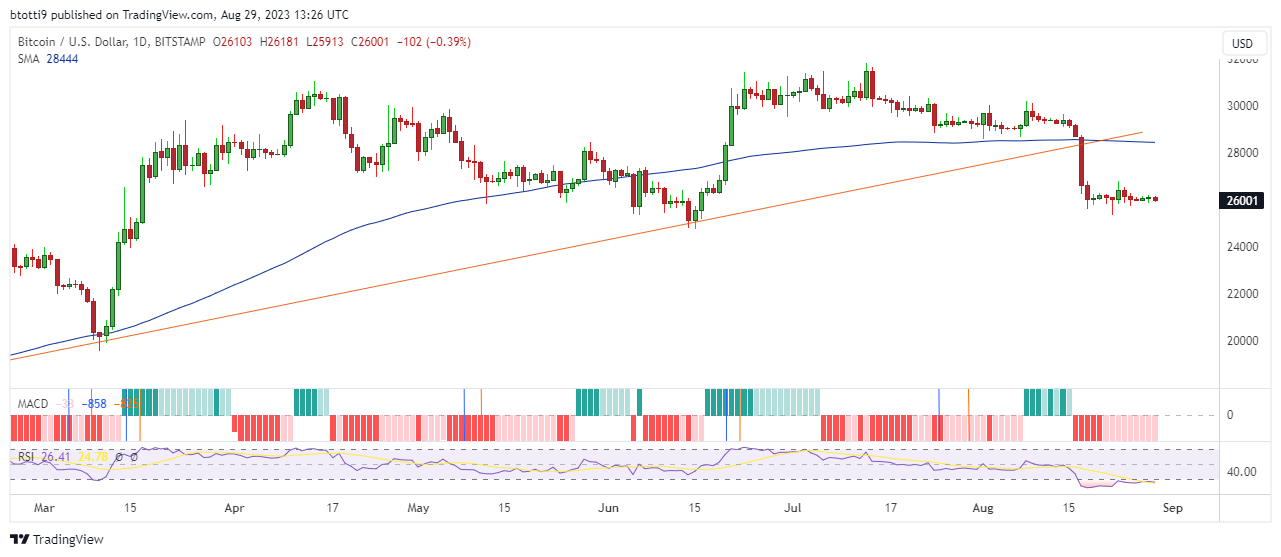
The crypto market recently witnessed a sharp sell-off for Bitcoin, the benchmark cryptocurrency falling to lows of $25,350. The struggle to strengthen above $26k has illustrated the market jitters permeating the broader risk assets sector, with this shown in outflows from Bitcoin investment products.

Bitcoin price chart

However, while outflows totaled $149 million last week, the flagship crypto asset’s flows are net positive for the year at roughly $265 million. Meanwhile, investors are increasingly selling their short positions, with $4 million in outflows registered last week for an 18-week streak of outflows. 

Data shows shorts outflows are currently 89% of the total AuM.

In the altcoin market, Ethereum recorded outflows of $17 million, while XRP and Litecoin had minor inflows of $0.5 million and $0.44 million, respectively.

The post Digital asset investment products record largest outflows since March appeared first on CoinJournal.

Bitcoin miner Canaan’s mining revenue rose 43% in Q2

  • Canaan Inc. (NASDAQ: CAN) has released its Q2 financial report showing an increase in mining revenue.
  • The Bitcoin miner’s total revenue rose to $73.9 million, increasing by 33.7% compared to Q1, 2023.
  • Canaan reportedly held 1125 bitcoins as of June 30, 2023.

Canaan Inc. (NASDAQ: CAN), one of the leading Bitcoin mining companies, has reported its unaudited financial results for Q2, 2023. According to the report, revenue from BTC mining jumped 43.3% quarter-on-quarter, from $11.1 million to $15.9 million.  

Meanwhile, total revenues rose to $73.9 million in the quarter, 33.7% up on Q1 revenues of $55.2 million. However, with the crypto market still heaving from the bear market impact, Canaan’s second quarter revenue is significantly lower compared to the $245.9 million reported in Q1, 2022.

Commenting on the financial results, Canaan CEO Nangeng Zhang, said in a press release: 

“We navigated the challenges in the second quarter of 2023, surpassing our topline guidance to achieve $73.9 million in revenue. Despite the relatively stagnant bitcoin price in the second quarter, our endeavor to drive sales across various fronts, including major clients, channels, and retail, yielded encouraging results. This effort propelled our total computing power sold to a remarkable 6.1EH/s, up 44% sequentially.”

Canaan held 1,125 bitcoins

According to Mr. Zhang, the company benefited from its collaboration with channel clients, and saw its online retail store attract new clients from across the globe.  The firm has recently looked to cement its footprint in the sector, setting up mining ventures in Africa and South America.

As noted above, Canaan sold 6.1 million Thash/s – this up from 4.2 million Thash/s in Q1, 2023. The company had sold a total of 5.5 million Thash/s in Q1, 2022.

CFO James Jin Cheng stated: “In the second quarter of 2023, we observed improvement in both our sales and mining activities, which contributed to our better-than-expected revenue performance. Despite a decrease in average selling price, our product sales grew by 31.3% quarter over quarter, driven by increases in total computing power sold.”

While the company expects Q3 revenue to decline to $30 million owing to the market conditions, net loss in Q2 was $110.7 million, compared to $84.4 million in Q1. The company had seen a net income of $90.1 million during the same quarter in 2022.

Per the report, Canaan held 1,125 bitcoins worth $28.8 million as of June 30, 2023. The company owned 747 of these bitcoins, while 378 BTC was from customer deposits. Impairment on the crypto in Q2 was $2.4 million, compared to $0 in Q1 and $4.5 million in Q2, 2022.

The post Bitcoin miner Canaan’s mining revenue rose 43% in Q2 appeared first on CoinJournal.

Crypto exchange Binance is considering a full exit from Russia

Key takeaways

  • Binance is considering exiting the Russian market as it continues to face regulatory challenges in other parts of the world. 

  • The crypto exchange recently revealed that its users in Belgium will access its services via its Poland unit.

Binance to exit the Russian market

Binance, the world’s leading cryptocurrency exchange by market cap, is reportedly considering exiting the Russian market. This is according to a recent report by the Wall Street Journal. 

This latest cryptocurrency news comes as the crypto exchange continues to face regulatory challenges in Europe and the United States. 

The report pointed out that Binance is currently tackling multiple lawsuits with US regulators and is currently considering numerous options, including a full exit from the Russian market.

Binance is working to align itself with international sanctions

Binance said it is working to align itself with international sanctions following allegations that it is helping nationals move funds outside the United States earlier this year. 

The cryptocurrency exchange is working to block accounts belonging to Russian nationals with connection to the Kremlin. 

In 2022, the crypto exchange took steps to block accounts belonging to Elizaveta Peskova, the daughter of Dmitry Peskov, spokesperson for Russian leader Vladimir Putin. 

Binance also said it shuttered accounts from others connected to family members of top Russian officials. The moves came following sanctions against Peskova by the US Treasury. 

The cryptocurrency exchange has been facing regulatory challenges in the United States and other parts of the world.

Earlier this month, Binance informed its users in Belgium that they could now access its services via Binance Poland, the crypto exchange’s Polish-regulated arm. The move was to ensure that Binance complies with regulatory requirements in the country.

The cryptocurrency exchange also discontinued support for its crypto-backed debit card for customers in Latin America and the Middle East earlier this month. However, Binance didn’t specify the reasons behind its decision. 

The US and EU have imposed sanctions on Russia after it invaded Ukraine last year. They have imposed bans on the acquisition, import, or transfer of coal and other solid fossil fuels.

The post Crypto exchange Binance is considering a full exit from Russia appeared first on CoinJournal.