Light Protocol and Helius Labs launch ZK Compression on Solana to reduce storage costs

  • The ZK Compression uses zero-knowledge proofs for data compression.
  • The ZK Compression slashes Solana on-chain storage costs by 99%.
  • The ZK Compression operates as an integrated L1 solution, avoiding typical L2 complexities.

Light Protocol and Helius Labs have unveiled a groundbreaking feature known as ZK Compression on Solana, aimed at revolutionising how data is stored on the Solana blockchain by significantly reducing on-chain storage costs.

Launched on June 21, ZK Compression harnesses zero-knowledge (ZK) proofs to compress on-chain data, promising immense scalability improvements and cost savings.

How does the ZK Compression work?

At its core, ZK Compression leverages zero-knowledge proofs to compress and verify off-chain data on Solana’s Layer 1 (L1) network.

By employing sparse state trees and hashing techniques, ZK Compression minimizes the amount of on-chain data required while maintaining data integrity and security.

This approach allows developers to store crucial information more efficiently, translating into substantial cost reductions. For example, according to the Helius Labs’ CEO, the cost of storing 100 compressed token accounts can plummet from 0.2 SOL to just 0.0004 SOL — a staggering 5000-fold decrease.

Solana’s implementation of ZK Compression marks a departure from traditional storage methods, where each piece of data necessitates significant on-chain resources. Instead, by storing only essential verification information on-chain and utilizing ZK proofs to validate the integrity of off-chain data, Solana achieves unparalleled efficiency in data management on its blockchain.

Comparing ZK Compression with Layer 2 solutions

Unlike conventional Layer 2 (L2) scaling solutions, which often require additional security measures and governance structures, ZK Compression operates seamlessly within Solana’s existing validator framework.

This distinction allows Solana to bypass typical L2 complexities while retaining the economic incentives and security assurances of its primary blockchain layer.

Although critics argue that labeling ZK Compression solely as an L1 enhancement overlooks its functional similarities to L2 technologies like ZKrollups, proponents emphasize that Solana’s approach simplifies scalability without compromising on the core benefits of blockchain decentralization and security.

By focusing on efficiency and cost-effectiveness, Solana positions ZK Compression as a robust alternative to traditional L2 solutions, appealing to developers seeking streamlined scalability solutions without the overhead of additional layers.

What does the ZK Compression mean for Solana?

The introduction of ZK Compression holds profound implications for the blockchain industry, particularly in enhancing the feasibility and scalability of large-scale applications on Solana.

For instance, projects involving extensive data storage or frequent transaction processing, such as decentralized finance (DeFi) protocols or non-fungible token (NFT) marketplaces, stand to benefit significantly from reduced operational costs and improved throughput.

Moreover, Solana’s commitment to advancing blockchain scalability through ZK Compression underscores its ambition to foster innovation and attract a broader developer community.

As the technology matures and adoption grows, ZK Compression could pave the way for new use cases and applications that leverage Solana’s high-performance blockchain infrastructure.

The post Light Protocol and Helius Labs launch ZK Compression on Solana to reduce storage costs appeared first on CoinJournal.

Metaplanet doubles down on Bitcoin, eyes additional $6.2 million purchase

  • Japanese firm Metaplanet announces 1 billion yen ($6.2 million) BTC purchase.
  • Funds will come from proceeds of a bond issuance.

Metaplanet, a top Japanese investment firm that has recently adopted the Bitcoin strategy by adding BTC to their balance sheet, has announced plans to buy more BTC.

The company is looking to add over $6.2 million more worth of Bitcoin, using funds from an upcoming bond issuance.

Metaplanet to buy more BTC

Per details shared in an announcement, the bond payments are set for June 26, 2024 and Metaplanet will use the proceeds to buy more Bitcoin. It’s a move that would bring its holdings to more than $15 million. The firm holds 141.07 BTC after its recent 250 million yen purchase.

The firm’s Board of Directors confirmed the decision to buy 1 billion yen worth of Bitcoin to add to its balance sheet on Monday.

“While our basic policy is to hold Bitcoin for the long term, if we use Bitcoin for operations or other purposes, the corresponding Bitcoin balance will be recorded as current assets on the balance sheet.”

Metaplanet pivoted towards Bitcoin in April, with the initial objective being to adopt BTC as a reserve asset as a way of cutting the firm’s yen exposure. The investment advisor also targets providing access to crypto investing for Japanese investors.

With $9 million in BTC already, Metaplanet’s holdings of the benchmark cryptocurrency pale in comparison to Bitcoin behemoths like MicroStrategy. Following its recent purchase (an additional 11,931 BTC for $786 million) MicroStrategy now holds 226,331 bitcoins acquired for about $8.3 billion.

While a drop in the ocean in comparison, the investment firm’s decision to go the Bitcoin way has attracted positive forecasts from market experts and observers. In most cases, many see this as another potentially huge shift across the market.

Bitcoin traded around $62,440 on Monday morning, about 3% down in the past 24 hours.

The post Metaplanet doubles down on Bitcoin, eyes additional $6.2 million purchase appeared first on CoinJournal.

JasmyCoin defies broader crypto market as price surges 12%

  • JasmyCoin surges 12% as price defies broader crypto market
  • JASMY could flip to $0.04 if bulls hold above key support level

JasmyCoin (JASMY), the native token of a Japan-based cryptocurrency project for decentralized data, has witnessed a significant price increase as most top altcoins mirror Bitcoin’s consolidation in the past month.

On June 23, JASMY price was up 12% – more than any other token in the top 100 by market cap.

As BTC and ETH hovered around the $64k and $3.5k price levels respectively, JasmyCoin was trading above $0.033, seeing a notable surge in daily volume and one of the top trending crypto tokens in the market.

JASMY price – what happened?

While JasmyCoin remains nearly 7% down in the past week, the past 24-hour gains have helped stem recent rot that saw JASMY fall to around $0.027.

The declines had accelerated once JASMY retreated from above $0.044 in early June, with a breakdown to $0.030 coinciding with Bitcoin’s sharp descent this month. As the crypto market struggled with sell-off pressure amid macroeconomic events and miner selling, JASMY broke below a technical support area to reach lows of $0.027 on June 21.

Today’s upside is a continuation of the bullish flip over the past two days.

According to CoinGecko data, this cryptocurrency has recorded a decent 24% uptick in 24-hour trading volume, currently at over $200 million. On the previous day, volume reached $176 million as price moved from near $0.029 to $0.032.

Read more: Jasmy unveils major partnership with Panasonic

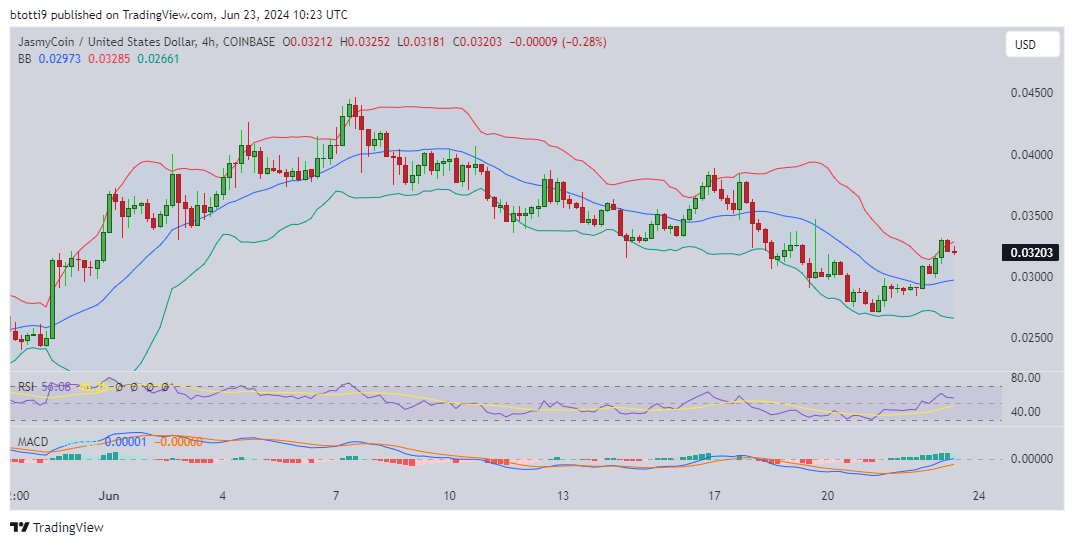
JasmyCoin chart

The technical picture for JasmyCoin suggests a slightly upper hand for bulls.

As shown above, the Moving Average Convergence Divergence (MACD) and Relative Strength Index (RSI) on the 4-hour chart both offer this advantage. The chart also shows JASMY is nicely poised despite the retreat from the resistance line of the Bollinger Bands.

The daily chart however shows RSI and MACD slightly favouring bears.

In this case, buyers must hold price above the psychologically important $0.030 level to prevent a bearish flip. On the upside, JASMY coin’s major hurdle could be around $0.38-$0.040.

The post JasmyCoin defies broader crypto market as price surges 12% appeared first on CoinJournal.