
BofA survey: Young wealthy investors remain skeptical of stocks, crypto seen as better alternative

  • 28% of young wealthy investors are focusing on crypto investments
  • A cautious mindset is what’s dominating young investors portfolio choices
  • 76% of young investors remain skeptical of traditional investments

Young investors are holding more crypto investments compared to traditional equities, according to a report from the Bank of America (BoA).

In its 2024 Study of Wealthy Americans, the bank received responses from over 1,000 respondents with at least $3 million in investable assets and were at least 21-years-old.

The survey found that among younger investors – mainly Gen Z and Millennials –  crypto and digital assets play a significant role in reshaping how America invests. BofA shows that these investors are focusing on real estate (31%), crypto and digital assets (28%), and private equity (26%).

Interestingly, 76% of young investors remain skeptical about traditional investments. They believe it’s no longer possible to achieve above-average investment returns by investing solely in traditional stocks and bonds.

On the flip side, those aged 44+ favor domestic equities (41%), real estate (32%), and emerging marketing equities (25%).

Katy Knox, president of Bank of America Private Bank, said that the investors are going through a “period of great social, economic and technological change alongside the greatest generational transfer of wealth in history.”

Cautious mindset

According to the survey, “the portfolio choices of younger people do suggest a perspective shift between the generations,” adding that while crypto is often compared to risk-averse investments such as gold, “it could be that a cautious mindset is what dominates some of these portfolio choices.”

And it’s the past that may be to blame for the cautious mindset of younger investors. For them, they’ve experienced two market crashes, which may have made them skeptical about investing in the stock market.

It’s because of this that they are looking beyond traditional stocks and bonds to build their wealth as they look to diversify their investments.

The post BofA survey: Young wealthy investors remain skeptical of stocks, crypto seen as better alternative appeared first on CoinJournal.

Bitcoin’s Price Slides as China Pares Stimulus Plans

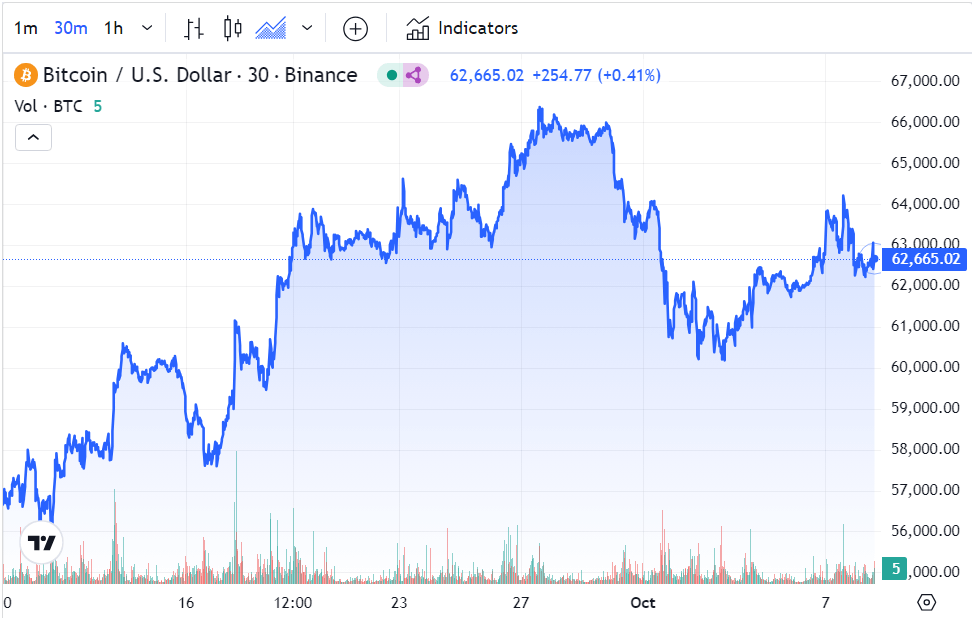
  • Bitcoin’s September rally, where the crypto rose 21%, was driven largely by Chinese stimulus packages.
  • Market players are underwhelmed as the Chinese government’s stimulus plans did not live up to their expectations.
  • Bitcoin failed to stay above $64,000 as the market seeks a catalyst despite ‘Uptober’ expectations.

The most recent Bitcoin rally, which started in early September and is believed to have been driven largely by Chinese stimulus packages, has begun to fizzle out. The largest crypto by market capitalization briefly crossed the $66,000 mark on September 27th but could not sustain the rally. As of October 2nd, it fell to $60,000 and trades at $62,700.

Chinese stimulus

While September is historically a bearish month for cryptos, Bitcoin performed favourably last month driven largely by a stimulus program from the People’s Bank of China (PBOC) in response to slowing economic growth and Fed rate cuts.

The PBOC slashed rates on medium-term lending and the 7-day repo to boost economic activity, a measure known to improve sentiments around risky assets. Mortgage rates and minimum downpayment requirements for all types of homes were also slashed to support China’s housing market.

Expectations remained that the government would be willing to sustain its stimulus efforts through a multi-trillion-yuan spending plan; however, the government announced that it will frontload 100 billion Yuan from its 2025 budget in addition to another 100 billion to support the construction industry, a far cry from expectations.

Uptrend catalysts for the crypto market

The focus on Chinese stimulus comes at a point when the crypto market awaits a catalyst to spur a rally. The Fed’s 50bps interest rate slash in September is expected to herald a rally, but October has been underwhelming as Bitcoin struggles to break the $64,000 level and institutional inflows into US Bitcoin (and Ethereum) spot ETFs dwindle.

Bitcoin fell roughly 1% after the announcement of the government’s stimulus plans but recovered somewhat in the London trading session.

The post Bitcoin’s Price Slides as China Pares Stimulus Plans appeared first on CoinJournal.

Alchemy Pay integrates Samsung Pay into its virtual card service

  • Alchemy Pay integrates its virtual card service with Samsung Pay for seamless crypto use.
  • Users can now make purchases at retailers like Amazon and Netflix using crypto.
  • The integration simplifies setup and expands Alchemy Pay’s supported payment platforms.

Alchemy Pay has announced the integration of its virtual card service with Samsung Pay. This development allows users to seamlessly spend their crypto holdings through Samsung’s contactless payment platform.

The new feature is set to enhance convenience for the growing number of users eager to utilize digital currencies in everyday transactions, following a similar integration with Google Pay just weeks earlier.

Alchemy Pay expands its crypto payment options

Alchemy Pay’s integration with Samsung Pay aims to bolster the utility of its virtual card service, which already boasts over 500,000 users.

The integration is part of a broader strategy to tap into the increasing demand for cryptocurrency payment solutions among mainstream consumers. With this integration, Alchemy Pay users can now make purchases both online and in-store at a variety of supported retailers, including popular platforms like Amazon, Netflix, eBay, and the Apple Store.

Alchemy Pay, a Singapore-based crypto payment provider founded in 2017, has seen substantial growth, with more than one million registered users on its platform. This latest partnership allows users to easily link their Alchemy Pay virtual cards to Samsung Pay, enabling them to make transactions using their crypto assets.

This development aligns with a growing trend of integrating crypto payment solutions into established digital wallet services, providing users with additional flexibility and options for spending.

The announcement also highlighted Alchemy Pay’s ambition to expand its services further. A spokesperson indicated that they expect to see increased demand for their products through the integration with Samsung Pay, particularly from indirect users who may engage with the service through partnerships and collaborations.

This strategy emphasizes Alchemy Pay’s commitment to enhancing accessibility to cryptocurrency payments, bridging the gap between traditional finance and digital currencies.

Alchemy Pay virtual card on Samsung Pay

Getting started with the Alchemy Pay virtual card on Samsung Pay requires users must first verify their card’s compatibility on the Alchemy Pay website. Once confirmed, they can add the card to the Samsung Pay app and start making crypto transactions almost immediately.

This streamlined setup process is designed to make it easier for users to adopt cryptocurrency payments without facing technical hurdles.

Looking ahead, Alchemy Pay plans to continue expanding its supported payment platforms, aiming for full integration with major card networks such as Visa, Mastercard, and American Express. By doing so, Alchemy Pay hopes to further solidify its position as a leader in the crypto payment sector, providing users with robust, flexible payment solutions that align with the evolving landscape of digital finance.

This integration with Samsung Pay is a pivotal step in making cryptocurrency more accessible to a wider audience, catering to the growing appetite for innovative payment options in today’s digital economy.

The post Alchemy Pay integrates Samsung Pay into its virtual card service appeared first on CoinJournal.

Crypto.com sues the US SEC after Wells notice

  • com has sued the SEC for overreaching its regulatory authority over crypto.
  • The lawsuit challenges SEC rules categorizing most crypto transactions as securities.
  • com seeks clarity on crypto derivatives through a petition with the CFTC.

Crypto.com has today filed a lawsuit against the US Securities and Exchange Commission (SEC) in response to a Wells notice received from the agency.

According to a communication from the exchange, the lawsuit aims to challenge what Crypto.com describes as the SEC’s overreach and misguided regulatory actions that threaten the future of the crypto sector in the United States.

The complaint asserts that the SEC has improperly expanded its jurisdiction, claiming that virtually all cryptocurrency transactions qualify as securities, except for those involving Bitcoin (BTC) and Ethereum (ETH).

This claim is based on the assertion that the SEC has established an unlawful rule without the necessary notice and comment period mandated by the Administrative Procedure Act.

According to Crypto.com, this arbitrary enforcement contradicts the fundamental principles of fair regulatory practices, particularly given that the characteristics and sales methods of various crypto assets are often indistinguishable from those of BTC and ETH.

Crypto.com emphasizes that it has always prioritized compliance and security, operating as a registered money services business with the Financial Crimes Enforcement Network (FinCEN) and holding over 40 state money transmitter licenses. The company views this lawsuit as a necessary step to halt the SEC’s actions, which they argue exceed its legal authority and violate federal law.

In addition to the lawsuit, Crypto.com’s subsidiary, Crypto.com | Derivatives North America, has filed a petition with the Commodity Futures Trading Commission (CFTC) and SEC. This petition seeks a joint interpretation confirming that certain cryptocurrency derivative products fall solely under the CFTC’s jurisdiction, further demonstrating Crypto.com’s commitment to clarifying regulatory frameworks for the industry.

As Crypto.com navigates this unprecedented legal challenge, the company remains steadfast in its operations, asserting that its commitment to regulatory compliance will ultimately benefit its customers and the broader crypto ecosystem.

This lawsuit not only underscores the growing tension between cryptocurrency businesses and regulatory agencies but also highlights the urgent need for clearer regulations in the rapidly evolving digital economy.

The post Crypto.com sues the US SEC after Wells notice appeared first on CoinJournal.