
Celestia and GOAT investors turn to Poodlana to try and recoup losses

  • Goatseus Maximus (GOAT) and Celestia (TIA) are facing significant price declines.
  • Poodlana (POODL) offers a low entry price of $0.003221, attracting new investors.
  • Poodlana raised $8 million in presale, indicating strong demand and growth potential.

In the volatile world of cryptocurrency, investors are constantly searching for opportunities to recover from losses and capitalize on emerging trends.

Recently, many have been looking toward Poodlana (POODL), a Solana-based meme coin that is gaining traction as established cryptocurrencies like Celestia (TIA) and Goatseus Maximus (GOAT) face challenges.

As these established coins face challenges, Poodlana offers an attractive alternative for investors hoping to regain their footing in the market.

GOAT and Celestia face challenges

Goatseus Maximus (GOAT), currently ranked at position 146 by market cap, has recently experienced a significant downturn.

Currently priced at $0.5368, GOAT has seen a decline of approximately 4.4% over the past 24 hours, exacerbating its losses, which now stand at nearly 30% over the past month. Following the price decline, investor confidence has waned, leaving many seeking alternative investments that might offer better potential returns.
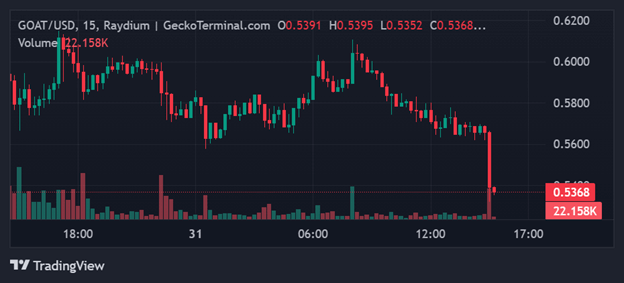
Goatseus Maximus (GOAT)

On the other hand, Celestia (TIA) has also faced its share of difficulties. Priced at $4.63, TIA has seen a notable decrease of around 7.4% in the last day, following the unlock of 176 million TIA tokens, which raised concerns among investors.
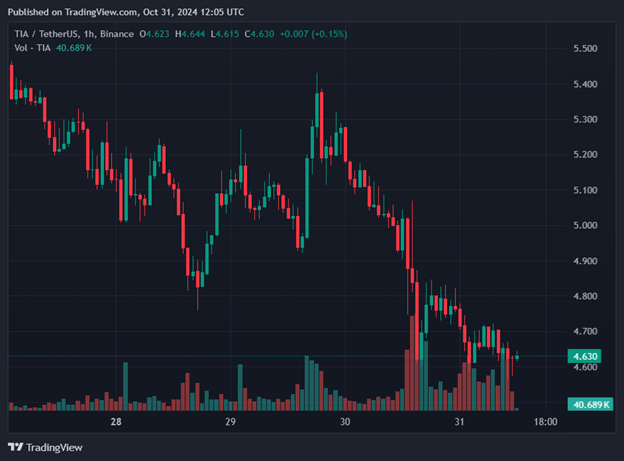
Celestia (TIA)

The token unlock event not only triggered fear, uncertainty, and doubt (FUD) in the market but also led to a price drop of about 9%. Analysts suggest that the failure to maintain the critical support level of $4.506 could trigger further declines, with potential selling pressure looming due to the significant token supply now in circulation.

Taran Sabharwal, CEO of the Stix trading platform, has attempted to reassure investors by clarifying that not all unlocked tokens will be available for immediate sale, as there is a 21-day unstaking period. However, the sentiment remains cautious, with many investors anticipating further declines in the short term.

Both GOAT and TIA have thus left their investors on edge, leading many to explore new opportunities.

Poodlana emerges as a promising alternative

Amidst the uncertainty surrounding GOAT and Celestia, Poodlana (POODL) emerges as a beacon of hope for investors looking to recoup their losses.

As a Solana-based meme coin, Poodlana has captured the interest of many due to its low entry price of $0.003221, offering significant growth potential compared to the more established cryptocurrencies. Poodlana has already demonstrated promise by raising $8 million during its presale, indicating strong demand and interest among investors.

The allure of Poodlana lies not only in its price but also in the favourable macroeconomic conditions projected for 2024.

Analysts anticipate a lower interest rate environment in the coming months, which could enhance liquidity in the market, thus favouring altcoins like Poodlana. Historically, meme coins have thrived in similar conditions, and with its strong foundation, Poodlana is well-positioned to benefit from these trends.

Additionally, the upcoming US presidential elections may catalyze the cryptocurrency market. Both major candidates have expressed favourable attitudes toward cryptocurrencies, potentially leading to a more supportive regulatory environment.

This political backdrop, combined with Poodlana’s already solid standing as a project built on the fast and cost-effective Solana network, adds another layer of appeal.

Moreover, Poodlana has gained visibility by being listed on three major exchanges: MEXC, Raydium, and BingX. This accessibility provides a broader audience with the opportunity to invest and increases its growth potential, particularly for those who may have missed the early gains of other meme coins like Dogecoin and Shiba Inu.

Conclusion

As investors from GOAT and Celestia grapple with the recent market challenges, Poodlana stands out as a promising alternative.

With its low entry price, strong presale success, and favourable market conditions on the horizon, Poodlana (POODL) presents an attractive opportunity for those looking to recoup losses and capitalize on future growth.

If interested in POODL, you can visit the official Poodlana website for more information about the project.

The post Celestia and GOAT investors turn to Poodlana to try and recoup losses appeared first on CoinJournal.

Ex-FTX Executive Nishad Singh sentenced to time served after guilty plea

  • Nishad Singh has been sentenced to time served and three years of supervised release.
  • The judge noted Singh’s limited involvement compared to other FTX executives.
  • Singh cooperated with prosecutors, aiding investigations into FTX’s collapse.

Nishad Singh, the former engineering director of the collapsed cryptocurrency exchange FTX, was sentenced to time served and three years of supervised release on October 30, 2024, in a federal court in New York.

This decision follows Singh’s guilty plea to six felony charges related to the misappropriation of user funds and campaign finance violations, which he entered in February 2023.

During the sentencing hearing, Judge Lewis Kaplan acknowledged the gravity of the situation, stating, “This may have been one of the biggest crimes in American history,” while also noting that Singh’s involvement appeared to be limited compared to that of FTX’s founder Sam Bankman-Fried and former Alameda Research CEO Caroline Ellison.

Singh expressed “overwhelming remorse” for his actions, highlighting the weight of his decisions during FTX’s tumultuous period.

Singh’s cooperation with federal prosecutors played a significant role in his sentencing outcome. He provided what US prosecutors described as “substantial assistance” in the ongoing investigations surrounding FTX’s collapse, which has resulted in multiple indictments of former executives.

Singh’s attorneys argued for a lenient sentence, emphasizing that the fraud primarily stemmed from the actions of Bankman-Fried and Ellison. The court also considered the perspective of John Ray, the new FTX CEO, who suggested that Singh’s skills could be more beneficial to the bankruptcy proceedings than serving time in prison.

Singh’s sentencing comes amidst a broader crackdown on FTX executives, with Bankman-Fried in custody since August 2023, and Ellison expected to surrender by November 7. The fallout from FTX’s collapse continues, as the estate pursues legal actions to recover lost assets, including a recent lawsuit against KuCoin for over $50 million.

As the FTX saga unfolds, Singh is the fourth former executive to receive sentencing, with co-founder Gary Wang set to face the court on November 20.

The post Ex-FTX Executive Nishad Singh sentenced to time served after guilty plea appeared first on CoinJournal.

MrBeast faces allegations of crypto insider trading

  • MrBeast allegedly made $23 million from insider trading in crypto projects.
  • He reportedly used 50 wallets to promote and dump tokens, misleading investors.
  • Evidence includes a publicly shared Ethereum address linked to $13 million in trades.

YouTube sensation MrBeast, known for his engaging content and 320 million subscribers, is facing serious allegations related to cryptocurrency trading.

A group of blockchain investigators claims that MrBeast, whose real name is James Stephen “Jimmy” Donaldson, profited significantly from questionable crypto deals, including a staggering $23 million from what they describe as insider trading.

MrBeast investigation by Loock.io

According to findings from advisory firm Loock.io and blockchain analysts, MrBeast has allegedly operated across approximately 50 wallets, utilizing exchanges such as Binance and Gemini to trade various tokens.

Notably, he reportedly promoted projects like SuperFarm—now known as SuperVerse—alongside fellow influencers like KSI and LazarBeam, only to later sell these tokens to unsuspecting followers.

In one highlighted instance, MrBeast invested $100,000 in SuperVerse, resulting in an estimated profit of $7.5 million. This profit came at the expense of early investors, who were reportedly left without returns due to legal loopholes that voided their gains.

The investigators argue that MrBeast’s influence in the crypto space allowed him to mislead investors while he profited from the very projects he promoted.

The evidence presented stems from an Ethereum address MrBeast publicly shared during a prior NFT purchase, which enabled investigators to trace transactions. They claim that approximately $13 million flowed through the aforementioned exchanges, raising questions about the legitimacy of these trades.

While the public blockchain allows for a certain level of analysis, it does not guarantee the absolute accuracy of claims regarding transaction origins. Nonetheless, the findings appear to have credibility, as they are grounded in publicly verifiable data.

As allegations swirl, the crypto community is closely monitoring the situation, which reflects a broader concern about celebrity endorsements in the volatile crypto market. With many celebrities venturing into Web3, the potential for controversy and financial mismanagement remains high, prompting calls for greater transparency and accountability.

The post MrBeast faces allegations of crypto insider trading appeared first on CoinJournal.

NYSE Arca seeks regulatory nod for Grayscale crypto ETF

  • NYSE Arca is seeking regulatory approval to list an ETF of the Grayscale Digital Large Cap Fund.
  • Grayscale recently filed to have go ahead to convert the fund to a spot ETF.

Securities exchange NYSE Arca is seeking regulatory approval to list a new crypto exchange-traded fund by Grayscale.

The ETF aimed at would track the Grayscale Digital Large Cap Fund, which the GBTC issuer launched in 2018 and is not an exchange-traded fund at the moment.

According to an Oct. 29 filing, the NYSE Arca wants to list the $565 million fund, which Grayscale recently sought approval to convert into a spot ETF. Grayscale’s application came on Oct. 16.

The fund currently holds five spot crypto assets, including Bitcoin, Ethereum and Solana, with BTC weighted at 76.5%, ETH at 16.88% and SOL at 4.46% as of Oct. 29.

Other digital assets in the Digital Large Cap Fund are Avalanche and XRP, weighted at 0.58% and 1.58% respectively.

Recently, the US Securities and Exchange Commission (SEC) greenlighted the trading of options on NYSE’s spot Bitcoin exchange-traded products. These included Grayscale’s flagship asset GBTC and the Mini Bitcoin Trust BTC. This comes as the industry continues to witness massive demand and investment in spot Bitcoin ETFs following SEC’s approval in January 2024.

Spot ETFs inflows and holdings

Inflows into spot ETFs, which includes Ether ETFs approved in May, has skyrocketed. According to SoSoValue data, US spot BTC ETFs have seen cumulative net inflows of $23.28 billion.

Meanwhile, total net assets have surpassed $72.55 billion, with this accounting for over 5% of the BTC market cap. BlackRock’s IBIT holds $30 billion in assets.

In a post on X on Oct. 30, Bloomberg senior ETF analyst Eric Balchunas shared that spot Bitcoin ETFs were on track to surpass 1 million BTC holdings.

Satoshi Nakamoto, the creator of Bitcoin who remains unknown, holds the most BTC today. Satoshi mined the coins in the early years of the flagship digital asset’s launch. Spot ETFs could surpass the 1.1 million figure within the next few days.

The post NYSE Arca seeks regulatory nod for Grayscale crypto ETF appeared first on CoinJournal.