
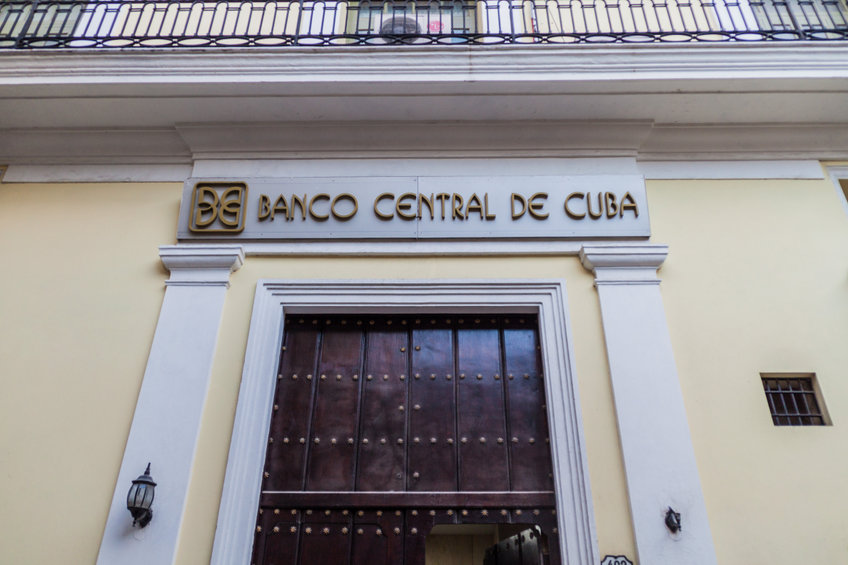
Cuban Central Bank to license Virtual Asset Providers

The Central Bank of Cuba (BCC) has announced that it will provide licenses to both Cuban and international virtual asset service providers, including organizations, individuals, or legal persons. This Spanish-language resolution was also published on Cuba’s official gazette.

However, the authorized licenses will be valid for one year upon which it might be extended for the second year.

The resolution noted that the providers will be able to work with only BCC-approved virtual assets.

‘’virtual assets do not contain digital representations of fiat currency, securities, and other financial assets extensively employed in traditional banking and financial systems, which other Central Bank of Cuba laws control.”

On Thursday, BCC recapped that the previous resolution enabled the bank to issue the licenses to the providers for the transaction of assets linked to exchange, collection, financial, or payment activities both at the national level and beyond.

Even though the government agencies would only use the virtual assets for transactions if only BCC permits them, the current resolution did not address the issue of how the Cuban government will tax the transaction of virtual assets.

However, the government stated that BCC will deny or grant the sought license within ninety working days after conferring with the Crypto Assets Group licensing.

Besides, the providers will only operate under BCC approval, The ministry of finance and prices approved by the Cuban Financial Reporting Standards will also require them to keep their accounting records on how they will be operating.

The post Cuban Central Bank to license Virtual Asset Providers appeared first on Coin Journal.

Brazil lawmakers pass bill seeking to regulate cryptocurrencies

Brazil’s senate passed the crypto bill on Tuesday, while the Central African Republic also took a similar step last week.

Brazil has become the latest country to pass a bill seeking the regulation of cryptocurrencies, joining a growing number of countries across the globe seeking to bring cryptocurrencies into financial regulatory frameworks.

The Senate reportedly passed the bill on Tuesday.

A crypto regulatory framework

The bill outlines the creation of a regulatory framework tailored for the crypto industry, with the government’s executive arm tasked with legislation.

The government also has the responsibility of constituting a new regulator for the crypto sector. If not, the bill provides for either the Securities and Exchange Commission or the central bank to be mandated to regulate it.

In attempts to attract crypto-focused businesses to the country, legislators included provisions that remove import levies on Bitcoin miners.

The bill now heads to the Chamber of Deputies, who, if they pass it, will send it to the president for accenting into law. This should happen before the end of 2022.

Central African Republic also eyeing crypto regulation

News of Brazil’s lawmakers passing a crypto bill on Wednesday comes a few days after it emerged their counterparts in the Central African Republic had also taken a similar step.

While the initial headlines had talked of CAR adopting Bitcoin as legal tender, the truth was that lawmakers had passed a bill seeking the creation of a regulatory framework on cryptocurrencies.

On Wednesday, a BNN Bloomberg report quoted the country’s Finance Minister Herve Ndoba as confirming the move. In comments made via a phone interview, Ndoba said the legislation seeks to make cryptocurrencies legal in the financial system.

But while the law would make use of crypto legal in the country, the Central African Republic wasn’t looking to make Bitcoin or any other cryptocurrency legal tender as El Salvador did.

El Salvador, whose President Nayib Bukele is a big Bitcoin proponent, remains the first and only country so far to adopt Bitcoin as legal tender.

The post Brazil lawmakers pass bill seeking to regulate cryptocurrencies appeared first on Coin Journal.

New York State Assembly approves bill to place 2 year ban on PoW mines

In a bid to limit the environmental impact caused by Bitcoin mining in the state, the New York State Assembly passed a bill yesterday, placing a two-year ban on all new proof-of-work (PoW) cryptocurrency mining facilities in its jurisdiction. 

The bill was passed as part of New York’s Earth Day Package. 

State senator Anna Kelles took to Twitter to announce that the bill she sponsored will also impose a hold on the renewal of the permits to existing PoW crypto facilities that are looking to increase their power consumption. 

The ban will extend however only extend to mining operations using carbon-based fuel as a source of power in the state.

With 95 in favour and 52 against, the bill has passed the crucial stage of receiving the State Assembly’s approval. It will now be carried forward by Senator Kevin Parker to gather the support of the State Senate. After this stage, the bill will be delivered to Governor Kathy Hochul, who can choose to sign it into law or veto it.

If implemented as a law, the proposal tasks the Department of Environmental Conservation (DEC) with presenting a “generic environmental impact statement” to locate, count and assess the effects of PoW miners on greenhouse gas emissions and public health.

The bill was met with staunch opposition from crypto advocacy group Blockchain Association which called upon “pro-tech, pro-innovation, pro-crypto” New Yorkers to write to senators against the bill.  

After the passing of the bill, the association argued that a 3-hour discussion regarding its effects took place in the house where they presented “greater opposition to the mining ban than proponents believed.” In a tweet, the advocacy group indicated that it will continue to fight against the “anti-technology bill”.


The post New York State Assembly approves bill to place 2 year ban on PoW mines appeared first on Coin Journal.

Kraken gets a crypto trading license to operate in the United Arab Emirates

Kraken became the second cryptocurrency exchange after Binance to get regulatory approval to allow it to operate in the United Arab Emirates. Kraken is now allowed to operate in Abu Dhabi Global Market (ADGM), the Abu Dhabi international financial center and free zone.

After obtaining the crypto trading license, Kraken will now provide local investors to the global crypto market through the dirham (AED) trading pairs, which marks a diversification in trading pairs to use local currencies instead of using the traditional British pound and US dollar.

Integrating with local banks in UAE

With the new crypto trading license, Kraken intends to integrate with local payment service providers in Abu Dhabi; something Kraken’s managing director Curtis Ting believes will help Kraken bring global-level liquidity to UAE.

Dubai is specifically known to have massive crypto following with a trading volume of more than $25 billion annually.

Curtis Ting said:

“For us, it’s really important to facilitate access to global markets and global liquidity by making sure that investors and traders in the region have access to local currencies [trading pair].”

Crypto exchange interest in the Middle East

While Kraken has only obtained its first crypto trading license in the Middle East, Binance, its competitor, has already gotten crypto trading licenses to operate in both Dubai and Bahrain.

Following the influx of regulated crypto exchanges in the Middle East, local businesses have also started stepping into the crypto world. Citizens School in Dubai, for example, started accepting Bitcoin (BTC) and Ethereum (ETH) as tuition payments where the crypto payments are automatically converted into dirhams.

The post Kraken gets a crypto trading license to operate in the United Arab Emirates appeared first on Coin Journal.

Ukraine’s central bank bans crypto purchases using local currency

  • The National Bank of Ukraine said the move is intended to prevent an unproductive outflow of capital.
  • Crypto purchases can only be completed using foreign currency, with monthly restrictions of 100,000 Ukrainian hryvnia per individual.

Ukraine’s central bank has banned the use of the local currency hryvnia in the purchase of cryptocurrency, according to a news release on Thursday.

Per the announcement, the National Bank of Ukraine made the move as part of efforts meant to restrict the unproductive outflow of capital during this time of war.

The ban means no cross-border transactions involving citizens, a measure taken in line with martial law that has been in place since Russia’s invasion in February.

Only foreign currency

According to the central bank, those seeking to buy cryptocurrencies will only be allowed to do so using foreign currency. All crypto purchases have now been limited to UAH 100,000 (Ukrainian hryvnia) per month (roughly $3,400 as per current rates).

The National Bank has also allowed a similar amount (UAH 100,000 per month) in cross-border P2P transfers as part of supporting IDPs from Ukraine. However, the transactions must be made from bank accounts the individuals opened with the Ukrainian national currency.

As well as crypto, the bank has designated topping up of electronic wallets, forex or brokerage accounts and payment of traveller’s checks as ‘quasi cash transactions.”

The measures are also meant to bolster the foreign exchange market, the central bank said. It’s also targeted at “reducing pressure on Ukraine’s international reserves.”

The post Ukraine’s central bank bans crypto purchases using local currency appeared first on Coin Journal.