

Andre Cronje quits DeFi, but life will go on

Cryptocurrency is a dynamic industry changing at the speed of light, with new layers, projects and aims cropping up every day. Within crypto, DeFi is one of the most intriguing sectors in the space.

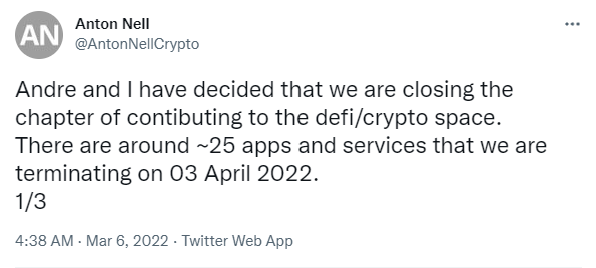
With the term itself – “DeFi”- coined only three years ago, it is very much in its infantile stage; it only broke into the crypto “mainstream” in summer 2020. But with change at this speed, friction is inevitable too. We saw that over the weekend when Andre Cronje, known by some as the Godfather of DeFi, downed tools and quit the space at large.
Resumé

Cronje is an impressive operator, his talents apparent by the disappointed reaction of crypto enthusiasts. His longtime partner-in-crime Anton Nell is also leaving the crypto space. Between the duo, they will be leaving around 25 DApps and services that they have been working on.

Perhaps the most prominent of these are Fantom and Yearn Finance, which plunged 15% and 13% respectively on the news. There were other coins which wobbled more (Solidly, which only launched last week, shed nearly two thirds of its value), showing the respect and importance the community placed on Cronje and his colleague.

Why Leave?

There are two possible reasons here. The first, and the most is likely, is that Cronje is a human being. And the thing about humans is that we are all different. Cronje is by all accounts an introvert, an incredibly talented coder who likes to build things. Of course, crypto operates on the Internet, and people on the Internet can be … not so friendly (to put it politely). The anonymous nature of a lot of Telegram, Twitter and Discord accounts means there is free reign for people to get aggressive, and when money is on the line that attitude is unfortunately exacerbated. One of crypto’s black marks is that it is so tribal and discussions can often get heated. Cronje was, by all accounts, simply fed up at being a scapegoat and a target of disgruntled investors.

It’s by far the most likely reason that Cronje defected. Indeed, he has quite before – in October 2020 he told CoinDesk, “I’m not building anything anymore. I do it because I’m passionate, but if people are going to use my test environments, then lose money, and then hold me liable, it means there is 0 upside and only risk for me”.

Heavy is the head that wears that crown.

Alternate Theories

Of course, there could be other reasons, but they amount to nothing but speculation. There is a chance that Cronje fears regulation or legal constraints, as the DeFi space becomes more mature and regulatory bodies continue to keep a closer eye on crypto. Theories abound that he will continue to operate in an anonymous capacity. He certainly loves to build things, and he has a gift. People like this generally can’t simply “retire” and do nothing, but then again – we are all different. Who am I to speculate what is going on in his mind? It could be a million different things.  Maybe he will return, maybe he won’t, but for now I’m going to take him at his word and assume he has left the space.

Consequences?

I don’t think this is the apocalypse that a lot of knee-jerk reactions propose it to be. Let’s take Yearn Finance for example after the 13% fall. Cronje has not worked on Yearn for over a year, while there are 50 full-time employees and 140 part time contributors still very much on board. At a market cap of $700 million at time of writing, it’s a big project. The red candle this reads like an overreaction to me. Let us not forget that Satoshi left Bitcoin behind, and that did just fine. Ditto for Fantom, which has a market cap of $3.6 billion currently.

After all, the space is called decentralised finance, meaning we should not be dependent on any one person or agency. Of course, that’s well and good in theory, but faces behind the applications which investors are trusting with their money do help provide a degree of confidence. But I don’t think this will be a big issue for the larger projects of Cronje’s. Sure, the smaller coins (such as Solidly above) will have a tougher time recovering, but in terms of the overall impact on the DeFi space, it should not be a hammer blow.

Where Now For DeFi?

Following the explosive growth of “DeFi Summer”, growth in the space has slowed with many investors growing angsty. Most of these projects have not yet gone through a prolonged bear market, with DappRadar reporting earlier this year that should a bear market last at least a year, 80% of DeFi apps would cease to exist.

“As far as crypto winter, DeFi DApps have never gone through it”, the report states.  “They have experienced crashes, but this feels like a prolonged one. Probably 20% of the apps that hold 80% of the industry value will survive. And we could see protocols that are not widely used fade away.”

TVL in DeFi currently sits at $195 billion, down 24% from the highs of $255 billion at the start of December.
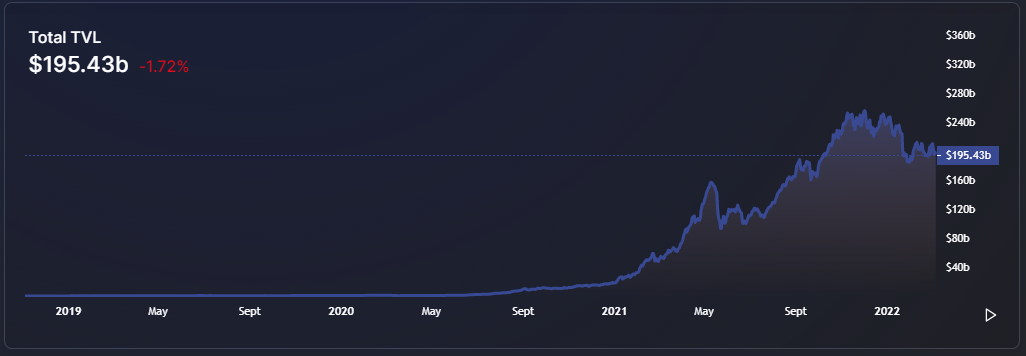
TVL in the DeFi space over the last few years, via DefiLlama

Solving the very real wider issues in the space, rather than worrying about one developer, should be the priority. The real question we need to ask following Cronje’s “resignation”, is not what that means for certain DeFi apps, but rather does it signal something more problematic about the wider DeFi space in general. I tend to think it will be just fine.


The post Andre Cronje quits DeFi, but life will go on appeared first on Coin Journal.

Adobe’s Behance to support Phantom Wallet

Adobe’s Behance announced support for Phantom Wallet, with which people can showcase Solana-based NFTs on their profile. They can also display NFTs minted on Ethereum, CoinJournal learned from a series of tweets by Adobe’s VP of Product William Allen.

Starting today, Behance users can connect their Phantom and showcase NFTs created on Solana on their Behance profile.

On a mission to help creatives   

Behance’s stated mission has been to help creatives build their careers on their own terms ever since its founding. Some are looking for full-time jobs, others are freelancers. Still others offer subscriptions, livestream, or sell templates or NFTs.  

Addressing energy and cost issues

At the moment, some Behance users are displaying NFTs they minted on Ethereum on their profiles. However, quite a number are concerned about the blockchain’s high energy use and the corresponding transaction costs. Solana addresses these concerns as a Proof of Stake chain.

According to William Allen, a transaction on Solana uses as much energy as a Google search – a fraction of a penny. It’s easy to mint using tools like Holaplex and to set up your own store on Solana.  

Solana NFT marketplaces MagicEden and Form Function feature many creatives. Metaplex provides complete control to those with a technical background. QuickNode helped Behance develop this feature on Solana. 

Preventing theft

Many creatives have had their work stolen in the NFT space, which is something William Allen has been very focused on for the past year. In the near future, Solana will add addresses to the Content Credentials tool to make sure people get credit for their work. Additional chains will be put in place to keep artists and their work safe.  

About Behance 

Behance is a social media platform owned by Adobe. Its main focus is to showcase and discover creative work. It was founded by Matias Corea and Scott Belsky in November 2005. Users can sign up to Behance and build profiles consisting of projects.

Both registered and unregistered users can view and comment on projects. Members of Behance can follow other users‘ profiles. Adobe Portfolio is Behance’s DIY web design application, similar to popular tools like Weebly and Joomla.

The post Adobe’s Behance to support Phantom Wallet appeared first on Coin Journal.

FTM bounces as Fantom CEO ‘clarifies’ Anton Nell and Andre Cronje’s exits

Fantom (FTM) plunged more than 16% on Sunday, dropping as lows as $1.38 as negative sentiment cut across the decentralised finance (DeFi) market.

The sharp decline was triggered by an unexpected tweet from Anton Nell, a high-profile developer and Fantom Foundation advisor.

Andre Cronje and Anton Nell ’shocker‘

In a brief thread on Twitter, Nell said that he and legendary DeFi developer Andre Cronje had come to a decision about their future engagements in the Fantom ecosystem and overall decentralised finance (DeFi) space. 

According to Nell, he and Cronje had finally decided to quit as crypto developers, listing several projects that they would no longer be involved with.

The news saw Fantom (FTM) plummet alongside Yearn.finance (YFI), a project closely associated with Cronje. YFI tanked more than 10% on Sunday.

But in the last few hours, both tokens have bounced higher, with FTM price up more than 2% and YFI +6%. 

For Fantom, the upside comes after the CEO of Fantom Foundation Michael Kong issued a statement ‘clarifying’ that the crypto community likely misunderstood Nell’s message.

In reassurance to the Fantom community, Kong noted on Monday:

“As many of you are aware, Anton, who works with Andre, tweeted that they were “terminating” 25 projects. This was misunderstood. They are “terminating” their involvement, but handing over anything they run to the existing teams.”

Fantom and YFI has ‘hundreds of developers’

Kong has reiterated that Fantom and Yearn.finance will be okay even with the exit of the iconic developers.

He believes this is certainly the case given the Fantom ecosystem currently has “hundreds of developers” working on multiple applications. According to him, these developers have been doing a great job and would continue to do so despite the turn of events.

Speaking of Yearn.finance, Kong noted that the project “has been around for years.” In addition, it has an existing team that will continue to work on it as before.

He has the same view of Multichain and Solidex, two of the largest projects on the Fantom chain. Like YFI’s, these projects have been teams that have worked on them for years. He assured the community that these and many other projects in the ecosystem that are largely associated with Nell and Cronje won’t be ‘terminated.’

Echoing Kong’s viewpoint was Year.finance developer pseudonymously known as banteg. As the YFI token tanked, the developer commented:

“People burying YFI, you do realize Andre hasn’t worked on it for over a year? And even if he did, there are 50 full-time people and 140 part-time contributors to back things up.”

The post FTM bounces as Fantom CEO ‘clarifies’ Anton Nell and Andre Cronje’s exits appeared first on Coin Journal.

FTX establishes European unit

Two years after founding FTX.US, cryptocurrency exchange FTX has established a European unit licensed in Cyprus, various media sources reported. CySEC, Cyprus’ financial market regulator, approved FTX’s European platform (ftx.com/eu), the exchange announced.

FTX Europe will make products and services available in EEA via an unidentified investment firm licensed to operate across the region. The head office of the division will be in Switzerland. Cyprus will have an additional base.

Users in the EEA will have access to a variety of cryptocurrency products powered by FTX’s industry-leading digital asset offerings and trading technology.

The next phase of international growth

By extending FTX’s presence into Europe and the Middle East, this development marks the next phase of international expansion. Apparently, the new unit will be the crypto exchange’s European equivalent of FTX.US. After a $400 million funding round in January, it is valued at $8 billion.

Sam Bankman-Fried, CEO and founder of FTX commented:

We’re excited to launch our European operations in a regulated fashion to better serve those within the continent. As we continue to grow, we are constantly looking at opportunities to become appropriately licensed and regulated in every market we enter. We’ll be interacting with regulators in various countries across Europe to continue to provide a safe and secure environment for people to trade crypto.

Patrick Gruhn, Head of FTX Europe added:

We’re excited to bring FTX’s innovative offerings to the European markets and that CySEC officially approved our domain. Europeans will now be able to use FTX’s best-in-class trading platform to invest in a wide range of cryptocurrencies derivatives thru a regulated investment firm. 

A reputable investment jurisdiction

Cyprus is a highly reputed investment jurisdiction providing access to the entire European Economic Area, which includes the European Union plus three countries. 

The approval of FTX’s domain by the Cyprus CySEC to provide derivative services to European users also sets a new standard for cryptocurrency exchanges in Europe.

About FTX Europe

FTX Europe gives users in the European Economic Area and the Middle East access to FTX’s innovative products, including industry-leading options and derivatives, tokenized stocks, and volatility products among others. 

The post FTX establishes European unit appeared first on Coin Journal.

Highlights March 7: Major cryptos in the red, UK100 suffers amidst Russia-Ukraine war

Crypto market as a whole is in the red today. Ukraine has spent $15 million worth of cryptocurrency, primarily Bitcoin and Ether, on military equipment. It has received more than $50 million in cryptocurrency donations.

The UK100 lost more than 6% last week as the escalating Russia-Ukraine war caused a selloff in global markets. Firms with strong Russian links were the biggest losers, with miners Polymetal International and Evraz slumping 64.87% and 60.02%, respectively.

The price of oil has risen around 30% in the past week. It almost reached $125 early Monday morning and was trading around $123 at time of writing. Investors will be following closely the possibility that the US will ban imports on Russian oil, which could send prices even higher.

Top cryptos

Solana is down more than 6%, while Cardano, Avalanche, and Ethereum slid more than 4%. Bitcoin was trading just above $38,000 at time of writing, down around 3% over the past 24 hours.

Top movers

Most top 100 coins lost 3-5% of their value today. A notable standout is Fantom, which shed almost 12% of its value. Anchor Protocol lost 14% as the effects of a recent cash injection begin to dissipate.

Convex Finance is still spiraling downward. It has lost 8.68% in the last 24 hours and 9.82% over the past 7 days after a bug caused CVX to sink on a forced token unlock.           

Monero is down 6%, reversing recent gains. Other notable losers include Zcash (-9%) and Chiliz (-7%). Waves is still rallying on support for Ukraine. It gained around 2% today.   

Trending

The token of Meta Speed, an online multiplayer racing game based on blockchain technology, gained 746% today. You can gather your friends, form a team, battle with others and earn token rewards after winning the race.

MovieBloc, a decentralized movie and content distribution platform, is surging on news of lucrative film studio partnerships. The exciting movies it screens contribute to its massive popularity. It added 82% to its value in 24 hours.

The live TROY price today is $0.007 with a 24-hour trading volume of $118 million. TROY is up 29% after announcing an upcoming NFT launch.  

The post Highlights March 7: Major cryptos in the red, UK100 suffers amidst Russia-Ukraine war appeared first on Coin Journal.