TerraUSD (UST) vs Dai (DAI) – Which one is a better investment?

 UST and DAI are two stablecoins backed by other cryptocurrencies. Unlike other stablecoins, they are decentralized. Stablecoins are cryptocurrencies that maintain a stable price by being tied to another asset; crypto or fiat. They are less volatile than other cryptocurrencies.

 DAI was launched in 2017 by MakerDAO and was built on the Ethereum blockchain. It has the stability of a stablecoin and is as secure as the Ethereum platform. Its stability is maintained by collateralizing it with ETH in a smart contract algorithm. It helps secure and power the Maker network on which it is generated and traded.

 UST was launched in September 2020 by Terraform Labs. It is stabilized with the aid of a smart contract algorithm and an elastic money supply mechanism. New USTs are minted through a process called seigniorage. It is collateralized by LUNA- Terra’s native coin.

 Both stablecoins are decentralized as they have no central authority like the other popular stablecoins. Similarly, they are pegged to cryptocurrencies rather than fiat currencies. They use smart contract algorithms to maintain stable prices.

 In minting DAI, the collateral (ETH) must be way more than the amount of DAI to be minted. UST, on the other hand, needs an equivalent of LUNA in USD to mint the same amount. In doing this, a percentage of the LUNA is burnt, and another is reserved for the community treasury. The more UST is demanded, the more the appropriate amount of LUNA is burnt.

 The smart contract algorithm used for stabilizing UST can generate UST and maintain itself. However, high volatility with ETH can affect the stability of DAI. Also, the market caps and trading volumes of these assets indicate that UST is adopted over DAI.

 This might be due to UST’s arbitrage system that helps it automatically maintain supply when it is below peg. Right now, the Anchor protocol has made it possible to earn an APY of about 20% when UST is lent out. If you are looking to invest in a decentralized stablecoin, UST is the better investment.

 In the crypto space, everything is volatile no matter how stable it seems. Thus, deal wisely and do your research. Don’t invest beyond what you can’t afford to lose.

The post TerraUSD (UST) vs Dai (DAI) – Which one is a better investment? appeared first on Coin Journal.
LINK/USD value rose to a high of $18.05, as the recent bullish trend persists

  • At $18.05, there was resistance.

  • At $15.5, the LINK/USD pair found strong support.

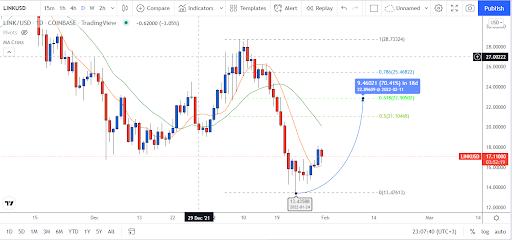
The Chainlink price research shows that bulls have been ready to withstand the negative wave, which is good for cryptocurrencies. The currency had tremendous depreciation over the current month, but prices are steadily increasing, and they are predicted to reach beyond their current price level of $17 in the near term. 

However, the next barrier is still at $18.6, which explains why the price oscillation is moderate today. However, if the bullish trend continues in the following 24 hours, the resistance level may be exceeded, and LINK may have a smooth rally to $20, which is the next key level. 

The bulls maintain their advantage, overcoming the bearish impediment

According to the most recent updates, the one-day price chart for the Chainlink price review reveals that cryptocurrency prices have grown today, with negative pressure also visible. The price had hit $18.053, up 10.36 percent on Sunday. The chart also illustrates that the bulls attempted to make a comeback in recent days and have now regained control as bulls today have held prices above prior low. 

Source – TradingView

The four-hour Chainlink price analysis shows that the bullish trend is regaining control. The last few hours have been quite advantageous for the bulls, with the short-term moving line displaying more green candlesticks, surpassing the impediment created by the bears in earlier hours of the day.

The post LINK/USD value rose to a high of $18.05, as the recent bullish trend persists appeared first on Coin Journal.

FIL/USD has a potential to gain 30% if bullish momentum is sustained

  • Filecoin price analysis turns optimistic.

  • At $19.2, there is support for FIL.

  • At $21.9, there is some resistance.

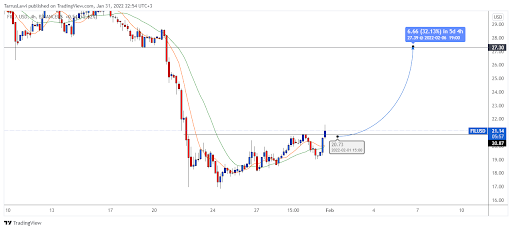
The most recent Filecoin price analysis indicates a positive trend, as the price has increased significantly today. Yesterday, the value of FIL peaked at $19.6 after breaking over the barrier of $19.3, and today, the bullish upswing has led to a further gain in the price, with its value increasing to $20.3, hitting a weekly high. At the start of today’s trading session, the price breakout was higher, as bulls managed to maintain their advantage. Prices are projected to rise much more in the following hours.

The upward trend in the FIL/USD 1-day price chart continues over $20

The one-day Filecoin value analysis reveals that today’s price function is still moving higher. The price has risen, and the coin is now worth $20.3. Although these price fluctuations are minor, the cryptocurrency has acquired a valuation of 5.60 percent in the previous 24 hours. The crypto combination has earned a value of 8.80 percent in the last week; perhaps, the price will rise more during the day. 

The FIL/USD has been able to hold the price level during this week, as the persistent downward trajectory appears to be drawing to a halt.

Source – TradingView

Even though the bulls had previously dominated the market movements, the bears hampered the price function, and a reversal was also witnessed four hours ago. However, the price is presently filling the range again, as it trades around the upper threshold of the volatility indicator.

As a consequence of the recent positive movement, the price is presently at $20.3.

The current moving average value is $19.7. Volatility is minimal, suggesting that an upswing is imminent. The Bollinger Bands Indicator’s upper limit is $20.55, signaling resistance for FIL’s price, while its lower limit is $18.1.

The post FIL/USD has a potential to gain 30% if bullish momentum is sustained appeared first on Coin Journal.

Terra (LUNA) is in free fall right now – Time to buy?

The crypto winter in January has seen many coins lose value. However, even though we are starting to see some price stability in the broader market, Terra (LUNA) appears to be going against the trend. The coin is quite literally on free fall right now so it begs the question, is it a good buy? Well, more on that below but here are some highlights:

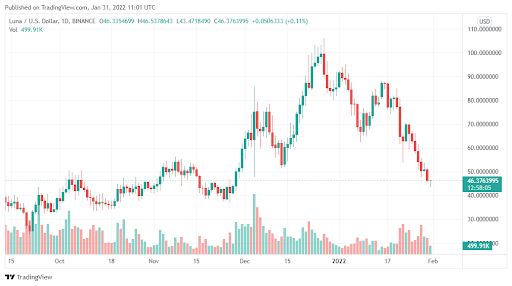
  • In the last month alone, LUNA has seen a sharp decline, falling by nearly 50% during the period.

  • At press time, LUNA was trading at $45, down 8% for the day and down nearly 25% over the past week.

  • The negative sentiment, mostly associated with Terra’s connections with Magic Internet Money (MIM), will continue in the near term.

Data Source: Tradingview.com 

Is a recovery in sight for LUNA?

Right now, it is quite possible that the free fall will continue at least in the foreseeable future. Besides, some investors are raising concerns that the Terra ecosystem could be in danger due to its association with the Anchor Protocol and MIM. 

Also, we are still not sure if the storm has passed in the crypto market. Even with gains in the last few days, there is still a lot of downside risks here that could have a massive impact on the LUNA price action. For this reason, we expect the coin to slip further in decline over the coming days.

Is it time to buy Terra (LUNA)

As a major coin in the crypto market, LUNA is of course worth having. But as the sell-off continues, it may not be the most ideal time to get in right now. Give it a week or so and see how the price plays out. If it dips even further, then you can buy and avoid any serious downtrend. After all, from a long-term point of view, LUNA is a must-have.

The post Terra (LUNA) is in free fall right now – Time to buy? appeared first on Coin Journal.

Crypto-backed cards usage is growing rapidly regardless of volatility, says i2C’s McCarthy

  • i2c saw a 500% jump in crypto-linked card issuance and a 600% surge in transaction volume, McCarthy told CNBC’s “Squawk on the Street.”
  • He says the average daily transaction volume stands at $60 million, with volatility not a major impact on everyday spending.

 i2c Inc. president Jim McCarthy says the firm continues to see tremendous growth in the use of crypto-backed cards despite the volatility that has seen prices of digital assets plummet.

The levels of growth and usage seen across crypto-linked cards in 2021 far exceeded what was observed in traditional credit and debit cards, the i2c boss told CNBC’s “Squawk on the Street” on Monday.

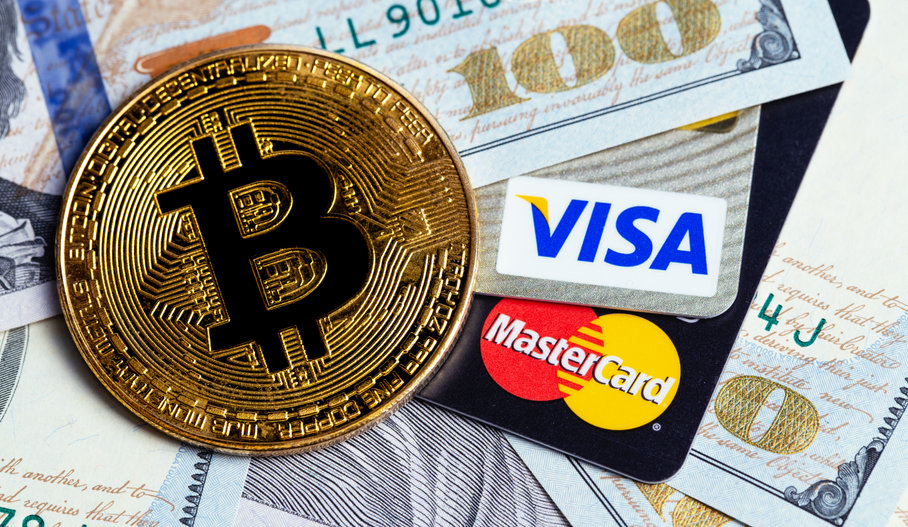
He said that across the Visa and Mastercard product offerings, the issuance of crypto-backed cards jumped 500% between January and December last year. 

Meanwhile, transactions spiked sixfold, with the 600% surge coming even as prices of cryptocurrencies soared and then began to fall towards the end of the year.

People are using the Visa or Mastercard crypto wallets for everyday spending, he added. He believes this is the reason the sector continues to “see a lot of growth regardless of the volatility in underlying assets.”

Every day spends, according to McCarthy, averages $60 million.

He also told CNBC that there has not been a direct correlation so far between prices tailing off and consumers increasing or cutting their usage.

Commenting on the demographics and what users were using more on a daily basis, the i2c president highlighted that it really cuts across all ages. For example, a study of over 3.5 million users showed that 45% of crypto-backed card users were aged 35 years and above.

Asked about what this meant for the industry even as cryptocurrency looks at decentralised finance over traditional payment rails, he noted:

“I think that DeFi is still more theoretical at this point. [Again] where I sit, what I think is interesting is that people are using these assets, even though there’s a lot of volatility in them, for everyday spend using traditional rails.”

McCarthy’s comments come a few days after Visa Inc., the world’s leading provider of credit cards, said processed $2.5 billion worth of payments made via crypto-linked cards. The company said this represented a 70% jump in volume over that recorded in 2021.

i2c reportedly accounts for over 5 million crypto-backed cards, with services accessible across 200 countries and available 24/7. The Silicon Valley firm was founded in 2001.

The post Crypto-backed cards usage is growing rapidly regardless of volatility, says i2C’s McCarthy appeared first on Coin Journal.