
X2Y2 token price jumps over 200% in two days: what is causing the new token to rally?

X2Y2 price has been soaring since February 16. It has risen by more than 200% in a little over two days.

At the time of writing, it was trading at $3.56 up 16.20% in the last 24 hours having hit a daily high of $4.17and a daily low of $2.64.

Though it is normal to see a new token rise immediately after launch, X2Y2’s surge has made headlines after jumping by over 200% in two days. Let’s take a deep dive into what is propelling the surge.

Why is the price of the X2Y2 token rising?

One of the factors being attributed to the current X2Y2 price surge is its launch on February 16. The X2Y2 Ethereum-based NFT trading platform team conducted a vampire attack, a tactical move that projects use to distribute free tokens to incentivize users of OpenSea to start using their product. LooksRare also used the same move.

In its case, LooksRare dropped tokens for OpenSea users who had traded over 3 ETH on OpenSea and also rewarded its active users. While the method attracted some traffic for LooksRare, it also led to some suspected cases of wash trading on the platform.

X2Y2 airdropped 120 million tokens, which is 12% of its 1 billion token supply to 861,417 wallets had traded on OpenSea between mid-June and mid-December 2021. Token distribution was proportional to their trading activity on OpenSea. In reciprocation, the Airdrop claimers were to list their OpenSea-listed NFTs on X2Y2 at the same price they list on OpenSea.

Although OpenSea is the leading NFT trading hub although it does not have a cryptocurrency token of its own, other alternatives are rapidly cropping up and trying to offer a better user experience as they aim at snatching the OpenSea users base. And one of the ways competitors are doing so is through Airdrops like what X2Y2 did.

X2Y2 tokenomics

X2Y2 tokenomics design was almost similar to that of the LooksRare (LOOKS) token, only that X2Y2 will pay token stakers and also an additional platform cut-off fee paid in WETH rather than rewarding users for trading.

Staking X2Y2 tokens currently is over 8000% per annual yield. In addition, the platform also rewards staking NFTs.

Listing an NFT on X2Y2 is also counted as an NFT staking and makes the users eligible for free rewards.

The post X2Y2 token price jumps over 200% in two days: what is causing the new token to rally? appeared first on Coin Journal.
SEC chair says concerns about lack of spot Bitcoin ETF under ‘careful consideration’

SEC building in Washington DC, USA

Gary Gensler said the US Securities and Exchange Commission (SEC) considers every proposal seeking the listing of spot Bitcoin exchange-traded products (ETPs)“under the appropriate regulatory framework.”

US Securities and Exchange Commission (SEC) chair Gary Gensler has hinted in a letter to US lawmaker Tom Emmer that the commission may not be any closer to approving a Bitcoin spot exchange-traded fund (ETF).

In a response to the lawmaker’s letter sent to the SEC last November, Gensler says that the agency’s handling of all the Bitcoin (BTC) spot ETFs to come before it has been in accordance with the Exchange Act.

The SEC chair, who pointed out that he remains technology-neutral, said the regulator is tasked with ensuring the proposed spot ETP is “designed to prevent fraudulent and manipulative acts and practices.”

Emmer, acknowledging receipt of Gensler’s letter, noted that lawmakers would continue to oversee the regulator towards its mission of maintaining “fair and orderly markets.”

The SEC has approved a number of Bitcoin futures ETFs, with the first coming in early November as Bitcoin price rallied to its all-time high of $69,000. But while spot ETPs have been launched in Canada for instance, the US market still awaits its first spot-based fund.

Gensler, in this latest view of the matter, only appears to suggest the waiting might yet be further off. His remark about a possible approval is that the commission will give “careful consideration” to all proposals seeking the listing and trading of Bitcoin spot ETFs.

As it stands, the US has approved Bitcoin (BTC) futures ETFs by ProShares, Valkyrie, and VanEck. Of the recent spot ETF applications to come before it, the SEC has rejected proposals from SkyBridge, Fidelity and WisdomTree.

The post SEC chair says concerns about lack of spot Bitcoin ETF under ‘careful consideration’ appeared first on Coin Journal.

iZUMi Finance launches a revolutionary DAO with veiZi NFTs

The protocol provides for a decentralised autonomous organisation (DAO) governance mechanism based on a Quadratic voting model.  

iZUMi Finance, an innovative protocol for programmable liquidity mining built on the Uniswap V3 platform, has launched its highly anticipated decentralized autonomous organization (DAO), promising a revolutionary governance system powered by a quadratic voting mechanism.

According to an announcement shared with CoinJournal on Thursday, iZUMi Finance said its DAO governance token will be based on veNFT (veiZi). 

The token is ERC271 standard compatible, meaning that users will have access to all the governance rights applicable to the platform. These will include the right to vote, boost and return staking rewards, iZUMi Finance said in the statement.

“veNFT’s are a major step forward for the industry in terms of NFT utilization. Whereas in most DAOs, governance votes are represented by the number of tokens held in a wallet, iZUMi DAO governance votes are represented by the number of tokens held within a veiZi NFT,” the protocol’s team added in their announcement. 

On its Quadratic Voting mechanism, iZUMi Finance said:

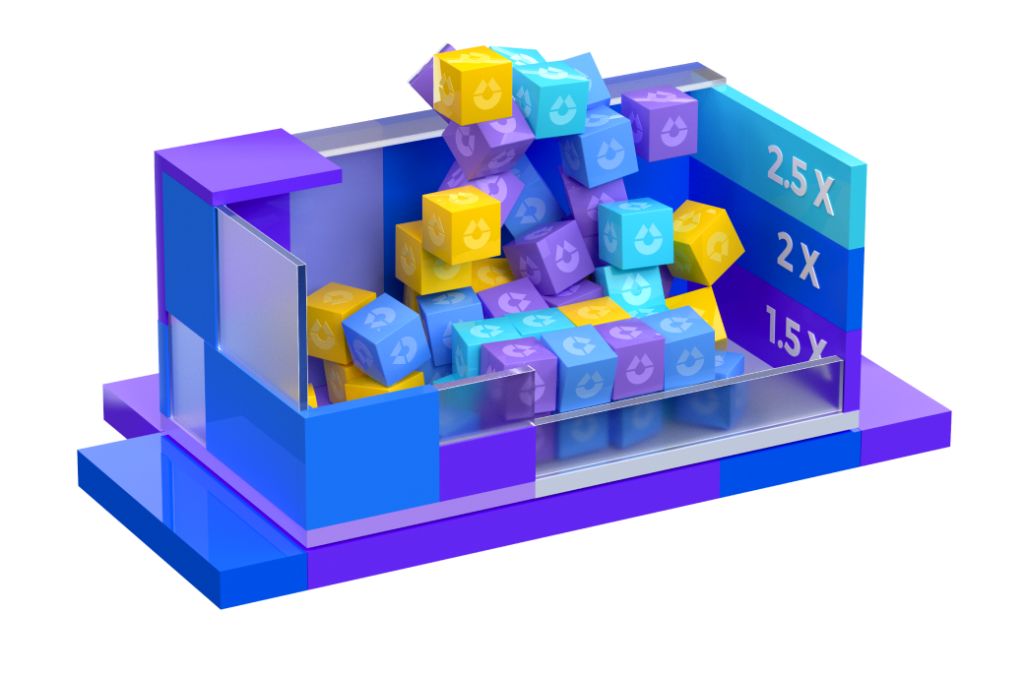
“Each cycle’s iZi emissions will be determined and allocated according to the outcome of veNFT voting. For staking rewards, 50% of the platform’s revenue will be used to buy back iZi, which will be allocated to veiZi NFTs according to voting power. With NFT staked, veiZi will be used to boost iZUMi i’s farming pool APR by up to 2.5 times.“ 

Minting veiZi NFTs

Users can mint veiZi NFTs via any iZUMi wallet address, which will happen when they lock their iZi tokens for a given period. However, it’s also possible to buy the tokens on third-party NFT marketplaces. 

As an interest-bearing NFT, veiZi offers a unique opportunity for holders to get monthly rewards through staking.

An iZUMi wallet can only stake one veiZi NFT, but the platform’s technology allows for an extension of the locked period. If a user wants to, they also can opt to unstake their tokens once they successfully redeem their rewards.

iZUMi Finance’s programmable liquidity as a service feature is available on Uniswap V3 multi-chains.

DAOs have increasingly found a footing in recent months, with many users attracted to the commitment to decentralisation projects put forth via governance tokens.

Many projects now offer users the right to vote on governance issues, with the trend growing as decentralised finance (DeFi) becomes even more entrenched in the crypto ecosystem.

The post iZUMi Finance launches a revolutionary DAO with veiZi NFTs appeared first on Coin Journal.

Aave (AAVE), Compound (COMP) and Maker (MKR) might offer buy opportunities: Santiment

Aave and the three other tokens COMP, MKR and REN have shown ‘clear price bottoms recently’, according to on-chain analytics platform Santiment.

Aave’s price has dipped 2.5% in the past 24 hours and nearly 15% over the past week as of writing, with the altcoin’s price falling alongside that of major cryptocurrencies such as Bitcoin and Ethereum.

The top two crypto assets by market cap are down 4% and 3.3% respectively amid a slowdown across the markets, with sentiment driven by inflation concerns, the US Federal Reserve’s move to hike rates and tensions related to the Russia-Ukraine crisis.

While cryptocurrencies are likely to trade lower as they mirror losses in the equities market, Santiment has noted that Aave (AAVE), Compound (COMP), Maker (MKR) and Ren (REN) could offer a great buy opportunity in the short term.

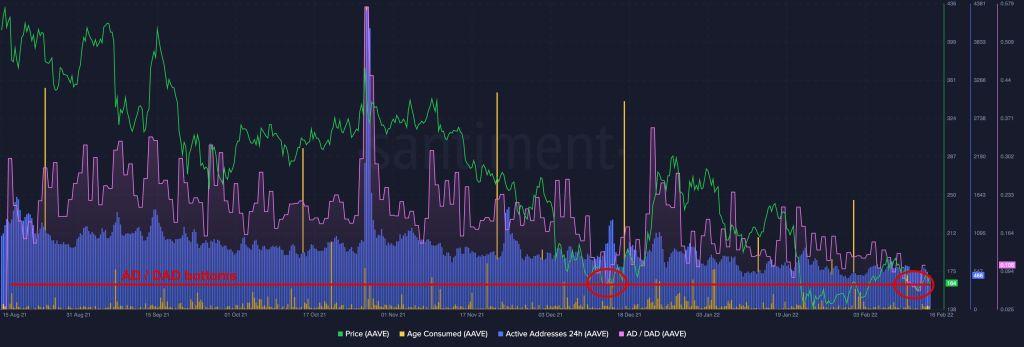
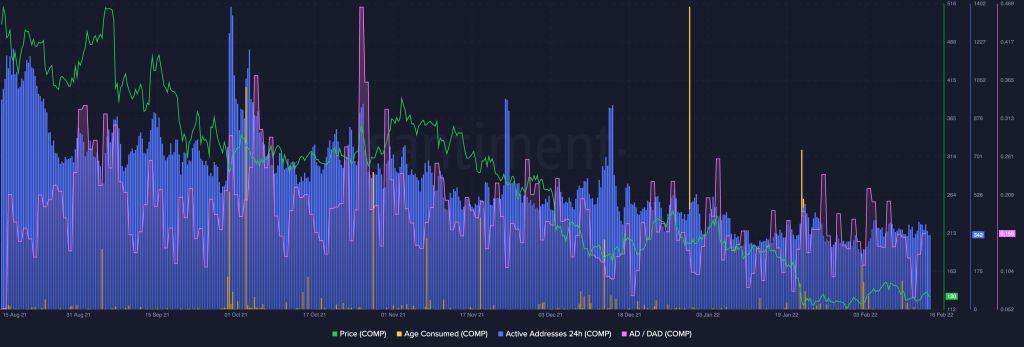
In a “spotting the dips” analysis, Santiment points to the ratio of active deposits to daily active addresses (AD/DAD) to highlight that the four altcoins could be trading at “clear bottoms.”

 “AAVE, COMP, MKR, and REN have all shown very clear price bottoms recently. And they have all been accurately predicted by looking at how many active deposits have made up the total address activity of [the] asset,” the analytics platform noted.

Aave (AAVE)

Looking at Aave, Santiment notes:

“Looks like price likes to grow from this metric’s bottom. We could suggest that low values of AD/DAD ratio are indicating a nice buy opportunity.”

AAVE chart showing the AD/DAD ratio. Source: Santiment.
On the likelihood of opposite price action, the platform shared:

“Higher levels of AD/DAD indicate ‘exit’ points, where holders probably tend to exit their positions. The higher deposits (AD), the higher holders ‚panic‘ level.”

Compound (COMP)

Santiment suggests Compound (COMP) is also poised for an upside. “Compound’s AD/DAD dipped to all time low just a few days ago. Good sign,” they wrote.

Compound chart showing the dip in the active deposits to daily active addresses. Source: Santiment

Maker (MKR)

Maker’s AD/DAD also shows the latest dip has pushed prices to a decent buy level. However, it’s likely to dip even more after reaching current levels at the end of January. Santiment says the ratio could surge more, indicating further declines, but “not as strong as other tokens.”

REN (REN)

REN/USD touched year-to-date lows on 24 January, with a decent spike in February helping it break above $0.40. However, an 11% dip over the past seven days has left it battling pressure around $0.35.

Another “panic” move to recent lows could offer a fresh buying opportunity.

The post Aave (AAVE), Compound (COMP) and Maker (MKR) might offer buy opportunities: Santiment appeared first on Coin Journal.

Ukraine legalises Bitcoin and other cryptocurrencies

Ukraine has been in the news a lot recently. Well, it has cropped up again, although not in the way you may expect.

Today, the government officially passed a law legalising Bitcoin and other cryptocurrencies. The bill was originally passed last September, although Ukrainian President Volodymyr Zelanskyy had sent it back to parliament for changes. Today, four months later, it has been formally signed into law.

What it Means

“The development of a new industry will allow attracting transparent investments and will strengthen the image of our country as a high-tech state,” Mykhailo Fedorov, Ukraine’s vice prime minister of digital transformation, had commented on the bill in September.

It is a positive step that strives to protect digital asset owners, exchanges and other stakeholders in the industry. Particularly notable is the inclusion of the terms digital wallet, private key and virtual assets in Ukrainian legislation for the first time. While there will always be groups who protest the introduction of regulation into crypto, overall it is a promising development for the industry and should encourage more transparency and confidence for those operating in Ukraine, as well as reducing fraud. The hope is that covert mining operations, evasive tax schemes and other “shadow” crypto activities should now decrease, while innovation will spike and foreign investment will flow into the country.

Political Turmoil

Unfortunately, there is an elephant in the room here. Even diehard crypto fans are unlikely to be queuing up to book one-way tickets to Ukraine, given the ongoing issues with a certain Mr. Putin. The reality is that you can list all the Ukrainian crypto positives you want – such as low taxes, streamlined legal framework, improvement in technical infrastructure and an abundance of engineers – but as long as there are 150,000 Russian troops stationed at the border, Ukraine’s hope to become the digital asset hub of Eastern Europe isn’t likely to be achieved anytime soon.

However, political concerns aside, it sees Ukraine steam towards the front of the European countries legal framework on crypto. While South America has been particularly welcoming in their approach to crypto legalization, Europe to date has not been as warm. The EU has begun to place a tighter leash on crypto transfers, striving to make them more traceable. While individual states have legalized it – perhaps most notable was the passing of a law in Germany last year allowing German Spezialfonds to allocate up to 20% of their assets to crypto – Ukraine still had high hopes to lead the virtual charge on the continent, back when the bill was originally put forward.

Of course, the final interesting quirk in this story is the stark contrast compared to Russia. Putin has been notoriously anti-crypto, pushing for an outright ban on the industry and instead focusing efforts on the development of a central bank digital currency.

It’s one more thing for them to disagree with Ukraine on.

The post Ukraine legalises Bitcoin and other cryptocurrencies appeared first on Coin Journal.