SEC could scrap crypto staking, Coinbase CEO reveals

  • Coinbase CEO Brian Armstrong tweeted saying The SEC could ban crypto staking
  • Armstrong however said that crypto staking is an essential innovation in crypto.
  • The revelation was met with criticism from Charles Hoskinson who said Ethereum staking is problematic.

The co-founder and CEO of Coinbase Brian Armstrong earlier today tweeted revealed that he is hearing rumours that the SEC intends to “get rid” of crypto staking in the US for retail customers.

According to Armstrong, staking is an important innovation in the crypto space since it allows crypto users to participate directly in running decentralized blockchain networks. In his follow-up tweets, he said that crypto staking has brought many positive improvements in the crypto industry including increasing security and scalability and also helping in reducing carbon footprints.

For those new to crypto staking, it is when users lock up their crypto assets for a certain amount of time to help support certain functions of a blockchain including governance and verifying transactions and get some staking rewards in return.

Armstrong’s revelation met with scorn

While some hold the same views as Brian Armstrong, some responded with memes and derision. Charles Hoskinson, the founder of Input Output Global weighed in on the matter saying that “Ethereum staking is problematic.”

Hoskinson argues that giving up assets temporarily to someone else in return for rewards resembles regulated products. He said:

“Slashing and bonds [are] not so good. Non-custodial liquid staking on the other hand is like the mining pools we’ve used for 13 years… It’s sad that all proof of stake protocols might get lumped together due to a fundamental misunderstanding about the actual facts of operation and design.”

The post SEC could scrap crypto staking, Coinbase CEO reveals appeared first on CoinJournal.
Lido DAO’s LDO price just went parabolic: 12% gains possible

  • Lido DAO price jumped after the developers announced V2 upgrade.

  • The new upgrade will be implemented ahead of Ethereum Shanghai upgrade.

Lido DAO LDO price jumped to its highest point since January 24 after the developers unveiled the next steps towards Ethereum’s Shanghai upgrade. LDO crypto jumped to a high of $2.63, which was about 40% above the lowest level this year. 

Lido unveils V2 plans

Lido has grown to become the biggest player in decentralized finance (DeFi) with a total value locked (TVL) of over $8.7 billion. Most of these assets are in Ethereum, followed by Polygon, Solana, Polkadot, and Kusama. Lido Staked ETH has a total market cap of over $5.6 billion. 

LDO price has done well in the past few months because of the upcoming Shanghai upgrade that will see people be able to withdraw their staked ETH. In a statement, the developers said that they will implement Lido V2 as the road to decentralization continues. It will be the biggest upgrade in the project’s history.

As part of the upgrade, Lido will introduce staking router and withdrawals. With the staking router, anyone will be able to develop on-ramps for new Node Operators. The goal of this upgrade will be to create a more diversified validator ecosystem.

The next part will be on withdrawals, where stETH holders will be able to withdraw from Lido on a 1:1 ratio. This feature will have two modes: Turbo and Bunker modes. Turbo’s withdrawals will be implemented more quickly by automating tooling for node operators and the protocol. The bunker mode will be implemented in case of catastrophic situations.

Therefore, the next few weeks will be crucial for Lido and LDO prices. Analysts expect that the Shanghai upgrade will happen in March or early April. Because Ethereum is the most dominant part of Lido, we could see more activity before then. As we wrote here, Lido will distribute LDO rewards via Aave v3 liquidity pools.

Lido DAO price forecast

LDO/USD chart by TradingView

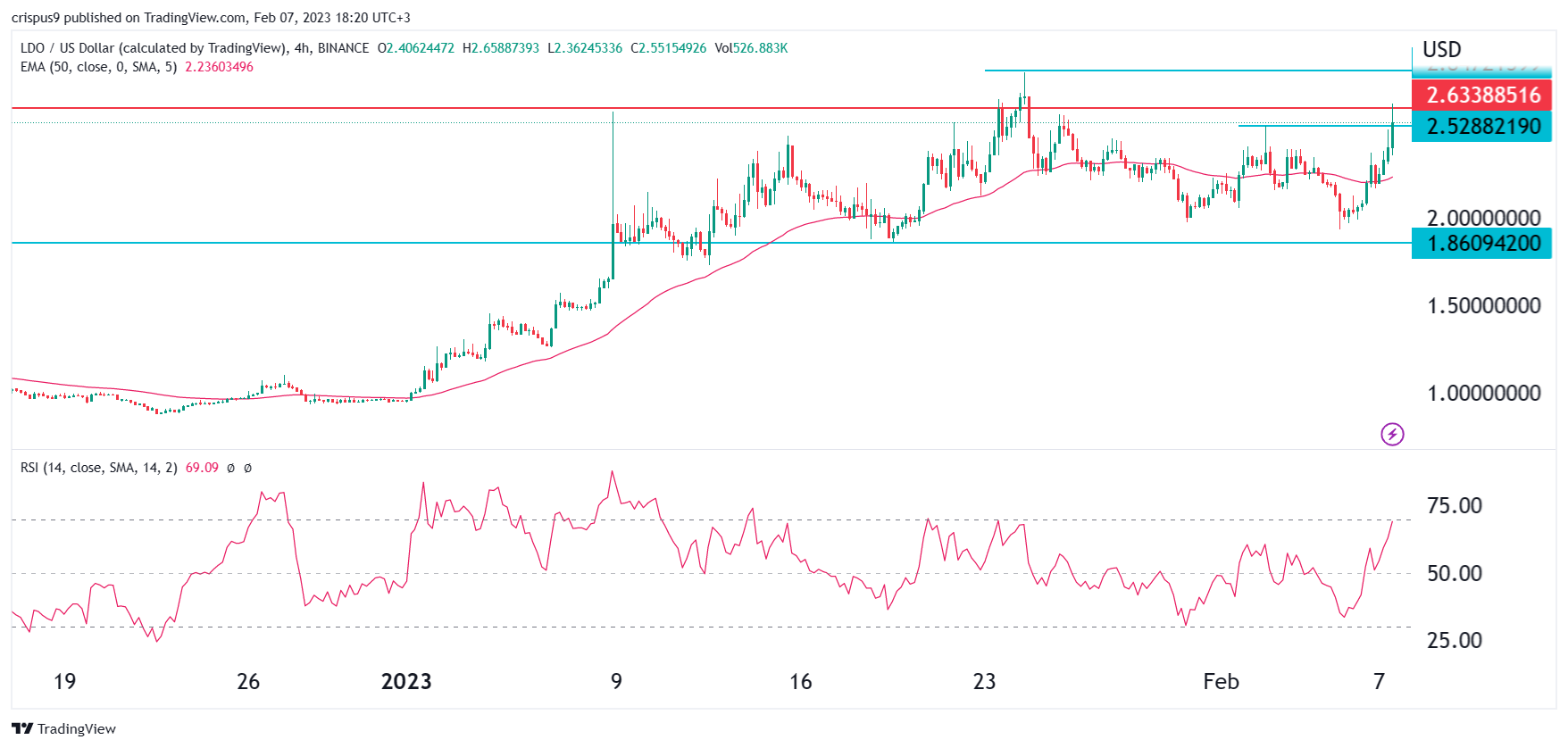
LDO crypto price jumped to a high of $2.65 on Tuesday, which was the highest point since January 24. As it rose, it moved above the important resistance point at $2.52, the highest point on February 2. It also moved above the 50-period moving average. The Relative Strength Index (RSI) is approaching the overbought level.

Therefore, the outlook of Lido is bullish, with the next reference level being at $2.85, the highest point this year. This price is about 12% above the current level. A break below the support at $2.30 will invalidate the bullish view.

How to buy Lido DAO

As LDO is such a new asset, it’s yet to be listed on major exchanges. You can still purchase LDO using a DEX (decentralised exchange) though, which just means there are a few extra steps. To buy LDO right now, follow these steps:

1. Buy ETH on a regulated exchange or broker, like eToro ›

We suggest eToro because it’s one of the world’s leading multi-asset trading platforms, an exchange and wallet all-in-one with some of the lowest fees in the industry. It’s also beginner-friendly, and has more payment methods available to users than any other available service.

2. Send your ETH to a compatible wallet like Trust Wallet or MetaMask

You’ll need to create your wallet, grab your address, and send your coins there.

3. Connect your wallet to the 1Inch DEX

Head to 1Inch, and ‚connect‘ your wallet to it.

4. You can now swap your ETH for LDO

Now that you’re connected, you’ll be able to swap for 100s of coins including LDO.

The post Lido DAO’s LDO price just went parabolic: 12% gains possible appeared first on CoinJournal.

Ethereum Deep Dive: Health check ahead of Shanghai upgrade in next month


Key Takeaways

  • Ethereum’s Shanghai upgrade is slated for March, when all staked ETH will be released and become eligible to be sold
  • 16.1 million ETH is currently staked, equating to $26 billion, 14% of the entire supply
  • Capital has fled the Ethereum ecosystem over the last year, as higher interest rates from the Fed offer investors an alternate source of yield, while DeFi rates have collapsed
  • Total value locked (TVL) in Ethereum is down over 75% from its peak

Ethereum has a big event looming on the horizon. 

The much-awaited Shanghai upgrade is slated for March. This is a pivotal date because, after a long wait for investors, the ETH locked up in the ETH 2.0 staking contract will finally be released. 

And, there’s a lot of it. 16.4 million ETH, to be precise, which is equivalent to 15% of the entire supply. This locked ETH is worth close to $26 billion at time of writing. 

Ethereum volume and TVL is down

Unless you’ve been living under a rock, you will know that the last year in crypto has been, well, decidedly unfun. Volumes, interest and prices have cratered in the space, as a dire macro environment coupled with several crypto scandals have torpedoed the market. 

For Ethereum, when looking at transaction volume, the numbers have actually held up a little better than perhaps one could have expected, however still don’t make overly pretty reading. 

From a peak of 1.5 million transactions per day, the number has certainly come down, but is still lingering around the million mark, and up substantially from pre-COVID. Notably, several of Ethereum’s rivals have fallen significantly more, with its market share consequently growing; it may be a bigger piece of the pie, but the pie is significantly smaller. 

Capital has fled the Ethereum ecosystem

TVL is perhaps a better indicator. The metric sums up the capital flight from the space well, with Ethereum down to $28 billion, a 74% fall from its peak of $109 billion in November 2021. 


I included the ETH price on the above chart to demonstrate how correlated with the price this is. That makes intuitive sense, obviously, and ETH’s price has collapsed in live with the TVL. 

But when denominating the above chart in ETH rather than USD, it still shows a fall-off. 

This is indicative of a decline in the crypto space in general, but also the very real threat to DeFi that is rising interest rates in the economy. 

The Federal Reserve has engaged in an extremely aggressive hiking cycle, as it moves to aggressively rein in inflation. Not only has this nuked the price of risk assets, but it has offered a competitive source of yield for investors, who previously were forced to move out on the risk curve, many of whom looked towards sky-high DeFi rates. 

Not only has the Fed rate jumped from near zero up towards 4.5%, but DeFi yields have collapsed in the opposite direction, driven down towards 1%/2% from the dizzying levels seen during the pandemic, many of which were in the teens. This has caused extra capital to flee Ethereum.  


Eyes now turn to Shanghai upgrade

All eyes now will turn to the Shanghai upgrade, the next major date for Etheruem, following the Merge event which went live in September and converted the network to Proof-of-Stake, from its prior Proof-of-Work consensus. 

While liquid staking options have allowed many investors to trade ETH regardless, the release of so much ETH is nonetheless a big deal. I’ll follow up with another piece on what this could mean for the price of ETH, but regarding the fundamentals and continued development of the network, it is certainly a step in the right direction. 

The Merge dragged on but came and went smoothly in September. The Shanghai upgrade is the next stage of that. 

Crypto has been hurt immensely in the last year, and Ethereum has felt the brunt of that. Freefalling volumes, capital and prices are indicative of that. And while macro continues to drive the bus for crypto, that will (hopefully) turn around eventually. Then – and only then –  these things will help set Ethereum up to resume its growth. But it’s a long road back. 

The post Ethereum Deep Dive: Health check ahead of Shanghai upgrade in next month appeared first on CoinJournal.

Optimism price: OP surges 30% to hit new all-time high

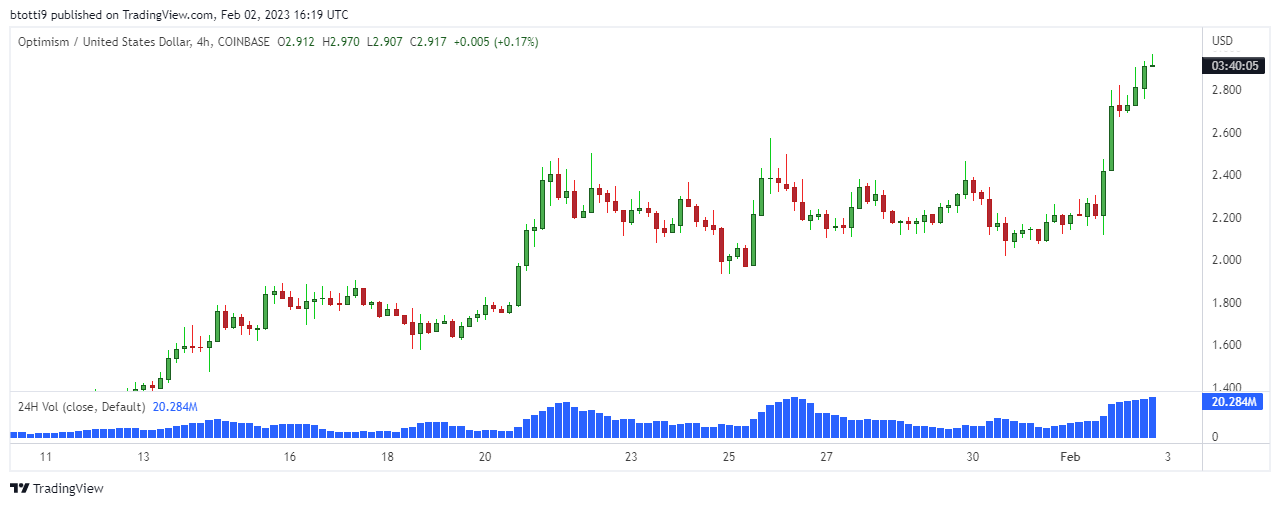
  • OP has rallied over 30% in the past 24 hours, reaching a new all-time high of $2.97 on Coinbase
  • Optimism is outperforming major coins even as cryptocurrencies rally on Thursday.
  • Gains for Optimism comes amid buying pressure after news of an upgrade proposal planned for activation on 15 March.

Optimism is rallying again as excitement around the Ethereum layer 2 scaling solution increased following a major news announcement.

As shown on the 4-hour chart below, OP reached a new all-time high of $2.97 on Coinbase. As of 11:20 am ET on 2 February, the platform’s native token OP was trading at $2.91, still up by more than 32% in the past 24 hours.

Chart showing Optimism price rally to new all-time high on Coinbase. Source: TradingView.According to data from CoinGecko, the OP token price is up 205% in the past 30 days, outshing major coins. About 75% of the gains have come in the past two weeks as platform’s market capitalization steadily rose to currently stand around $625 million.

Why OP token price is surging

Optimism’s gains in the past few hours have come as buying pressure ramped up ahead of what promises to be groundbreaking network upgrade.

On Wednesday, the Optimism Foundation released a proposal seeking to deploy an upgrade to the protocol’s mainnet. According to the proposal, the upgrade targets improving network performance via the Optimism Collective: Bedrock.

It is the first major upgrade to the Optimism protocol and brings a rollups architecture to the protocol, with  transaction batching one of the main features highlighting the huge impact the upgrade could have for the blockchain’s performance.

This upgrade offers a new level of modularity, simplicity, and Ethereum equivalence for Layer 2 solutions, providing unprecedented performance and functionality,” the Optimism Foundation wrote.

Improvements set to be added via the Bedrock release include reduced transaction fees, high throughput and improved sync speeds.

According to the team, the upgrade will not impact most users as the Optimism mainnet is “already EVM-equivalent.” However, some users including those running full and archive nodes have to take action in preparation for the upgrade.

The Bedrock proposal is expected to go through a two-week voting period, with deployment to the mainnet scheduled for 15 March if it passes.

The post Optimism price: OP surges 30% to hit new all-time high appeared first on CoinJournal.

Ethereum price after Zhejiang testnet launch

  • The Ethereum Zhejiang public testnet went live on February 1, just according to the plan.
  • The testnet paves the way for the Shanghai and Capella upgrade testnet.
  • Ethereum price has responded positively to the launch by maintaining a positive sentiment.

At press time, Ethereum (ETH) price was $1,672.19, up 5.80% in the past 24 hours a day after the launch of the Zhenjiang public testnet.

While the testnet may not have much of an impact on the price of ETH since it has been on an upward trend since the start of 2023, it is important to acknowledge that if the launch went south, the price would definitely have been negatively affected.

What next for Ethereum?

The Zhenjiang public testnet is designed to allow Ethereum users to test and evaluate the process of withdrawing the staked ETH tokens and also test the network functionality after the Shanghai upgrade. Users can test validator deposits, familiarize themselves with how to change BLS, and evaluate the user interface navigation without risks.

That said, the testnet is a great pointer for the upcoming upgrades and sets the stage for Ethereum to go ahead with the next upgrades.

It is important to also acknowledge that The Zhenjiang testnet is the first release for the Ethereum development team since the highly successful Merge upgrade that made Ethereum a proof-of-stake (PoS) blockchain.

Staked ETH

Currently, about 16.3 million Ether tokens have been locked on the Beacon Chain (Ethereum PoS chain). This represents about 13.5% of the total ETH circulating supply.

At the current market price, the staked ETH tokens are valued at about $27.257 billion. Unlocking these tokens will be a huge boost to the Ethereum ecosystem and investors will now not have to worry about when their staked ETH and interest will be available for use.

The post Ethereum price after Zhejiang testnet launch appeared first on CoinJournal.