
Bitcoin ETFs outperform Ether ETFs as BlackRock’s IBIT leads peers

  • Bitcoin ETFs have attracted $5B net inflows while Ether ETFs have seen $500M net outflows.
  • BlackRock’s IBIT leads with over $224M in a single day, currently holding over 350,000 BTC.
  • Ether ETFs are struggling due to liquidity issues and Grayscale’s $2.5B outflows.

Recent trends in the cryptocurrency exchange-traded funds (ETF) market have highlighted a significant divergence in the performance of Bitcoin and Ether ETFs.

Comparing Bitcoin ETF Flow data to Ethereum ETF Flow data on Farside Investors, Ether spot ETFs have underwhelmed compared to their Bitcoin counterparts. Since their launch, Ether ETFs have experienced net outflows of approximately $500 million, a stark contrast to the $5 billion net inflows recorded by BTC ETFs during a similar period following their debut.

Several factors contribute to this disparity. To start with, Bitcoin’s “first mover advantage,” higher liquidity, and lack of staking opportunities in Ether ETFs have made Bitcoin more appealing to institutional investors.

Additionally, unexpected outflows from Grayscale’s Ethereum Trust (ETHE), amounting to $2.5 billion, far exceeding the bank’s initial $1 billion estimate, have further dampened Ether ETF performance. To counter these outflows, Grayscale introduced a mini-Ether ETF, but it has only managed to attract $200 million in inflows.

In contrast, BTC ETFs have shown resilience and robust performance with US-based BTC ETFs recording an impressive eight-day winning streak, with net inflows totalling $202 million led by BlackRock’s iShares Bitcoin Trust (IBIT).

On August 26 alone, IBIT attracted over $224 million in net inflows bringing its total Bitcoin holdings to over 350,000 BTC, solidifying its dominance in the market.
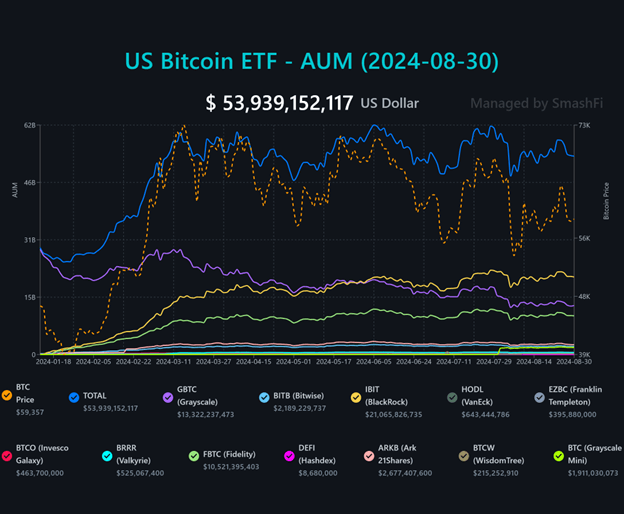
Bitcoin ETF flows outperform Ether ETFs as BlackRock's IBIT leads peers
US Bitcoin ETF AUM, August January 18 – August 30, 2024|Source: Bitcoin ETF Fund Flows

Competing funds such as those managed by Franklin Templeton and WisdomTree also saw positive inflows, while others, including Fidelity, Bitwise, and VanEck, reported negative flows. Notably, Grayscale’s Bitcoin Trust (GBTC) saw a decline in redemptions over the past two weeks, indicating stabilization in the market.

As investor confidence in Bitcoin ETFs grows, asset managers are increasingly exploring combined ETFs that offer exposure to both Bitcoin and Ethereum, reflecting the evolving dynamics of the cryptocurrency investment landscape.

The post Bitcoin ETFs outperform Ether ETFs as BlackRock’s IBIT leads peers appeared first on CoinJournal.

Vitalik Buterin defends recent ETH sales, says they’re for projects and charity

  • Vitalik Buterin clarifies ETH sales were for projects and charity, not profit.
  • He held 325K ETH three years ago but now holds 240K ETH.
  • Buterin has also defended Ethereum’s support for DeFi amid criticisms from some in the space.

Ethereum co-founder Vitalik Buterin has come out to address allegations surrounding his sales of Ether (ETH), clarifying that these transactions were not driven by personal profit but by a commitment to support Web3 projects and charitable initiatives.

According to a recent post by on-chain analytics firm Lookonchain, Buterin has reduced his ETH holdings by 85K ETH ($209M) in 3 years.

The most recent is the transfer of 800 ETH worth over $2 million to a multi-sig wallet. Lookonchain highlighted that the same wallet address had received 3,000 ETH from Buterin on August 9, fueling concerns about the motives behind Buterin’s sales.

Vitalik Buterin denies selling ETH for profit

In response, Buterin firmly denied any allegations of selling ETH for personal profit. He clarified that he has not sold any Ether for personal financial gain since 2018. Instead, he explained that his ETH sales were intended to support various Web3 projects and philanthropic endeavours.

Buterin’s statement aims to underscore his longstanding commitment to using his resources for the advancement of important causes rather than personal enrichment.

Supporting Ethereum and DeFi

Buterin’s statements also touch upon his stance regarding decentralized finance (DeFi) and the broader Ethereum ecosystem. He has come under fire for Ethereum allegedly not sufficiently supporting DeFi.

Kain Warwick, the inventor behind the concept of yield farming, and MilliΞ a crypto philosopher criticized Buterin for his perceived lack of emphasis on DeFi.

However, Buterin defended Ethereum’s role in DeFi and his position stating that he thinks “DEXes are great, and I use them every week.”

Buterin’s defence reflects his commitment to ensuring that Ethereum continues to support meaningful and sustainable developments within the blockchain space. He has consistently advocated for the importance of long-term value over temporary gains, reinforcing his position that the Ethereum network should remain focused on foundational principles rather than transient trends.

By addressing these allegations and defending Ethereum’s role in DeFi, Buterin reaffirms his commitment to the broader vision of a decentralized and impactful digital future.

The post Vitalik Buterin defends recent ETH sales, says they’re for projects and charity appeared first on CoinJournal.

BlackRock launches Ethereum ETF on B3 stock exchange in Brazil

  • BlackRock launches Ethereum ETF (ETHA39) in Brazil via BDR on B3 stock exchange.
  • Initial trading price set between R$40-R$50 with first-year fees halved to 0.12%.
  • Brazil now has 15 crypto-linked ETFs.

BlackRock has expanded its cryptocurrency product portfolio in Brazil by launching the iShares Ethereum Trust (ETHA) via a share receipt (BDR) on the B3 stock exchange.

This follows the successful introduction of BlackRock’s Bitcoin ETF (IBIT39) in the country, marking another significant step in making crypto assets more accessible to Brazilian investors.

Initial trading price to range between R$40 and R$50

The iShares Ethereum Trust, trading under the ticker ETHA39, is designed to cater to both retail and institutional investors.

The ETF’s initial trading price is expected to range between R$40 and R$50, representing approximately one-third of the value of the original asset that backs the BDR.

The management fee for the ETF is set at 0.25% per year, mirroring the fee structure in the United States. However, during the first year of trading or until the ETF reaches $2.5 billion in assets under management (AUM), the fee will be halved to 0.12%, making it even more attractive to investors.

Demand for crypto-related products in Brazil

Cristiano Castro, BlackRock’s director in Brazil, emphasized that the launch is a response to the growing demand for crypto-related products in the country. He highlighted the success of the iShares Bitcoin Trust as evidence of this demand, noting that it became the fastest-growing ETF in history over three months.

According to Castro, BlackRock’s strategy is to meet this demand by facilitating access to digital products within the capital market.

Before being launched in Brazil by BlackRock, the original iShares Ethereum Trust was launched in the United States in June 2024 and quickly became the most liquid cryptocurrency fund, with 80% of its trading volume coming from individual investors.

The Brazilian market, which has seen significant growth in crypto trading, now offers 15 ETFs or BDRs linked to digital assets. Despite the existence of multi-asset funds in Brazil, BlackRock’s reputation and established governance are expected to attract investors to ETHA39.

This launch underscores Brazil’s position as a key market for crypto investments, with nearly 180,000 investors holding crypto products valued at approximately R$5.5 billion.

As the demand for digital assets continues to rise, BlackRock’s Ethereum ETF is poised to play a crucial role in the evolving landscape of Brazil’s financial market.

The post BlackRock launches Ethereum ETF on B3 stock exchange in Brazil appeared first on CoinJournal.

Argentina’s Ministry of Education adds Ethereum to high school curriculum

  • Buenos Aires high schools will start offering blockchain internships on August 27.
  • ETH Kipu will train 500 students in Solidity and prepare 30 instructors.
  • Argentina’s high inflation drives strong local engagement with digital assets.

In a groundbreaking move to advance blockchain education, Argentina’s Ministry of Education has partnered with ETH Kipu to introduce Ethereum and blockchain technology into the high school curriculum in Buenos Aires.

Starting August 27, high schools across the city will offer blockchain internships, providing students with invaluable hands-on experience in this rapidly evolving field.

Spurring blockchain adoption in Argentina

The collaboration with ETH Kipu, a prominent organization dedicated to Ethereum education in Latin America, marks a significant step in integrating cutting-edge technology into secondary education.

The program will include a specialized online Solidity course, designed to train 500 students in the intricacies of decentralized application (DApp) development.

Solidity, a high-level programming language used to create smart contracts on the Ethereum blockchain, has gained prominence in various networks, including the BNB Smart Chain and Avalanche.

ETH Kipu aims to equip students with the skills necessary to thrive in the blockchain sector, while also preparing 30 instructors to deliver comprehensive Ethereum and blockchain training.

According to Paula Doy, co-founder of ETH Kipu, this initiative not only introduces students to advanced technology but also opens new career opportunities, positioning Argentina at the forefront of the global blockchain movement.

Argentina’s soaring inflation driving crypto adoption

The Ministry of Education initiative comes against the backdrop of Argentina’s soaring inflation rate, which has driven significant local engagement with digital assets.

With an annual inflation rate of 276%, many Argentinians are turning to cryptocurrencies like Tether (USDT) to safeguard their assets.

Recently Forbes analysts reported that Argentina leads the Western Hemisphere in crypto adoption, with substantial activity on major platforms like Binance.

ETH Kipu’s partnership with Buenos Aires is a promising development, reflecting the country’s commitment to fostering technological innovation and preparing its youth for the future of digital finance.

The post Argentina’s Ministry of Education adds Ethereum to high school curriculum appeared first on CoinJournal.

Lido Finance votes to integrate stETH into BNB Chain

  • Lido Finance integrates stETH into BNB Chain, marking its first cross-chain move.
  • The integration uses Axelar and Wormhole to bridge $23 billion in TVL to BNB.
  • Lido remains a leading DeFi protocol with $25.94 billion TVL and one million validators.

In a landmark decision, the Lido Finance community has voted to integrate its stETH (Staked Ethereum) into the BNB Chain. This move, finalized on August 9 through an on-chain vote by the Lido decentralized autonomous organization (DAO), marks the first time Lido has connected to a layer-1 blockchain outside of the Ethereum ecosystem.

The approved integration will utilize Axelar and Wormhole as the canonical solutions to bridge stETH to the BNB Chain.

Lido seeking to expand its utility within DeFi

This significant development allows Lido’s total value locked (TVL) to interact with one of the top five chains by TVL, expanding its reach and utility in the decentralized finance (DeFi) sector.

Lido Finance remains a dominant player in the Ethereum staking market, holding a substantial 28.2% share of net ETH deposits.

Despite a slight dip earlier in the year, Lido’s position as a leading staking platform is reinforced by its extensive validator network, which reached one million in April 2024. This growth underscores the platform’s vital role in the DeFi ecosystem and its impact on staking services.

The DeFi landscape has seen significant contributions from liquid staking protocols like Lido. Unlike traditional staking, which locks funds for a set period, liquid staking enables users to earn yields while retaining the flexibility to move or trade their staked assets.

For Lido, this process involves depositing ETH to receive stETH, a token that accrues interest and can be redeemed at an approximate 1:1 ratio with the underlying asset.

According to DefiLlama data, Lido’s liquid staking protocol commands a remarkable $26.227 billion of the total $83.782 billion in the DeFi ecosystem, solidifying its position as the largest DeFi protocol. This integration into the BNB Chain is expected to further enhance Lido’s influence and operational scope within the DeFi space.

The post Lido Finance votes to integrate stETH into BNB Chain appeared first on CoinJournal.