Bitcoin’s sell-off is a massive buying opportunity, says Chamber of Digital Commerce CEO

Bitcoin price fell sharply on Monday to break below $30,000 and register its lowest level since July 2021. 

As the sell-off in the crypto market mirrored Monday’s bloodbath on Wall Street to hit lows of $29,996, over 40% of Bitcoin supply slipped into an unrealized loss. And on-chain data from Glassnode suggest more pain remains a possibility if the current outlook is compared to that of the 2018 bear market.

The picture could be worse given Bitcoin’s short-term correlation with stocks, which means more losses for stocks amid higher rates and other macro headwinds could see BTC also plummet. It’s looking increasingly bleak for Bitcoin, which could retreat beyond the $28k level.

But according to Perianne Boring, the CEO and founder of the Chamber of Digital Commerce, the drawdown is a “massive buying opportunity.”

Everything is down,” Boring noted in an interview with CNBC’s “Squawk Box” on Tuesday, pointing to the rout seen in stocks and bond markets amid Fed’s tightening. The low prices offer a buy the dip opportunity, she told CNBC’s Andrew Ross Sorkin.

Among the biggest dip buyers this week was El Salvador, which snapped 500 BTC worth over $15 million. 

Boring also said people are trading Bitcoin like a traditional asset, yet the cryptocurrency is not. Again, the focus has been on BTC’s price although really it should be on the network value.  

In terms of where she thinks Bitcoin will go in the future, she said the benchmark cryptocurrency’s fair value as per valuation models, currently stands between $48,000 and $180,000.

Bitcoin reached its all-time high of $69,000 in November and, at current price levels, is trading nearly 54% off that peak.

The post Bitcoin’s sell-off is a massive buying opportunity, says Chamber of Digital Commerce CEO appeared first on Coin Journal.

KuCoin announces $150M funding round, $10B valuation

  • KuCoin announces $150 million pre-Series B funding raise.
  • The raise values the global crypto exchange at $10 billion.
  • KuCoin will use the funds to build the next generation of its core trading system.

Leading global crypto exchange KuCoin announced a $150 million pre-Series B funding round, with which it is valued at $10 billion. Jump Crypto led the round and investment funds such as Circle Ventures, IDG Capital, and Matrix Partners took part.

Expanding presence in Web3

The inflow of capital will allow the exchange to expand beyond centralized trading services and augment its presence in Web 3.0, including GameFi, crypto wallets, DeFi, and NFT platforms.

This will be possible through KuCoin Ventures and other investment arms. The KuCoin community built a public chain, KCC, on which many resources will be deployed to create a decentralized ecosystem.

Building the next-gen KuCoin trading system and more

Among the uses of the new funds will be to build the next generation of the exchange’s core trading system. Performance is expected to improve tenfold thereafter. 

The funds will also support KuCoin’s global regulation efforts and improve security and risk management systems to make the platform more secure and accessible.

Johnny Lyu, CEO of KuCoin, commented:

The vote of confidence from prominent investors, including Jump Crypto and Circle Ventures, solidifies our vision that one day everyone will be with crypto. KuCoin is built for all classes of investors, and we believe these new investors and partners will contribute to making KuCoin synonymous with a reliable and trustworthy gateway into crypto space.

Tak Fujishima, Head of Asia, Jump Crypto, stated:

KuCoin provides a comprehensive platform of crypto services to a global audience, which is one of the many reasons we’re proud to lead this round. We are pleased to support the company as it continues to grow and expand its offerings in futures and margin trading, lending, staking and passive yield generation to support the growth of Web 3.0 and the crypto markets.

KuCoin is currently the fifth biggest crypto exchange on the market according to CoinMarketCap data. It secured $20 million in Round A funding in November 2018. 

The post KuCoin announces $150M funding round, $10B valuation appeared first on Coin Journal.

Highlights May 10: Crypto market crashes, Terra down 50%

Crypto futures racked up more than $1 billion in liquidations in the past 24 hours amid major cryptos losing key support levels and weak market sentiment.

Top cryptos

Bitcoin (BTC) fell as much as 5% in the past 24 hours. Ethereum saw a similar loss. Dogecoin, XRP, and BNB lost around 7% each.

Bitcoin briefly dropped under $30,000 in early Asian hours, buoyed by a weak wider market. It was trading at just below $32,000 at the time of writing. 

Terra’s LUNA fell 50% as its UST stablecoin lost its peg with the US dollar. LUNA dropped out of the top 10, slumping to 14th position on Coinmarketcap’s ranking.  

Cardano suffered the least, down only around 3% today. The only top 20 gainer is Polygon, which has added around 0.70% to its value. 

Top movers

Coins in the top 100 mirrored the overall slump, with most losing up to 10% of their value. 

The hardest hit were Lido DAO (-43%), NEM (-16%), Amp (-18%), STEPN (-24%), Klaytn (-14%), Tezos and Algorand (each -13%), ApeCoin (-19%), and Monero (-15%). 

Not all is gloom and doom on the market. Notable standouts are FTX Token (FTT) and Elrond, each of which gained 3%. Maker is up 5%, and Qtum – 4%.  

Maker DAO’s traffic is consistently rising all over the world, especially traffic from Japan and Russia. In addition, Maker revealed the launch date of the AstraProtocol. The token ASTR SHO (Strong Holder Offering) is coming to Maker on May 30, 2022.

BitStore announced that it would list the QTUM token on May 11. It becomes available on the BitStore app tomorrow. 

Elrond is gaining on news of an upcoming listing on BitMart exchange, which will also integrate the ESDT token standard.

Elrond’s CEO tweeted that their new strategic partner would support the development and growth of the Elrond ecosystem by providing exceptional projects with funding and access to new markets. 

Trending

The biggest winner today is Rakon, whose token RKN added 406%. Rakon describes itself as a blockchain-based network designed to connect satellites, infrastructure, and navigation and communication systems in trustless ecosystems without relying on middlemen.

Rakon uses smart contracts to power timing solutions and frequency control of devices such as smart power grids, wireless controls, aviation systems and other applications. 

The post Highlights May 10: Crypto market crashes, Terra down 50% appeared first on Coin Journal.

Luna: Why I sold my UST for 95 cents on the dollar today

I ate a healthy dose of humble pie today, so maybe this article can serve as a form of therapy.

I’m talking about Terra, its native token Luna, and its UST stablecoin. To quickly summarise, UST is an algorithmic stablecoin that is technically backed by nothing (bear with me, Luna bulls).  Every time 1 UST is minted, 1 LUNA is burned, and vice versa.

This maintains the peg to $1, but what happens when there is so much selling pressure that UST dips below the peg? That scares people.

And when people are scared, they sell UST, for fear of the peg breaking.

That triggers more fear, which triggers more selling, which triggers more fear and so on and on and on. If I was on a stricter word count, I could merely have called it a run on the bank.  We saw this today, with the UST de-pegging, trading down as low as 88 cents about thirty minutes ago (currently at 90 cents).

I Capitulated

I was one of those scared people. In fact, I sold my UST for 95 cents on the dollar, swallowing a rather uncomfortable 5% loss, as detailed in the Twitter thread below, which I typed as the tears flowed down my face and fell onto my keyboard.

A couple of reasons why, before you throw abuse at my already-egg-covered face.

As I write this, Do Kwon has not tweeted in five hours and counting, when he said “deploying more capital – steady lads”. While his tone was questionable at best amid the greatest crisis in Luna’s history, the lack of further elaboration on the defense mechanism is a real problem. We know Terra, via the Luna Foundation Guard, hold Bitcoin in reserve to collaterise the peg in such cases. But when will this be deployed, what has already been spent and is any additional capital available?

I did my best to track the Bitcoin reserves via the below address tweeted out by LFG, but it’s unclear what has been spent of the 37,000 bitcoins withdrawn (circa $1 billion) as much of it was sent to various exchange wallets.

Aside from that one tweet from Do Kwon, it has been radio silence.

Why Sell?

I ran the numbers and decided that selling was the best decision for me. The final two words in that sentence are essential – “for me”. Everyone has their own risk tolerances, and each investment decision should always be taken in the context of one’s own portfolio.

For me, I had been using an “arbitrage” strategy of earning the Anchor 19.5% yield (which was recently reduced to 18%) while paying a lower interest rate on a loan. The fact these were borrowed funds was key, and in compiling a scenario analysis, was ultimately the deciding factor in whether to sell.

In holding, I was implicitly betting my entire UST reserve (the majority of which was borrowed) that the peg would hold at 1/20 odds. I was borrowing money to bet that this peg would hold. I didn’t like those odds.

Another way to look at it is the following: at 18% yield, a 5% haircut equates to 5%/18%*365 = 101 days worth of interest in the Anchor protocol. I can live with sacrificing that, but a loss of my entire UST holdings would have caused severe damage to my portfolio.

With the UST trading at 95 cents to the dollar, while I ate my stale leftover salad for lunch a couple of hours ago, I hit the sell button.

Risk Management

This is the part where you say I messed up, that my risk management was off, and that this was always a possibility. And you’re right.

The funny part is that I was in the process of doing due diligence on other protocols, as I was in the process of moving these borrowed funds. I was growing increasingly uncomfortable with the rhetoric out of Do Kwon and Terra and, coupled with the fact Anchor has been made dynamic and the rate is now falling (already to 18% and projected to 16.5% next month) made me want to diversify out and move a bulk of my holdings elsewhere.

So if this madness hit a week later, I would have been laughing.

But that’s crypto. That’s life.

It definitely feels painful that I had assessed Anchor as a higher risk and yet still am coming out on the wrong end.

What Happens Next?

My gut feel is that the peg holds. I think the market hopefully finds its foot a little and stabilises, at least in the short term. I’m not sure what it means for the long-term confidence in the peg, but I don’t think I wake up tomorrow to see UST is no more.

And that isn’t a contradictory statement to make. I feel like it holds; I’d still be very surprised to see it break down. But I wasn’t willing to risk it, as I didn’t like the odds that were being offered.

If it has rained 95 of the last 100 days, you’d gladly accept a $10 bet that it would rain again tomorrow. But would you bet half your net worth? Would you take out a loan to leverage up? Exactly – it depends on your financial circumstances and risk tolerance. For me, today at lunchtime, UST no longer was worth it for me on a risk-reward basis.  

So yeah, I sold a big chunk of my UST at 95 cents on the dollar, taking a hit to my pride and ego in the process. But that’s the world of investing, and if you don’t like it, well you can always go hold cash.  

Win some, lose some.

The post Luna: Why I sold my UST for 95 cents on the dollar today appeared first on Coin Journal.


Bitcoin falls below $32K as on-chain data suggests more pain likely

Bitcoin slipped below $32,000 on Monday and is dangerously close to breaking the $32.5k level amid a major sell-off across cryptocurrencies and stocks.

With the value of BTC/USD down more than 7% in the past 24 hours, bulls are staring at price levels seen in July 2021, with on-chain data suggesting more pain.

BTC price slip sends 10% of supply into the unprofitability zone

As crypto sells off alongside stocks, more BTC has fallen into a loss. According to on-chain analysis platform Glassnode, the volatile dip to prices below $33k has thrown an additional 10% of Bitcoin supply into the red.

Last week Glassnode highlighted how a slump to lows of $33k would push more people, especially short-term investors into unprofitability.

Bitcoin was by then around $38k, but the dips seen over the last few days seem to have spooked a large pool of the short-term holder group, even as stocks sold off to see the broader risk-on market staring at more pain.

Bitcoin bulls remain under pressure this week, as prices fall back to $33.8k, and network profitability falls by ~10%. Weakness has appeared across ETF product flows, stablecoin supply contraction, and in investor urgency to deposit coins to exchanges, largely in response to downside volatility,” the firm wrote in its weekly newsletter.

More pain is likely

Bitcoin is now over 53% off its November all-time-high above $69k.According to Glassnode, there could yet be more pain if the current drawdown is compared to previous bear markets.

 First, the slump seen in July 2021 sent BTC to a price level that was 54.2% off its ATH. The bear markets that occurred in 2015, 2018 and March 2020 were even more painful, with capitulation sending Bitcoin -77.2% and -85.5% from its all-time highs then.

Network profitability has dropped to around 60% with the latest slump in BTC price pushing the flagship cryptocurrency to a ‘pain threshold’ similar to previous bear markets. The profitability levels are also similar to those recorded in the 2018 and 2019-20 bear markets.

However it should be noted that both instances were prior to the final capitulation flush out event,” the firm’s analysts added in the report.

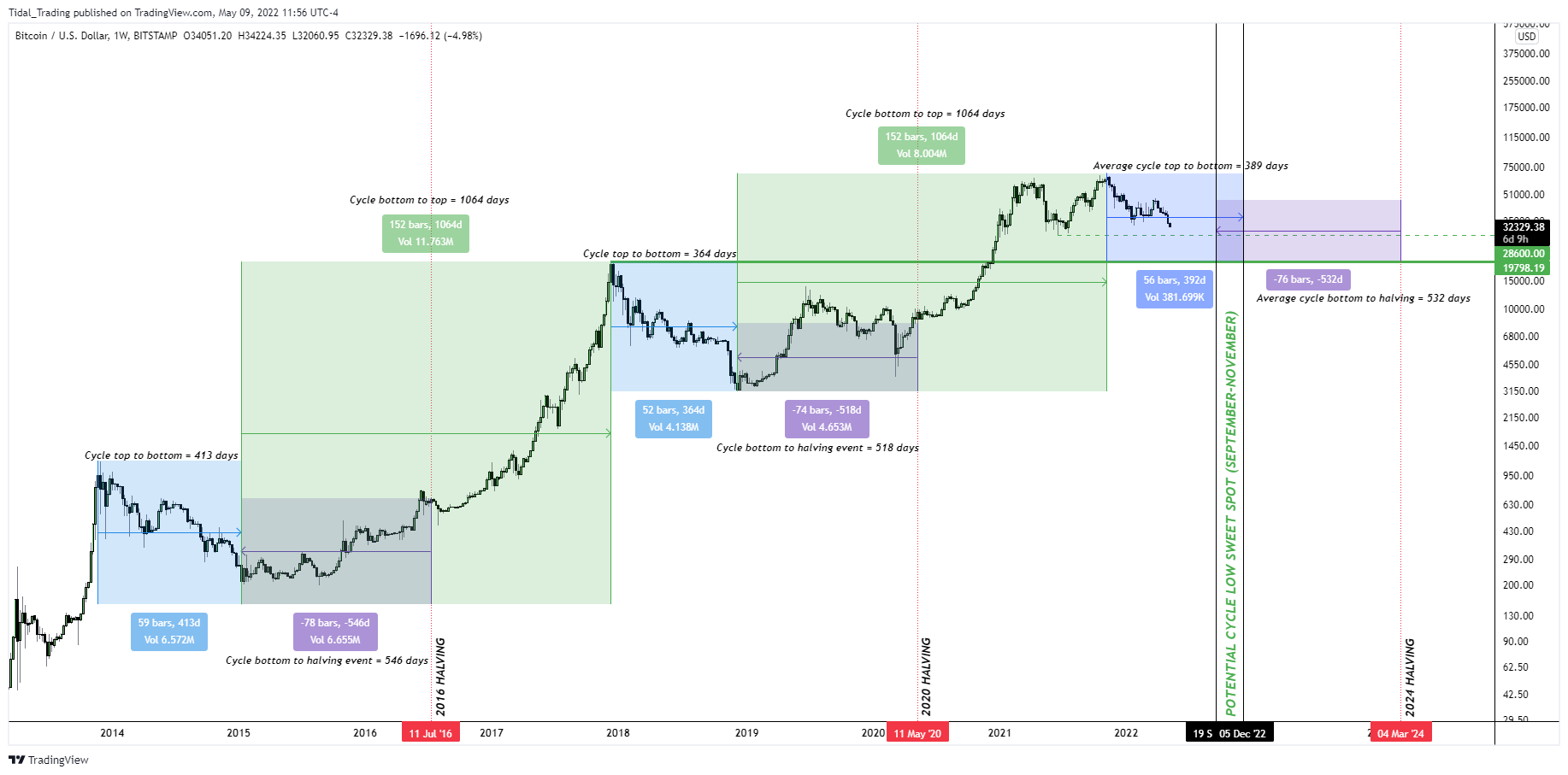
Crypto trader and analyst HornHairs believes a bottom is not in yet and that more pain is likely.

 “Looking at the average time from cycle highs to cycle lows, as well as the average time cycle lows occur before the next halving, September-November of this year would be the most historically similar to previous cycles, in terms of time span, for a bottom to form.”

Chart showing historical price movement for BTC. Source: HornHairs on Twitter.

According to Michael van de Poppe, a full-time trader and top crypto analyst, investors might want to watch the current price levels for BTC. In his view, the area could provide for a “bounce play.”

Bitcoin was trading around $31,580 on Monday afternoon, nearly 7.5% down in the past 24 hours.

The post Bitcoin falls below $32K as on-chain data suggests more pain likely appeared first on Coin Journal.