Bitcoin volatility trended downwards in Q3: report

  • Bitcoin’s average 30-day volatility in August was 60%, while it stood at 80% in June.
  • In 2022, risk asset markets (crypto included) have traded lower and Bitcoin more so like a high-beta US stock.

Bitcoin (BTC) realized volatility during quarter three has trended downwards, according to the latest report on the metric from crypto intelligence and research firm Messari.

Per the research platform, the benchmark cryptocurrency recorded the lower volatility as the crypto saw a slight recovery from June lows.

So while BTC has once again dipped below $20,000 in September, the recovery from the $17,600 levels in June and the retest of key resistances near $25,000 in mid-August was key.

Bitcoin realized volatility trended downwards as it made a gradual recovery in Q3. Average 30-day volatility for August was 60% compared to over 80% for June,” Messari’s Sami Kassab and Kuna Goel wrote in the State of Bitcoin Q3 2022 report.
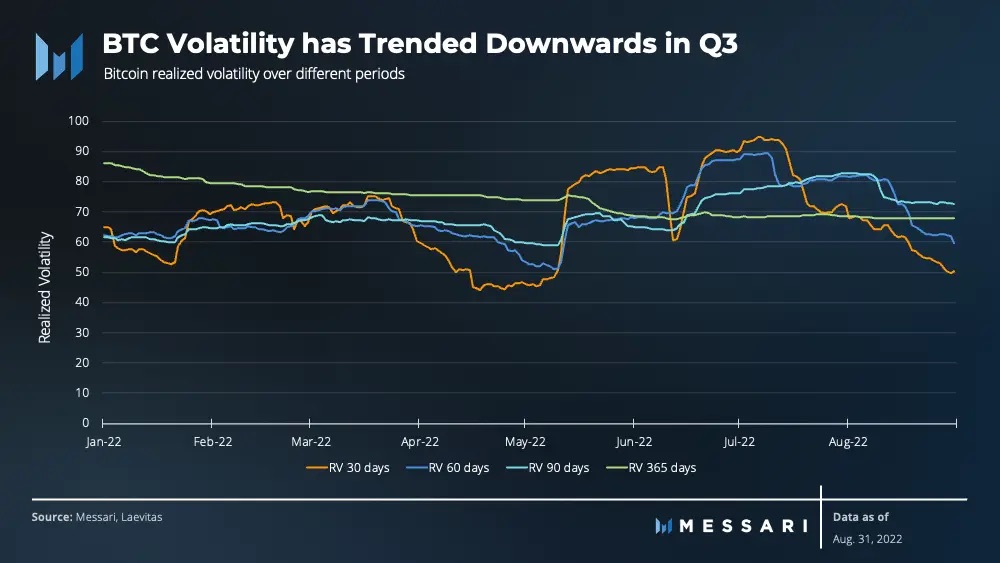
BTC volatility chart showing downward trend in Q3. Source: Messari

The lower volatility for the world’s largest cryptocurrency by market cap saw the broader crypto market record much lower liquidations across the period, the analysts added. For instance, total long liquidations stood at $5 billion in August, a more than 50% drop from the $10.8 billion recorded in June.

As for total short liquidations, the figure fell to $3.5 billion last month, compared to $6.6 billion total liquidations seen in June.

BTC traded like a high-beta US tech stock

As crypto prices see-sawed over the quarter, Messari notes, Bitcoin traded more like a tech stock as it tracked the Nasdaq 100 (rebased). 

This happened not just as the federal fund rates increased across the three months, but reflected the rot going back to late 2021. Prior,  availability of easy money amid institutional adoption, had helped fuel the bull market.

For the quarter, the average correlation between Bitcoin and NASDAQ 100 was 0.6 as inflation and rate hikes dominated the narrative. Surprisingly, digital gold and physical gold are far less correlated. The average correlation for the quarter between the two assets was 0.2,” Kassab and Goel wrote.

Overall, Q3 has seen Bitcoin essentially lose two of its key narratives – as an inflation hedge and store-of-value asset – amid the bear market crash that precipitated declines of over 72% since the all-time-highs of 2021.

Bitcoin was trading around $18,910 on Sunday afternoon, about 6% and 13% down over the past 7 days and 30 days respectively.

The post Bitcoin volatility trended downwards in Q3: report appeared first on CoinJournal.

Tezos upgrade Kathmandu goes live on mainnet

Kathmandu has introduced several new features set to improve network scalability and security.

Tezos, the layer 1 proof of stake blockchain designed to self-upgrade and evolve as it scales amid adoption, has successfully activated the latest protocol upgrade on the mainnet.

On Friday, the 11th upgrade dubbed Kathmandu went live on the Tezos PoS network at block 2,736,129, following a community adoption.

As noted in the proposal that ran from 9-23 September, the new upgrade comes after another named Jarkata went live on 28 June, 2022. The upgrade proposal was made by Tezos contributors and research firms Nomadic Labs, DaiLambda, Marigold, Oxhead Alpha, TriliTech, Tarides, and Functori & Tweag.

Upgrade brings new features

Kathmandu’s activation keeps with Tezos’s regular schedule and as with previous protocol changes, this adds a number of features set to massively improve on scalability.

These include smart contract optimistic rollups, pipelined block validation that’s set to improve transactional throughput, and improved randomness for enhanced network security- this is achieved via verifiable delay functions. 

Other features added include tailored governance via new permanent testnets that allow for more room for developers to experiment, event logging and increased paid storage for smart contracts.

Tezos launched in mainnet in 2018, with the network going live following an initial coin offering in 2017.

The post Tezos upgrade Kathmandu goes live on mainnet appeared first on CoinJournal.

Tether’s USDT launches on Polkadot

Tether’s USDT is now live on 11 blockchain networks and ecosystems, including Ethereum, Tron and Solana.

Tether, the company behind the world’s largest and most widely used US dollar-pegged stablecoin USDT, has announced that tokens are now live on the Polkadot (DOT) blockchain.

USDT, with a market capitalisation of more than $68 billion, is currently the third largest by market cap behind Bitcoin (BTC) and Ethereum (ETH).

USDT now on Polkadot

Polkadot is a decentralised blockchain platform supporting a thriving Web3 ecosystem, and the launch of the USDT stablecoin is another milestone set to boost network growth and benefit the community of users.

Polkadot is on a trajectory of growth and evolution this year and we believe Tether’s addition will be essential in helping it continue to thrive,” Tether CTO Paolo Ardoino said in a statement.

With this launch, USDT is adding a liquid and stable token to the network’s DeFi space and will allow users to easily move in and out – a factor not to be downplayed in a volatile market.

Tether is now available on 11 blockchain networks, including top smart contracts and largest Proof-of-Stake network Ethereum, Tron, Avalanche, Solana, Kusama, Ethereum, Algorand, and EOS.

USDT is also live on NEAR, Liquid Network, Omni, and Bitcoin Cash’s Standard Ledger Protocol. 

The post Tether’s USDT launches on Polkadot appeared first on CoinJournal.

GitHub lifts ban on Tornado Cash’s code repositories

GitHub, the most widely used software hosting online platform, has today reversed its decision to completely ban Tornado Cash’s open source code. However, despite lifting the ban, the functionality of the code repositories remains restricted to “read-only” allowing visitors to only open and read the code.

The move comes days after the US Treasury clarified that the sanctions against Tornado Cash did not apply to the sharing and reading of the app’s code.

Tornado Cash ban

Tornado Cash was launched in 2019 as a privacy-preserving tool aimed at shielding users’ financial activities on public blockchains like Ethereum.

The use of Tornado Cash and certain Ethereum addresses connected to the app was blacklisted by the US Treasury Department Office of Foreign Assets Control (OFAC) in August. The OFAC cited the app’s use by criminals for money laundering.

It was after the blacklisting by the OFAC that GitHub banned and removed the entire Tornado Cash code to remain compliant with the regulator.

Why did GitHub reverse its Tornado Cash ban?

However, the US Treasury on September 13 clarified that the blacklisting of Tornado Cash did not prohibit people from reading and sharing the app’s code.

The official post by the US Treasury read:

“US persons would not be prohibited by U.S. sanctions regulations from copying the open-source code and making it available online for others to view, as well as discussing, teaching about, or including open-source code in written publications.”

It is following this clarification that GitHub has modified its blanket ban on the app’s code although the full functionality of Tornado Cash on GitHub has not been reinstated.

The post GitHub lifts ban on Tornado Cash’s code repositories appeared first on CoinJournal.

Reserve Rights (RSR) rallies ahead of mainnet launch: here’s where to buy the RSR

Reserve Rights (RSR), the native token of Reserve Protocol, has rallied 33% in the past 24 hours as the mainnet launch nears. The token was trading at $0.007756 at press time.

The mainnet launch is expected to take place in October this year with five audits already completed so far.

To help traders who want to take advantage of the current Reserve Rights price surge ahead of the mainnet launch, Coinjournal has prepared this brief guide on where to buy the RSR token.

To find out more, please continue reading.

Where to buy RSR cryptocurrency

Binance

Binance is one of the largest cryptocurrency exchanges in the world. It is better suited to more experienced investors and it offers a large number of cryptocurrencies to choose from, at over 600. Binance is also known for having low trading fees and a multiple of trading options that its users can benefit from, such as; peer-to-peer trading, margin trading and spot trading.

Buy RSR with Binance today

KuCoin

Kucoin is a cryptocurrency exchange which offers over 200 cryptocurrencies. Kucoin has a wide range of services, such as; a built-in peer-to-peer exchange, spot and margin trading, bank level security and a wide range of accepted payment methods. Users can benefit from a beginner-friendly interface and relatively low fees.

Buy RSR with KuCoin today

What is Reserve Rights cryptocurrency?

Reserve Rights (RSR) cryptocurrency is a native token of the Reserve Protocol, which is a pool of stablecoins. It was launched in May 2019 after a successful Initial Exchange Offering (IEO) on the Huobi Prime platform.

The Reserve Protocol is designed to reduce risk through diversification and decentralized governance.

The RSR token is an ERC token and it is used for insuring Reserve stablecoins (RTokens) on the Reserve Protocol through staking and for governing the Reserve Protocol pools through proposing and voting on changes to be effected on the pool configurations.

RSR stakers receive a staking reward for providing insurance to RTokens.

Should I buy RSR today?

RSR could be a good buy now that its price is rallying ahead of its mainnet launch, which is expected to trigger a further upward movement.

However, the cryptocurrency market is an extremely volatile market and it can be very unpredictable at times. Therefore, it is important to proceed with caution.

Reserve Rights price prediction

Analysts expect RSR to maintain the current bullish trend, which they predict will gather momentum after the Reserve Rights mainnet launch, scheduled for October.

Reserve Rights social media trends


The post Reserve Rights (RSR) rallies ahead of mainnet launch: here’s where to buy the RSR appeared first on CoinJournal.