TerraUSD (UST) vs Dai (DAI) – Which one is a better investment?

 UST and DAI are two stablecoins backed by other cryptocurrencies. Unlike other stablecoins, they are decentralized. Stablecoins are cryptocurrencies that maintain a stable price by being tied to another asset; crypto or fiat. They are less volatile than other cryptocurrencies.

 DAI was launched in 2017 by MakerDAO and was built on the Ethereum blockchain. It has the stability of a stablecoin and is as secure as the Ethereum platform. Its stability is maintained by collateralizing it with ETH in a smart contract algorithm. It helps secure and power the Maker network on which it is generated and traded.

 UST was launched in September 2020 by Terraform Labs. It is stabilized with the aid of a smart contract algorithm and an elastic money supply mechanism. New USTs are minted through a process called seigniorage. It is collateralized by LUNA- Terra’s native coin.

 Both stablecoins are decentralized as they have no central authority like the other popular stablecoins. Similarly, they are pegged to cryptocurrencies rather than fiat currencies. They use smart contract algorithms to maintain stable prices.

 In minting DAI, the collateral (ETH) must be way more than the amount of DAI to be minted. UST, on the other hand, needs an equivalent of LUNA in USD to mint the same amount. In doing this, a percentage of the LUNA is burnt, and another is reserved for the community treasury. The more UST is demanded, the more the appropriate amount of LUNA is burnt.

 The smart contract algorithm used for stabilizing UST can generate UST and maintain itself. However, high volatility with ETH can affect the stability of DAI. Also, the market caps and trading volumes of these assets indicate that UST is adopted over DAI.

 This might be due to UST’s arbitrage system that helps it automatically maintain supply when it is below peg. Right now, the Anchor protocol has made it possible to earn an APY of about 20% when UST is lent out. If you are looking to invest in a decentralized stablecoin, UST is the better investment.

 In the crypto space, everything is volatile no matter how stable it seems. Thus, deal wisely and do your research. Don’t invest beyond what you can’t afford to lose.

The post TerraUSD (UST) vs Dai (DAI) – Which one is a better investment? appeared first on Coin Journal.

LINK/USD value rose to a high of $18.05, as the recent bullish trend persists

  • At $18.05, there was resistance.

  • At $15.5, the LINK/USD pair found strong support.

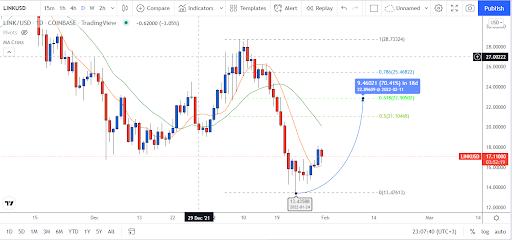
The Chainlink price research shows that bulls have been ready to withstand the negative wave, which is good for cryptocurrencies. The currency had tremendous depreciation over the current month, but prices are steadily increasing, and they are predicted to reach beyond their current price level of $17 in the near term. 

However, the next barrier is still at $18.6, which explains why the price oscillation is moderate today. However, if the bullish trend continues in the following 24 hours, the resistance level may be exceeded, and LINK may have a smooth rally to $20, which is the next key level. 

The bulls maintain their advantage, overcoming the bearish impediment

According to the most recent updates, the one-day price chart for the Chainlink price review reveals that cryptocurrency prices have grown today, with negative pressure also visible. The price had hit $18.053, up 10.36 percent on Sunday. The chart also illustrates that the bulls attempted to make a comeback in recent days and have now regained control as bulls today have held prices above prior low. 

Source – TradingView

The four-hour Chainlink price analysis shows that the bullish trend is regaining control. The last few hours have been quite advantageous for the bulls, with the short-term moving line displaying more green candlesticks, surpassing the impediment created by the bears in earlier hours of the day.

The post LINK/USD value rose to a high of $18.05, as the recent bullish trend persists appeared first on Coin Journal.

FIL/USD has a potential to gain 30% if bullish momentum is sustained

  • Filecoin price analysis turns optimistic.

  • At $19.2, there is support for FIL.

  • At $21.9, there is some resistance.

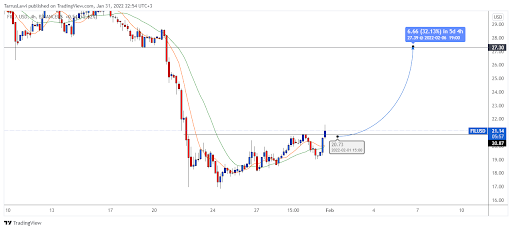
The most recent Filecoin price analysis indicates a positive trend, as the price has increased significantly today. Yesterday, the value of FIL peaked at $19.6 after breaking over the barrier of $19.3, and today, the bullish upswing has led to a further gain in the price, with its value increasing to $20.3, hitting a weekly high. At the start of today’s trading session, the price breakout was higher, as bulls managed to maintain their advantage. Prices are projected to rise much more in the following hours.

The upward trend in the FIL/USD 1-day price chart continues over $20

The one-day Filecoin value analysis reveals that today’s price function is still moving higher. The price has risen, and the coin is now worth $20.3. Although these price fluctuations are minor, the cryptocurrency has acquired a valuation of 5.60 percent in the previous 24 hours. The crypto combination has earned a value of 8.80 percent in the last week; perhaps, the price will rise more during the day. 

The FIL/USD has been able to hold the price level during this week, as the persistent downward trajectory appears to be drawing to a halt.

Source – TradingView

Even though the bulls had previously dominated the market movements, the bears hampered the price function, and a reversal was also witnessed four hours ago. However, the price is presently filling the range again, as it trades around the upper threshold of the volatility indicator.

As a consequence of the recent positive movement, the price is presently at $20.3.

The current moving average value is $19.7. Volatility is minimal, suggesting that an upswing is imminent. The Bollinger Bands Indicator’s upper limit is $20.55, signaling resistance for FIL’s price, while its lower limit is $18.1.

The post FIL/USD has a potential to gain 30% if bullish momentum is sustained appeared first on Coin Journal.

LINK vs BAND – Which one is a better investment?

 Chainlink and Band protocol are two blockchain oracles that have been gaining momentum. Oracles are a new type of technology that enables the transfer of real-world data into the blockchain network. They make data readily available for blockchains and their smart contracts. It can be hardware, software, or consensus-based.

 Chainlink is the first oracle platform, and it was launched in September 2017 on the Ethereum blockchain. It aims to integrate off-chain data with existing smart contracts. It provides projects on the Ethereum blockchain with relevant data. In essence, it comprises nodes built on an oracle framework to transmit data and information from off-blockchain sources to the smart contracts on supported blockchains.

 Its execution process includes oracle selection, data reporting, and result aggregation. Like Chainlink, Band protocol connects the blockchain network with verifiable data from the outside world. It was initially built on the Ethereum blockchain in 2017 when it was launched. However, it was recently moved to the Cosmos network.

 It uses the Tendermint Delegated-Proof-of-Stake consensus algorithm. Also, it has Inter-Blockchain Communication (IBC) protocol that allows it to interact with other blockchains. It is aimed at improving speed, scalability, cross-chain interoperability, and data flexibility on the blockchain.

 While both offer nearly the same functionality, the Band protocol is interoperable, cheaper, faster, and easier to use. Moreover, data providers can earn their data native tokens for data provision. While the total and max supply of LINK is 1 billion, BAND is capped at 100 million.

 One LINK is worth $16.26 as of today having dropped by 68.8% from its ATH of $52.70 in May 2021. BAND, on the other hand, costs $3.50 right now which is 84.8% from its peak of $22.83 in April 2021. As blockchain oracles, BAND has the potential of outperforming LINK in the long run and is low right now that you can bag it massively. In the long run, its limited supply will contribute to driving its price upward.

 This is asides from its compatibility with other blockchains and eco-friendly nature. If you are looking for something stable and secure, LINK is the call. But if you want a long-term investment option, then go for BAND.

Cryptocurrency investment is very risky. Do not put the money you can’t afford to lose wholeheartedly. Deal wisely and do your research.

The post LINK vs BAND – Which one is a better investment? appeared first on Coin Journal.
LUNA vs AAVE – Which one is a better investment?

 Decentralized finance (DeFi) uses smart contracts to decentralize and disrupt the financial system. It aims to eliminate intermediaries, remove paperwork, and create equal opportunities. Blockchain technology has led to the creation of numerous DeFi platforms, including Terra and Aave, which would be a better buy between the native tokens of these two platforms.

 Aave was initially ETHLend when it was launched in 2017 by Stani Kulechov. It was one of the pioneer DeFi platforms that provided liquidity for borrowers and lenders in the crypto space. It also allowed users to stake their AAVE for rewards and discounts. Asides from this, it supports Aave pay, Aave clearing, and Aave gaming.

 LUNA is the native token of the Terra blockchain, a blockchain in 2018 by Daniel Shin and Do Kwon. It was built on the Cosmos SDK and operated on the Tendermint Delegated-Proof-of-Stake consensus algorithm. It is a DeFi platform that allows the deployment of stablecoins. Transactions are settled instantly at low fees across borders. Mirror Finance, Anchor Protocol, and CHAI payment app are some projects on the ecosystem.

 While LUNA was created on the Terra blockchain, AAVE is an Ethereum token. This implies that AAVE will be affected by the high transactions fees of the Ethereum network. To get one AAVE, you need $152.65, whereas a LUNA costs $52.72.

 The increase in the adoption of the Terra blockchain is evident in the market cap of LUNA ($21.08 billion), unlike AAVE which has a low market cap ($2.04 billion). Similarly, their 24-hour market cap shows that LUNA is being traded largely compared to AAVE ($3 billion to $125 million). It is predicted that LUNA can do times four its current price before the end of the year.

 LUNA’s price would be driven by its significant role in the Terra blockchain as it helps to stabilize the economy amidst other functions. The price aside, LUNA is the best buy anytime any day. It is advisable to bag as much as you can before the bull run returns.

 However, this isn’t enough; do your research, average the dollar cost, and deal wisely.

The post LUNA vs AAVE – Which one is a better investment? appeared first on Coin Journal.