
Switzerland’s 4th largest bank ZKB launches Bitcoin and Ethereum trading

  • Zürcher Kantonalbank (ZKB) now offers Bitcoin and Ethereum trading via ZKB eBanking and Mobile Banking.
  • The bank has partnered with Crypto Finance AG and will use Fireblocks for secure custody.
  • The services are available only to Swiss residents with the necessary agreements signed.

Zurich Cantonal Bank, Switzerland’s fourth-largest bank locally known as Zürcher Kantonalbank (ZKB), has taken a major step into the cryptocurrency realm with the launch of Bitcoin (BTC) and Ethereum (ETH) trading services.

Announced on September 4, this development marks a significant milestone in the mainstream adoption of digital currencies by traditional financial institutions.

ZKB has partnered with Crypto Finance AG and Fireblocks

ZKB’s new offering allows retail clients to trade and store Bitcoin (BTC) and Ether (ETH) directly through its digital platforms: ZKB eBanking and ZKB Mobile Banking. This integration provides a seamless experience for customers, who can now manage their cryptocurrency holdings alongside their traditional investments without needing separate wallets.

To ensure a secure and regulated environment for these transactions, ZKB has partnered with Crypto Finance AG, a subsidiary of Deutsche Börse Group.

Crypto Finance AG’s technology, licensed by both FINMA and BaFin, will support the ZKB’s trading operations, ensuring compliance and security.

ZKB has also developed its own crypto custody solution, with Fireblocks playing a key role in safeguarding digital assets.

This strategic moves positions ZKB at the forefront of the cryptocurrency revolution, providing a centralized platform for trading and storage that eliminates the need for clients to manage their own private keys.

According to Alexandra Scriba, ZKB’s head of institutional clients, the bank’s approach offers high levels of security and the potential for integrating other digital currencies and applications in the future.

Currently, the crypto trading services are only available to clients residing in Switzerland and to activate an account, clients must sign agreements for trading, securities, and a “Consent Declaration Disclosure.”

This cautious approach reflects ZKB’s commitment to maintaining robust security standards while expanding access to digital currencies.

ZKB’s entry into the cryptocurrency market underscores a broader trend within the banking sector, where institutions are increasingly embracing digital assets. Competitors like PostFinance are also exploring crypto services, highlighting a growing acceptance of digital currencies in traditional finance, paving the way for more integrated and accessible cryptocurrency solutions.

The post Switzerland’s 4th largest bank ZKB launches Bitcoin and Ethereum trading appeared first on CoinJournal.
Threshold community proposes merger to safeguard WBTC amid growing concerns

  • Threshold community proposes merging tBTC with WBTC.
  • The proposal is driven by concerns over WBTC’s stability due to Justin Sun’s involvement.
  • According to the proposal, BitGo will receive T tokens, becoming a major stakeholder in Threshold Network.

In a strategic move to protect the future of Wrapped Bitcoin (WBTC), a proposal dubbed “#saveWBTC – a merger with Threshold’s tBTC” has been put forward to merge the decentralized tBTC token of Threshold with BitGo’s WBTC.

The proposal, currently under discussion on Threshold’s forum page, comes in response to rising concerns within the crypto community regarding WBTC’s stability following BitGo’s partnership with Hong Kong-based BiT Global, a company partly owned by Justin Sun, founder of the Tron ecosystem.

Unease with Justin Sun’s involvement with WBTC

The partnership has raised alarms due to Sun’s controversial track record, with past incidents of misappropriating collateral. This unease has already led major DeFi protocols like MakerDAO to limit their exposure to WBTC, halt its use as collateral, and consider fully offboarding the asset.

Aave, another significant player in the DeFi space, is also closely monitoring the situation.

The Threshold, WBTC merger proposal

The merger proposal seeks to replace WBTC’s centralized custody and merchant-based mint and burn model with its decentralized and permissionless mint/redeem mechanism. This transition aims to ensure the safety and stability of the underlying collateral, reassuring users and protocols reliant on WBTC.

The plan involves granting Threshold’s DAO merchant privileges for WBTC while disabling tBTC minting, allowing existing tBTC holders to redeem WBTC at a 1:1 ratio.

As part of the proposal, BitGo would receive a grant of T tokens, making it the largest stakeholder in the Threshold Network.

The merger would be implemented in stages to ensure a seamless transition, with a fallback plan to offboard WBTC safely if the proposal is declined.

By combining WBTC’s established user base and liquidity with tBTC’s decentralized technology, Threshold aims to preserve WBTC’s role in the DeFi ecosystem, ensuring that the concerns over BiT Global’s involvement do not destabilize the broader market.

The post Threshold community proposes merger to safeguard WBTC amid growing concerns appeared first on CoinJournal.

Bitcoin ETFs outperform Ether ETFs as BlackRock’s IBIT leads peers

  • Bitcoin ETFs have attracted $5B net inflows while Ether ETFs have seen $500M net outflows.
  • BlackRock’s IBIT leads with over $224M in a single day, currently holding over 350,000 BTC.
  • Ether ETFs are struggling due to liquidity issues and Grayscale’s $2.5B outflows.

Recent trends in the cryptocurrency exchange-traded funds (ETF) market have highlighted a significant divergence in the performance of Bitcoin and Ether ETFs.

Comparing Bitcoin ETF Flow data to Ethereum ETF Flow data on Farside Investors, Ether spot ETFs have underwhelmed compared to their Bitcoin counterparts. Since their launch, Ether ETFs have experienced net outflows of approximately $500 million, a stark contrast to the $5 billion net inflows recorded by BTC ETFs during a similar period following their debut.

Several factors contribute to this disparity. To start with, Bitcoin’s “first mover advantage,” higher liquidity, and lack of staking opportunities in Ether ETFs have made Bitcoin more appealing to institutional investors.

Additionally, unexpected outflows from Grayscale’s Ethereum Trust (ETHE), amounting to $2.5 billion, far exceeding the bank’s initial $1 billion estimate, have further dampened Ether ETF performance. To counter these outflows, Grayscale introduced a mini-Ether ETF, but it has only managed to attract $200 million in inflows.

In contrast, BTC ETFs have shown resilience and robust performance with US-based BTC ETFs recording an impressive eight-day winning streak, with net inflows totalling $202 million led by BlackRock’s iShares Bitcoin Trust (IBIT).

On August 26 alone, IBIT attracted over $224 million in net inflows bringing its total Bitcoin holdings to over 350,000 BTC, solidifying its dominance in the market.

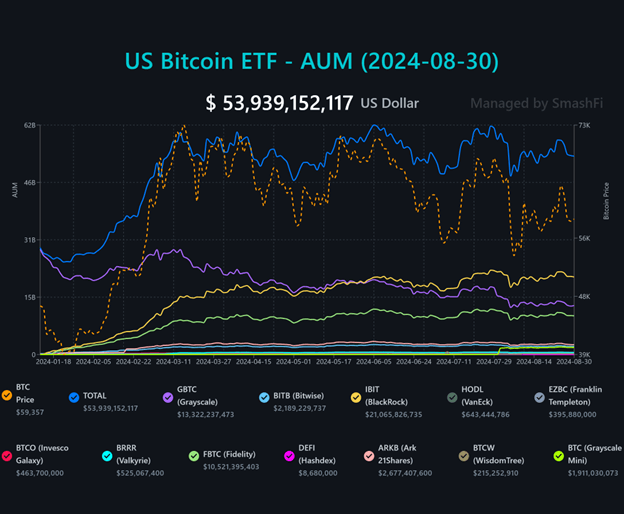
Bitcoin ETF flows outperform Ether ETFs as BlackRock's IBIT leads peers
US Bitcoin ETF AUM, August January 18 – August 30, 2024|Source: Bitcoin ETF Fund Flows

Competing funds such as those managed by Franklin Templeton and WisdomTree also saw positive inflows, while others, including Fidelity, Bitwise, and VanEck, reported negative flows. Notably, Grayscale’s Bitcoin Trust (GBTC) saw a decline in redemptions over the past two weeks, indicating stabilization in the market.

As investor confidence in Bitcoin ETFs grows, asset managers are increasingly exploring combined ETFs that offer exposure to both Bitcoin and Ethereum, reflecting the evolving dynamics of the cryptocurrency investment landscape.

The post Bitcoin ETFs outperform Ether ETFs as BlackRock’s IBIT leads peers appeared first on CoinJournal.

Metaplanet partners with SBI VC Trade to enhance Bitcoin strategy

  • Japanese investment firm Metaplanet has announced a partnership with SBI VC Trade, a subsidiary of financial services behemoth SBI Group.
  • Partnership will help boost Metaplanet’s Bitcoin strategy, including compliance.
  • Metaplanet has acquired 360 Bitcoin (BTC) as it targets becoming ‘Asia’s MicroStrategy’

In an announcement on Sept. 2, Metaplanet said its collaboration with SBI VC Trade is part of the company’s quest to enhance its Bitcoin strategy with support from Japan-based firms. This includes trading, custody and management of Metaplanet’s Bitcoins.

Metaplanet is a publicly-traded company listed on the Tokyo Stock Exchange and the partnership with the SBI crypto arm offers a route to further compliance.

“A key element of this partnership is access to a compliant corporate custody service that prioritizes tax efficiency and offers the potential to utilize Bitcoin as collateral for financing,” Metaplanet said in a statement.

The alliance with SBI VC Trade aligns with Metaplanet’s vision of becoming a leading modern financial services firm. It also adds flexibility to Metaplanet’s corporate strategy, bolstering its efforts to accumulate more BTC via equity and debt financing.

Metaplanet will update its stakeholders of any financial o material impact that arises from the partnership, part of the statement read.

BTC as a corporate strategy

The partnership with SBI VC Trade comes amid Metaplanet’s increasing bet on Bitcoin as part of its corporate strategy. In April 2024, the company disclosed its addition of BTC as a core treasury asset and committed an initial 1 billion Japanese yen to buying Bitcoin.

Over the next months, the strategic pivot has seen the industry dub Metaplanet as “Asia’s MicroStrategy” in a nod to its target to mirror the US-listed MicroStrategy’s embrace of the digital asset.

Currently, the Michael Saylor-led company has acquired a total of 226,500 BTC. This accounts for just over 1% of the total supply of Bitcoin and makes MicroStrategy the largest holder of BTC among publicly-traded companies.

On the other hand, Metaplanet holds a total of 360 BTC, having increased its holdings with a series of purchases over the past two months.

The post Metaplanet partners with SBI VC Trade to enhance Bitcoin strategy appeared first on CoinJournal.

Bitcoin Dogs (0DOG) surges as Bitcoin (BTC) demand increases in the US

  • Bitcoin Dogs’ token 0DOG surges after launching a high-APY liquidity pool.
  • Rising Bitcoin interest in the US boosts 0DOG’s value amid broader market trends.
  • Despite a US demand spike, global Bitcoin demand and profits remain weak.

The cryptocurrency market is abuzz with recent developments as Bitcoin Dogs’ native token, 0DOG, experiences a dramatic surge amidst rising Bitcoin demand in the US. This notable increase in 0DOG’s value comes on the heels of the launch of its liquidity pool and a spike in Bitcoin interest following Federal Reserve Chair Jerome Powell’s comments.

While Bitcoin’s broader market demand remains negative, the US sector’s engagement is driving significant shifts in both Bitcoin Dogs and Bitcoin itself.

Bitcoin Dogs (0DOG) sees significant rebound

Bitcoin Dogs (0DOG) has recently captured the spotlight with an impressive price surge following the launch of its highly anticipated liquidity pool.

Initially, 0DOG faced a bearish trend, dipping to a low of $0.00603 after an initial surge on its first trading day. However, the token’s fortunes have reversed sharply with the liquidity pool’s debut. At press time, 0DOG was trading at 0.01646 after surging above $0.029 on August 30, 2024.

The newly launched liquidity pool, offering an initial APY of 405.56%, has been a major catalyst for the price spike, drawing significant investor interest.

The liquidity pool’s dynamic APY structure is designed to incentivize early participation, making it a lucrative opportunity for investors.

With an initial pool size of $50,000, the APY will decrease as the pool grows, encouraging early entry to maximize returns. This structure, combined with Bitcoin Dogs’ innovative approach as the world’s first ICO on the Bitcoin BRC20 token, is driving heightened investor enthusiasm.

The integration of 0DOG into the Telegram gaming sector and the forthcoming NFT collection further bolsters its growth prospects.

These strategic developments are expected to attract a significant user base and provide added value through in-game utility for NFTs.

Rising Bitcoin (BTC) demand in the US

As Bitcoin Dogs regains its footing, Bitcoin’s demand in the US has shown a notable increase following Federal Reserve Chair Jerome Powell’s remarks at the Jackson Hole symposium.

This uptick in US investor interest is evident from the rise in the Coinbase Premium to 0.11%, indicating higher local demand compared to international exchanges. The Inter-exchange Flow Pulse (IFP) metric has also seen a rally, signalling that BTC is flowing into US-based platforms in response to the price premium and increased demand.

Despite this localized surge, overall Bitcoin demand growth remains lacklustre. The price of Bitcoin has been struggling to stay above $60,000 making investor engagement not to be marked by significant profit-taking.

Realized profits of $536 million are modest compared to the multi-billion-dollar figures observed at previous market peaks. Furthermore, the Apparent Bitcoin Demand 30-day growth has transitioned from a positive 496,000 BTC in April to a negative 36,000 BTC, reflecting a broader decline in demand.

Conclusion

While Bitcoin Dogs (0DOG) benefits from the recent liquidity pool launch, there has been a rising Bitcoin interest in the US while the broader market presents a mixed picture.

For more information about the relatively new Bitcoin Dogs project, whose native token is currently available for trading on MEXC, Gate.io, and Unisat, you can visit the project’s official website.

The post Bitcoin Dogs (0DOG) surges as Bitcoin (BTC) demand increases in the US appeared first on CoinJournal.