Bitcoin price drop caused by profit-taking and macroeconomic conditions

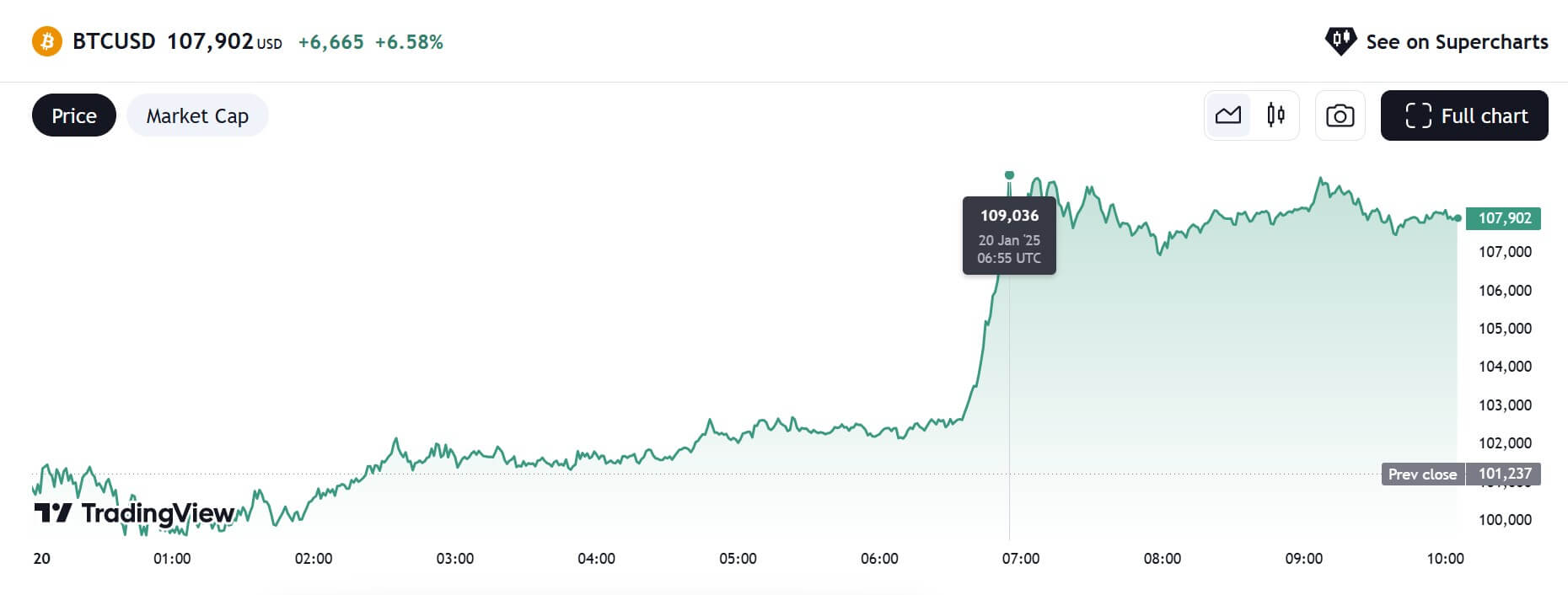
  • Bitcoin dropped to $89,900 on January 13, its lowest decline in two months
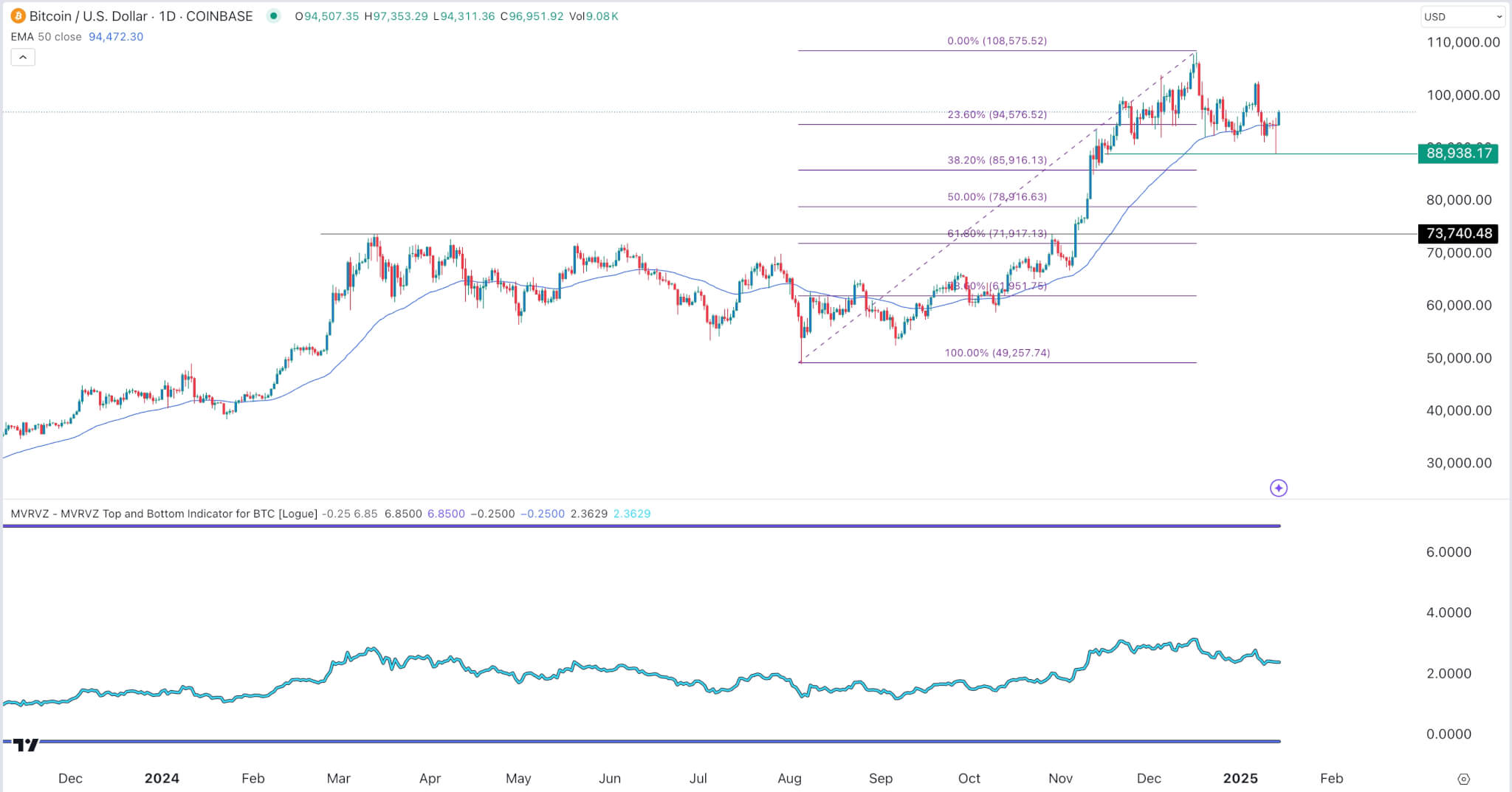
  • James Toledano, COO at Unity Wallet, said one of the reasons for the drop is profit-taking after Bitcoin hit $108,000 in mid-December
  • The inauguration of President-elect Donald Trump could spark renewed buying interest, Toledano said

Bitcoin fell below $90,000 for the first time in two months, dropping 3.6% in 24 hours as the market experienced selling pressure.

Data from CoinMarketCap shows that Bitcoin’s price dropped to around $89,900 on January 13. However, at the time of publication, it’s trading over $95,000.

Bitcoin drops below $89,000. Source: CoinMarketCap

According to James Toledano, COO at Unity Wallet, there are several reasons why Bitcoin’s price fell.

“The first is profit-taking, after hitting a peak of around $108,300 in mid-December, the market has seen a massive amount of it, particularly following the election of pro-crypto President-elect Donald Trump,” he said to CoinJournal, adding:

“Secondly, while institutional buying has continued contributing to Bitcoin reserves on exchanges hitting a seven-year low, trading volume remains subdued and this could simply be down to a seasonal slow-down.”

Macroeconomics weigh on the market

Recent analysis suggests that bleak economic expectations drive this bearish sentiment. This includes Trump’s tariff plans, the US Federal Reserve’s cautious approach to interest rate cuts, and a strong dollar.

Zach Pandl, head of research at Grayscale Investments, said to CNBC that:

“I would attribute the drawdown in the last two days largely to the market starting to appreciate that not every aspect of the Trump policy agenda is going to be positive for Bitcoin – and tariffs do introduce some new uncertainty.”

As questions surround Trump’s forthcoming policies, it may have dampened enthusiasm, which can “lead to short-term volatility for an already highly volatile asset,” said Toledano.

Some analysts believe Bitcoin can reach between $140,000 and $200,000 by mid-2025, so the current price action may appear concerning. Yet, it doesn’t necessarily signal the end of the bull run.

“The inauguration of President-elect Trump is just seven days away and could be a pivotal moment, with markets anticipating announcements of pro-crypto policies that might spark renewed buying interest,” said Toledano. “Institutional accumulation, as reflected in falling exchange reserves also supports the view that demand remains strong despite low trading volumes.”

The post Bitcoin price drop caused by profit-taking and macroeconomic conditions appeared first on CoinJournal.

Nasdaq-listed Heritage Distilling adopts Bitcoin strategy

  • Heritage Distilling Company has announced a Bitcoin treasury strategy
  • The Nasdaq-listed company will accept BTC for its products and services

Heritage Distilling, a publicly traded company listed on NASDAQ, is the latest to adopt Bitcoin as a reserve asset.

The distiller announced on January 10, 2025, that its board of directors had approved a proposal to add Bitcoin as a treasury asset. Heritage Distilling plans to accept Bitcoin payments for its products and services as part of the BTC treasury policy that will see the company acquire and hodl BTC.

“As noted in our policy statement, unlike traditional investors who purchase Bitcoin with cash and are immediately subject to potential pricing volatility, as a company producing goods for sale, acceptable margins between the retail price of our products and their cost of production is expected to offset potential fluctuations in the value of Bitcoin we accept as payment,” said Justin Stiefel, CEO of Heritage Distilling.

Stiefel added: “This provides us considerable financial flexibility as we develop product offerings for users and enthusiasts of Bitcoin.”

HDC board to approve BTC policy

Heritage’s technology and cryptocurrency committee is expected to outline a formal BTC treasury policy, which it will present to the company’s Board for approval. The next steps will see Heritage begin to accept, acquire, hold and use Bitcoin across its operations.

Bitcoin adoption as a treasury asset has gathered pace among public and private companies, the former led by MicroStrategy.

After acquiring over $100 million worth of BTC this week, MicroStrategy has increased its total Bitcoin holdings to 447,470 BTC. The company is the world’s largest corporate holder of BTC.

Other companies have drawn inspiration from the Michael Saylor-led US-listed company, many announcing Bitcon strategy policies in 2024. These include KULR Technology, Thumzup, and Genius Group, which announced on Jan. 10 that it had added $5 million BTC to its holdings.

The post Nasdaq-listed Heritage Distilling adopts Bitcoin strategy appeared first on CoinJournal.

Russia confiscates $10M Bitcoin from former law enforcement official

  • Russia seizes 2,718 Bitcoin worth $10M from ex-ICRF official.
  • The ex-official was involved in what has been termed the largest bribery case in Russia.
  • The confiscated bitcoins will be added to the state revenue.

Russian authorities have seized approximately $10 million worth of Bitcoin from Marat Tambiev, a former employee of the Investigative Committee of the Russian Federation (ICRF).

The seizure, reported by the local news agency TASS, involved the confiscation of 103 Bitcoin, stored in a Ledger Nano X hardware wallet, marking a significant moment in Russia’s handling of digital assets in legal contexts.

The largest bribery scandal in Russian history

Tambiev’s conviction stems from what has been described as the largest bribery scandal in Russian history, involving a staggering 2,718 BTC bribe, which was valued at around $258 million at the time of sentencing.

The Nikulinsky District Court of Moscow had previously ordered the seizure of 1,032 BTC from Tambiev in 2023, citing the assets as derived from unconfirmed income.

The case against Tambiev came to light after his arrest in March 2022, where investigators discovered the private keys to his Bitcoin wallet in a folder named “Retirement” on his laptop.

The source of the bribe was traced back to the Infraud Organization, a notorious hacker group. Members from Kazakhstan and Estonia allegedly bribed Tambiev in exchange for favourable judicial decisions, including efforts to halt their own criminal prosecutions and hide assets worth over $138 million in cryptocurrency.

This case not only showcases the scale of corruption within certain sectors of Russian governance but also reflects the country’s evolving stance on cryptocurrency.

The confiscated Bitcoin to be integrated into Russia’s state revenue

As part of the legal proceedings, the confiscated Bitcoin will now be integrated into Russia’s state revenue, a move that signals how the nation is dealing with digital currencies in official capacities.

This development comes as Russia is increasingly considering cryptocurrencies for international trade, especially as a means to circumvent Western sanctions.

The finance minister has indicated openness to using Bitcoin in foreign trade, showcasing a potentially dual approach to crypto — one of regulation and integration, alongside stringent action against its misuse in criminal activities.

The post Russia confiscates $10M Bitcoin from former law enforcement official appeared first on CoinJournal.

UK judge says there’s no “reasonable grounds” for success with Bitcoin landfill hard drive case

  • Upon hearing the judge’s decision, Howells said “it’s the great British justice system striking again”
  • Howells lost his hard drive in 2013 when it was accidentally thrown away at the tip
  • He has been trying to engage with Newport City Council for 12 years to recover his hard drive, but says he’s been “largely ignored”

James Howells has lost his case to recover a lost Bitcoin hard drive from a Welsh landfill that’s now worth around $740 million.

Howells accidentally threw out his hard drive containing 8,000 Bitcoin in 2013 during a household clearout. At the time, he had two hard drives of the same size: one was blank while the other contained his Bitcoin.

He mistakenly put the one containing the Bitcoin into a black bin bag, which his then-girlfriend took to the tip. At the time of his loss, his assets – that he mined in 2009 – were worth around $1.3 million.

In October, Howells sued Newport City Council for $646 million in damages after being denied access to the landfill due to environmental concerns.

Now, Judge Keyser KC, the Circuit Commercial Judge for Wales, has dismissed Howells’ case, stating that there are no “reasonable grounds” for succeeding at a full trial, reports the BBC.

A 12-year battle

Upon hearing the decision, Howells said he was “very upset,” adding “it’s the great British justice system striking again.”

Over the past 12 years, Howells said he has been trying to engage with Newport City Council to recover his lost hard drive, but has been “largely ignored.”

A court filing states Howells hard drive is located in Cell 2, Area 2 of the Docksway landfill. Yet, despite promises to safely excavate the Newport site and to modernize the landfill, the council have rejected Howells’ requests to dig due to “environmental concerns.”

Howells’ lawyers claim that the council have “simply ignored” that 10% of Bitcoin could bring “a huge and desperately needed investment in the local community.”

The judge’s decision comes as Bitcoin soared past $100,000 for the first time at the beginning of December, pushing to an all-time high of more than $108,000.

The post UK judge says there’s no “reasonable grounds” for success with Bitcoin landfill hard drive case appeared first on CoinJournal.

Oklahoma senator files Bitcoin Freedom Act enabling wages in BTC

  • The Bitcoin Freedom Act lets Oklahomans accept their wages in Bitcoin
  • Oklahoma State Senator Deevers said Washington is “ruining the US dollar”
  • The Bitcoin Freedom Act is eligible for consideration in the 60th legislative session beginning on February 3

Oklahoma State Senator Dusty Deevers has filed legislation allowing employees to receive wages in Bitcoin and businesses to accept Bitcoin payments.

Introducing the Bitcoin Freedom Act, Deevers said: “In a time when inflation is eroding the purchasing power of hard-working Oklahomans, Bitcoin provides a unique opportunity to protect earnings and investments.”

Deevers continued: “As Bitcoin continues to rise and the value of the dollar continues to be printed away in Washington D.C., Oklahoma must act to protect our people.”

The bill, known as SB325, states under section 4 that: “Any employee of this state, business, corporation, other entity, and resident of this state may negotiate and receive payment and compensation, including salaries, wages, and other forms of compensation, in Bitcoin.”

Embracing the future of finance

Deevers pointed out that Bitcoin is becoming increasingly seen as a hedge against inflation, unlike traditional currencies such as the US dollar. Taking to X, Deevers posted: “If Washington DC can ruin something, it likely will. And it is certainly ruining the US dollar.”

Continuing, Deevers wrote: “This small but possibly revolutionary change has the potential to offset the harms suffered due to inflation and make Oklahoma a national leader who embraces the future of financial technology.”

Deevers also praised President-elect Donald Trump who spoke at Bitcoin events during his presidential election.

“Bitcoin has arrived into the mainstream of our economy and is unquestionably a significant part of the financial future,” he added.

The Bitcoin Freedom Act is eligible for consideration in the 60th legislative session beginning on February 3.

The post Oklahoma senator files Bitcoin Freedom Act enabling wages in BTC appeared first on CoinJournal.