Crypto market sheds $633.5B in Q1 2025 as Trump rally momentum fades

  • Bitcoin’s market share rose to 59.1% despite falling 11.8%.
  • Ethereum’s 2024 gains wiped out in Q1 2025.
  • DeFi TVL fell 27.5% across multichain platforms.

The global cryptocurrency market started 2025 with optimism, fuelled by expectations of favourable policy shifts under Donald Trump’s presidency and a strong rally across meme coins.

But those hopes have since been dashed. According to CoinGecko’s latest quarterly report, crypto’s total market capitalisation fell 18.6% in Q1 2025, wiping out $633.5 billion in value.

Trading volumes also took a hit. The report shows that average daily trading volume fell 27.3% compared to the previous quarter. Spot trading on centralised exchanges declined 16.3%, a drop that was partly attributed to the Bybit hack earlier this year.

Despite signs of strength in early January, recession concerns and fragmented investor interest led to a broad sell-off across digital assets.

Bitcoin outperforms altcoins but still falls 11.8%

Bitcoin retained its dominance over the broader market in Q1, accounting for 59.1% of the total crypto market cap — its highest level since 2021.

This shift highlights how investors have treated Bitcoin as a relatively more stable asset compared to altcoins during uncertain periods.

However, Bitcoin itself was not immune to losses. It declined 11.8% during the quarter and underperformed traditional safe havens like gold and US Treasury bonds.

The report also noted that Trump’s newly imposed tariffs triggered volatility in the bond market, impacting yields — a key metric closely linked to digital asset flows.

Ethereum saw an even sharper reversal. It gave up all of its 2024 gains, returning to levels last seen before its Shanghai upgrade. The report attributed this trend to declining decentralised finance (DeFi) activity and persistent concerns around gas fees and scalability.

DeFi TVL and Solana activity decline sharply

Multichain DeFi protocols suffered significantly, with total value locked (TVL) falling 27.5% over the three-month period.

Solana, which led the decentralised exchange (DEX) trading space during the meme coin frenzy in January, saw its own TVL drop by more than 20%.

CoinGecko’s data indicates that market excitement around Trump-themed tokens, particularly the TRUMP coin on Solana, sparked a temporary spike in transaction volumes. However, this activity failed to sustain investor interest beyond January.

The LIBRA scandal, which emerged shortly after, added further pressure on altcoin sentiment and liquidity.

Despite these setbacks, Bitcoin exchange-traded funds (ETFs) recorded $1 billion in fresh inflows in Q1.

But the total assets under management (AUM) across these ETFs still fell by nearly $9 billion due to declining prices, highlighting the gap between investment inflows and market returns.

Structural concerns deepen

While some data points suggested limited resilience, nearly every positive trend in the report was accompanied by a downside risk.

The report shows that centralised exchanges, stablecoin volumes, and DeFi applications all registered lower activity in February and March. Many projects lost traction as macroeconomic concerns mounted and investor caution grew.

CoinGecko noted that the first quarter of 2025 represents one of the most challenging periods for crypto since the FTX collapse in late 2022.

The report reflects broader market concerns that the crypto sector, despite structural improvements in infrastructure and compliance, remains deeply vulnerable to global economic shocks.

As recession fears take hold and regulatory uncertainties continue to loom in major markets, the path forward for crypto in the coming months remains highly uncertain.

Although Bitcoin’s rising market share signals a flight to perceived safety, the broader market may need more than optimism and meme coin rallies to recover from this quarter’s losses.

The post Crypto market sheds $633.5B in Q1 2025 as Trump rally momentum fades appeared first on CoinJournal.

Colorado receives fewer than 80 crypto tax payments in three years

  • PayPal converts crypto into US dollars before funds reach the state.
  • Bitcoin’s rising value discourages users from spending it on taxes.
  • Stablecoins may become the preferred method for future payments.

Since 2022, the State of Colorado has collected over $11 billion in income tax. Yet of that, only $57,211 has come from cryptocurrency payments. That is just 0.0005% of the total.

When Colorado became the first US state to accept crypto tax payments under Governor Jared Polis, the move was presented as a breakthrough for digital finance adoption.

But nearly two years later, figures provided to Colorado Newsline by the Department of Revenue suggest that uptake has remained negligible.

The data shows that while crypto ownership is rising across the United States, its use for tax obligations is far from mainstream.

Colorado residents can use PayPal’s Cryptocurrency Hub to pay in Bitcoin or other digital assets, which are instantly converted into US dollars before reaching the state treasury.

Despite the infrastructure being in place, only a handful of residents have opted in—and their reasons are more financial than technical.

Fewer than 80 payments

In 2022, only eight crypto-based tax payments were made in Colorado, totalling $16,426. That figure rose modestly in 2023 to 22 payments, amounting to $23,241.

In 2024, the number of transactions increased to 48, but the total paid declined to $17,544. Altogether, fewer than 80 payments have been recorded, with total crypto contributions stuck below $60,000.

None of this crypto is held by the state. All payments are instantly converted to fiat via PayPal’s system, meaning the Department of Revenue never touches digital assets directly.

That distinction matters: while Colorado is technically accepting crypto, it is functionally no different from accepting a card payment in dollars.

Store of value

Despite the small number of transactions, crypto ownership in the United States remains high. Around 20% of American voters have held or used crypto at some point.

But for most, coins like Bitcoin are not used to pay for goods or services—they are held as long-term investments.

That investment mindset is reinforced by Bitcoin’s performance. Since the start of Colorado’s crypto tax pilot in September 2022, the price of Bitcoin has surged more than 320%.

In September 2023, it posted a 30% annual gain, followed by another 125% in September 2024. With such returns, many holders are reluctant to spend their coins on tax bills, especially if doing so could trigger capital gains tax.

Stablecoin future

Colorado is not the only place experimenting with crypto-based public payments. Utah also allows tax payments via PayPal’s system. Detroit is planning to introduce the same model later this year.

Louisiana already accepts crypto payments for services and fines through Bead Pay.

Even so, experts remain sceptical about the long-term viability of using major cryptocurrencies for this purpose. Store-of-value assets like Bitcoin and Ethereum are ill-suited to everyday transactions, especially in volatile markets.

Industry voices suggest that stablecoins—digital tokens pegged to fiat currencies—may be the better fit for tax payments going forward.

Adoption remains symbolic

The Colorado example illustrates that offering crypto payments does not guarantee adoption. Many residents are unaware of the option, and even those who are often have little incentive to use it.

For now, crypto tax payment infrastructure may serve more as a political or technological signal than a practical alternative.

Still, the systems put in place could pave the way for broader adoption as the digital asset landscape matures. Whether that shift will be led by stablecoins, central bank digital currencies, or other innovations remains to be seen.

The post Colorado receives fewer than 80 crypto tax payments in three years appeared first on CoinJournal.

Panama City joins global move to allow crypto payments in public sector

  • Local law allows payment for taxes, tickets, and permits.
  • City partners with banks to convert crypto to fiat.
  • Panama bypasses national legislation through local ordinance.

Panama City is set to become one of the first Latin American capitals to formally integrate crypto payments into its municipal system, allowing residents to pay for public services in Bitcoin, Ethereum, and stablecoins.

This move, driven by the city’s administration and not national legislation, marks a notable shift in how governments are embracing digital assets.

Panama City Mayor Mayer Mizrachi confirmed the development via a post on X (formerly Twitter) on Wednesday.

He stated that locals will be allowed to settle payments for taxes, permits, traffic tickets, and other municipal fees using cryptocurrencies such as Bitcoin, Ethereum, USDC, and Tether (USDT).

This step was made possible through a council-approved proposal and will be implemented in collaboration with banks that can receive and convert crypto to fiat currency.

Crypto rollout starts with top tokens

The new law gives local residents the option to use select cryptocurrencies instead of fiat money to meet their obligations to city hall.

The digital assets initially accepted include Bitcoin, Ethereum, USDC, and USDT, which have become widely adopted across both retail and institutional ecosystems.

Unlike previous efforts that attempted to implement crypto usage through national-level legislation, Panama City’s government found a way to bypass this hurdle by focusing on local regulation.

Mizrachi explained that earlier governments tried to push similar measures through Panama’s senate, but his administration opted for a simpler legal workaround that avoided introducing entirely new laws.

So far, there has been no official confirmation on whether other cryptocurrencies will be accepted in the future. A city representative did not immediately respond to media enquiries about the possible expansion of the asset list.

Banks to handle conversion

In order to operationalise this system, the city will rely on partnerships with banks that are technically capable of receiving digital assets and converting them to fiat.

This model allows Panama City to remain in line with national financial regulations while also giving residents the freedom to transact in crypto.

By allowing local banks to act as intermediaries, the city is aiming to balance innovation with compliance. The measure is expected to support wider crypto adoption in Panama without putting pressure on the central government to introduce sweeping policy changes.

Global crypto adoption grows

Panama City’s move reflects a broader shift across the region and beyond as governments begin to accommodate digital asset payments.

In 2021, El Salvador became the first country in the world to adopt Bitcoin as legal tender, followed by the Central African Republic the following year. Other countries such as Fiji and Tonga have also considered recognising Bitcoin as an official currency.

In Switzerland, municipalities like Zug and Lugano have already enabled payments for local services using cryptocurrencies. Zug has earned the nickname “Crypto Valley” for its openness to blockchain technology and favourable regulatory environment.

Panama, by contrast, has had a mixed relationship with crypto. In 2022, Panamanian President Laurentino Cortizo partially vetoed a bill that aimed to regulate cryptocurrencies and legalise decentralised autonomous organisations (DAOs).

At the time, the president cited concerns that the bill was not fully aligned with existing financial system norms.

Despite this national-level setback, Panama City’s latest move highlights how local governments can still proceed with adoption in specific areas such as public service payments.

National tensions remain

While Panama City is still in the early stages of implementation, its approach could serve as a model for other urban centres looking to embrace crypto without overhauling national law.

By partnering with compliant financial institutions, the city hopes to provide a secure and legally sound way for citizens to use their digital assets in everyday transactions.

Whether this local strategy can scale remains to be seen. But it underscores the growing influence of cryptocurrencies in mainstream economic infrastructure—not just as speculative assets, but as tools for public finance.

The post Panama City joins global move to allow crypto payments in public sector appeared first on CoinJournal.

Bitcoin price prediction: analyst predicts BTC will hit $137k by Q3

  • Bitcoin (BTC) has rebounded above $85,000, with a predicted rise to $137,000 by Q3 2025.
  • US Treasury’s $500B liquidity boost and ETF inflows drive the bullish Bitcoin price prediction.
  • However, risks like US debt ceiling talks and failure of the coin to break $85,000 resistance could push the BTC price lower.

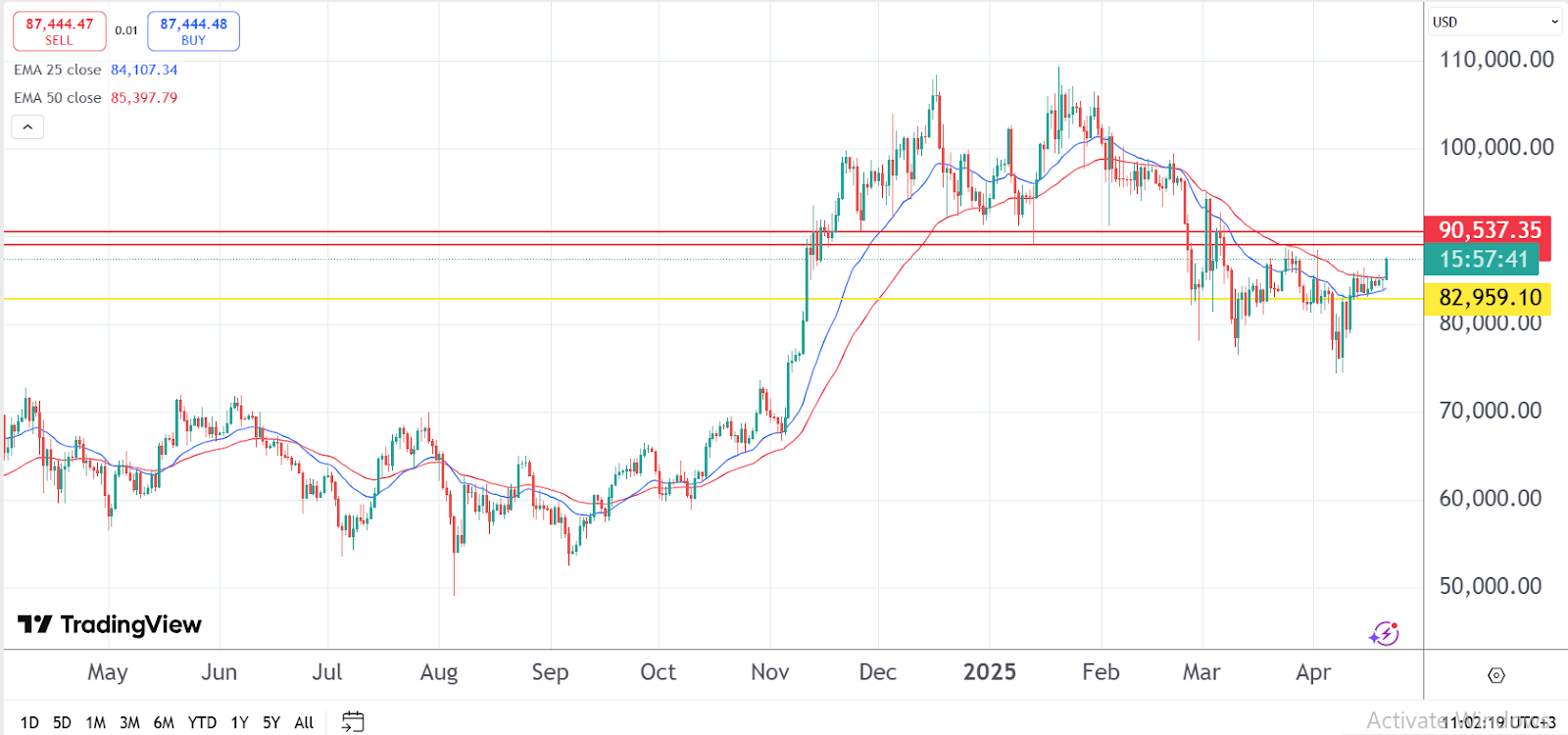
Bitcoin’s price trajectory over the past few days has captured the crypto community’s attention as it stabilizes above $85,000 after a recent dip below $80,000 following US President Donald Trump’s Liberation Day tariffs.

Analyst Titan of Crypto has forecasted that Bitcoin (BTC) could soar to $137,000 by the third quarter of 2025, igniting excitement among cryptocurrency enthusiasts.

This ambitious prediction hinges on a blend of technical indicators and macroeconomic trends currently shaping the market.

Why Bitcoin (BTC) price could hit $137,000

One of the factors behind Titan’s Bitcoin price prediction is the massive US Treasury liquidity injections.

The US Treasury has injected $500 billion into the markets since February 2025, reducing its Treasury General Account from $842 billion to $342 billion, significantly boosting liquidity in the markets.

This move elevated the net Federal Reserve liquidity to $6.3 trillion, with forecasts suggesting it could climb to $6.6 trillion by August if debt ceiling negotiations persist.

According to historical trends, BTC has exhibited an 83% correlation with global liquidity over the past year, often outperforming traditional assets like stocks and gold.

For example, past liquidity surges in 2022 and 2023 preceded notable Bitcoin rallies, hinting that the current environment could pave the way for another upward surge.

On the technical front, Titan of Crypto points to a bullish pennant pattern on Bitcoin’s daily chart, suggesting a potential 60% rally to $137,000 if it breaks the 200-day EMA near $90,000.

Bitcoin has struggled to overcome this resistance around $85,000 since late February, but a decisive close above it could shift momentum firmly in favour of the bulls.

Adding to the optimism, Bernstein analysts had predicted that over $70 billion in Bitcoin ETF inflows in 2025 could push prices as high as $200,000, reflecting growing institutional adoption.

The April 2024 halving, which slashed mining rewards to 3.125 BTC, further supports this narrative, as previous halvings have triggered bull runs exceeding 600% gains.

Beyond technicals, macroeconomic factors like recent tariff exemptions have lowered US Treasury yields, easing pressure on risk assets and creating a fertile ground for Bitcoin’s growth.

Market sentiment also leans bullish, with buy-side liquidity on exchanges like Binance outpacing sell-side by a factor of 10, while large investors shift BTC to cold storage, signaling long-term confidence.

The risks to Bitcoin’s climb

However, risks loom on the horizon, as an early US debt ceiling resolution could cap liquidity at $6.3 trillion, potentially stunting Bitcoin’s ascent.

Renewed trade war fears or geopolitical tensions could also drive investors toward gold, leaving Bitcoin vulnerable to a shift in safe-haven preferences.

Technically, failure to breach the 200-day EMA could trap Bitcoin below $85,000, risking a drop to supports at $78,000 or $74,500.

Despite these challenges, the broader 2025 outlook remains bright, with price targets ranging from $137,000 to $250,000, fueled by ETF inflows, corporate uptake, and post-halving dynamics.

Companies like Semler Scientific, planning to raise $500 million to buy more BTC, exemplify the rising corporate embrace of Bitcoin as a treasury asset.

Meanwhile, potential US-China trade talks could further enhance risk-on sentiment, benefiting speculative assets like Bitcoin if tensions ease.

In the mining sector, increased selling by miners due to lower profitability, evidenced by 15,000 BTC outflows on April 7 when prices hit $74,000 according to the weekly CryptoQuant’s report, presents a short-term hurdle.

Bitcoin miner CleanSpark on Tuesday announced it has secured a $200 million Bitcoin-backed credit facility from Coinbase Prime, shifting away from its previous 100% Bitcoin HODL strategy.

The company will now begin selling part of its monthly BTC production to support growth and fund operations.

However, the robust demand from institutional and retail investors appears poised to absorb this supply, maintaining upward pressure on prices.

Ultimately, Titan of Crypto’s $137,000 Bitcoin price prediction by Q3 2025 rests on a compelling mix of liquidity trends, technical potential, and institutional momentum, offering a plausible glimpse into Bitcoin’s near-term future.

The post Bitcoin price prediction: analyst predicts BTC will hit $137k by Q3 appeared first on CoinJournal.

Coinbase warns of renewed crypto winter as altcoin market cap plunges 41%

  • Bitcoin and COIN50 fall below 200-day moving averages.
  • Venture capital remains 60% below 2021 levels despite mild rebound.
  • Market may stabilise between mid and late Q2 2025, says Coinbase.

The risk of a renewed crypto winter is rising, Coinbase Research warned this week, as key technical and macroeconomic indicators suggest the digital asset market may be entering another prolonged downturn.

In a note published yesterday, Coinbase said Bitcoin has slipped below its 200-day moving average—a level widely seen as a bearish signal.

The COIN50 index, which tracks the top non-Bitcoin assets on the platform, has also fallen beneath its long-term support.

Adding to the market stress are surging global tariffs and prolonged fiscal tightening, both of which are weighing on investor sentiment and curbing inflows into crypto.

The situation echoes the 2022 crash, when over $2 trillion in market value was wiped out within 18 months.

Altcoins have been hit the hardest. Excluding Bitcoin, the total crypto market cap has dropped 41% since its December 2024 peak, falling to $950 billion.

That figure is lower than any level recorded between August 2021 and April 2022, a time when market turbulence was already high.

Altcoins fall 41%

According to Coinbase, the sustained drawdown in altcoins highlights the weakening appetite for riskier crypto investments.

Tokens outside the Bitcoin ecosystem have seen sharp sell-offs amid thin liquidity and a lack of new capital.

The COIN50 index now trades well below its 200-day average, signalling broad technical weakness across the sector.

Retail interest has also declined, while institutional flows remain limited. This suggests that the bullish momentum seen in late 2024 has largely dissipated.

Many smaller projects are underperforming, particularly those in niche segments such as decentralised AI, Web3 gaming, and tokenised real-world assets.

Funding stays low

Coinbase’s report also points to stagnation in venture capital. Although investment volumes have picked up modestly since late 2024, they remain 50% to 60% below the highs recorded during the 2021–2022 cycle.

This has left many early-stage startups without the runway to scale, pushing some to pause development or downsize operations.

The absence of fresh capital has slowed innovation across key verticals.

Many in the industry had expected decentralised finance, metaverse applications, and crypto crowdfunding models to lead the next bull cycle. Instead, these areas have stalled.

Macro weighs on sentiment

Coinbase cited external economic pressures as a major reason for the recent slump.

Tighter monetary policy, high interest rates, and the escalation of global tariffs have all eroded investor confidence.

David Duong, head of institutional research, said the investment environment has become “paralysed” as both traditional and crypto markets face liquidity stress.

These macro headwinds have discouraged speculation and limited the flow of capital into digital assets.

Traders have pulled back, focusing instead on safe-haven assets as geopolitical risk and inflation remain elevated.

Recovery may follow

Despite the gloom, Coinbase believes the market may find a bottom between mid and late Q2 of 2025.

A stabilisation in macro conditions—particularly a slowdown in inflation or an easing of interest rates—could help revive capital flows.

Coinbase warns of a potential crypto winter as altcoins drop 41% and Bitcoin breaks key support. Market cap falls to $950b, mirroring 2022’s downturn.

According to Duong, sentiment may reset quickly once market stress subsides, opening the door to a recovery in the second half of the year.

The report stops short of making bullish predictions but says tactical positioning may be useful in the current environment. Analysts suggest keeping a close eye on liquidity trends and macro data as potential signals of a shift in momentum.

The post Coinbase warns of renewed crypto winter as altcoin market cap plunges 41% appeared first on CoinJournal.